
The East German Hot-Air Balloon Escape: How Two Families Flew to Freedom in 1979
Shortly after two o’clock in the morning on 16 September 1979, eight people stood on a homemade metal platform beneath a balloon they had never flown.
Peter and Doris Strelzyk were there with their sons Frank and Andreas. Günter and Petra Wetzel had brought their sons Peter and Andreas. The youngest child was two years old. The oldest was fifteen.
Above them was an enormous patchwork envelope sewn from hundreds of metres of fabric purchased across East Germany. Below it sat an improvised burner fed by propane cylinders. A homemade blower had inflated the balloon in a forest clearing south of their home town of Pößneck.
Everything depended on the wind carrying them toward West Germany. Then, as the balloon began to lift, the launch started to go wrong.
The platform tilted. A burner flame struck the fabric and set part of the balloon on fire. An anchor ripped free and hit Frank Strelzyk in the head.
They extinguished the fire. The balloon kept climbing. Roughly half an hour later, after rising to about 2,000 metres, burning through its gas supply and descending rapidly toward the ground, the same homemade aircraft landed near the Bavarian town of Naila. The families had escaped the German Democratic Republic.
But the successful flight was only the last stage of a project that had already produced failed tests, one failed escape, an abandoned balloon, and a Stasi investigation large enough to examine hundreds of thousands of medical prescriptions.
A Border Designed to Stop People on the Ground
By 1979, leaving the German Democratic Republic without permission was a criminal offense.
The inner-German border was not simply a political line on a map. Over decades it had developed into a militarized barrier incorporating restricted zones, fences, alarms, patrols, mines in some sectors and other systems intended to detect and prevent unauthorized crossings. East German criminal law punished “unlawful border crossing,” and a 1979 revision allowed severe cases to draw substantial prison terms.
For people thinking about escape, that created a basic engineering problem. Most conventional routes still required confronting the border system somewhere on the ground. Peter Strelzyk and Günter Wetzel began considering a way to go over it.
Both families lived around Pößneck in Thuringia. Later oral-history interviews describe restricted travel, limits on political expression and concerns about the future of their children as important reasons they wanted to leave. Doris Strelzyk also remembered the imprisonment of her younger brother after a border-related case as a powerful influence on the family’s decision.
The balloon solution emerged in 1978 after the men encountered material about hot-air ballooning in a Western publication. The concept was obvious. The implementation was not.
Neither family had access to a commercial balloon, specialized fabric, certified burners or a professional ballooning crew. They would have to learn enough aerodynamics, sewing, burner design and load calculation to construct an aircraft in secret inside East Germany.
And it had to lift eight people.
The First Balloon Did Not Hold Air Well Enough
The first stage was experimentation rather than escape.
The men studied what information they could obtain and began constructing an envelope. The families bought fabric and worked at night. Günter Wetzel, who later emphasized his role in the calculations and sewing, used a mechanical sewing machine to join large numbers of fabric panels.
The early material failed.
Haus der Bayerischen Geschichte describes the first balloon envelope as too porous. Hot air escaped too quickly for the design to produce the lift they needed.
The Stasi’s later reconstruction of the project counted several test events in spring 1978. That is one reason sources can appear to disagree about how many “attempts” preceded the final flight: three principal balloon constructions were involved, but the builders conducted multiple ground and launch tests.
Every failure taught them something. It also consumed time and material that could not be purchased without risk.

The Second Balloon Created a Different Problem
The next balloon used a large quantity of taffeta-like fabric and incorporated lessons from the earlier tests. But the project had developed tensions of its own.
Wetzel concluded that the balloon would not safely carry all eight people. His family withdrew from that attempt. Peter Strelzyk continued preparing the craft for his own family of four.
During the night of 3–4 July 1979, Peter and Doris Strelzyk and their sons Frank and Andreas took off. This time the balloon flew. It did not fly far enough.
Participant recollections say weather and construction problems caused the craft to lose lift. Haus der Bayerischen Geschichte describes cloud or fog moisture affecting the envelope. The balloon came down on East German territory shortly before the border.
Exactly how close they came is disputed.
Peter and Doris Strelzyk later remembered the landing as only a few hundred metres short. The Stasi’s post-event report placed it about two kilometres from the state border.
Either way, they had failed on the wrong side. Now they had to escape from their own failed escape.
They Left the Balloon Behind
The Strelzyks could not simply drag the balloon home through a controlled border zone.
They abandoned much of the equipment and moved through the restricted area on foot. The Stasi later reconstructed their return: the family made its way back toward the launch area, removed traces there, recovered their vehicle and returned to Pößneck.
For the moment, nobody had connected them to the balloon. The physical evidence remained in the forest. That changed on 20 July 1979, when a hunter reported the abandoned craft. The authorities recognized that they were looking at evidence of an attempted illegal departure from the DDR.
The search began.
The Stasi Had a Balloon but No Balloonists
The abandoned July craft created an unusual investigation. The authorities could inspect its materials and the objects found around it, but they did not know who had built it. One obvious clue was the quantity of fabric.
A homemade hot-air balloon required an extraordinary amount of cloth. Investigators hoped that a purchase of hundreds of square metres might have attracted attention.
The problem was the East German economy itself.
Large amounts of suitable material had not necessarily been available in one place. Fabric was obtained in different purchases, making it difficult to identify a single suspicious transaction.
The investigators also found medicine associated with a thyroid condition. That clue produced one of the most extraordinary numbers in the case. According to the Stasi archival material, investigators checked roughly 800,000 prescriptions in the Gera district without finding the builders. Every day that search failed gave the families more time.
They used it to build another balloon.
The Investigation Went Public
By the middle of August, the authorities tried a different approach.
The newspaper Volkswacht published a police request for public assistance. It showed ordinary objects found at the site, including a barometer, pocket knife and water-pump pliers, and asked readers for information.
The builders saw the appeal. They now knew that the police and State Security had not forgotten the balloon. Günter Wetzel later remembered the notice as confirmation that the search was active but had not yet reached them. The pressure worked in two directions.
It made further construction more dangerous. It also made delay more dangerous. The two families reunited around the balloon project.
Material evidence
Building the balloon
Envelope, blower, burner, propane and platform worked as one improvised system; the diagram remains explanatory, not an engineering plan.
- 01Generated the hot-air volume required to lift eight people and the improvised gondola.
Patchwork balloon envelope
A very large sewn envelope made from multiple available fabrics including umbrella silk, tent nylon, taffeta and other cloth.
- 02Made construction of the envelope possible without commercial balloon manufacturing equipment.
Mechanical sewing machine
Used for extensive night-time sewing of hundreds of square metres of fabric into balloon panels.
- 03Allowed rapid inflation in the launch clearing while limiting the time spent making noise.
Homemade inflation blower
A fan/blower powered by a repurposed motorcycle engine inflated the cold envelope before heating.
- 04Reduced onboard gas consumption during initial inflation and helped raise the envelope to launch position.
Preheat burner and propane bottles
A separate burner and propane supply helped heat the balloon during inflation before takeoff.
- 05Maintained lift; continuous use after an envelope tear accelerated fuel exhaustion.
Main propane burner
A homemade burner fed from onboard propane cylinders heated the air during flight.
- 06Concentrated the family load into a structure light enough for the balloon to lift.
Improvised metal platform/gondola
A compact metal carrying structure held all eight people beneath the envelope and burner assembly.
- 07Prevented the takeoff fire from immediately ending the escape.
Fire extinguisher
Carried for launch safety and used when the envelope caught fire as the platform tilted.
- 08The balloon could not be conventionally steered; wind direction was therefore an essential part of the escape system.
Weather reports
The families monitored weather information, including West German broadcasts, to identify favorable northerly winds.
Building a Balloon While the Police Were Searching for One
The final craft had to solve the problem that had divided the group earlier. It had to lift eight people, not four.
Wetzel calculated a substantially larger envelope. Sources differ over the exact fabric total because they refer to calculated need, purchases and completed construction, but the final project involved roughly 1,200 to 1,300 square metres of cloth.
This time the families tried to avoid leaving a purchasing pattern.
The Stasi’s own later reconstruction recorded fabric purchases in more than one hundred places across the DDR during the final construction period. The families travelled widely and bought smaller quantities of umbrella silk, tent nylon, taffeta and other available material rather than obtaining the entire envelope in one conspicuous transaction.
The irony was sharp. The state was searching for people who had bought enough fabric to build a balloon. Those same people were travelling across the country buying enough fabric to build a larger one.
The Work Had to Look Like Ordinary Life
Secrecy was not only a matter of hiding the balloon. The adults still had jobs, neighbors and routines.
A sudden disappearance from work could create questions. Unusual visitors could create questions. Large purchases could create questions. Construction noise could create questions.
The project therefore existed alongside ordinary life.
Participant accounts describe night work and careful division of labor. Wetzel concentrated heavily on the envelope and calculations. Strelzyk’s mechanical and welding skills contributed to the burner and metal work. Doris Strelzyk, Petra Wetzel and the older children assisted in different parts of the project.
Later, Wetzel and members of the Strelzyk family disagreed over exactly who originated the idea and who deserves credit for particular design decisions. The historical result is easier to establish than the ownership dispute. A single family did not fly west in a machine built by one person. The final escape required both households.
The Weather Was Part of the Machine
A hot-air balloon could not be steered like an airplane. The escape depended on choosing a night when the wind would carry the families from East Germany toward Bavaria. The builders listened to weather information, including reports available from West German radio. By mid-September the final balloon was nearing completion, but the weather was not cooperating.
Then a front passed. A stable northerly airflow developed. The opportunity might not return before work obligations and the continuing investigation made the project impossible. They decided to go.
Problem → response
Escape was a sequence of problems
Each response solved a practical obstacle while often creating the next one.
- 01→
Obstacle
Unsuitable early fabric
The first major envelope lost hot air too quickly to provide reliable lift.
Response
They tested alternative fabrics and redesigned later envelopes.
- 02→
Obstacle
Second balloon inadequate for all eight
Wetzel concluded that the second major balloon lacked safe lifting margin for both families.
Response
The Wetzel family withdrew from the July attempt; after the Strelzyks failed, the families reunited to build a larger craft.
- 03→
Obstacle
Stasi investigation after failed July flight
The abandoned balloon gave authorities physical evidence of the escape project.
Response
The families dispersed fabric purchases, maintained ordinary routines and accelerated construction of a larger balloon.
- 04→
Obstacle
Material scarcity and suspicious bulk purchases
A final balloon required well over one thousand square metres of lightweight fabric during an active investigation of an earlier homemade balloon.
Response
Suitable cloth was purchased in many smaller quantities across a wide geographic area.
- 05→
Obstacle
Weather dependence
A hot-air balloon's horizontal movement depended on wind, and the border could not be crossed safely with an unfavorable flow.
Response
The families monitored forecasts and launched when a stable northerly wind developed.
- 06→
Obstacle
Launch fire and released anchor
The platform tilted during tether release, the burner ignited the envelope and an anchor struck Frank Strelzyk.
Response
The group used a fire extinguisher, controlled the burner and continued the launch.
- 07→
Obstacle
Night navigation
The balloon rotated and the occupants could not reliably identify the exact border line from the air.
Response
They relied on the forecast wind and continued until fuel exhaustion forced descent.
- 08→
Obstacle
Fuel exhaustion
The propane supply ran out while the balloon was still airborne.
Response
The balloon descended rapidly and made a rough but survivable landing near Naila.
Transporting the Balloon to the Launch Site
The balloon itself was too large to carry openly.
The families packed the envelope and equipment into vehicles and a trailer and drove toward the chosen launch area on secondary roads. Günter Wetzel’s oral-history account describes the load as disguised as an ordinary trailer superstructure.
The chosen clearing lay between Oberlemnitz and Heinersdorf, south of Pößneck and close enough to the border that a favorable wind could carry them into Bavaria before the gas supply ran out. The group reached the site after midnight. They waited first to make sure they had not been followed. Then they began assembly.
Balloon reconstruction
Three balloons, one successful flight
A development strip distinguishes the three principal constructions from the larger number of technical tests; the final cutaway and route remain conceptual.
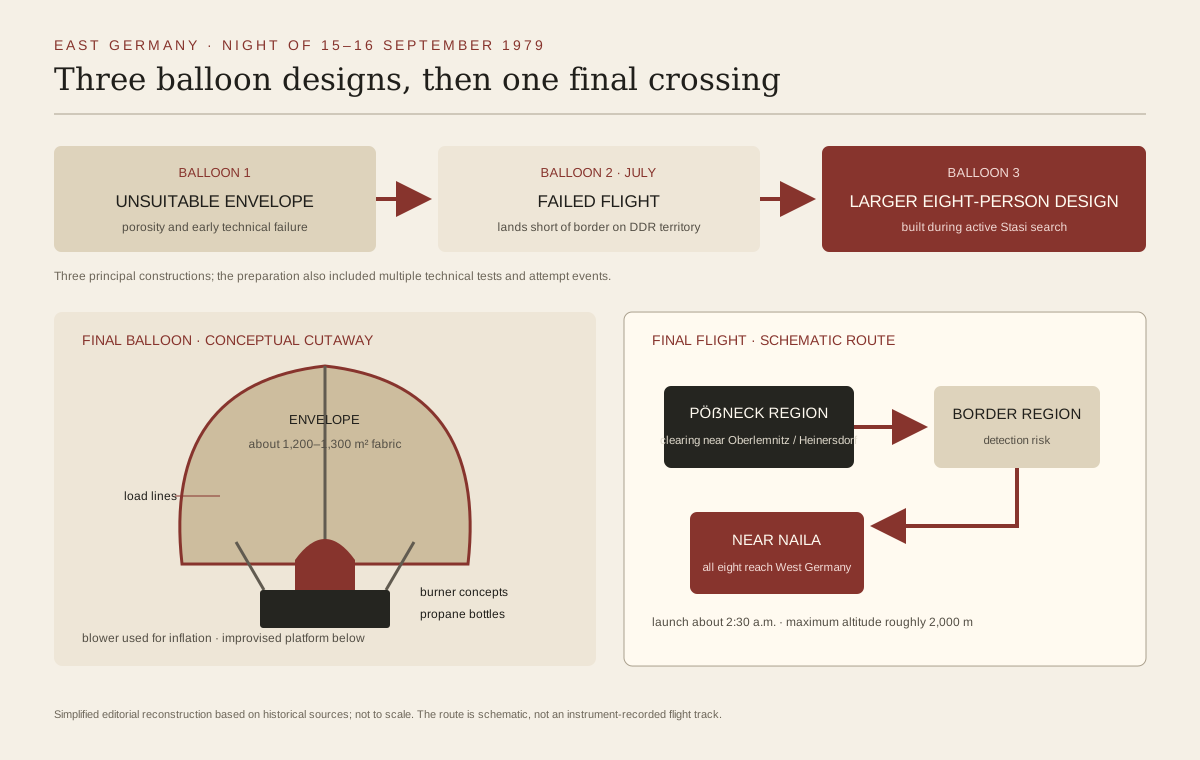
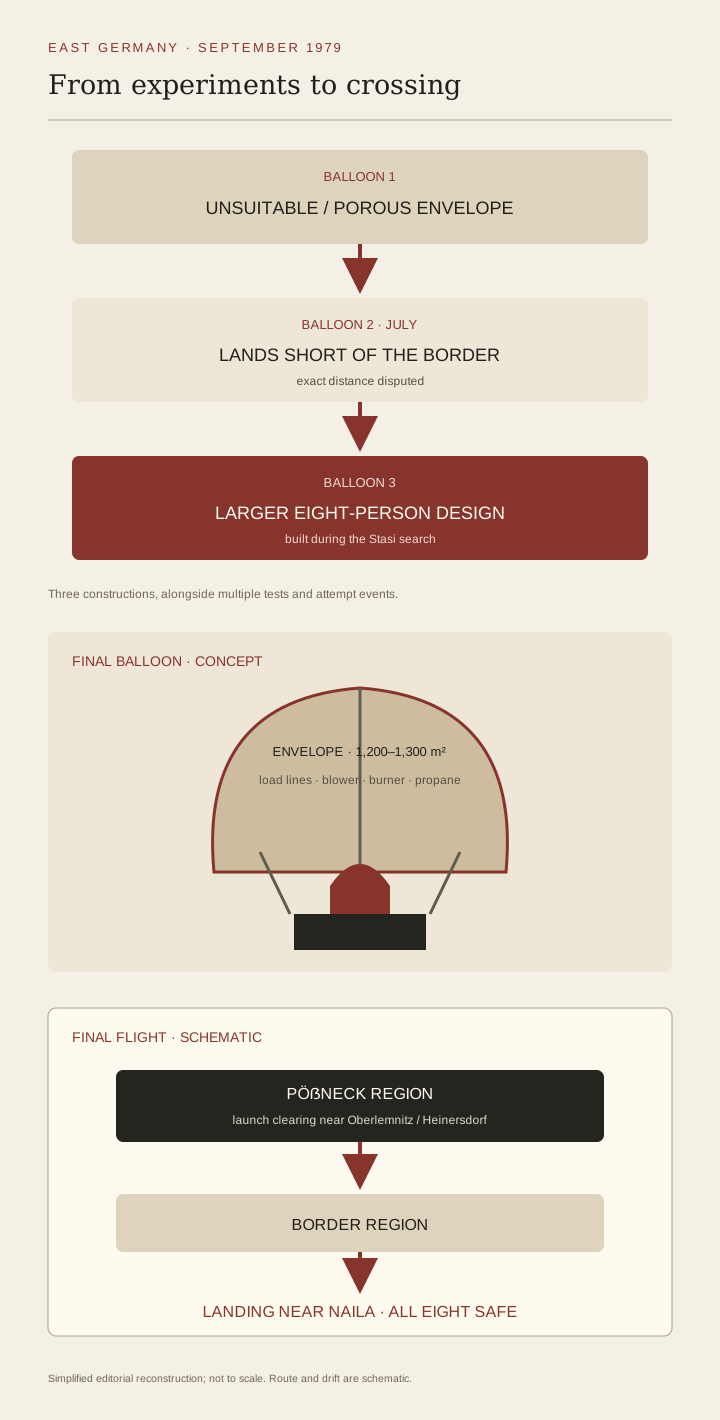
- 01
Early envelope
The first material was too porous for a workable craft.
- 02
July flight
The Strelzyk family landed short of the border and left evidence that triggered a Stasi search.
- 03
Final balloon
Both families built a larger craft during the investigation.
- 04
Launch
They departed at about 2:30 a.m. from a clearing between Oberlemnitz and Heinersdorf.
- 05
Landing
Fuel exhaustion forced a landing near Naila; all eight were in West Germany.
Simplified editorial reconstruction based on historical sources; not to scale. It is not a precise flight track, and source figures for material, launch minute, July landing distance and altitude vary.
How the Homemade Balloon Worked
The launch system had several distinct parts. The giant fabric envelope was spread across the clearing and attached to the improvised carrying platform.
A homemade blower, powered by a repurposed motorcycle engine, forced cold air into the envelope. A separate burner and propane supply helped heat the balloon during inflation so that the enormous envelope could rise above the platform.
The flight burner used additional propane cylinders carried onboard. The Mauermuseum’s collection description records a seven-cylinder arrangement for launch and flight: three bottles associated with preheating/inflation and four carried for the main burner during the flight. This was not a conventional wicker passenger basket. The eight people stood tightly together on an improvised platform or gondola beneath the burner system.
At roughly 2:30 a.m., the balloon began to lift.
The Launch Almost Ended the Escape
The final launch did not proceed cleanly. Günter Wetzel’s account describes the platform being held down by several anchoring ropes as the balloon developed lift. The men began cutting the restraints. The sequence became uneven.
With only one anchoring point remaining, the platform tilted. The burner tilted with it and the flame struck the fabric.
The balloon caught fire. At almost the same moment, the final ground anchor was torn free and thrown upward, striking fifteen-year-old Frank Strelzyk in the head. They had brought a fire extinguisher. The flame was reduced and the burning material was put out.
Frank’s injury did not stop the flight. The balloon continued upward. There was no practical opportunity now to return to an ordinary life in Pößneck and pretend that nothing had happened.
A Hole Opened in the Envelope
After takeoff, another construction problem became visible. Wetzel later wrote that the load on a knot near the top of the balloon opened a hole in the fabric cap. Hot air escaped. That meant the burner had to operate almost continuously to maintain lift.
The problem mattered because the balloon carried a finite amount of propane. Every extra minute of burner use reduced the time available before descent. The families kept climbing. They eventually reached roughly 2,000 metres above the ground.
At that altitude, participant and museum accounts describe temperatures around minus 8 degrees Celsius. The balloon was moving fast enough to carry them toward the frontier. They could not confidently see where that frontier was.
They Lost Their Orientation
The builders knew the desired general direction. They did not have modern GPS navigation or a controllable aircraft.
At night, from a rotating balloon, ground lights were difficult to interpret. Wetzel later recalled that the balloon turned repeatedly, making orientation increasingly uncertain.
Then they saw powerful lights below. Searchlights swept upward from a brightly illuminated border-crossing area.
The Haus der Bayerischen Geschichte narrative says the police had been informed within minutes of the launch after a night watchman reported an unknown flying object moving toward the state border. Wetzel later associated the searchlights with the Autobahn border crossing in the Rudolphstein/Hirschberg area.
The beams did not reach them. The balloon continued. They did not know exactly when they crossed from the DDR into the Federal Republic.
The Gas Ran Out
The hole in the envelope required constant heating. The cold at altitude made the propane system difficult to operate. Then the burner stopped. At first, the men tried to restart it.
The problem was simpler than they hoped. The gas supply was exhausted. A hot-air balloon without heat does not remain a hot-air balloon for long. The craft began to descend.
Wetzel later described shining an auxiliary vehicle headlamp downward while they searched for the ground. Tree tops appeared. Then the platform hit. The entire flight had taken approximately 28 minutes.
According to the Bundesarchiv, they had travelled about 18 kilometres.
Landing Did Not Answer the Most Important Question
The landing was rough, but all eight people survived.
Several suffered relatively minor injuries. Frank had already been struck by the anchor at launch. Wetzel later reported a calf injury serious enough that he was taken to hospital later that day.
But the families did not immediately celebrate. They did not know which Germany they were standing in. That uncertainty is one of the most important details in the escape because the balloon had never given them a precise border-crossing confirmation. They decided to move south.
If they had reached Bavaria, that direction would take them farther from the frontier. If they were still in East Germany, they believed the security forces would probably find them anyway. The women and children eventually waited in concealment while Peter Strelzyk and Günter Wetzel went ahead. The men began looking for evidence.
Small Clues Meant West Germany
Wetzel’s retrospective account remembers several observations that raised their hopes. The fields appeared smaller than the large agricultural plots they associated with East Germany. A power pylon carried a marking they did not recognize from the DDR. At a farm they saw agricultural machinery whose make suggested the West.
Then a car approached. Two policemen stepped out. The question the men asked became part of the escape’s memory: Were they in the West?
They were. The families had landed near Naila in Upper Franconia. Wetzel later said the men used a New Year’s firework they had brought with them to signal the women and children that it was safe to come out. The problem that had begun with a picture of a balloon in a Western magazine was over.
Two families
8people reached West Germany
Escaped to West Germany
All four adults and four children reached the Federal Republic of Germany.
Children who escaped
The children were approximately two, five, eleven and fifteen years old.
Fatalities
All eight survived the flight and landing; participants reported injuries but no fatality.
Security investigation
The successful escape embarrassed the East German security system and prompted further Stasi analysis of unconventional airborne escape methods.
Eight People, Four of Them Children
The four sons were approximately two, five, eleven and fifteen years old. That fact changes how the escape should be understood. The adults were not testing a machine for themselves. Every design decision had to carry the mass of two entire households.
The balloon needed enough lift for eight people and their equipment. The platform had to hold all of them. The propane supply had to remain manageable. The envelope had to be large enough to lift the load but light enough that the balloon could lift itself.
And every test failure carried consequences for children as well as adults.
This is also why the July 1979 split matters. Wetzel’s concern that the second balloon could not safely lift both families was not a minor technical disagreement. It changed who attempted the first flight.
The final balloon existed because the previous design was not enough for eight.
The Stasi’s Failure Did Not End at the Border
The successful escape became international news and an embarrassment for the East German security system. The Stasi’s own documents treated the event as a serious operational failure and studied it for lessons about preventing similar escapes. The archival record also shows why the final balloon was particularly embarrassing. The authorities had possessed the wreckage of the July attempt.
They had investigated fabric purchases. They had searched hundreds of thousands of medical prescriptions. They had published a request for public assistance. And while that investigation was active, the same families had acquired another enormous quantity of fabric, constructed a larger balloon and flown across the border.
The story did not simply demonstrate that the physical frontier could be crossed by air. It demonstrated that the surveillance system had failed to find the builders after receiving advance physical evidence of what they were trying to do.
Evidence discipline
What the record supports
Status labels distinguish secure conclusions from uncertainty and rejected claims. Color is never the only signal.
DOCUMENTED
The final escape involved eight people—four adults and four children.
This is consistently established by Bundesarchiv, Bavarian museum and participant sources.
Sources: SRC-001, SRC-003DISPUTED
There were exactly three escape attempts.
Three principal balloon constructions are commonly described, but the Stasi counted five balloon-related test/attempt events. The difference reflects what is being counted.
Sources: SRC-002, SRC-003DISPUTED
The July 1979 balloon landed exactly 200 metres short of the border.
Peter and Doris Strelzyk's later oral-history summaries give roughly 200 metres, while the Stasi's post-event report gives approximately two kilometres.
Sources: SRC-002, SRC-005, SRC-006DISPUTED
The final balloon launched at exactly 2:26 a.m.
Haus der Bayerischen Geschichte gives 2:26 a.m.; Günter Wetzel's detailed later reconstruction gives 2:32 a.m. The public article therefore uses about 2:30 a.m.
Sources: SRC-003, SRC-007DISPUTED
The final balloon used exactly 1,200 square metres of fabric.
Sources range from more than 1,200 m² to approximately 1,250 m² purchased and about 1,300 m² calculated need. These may measure different stages of the construction process.
Sources: SRC-001, SRC-002, SRC-008DOCUMENTED
The Stasi checked about 800,000 medical prescriptions while investigating the failed July balloon.
The figure appears in the Stasi archival presentation and Bundesarchiv synthesis.
Sources: SRC-001, SRC-002UNKNOWN
The Stasi fired at the successful balloon.
Reviewed sources establish detection, reports from the ground and searchlights, but do not establish that weapons were fired at the balloon. Do not dramatize gunfire without new evidence.
Sources: SRC-001, SRC-003, SRC-007DISPUTED
Günter Wetzel alone invented and built the escape balloon.
Wetzel later asserted primary authorship of the idea and design calculations, while institutional histories describe a joint Strelzyk-Wetzel project. The final escape clearly required labor and contributions from both families.
Sources: SRC-003, SRC-004, SRC-009DISPUTED
The successful flight reached a precisely documented maximum altitude of 2,500 metres.
Higher figures appear in some retellings, but the Bundesarchiv gives approximately 2,000 metres and museum/participant material centers on roughly that altitude.
Sources: SRC-001, SRC-003, SRC-007Which Balloon Was the “Third Balloon”?
The case is often described as succeeding with the third balloon. That is useful shorthand, but it can become misleading if “third balloon” is converted into “third attempt.”
The builders carried out multiple tests before the final flight. The Stasi later counted five balloon-related “attempt events” in its reconstruction, including several tests in 1978.
The clearest structure is:
Balloon 1: early construction/testing; envelope material proved unsuitable.
Balloon 2: improved design; not considered adequate for all eight; Strelzyk family attempted escape alone in July 1979 and landed short of the border.
Balloon 3: much larger final construction; carried both families to Bavaria in September.
That explains why a reader can encounter both “third balloon” and “fifth attempt” without either necessarily being a simple error.
Who Invented the Escape Balloon?
The answer depends on how narrowly the question is asked. Institutional histories normally describe Peter Strelzyk and Günter Wetzel as the men who planned and built the project together with their families.
Wetzel later made a more specific claim. On his own detailed website, he states that the original idea came to him after seeing a Western article about the Albuquerque balloon gathering, that he performed the design calculations and that the concept and construction of the balloons were primarily his responsibility. He credits Strelzyk with financing, welding and other work while disputing later versions told within the Strelzyk family.
That disagreement arose decades after the escape and cannot be solved merely by deciding which retrospective account sounds more detailed. The public article therefore should not assign a single uncontested inventor. What is documented beyond dispute is that the final escape required the labor and decisions of both families.
Did the Stasi Really Check 800,000 Prescriptions?
Yes—the figure is supported by the Stasi archival record as presented by the Bundesarchiv. Investigators found medicine at the site of the failed July balloon and tried to identify its source through medical records. The search did not lead them to the families in time. The number has become one of the most repeated details of the escape because it captures the scale of the investigation.
It should not be inflated into a claim that every individual prescription was manually examined in an identical way. The archival statement establishes the approximate scale of the records checked, not the exact clerical workflow.
Were They Almost Shot Down?
The evidence supports detection risk, not a documented order to shoot the balloon down.
Ground observers saw or reported the aircraft. Searchlights were directed toward the sky in the border region. The DDR border system was designed to prevent unauthorized departures, and ground crossings could be lethal.
But the reviewed sources do not establish that a weapon was fired at the balloon or that a specific unit received and attempted to execute an order to shoot it down. The danger of detection was real, but the evidence does not support adding a gunfire scene.
What the Films Change
The story was quickly adapted for popular culture.
Disney produced Night Crossing, released in the early 1980s, and Michael “Bully” Herbig’s Ballon retold the escape in 2018. The Bundesarchiv notes that the 2018 filmmakers were able to examine a large body of Stasi material with the families’ permission.
Both films are useful evidence of the case’s cultural reach. Neither should control the historical reconstruction. The primary escape page should be built from the archival investigation, institutional oral histories and participant testimony—not from scenes that work well on screen.
The Machine That Had to Work Once
The final balloon did not need to become a reliable aircraft. It had to work once. That distinction explains much of the engineering. The fabric was whatever suitable material could be secretly obtained.
The propulsion system used modified burners and propane bottles. The envelope had an opening tear during the flight. The gas ran out. The platform landed hard.
Measured by normal aviation standards, the craft was dangerously improvised. Measured by the problem its builders had set for it, the result was different. It carried eight people over a border specifically built to prevent them from leaving. And it did so while the security service was still trying to identify them from the wreckage of the balloon that had failed before it.
Selected chronology
Experiments, failed flight and final crossing
Balloon escape project begins
The families begin researching and developing a hot-air balloon escape concept.
Early tests fail
The first envelope and related tests demonstrate problems with fabric, lift and burner performance.
Strelzyk family lands short of the border
Peter and Doris Strelzyk and their two sons attempt to escape alone in the second balloon but come down on East German territory.
Abandoned balloon discovered
A hunter reports the remains of the failed craft, triggering a State Security investigation.
Police appeal appears in Volkswacht
The Volkspolizei publishes images/descriptions of objects found at the failed landing site and asks for public assistance.
Final balloon constructed
The reunited families obtain fabric across the DDR and build a larger balloon for all eight people.
Final flight launches
The eight escapees lift off from a clearing between Oberlemnitz and Heinersdorf. Sources differ by several minutes on the exact launch time.
Balloon lands near Naila
After about 28 minutes and fuel exhaustion, the balloon lands in Bavaria near Naila.