At a Glance
- Date: 9 July 1990
- Place: Miguel Castro Castro prison, Canto Grande, Lima
- Escapees: Imprisoned members of the Movimiento Revolucionario Túpac Amaru (MRTA)
- Best-supported count: 47 total escapees
- Alternative count: 48 in several press and participant-derived accounts
- Most prominent escapee: Víctor Polay Campos
- Method: A long tunnel constructed from outside the prison toward the MRTA prisoners' sector
- Outcome: Successful mass breakout; a number of leading escapees were later recaptured
In the early hours of 9 July 1990, dozens of imprisoned members of Peru's Movimiento Revolucionario Túpac Amaru disappeared from Canto Grande prison through a tunnel that had been driven in from outside.
The scale of the failure was immediately obvious. Víctor Polay Campos, the MRTA's best-known leader, was gone. So were other important members of an armed organization that had spent the previous years carrying out attacks, kidnappings and assassinations during Peru's internal conflict.
Even the number who escaped became disputed. Peru's Lugar de la Memoria and the Yuyanapaq chronology record 47 MRTA prisoners in total. Other newspaper and participant-based accounts say Polay escaped with 47 others, producing a total of 48.
The disagreement is small numerically but important historically. The Canto Grande escape was retold almost immediately by the government, the press and the MRTA itself, each with different reasons to emphasize its scale. The sources agree on the essential point: a large group of MRTA prisoners escaped on 9 July through an externally constructed tunnel whose preparation had taken months.
Canto Grande in Peru's internal conflict
Miguel Castro Castro prison, commonly called Canto Grande, had opened in Lima during the second half of the 1980s. It became one of the principal prisons holding people accused or convicted of terrorism-related offenses during a period of rapidly escalating political violence.
The MRTA was one of the armed organizations confronting the Peruvian state. It began its armed struggle in 1984. The Truth and Reconciliation Commission later distinguished the MRTA from the much larger and deadlier PCP-Sendero Luminoso while still finding the MRTA responsible for serious crimes, including killings, hostage-taking and systematic kidnapping.
That context matters because the prisoners were not simply a neutral collection of dissidents. At the same time, calling every detainee by the same legal status can also be misleading: some were undergoing proceedings while others had different stages of criminal cases against them.
The group inside Canto Grande included nationally important MRTA figures. Víctor Polay Campos had been captured in Huancayo on 3 February 1989. Miguel Rincón Rincón was arrested in Lima that April. Alberto Gálvez Olaechea, another prominent member, was also among those held. Their imprisonment created an obvious strategic problem for the MRTA outside: a significant part of the organization's leadership and experienced cadre was concentrated in state custody.
An escape built from the outside
Unlike prison tunnels dug secretly from a cell or workshop, the Canto Grande route was fundamentally an outside-in operation.
Later reporting says an external MRTA support network obtained control of a property near the prison. From there, a tunnel was excavated toward the sector where MRTA prisoners were being held. Work continued for many months.
This basic concept is consistent across hostile press coverage and participant-derived accounts. The exact engineering is not.
El Comercio later described the tunnel as about 250 metres long. The testimonial tradition represented by Claribel Alegría and Darwin Flakoll has commonly been associated with a figure closer to 315 metres. Accounts also differ in their technical descriptions.
Those measurements are not needed to understand why the escape worked. The historically important point is that the tunnel crossed hundreds of metres from an external base and emerged inside the prison environment close enough to the intended prisoners for a mass departure.
A modern reconstruction should stop there. Exact depth, dimensions, ventilation, structural reinforcement, excavation logistics and alignment techniques would turn a historical explanation into an unnecessary manual for defeating prison security.
Selected chronology
Selected chronology
MRTA begins armed struggle
The MRTA initiated armed operations against the Peruvian state.
Víctor Polay is captured
Police captured the MRTA leader in Huancayo.
Mass tunnel escape
Dozens of MRTA prisoners, including Polay, left Castro Castro through the externally constructed tunnel.
Alberto Fujimori takes office
The escape occurred nineteen days before the presidential transition from Alan García to Alberto Fujimori.
Gálvez Olaechea is recaptured
Yuyanapaq records the arrest of Alberto Gálvez Olaechea and Rosa Luz Padilla in Lima.
Polay is recaptured
Police recaptured Víctor Polay in San Borja, Lima.
Months of preparation
The length of the project imposed a different kind of difficulty: secrecy had to survive over time.
A tunnel driven from outside required people who were not themselves imprisoned to maintain the excavation while preserving a connection with those inside. The external project therefore depended on organization beyond Canto Grande's walls, not just initiative by prisoners.
Journalist Guillermo Thorndike later made this extended preparation the subject of Los topos. Alegría and Flakoll produced another narrative based on interviews with participants and escapees. Their accounts preserve valuable information about the human side of the project, but both emerged from unusually close access to the MRTA story. That matters because successful clandestine organizations have a strong incentive to present an operation as more controlled, ingenious and flawless than contemporary evidence may justify.
What can be said confidently is that the tunnel was not an improvised last-minute opening. It was the result of sustained preparation carried out over a substantial period from beyond the prison perimeter.
The final connection
The most dangerous phase was the moment when the external excavation had to become an actual exit route.
The tunnel had to reach the prisoners' area closely enough for the imprisoned group to use it without the breach being discovered first. Public narratives describe coordination between the outside construction team and people inside the prison, but the precise final alignment is exactly the sort of detail that should not be reconstructed as a reusable technique.
By the night of 8–9 July, the route was ready. The escape then became less a matter of digging than of moving a large number of people through a single concealed connection before prison authorities could react. Published accounts generally agree that the breakout itself occurred without casualties among the escapees.
Forty-seven—or forty-eight?
The strongest Peruvian institutional record uses 47.
The Lugar de la Memoria's event entry is titled as the escape of Víctor Polay and 46 other MRTA members, and its description says that 47 members escaped. The Yuyanapaq chronology similarly records 47 prisoners, specifically naming Polay, Miguel Rincón and Alberto Gálvez among them.
El Comercio presents a different count. Its archival retrospective says Polay escaped with 47 other members, for 48 total. Northwestern University Press uses the same total in describing Alegría and Flakoll's Tunnel to Canto Grande.
There is no good reason to pretend these records agree. For this reconstruction, 47 total is the baseline because two Peruvian memory institutions independently use it. 48 remains a credible competing count because it appears in major press coverage and participant-derived literature.
The uncertainty may reflect inconsistent prisoner lists, crew roles, or simply the way “Polay and 47” was repeated in early reporting. Without a verified contemporary nominal roster, the exact total should remain qualified.
The escape becomes public
By daylight, the tunnel was no longer secret.
Photographs from 9 July show investigators entering and examining the opening. Newspapers treated the breakout as a spectacular security failure. The political timing made it worse.
Alan García's first administration was in its final weeks. Peru was in economic crisis and deep internal conflict. On 28 July, only nineteen days after the escape, Alberto Fujimori would assume the presidency.
The MRTA could present the escape as evidence that the state could be outmaneuvered even inside a supposedly secure institution. The government and much of the press presented it as proof of grave negligence and the continuing danger posed by armed groups.
Both interpretations served political agendas. The factual core was serious enough without either one: dozens of prisoners connected to an armed organization had been removed from state custody in a single operation.
Documentary reconstruction
An outside-in tunnel concept
A case-local editorial visual separates the documented sequence from uncertainty without implying exact modern geography or operational detail.
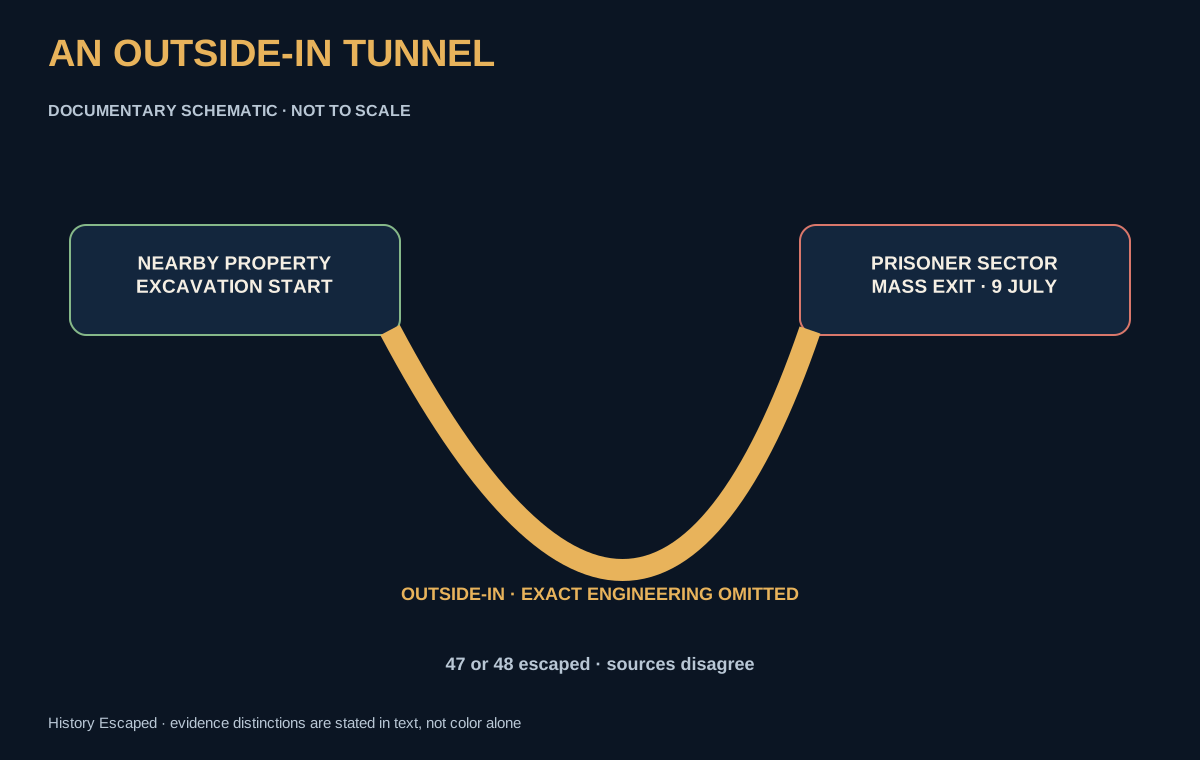
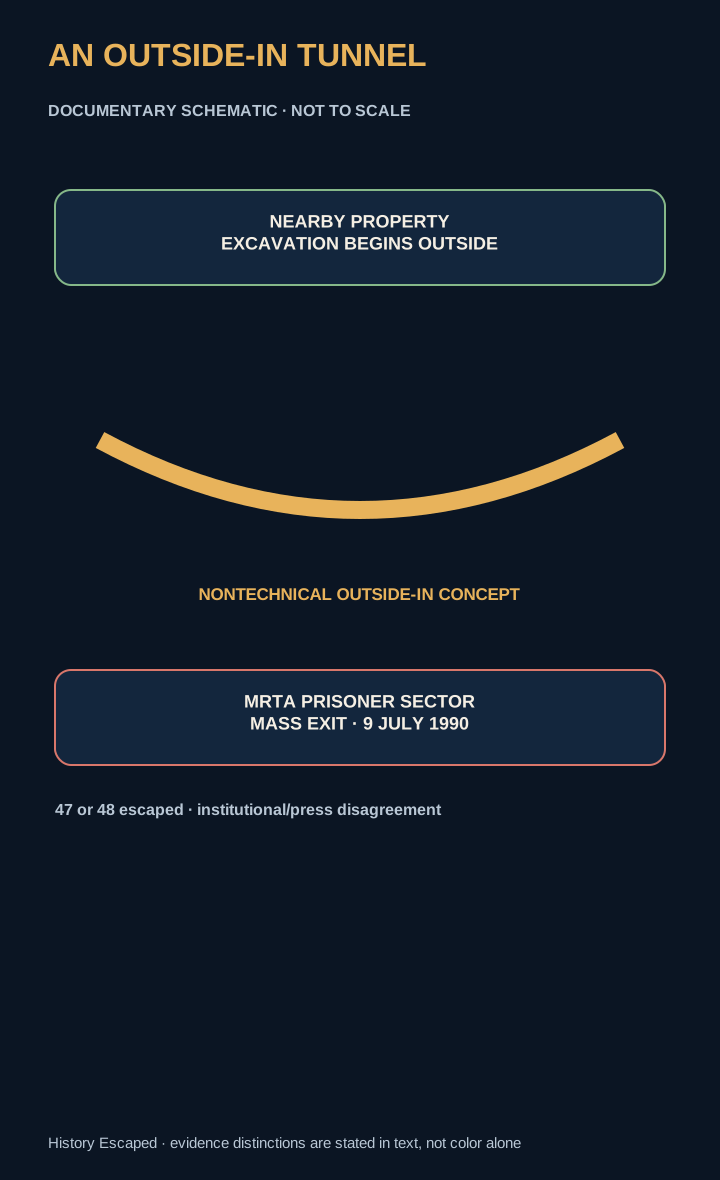
Simplified editorial reconstruction based on the cited historical record; not to scale. Uncertainty is stated directly in the visual and adjacent text.
What the escape changed
The breakout returned experienced MRTA members to clandestine activity at a moment when the organization was trying to maintain armed operations under increasing pressure.
It also worsened public distrust of Peru's prison and security institutions. In later political memory, the tunnel became shorthand for the state's weakness at the end of the 1980s. The escape did not, however, create a simple upward trajectory for the MRTA.
Police intelligence improved substantially in the early 1990s. The CVR later emphasized the importance of increasingly effective intelligence work in dismantling leadership structures of both the MRTA and Sendero Luminoso. Some people who had escaped Canto Grande were again in custody within the next two years.
Polay is recaptured
The most important recapture came on 9 June 1992.
Police arrested Víctor Polay in a café in San Borja, Lima. The Yuyanapaq chronology places the event within the same period of intelligence-driven operations that culminated three months later in the capture of Abimael Guzmán. Polay's recapture changes how the Canto Grande case should be classified.
The tunnel escape itself was completely successful as a mass breakout: the intended prisoners got out of the institution and temporarily regained freedom. But it was not a permanent escape for its most famous participant. The same was true for a number of other MRTA members as police operations gradually dismantled their networks.
The final accounting
Outcome
Immediate mass-breakout success
The tunnel allowed the intended group to leave the prison before authorities stopped the escape.
Major political and propaganda impact
The breakout publicly exposed serious prison-security failures during the final weeks of Alan García's government and provided the MRTA with a major symbolic success.
Freedom was not permanent for all
Police recaptured several prominent escapees, including Víctor Polay in June 1992.
Tunnel mythology
The Canto Grande tunnel quickly acquired the mythology common to unusually ambitious escapes.
Lengths became more precise. Construction techniques became more elaborate. Later narratives added moments of near discovery, personalities, arguments and engineering feats. Some of those details may be accurate. Others derive from participants with an interest in celebrating the operation or from journalism written after the fact.
The two best-known narrative books illustrate the problem.
Guillermo Thorndike's Los topos, published in 1991, is an important work of journalistic nonfiction produced close to the event. Claribel Alegría and Darwin Flakoll's later Tunnel to Canto Grande drew on direct interviews with MRTA participants. Northwestern University Press openly notes that the authors were invited by MRTA leaders and interviewed escape participants in a clandestine safe house.
That access makes the book valuable. It also means it cannot function as neutral verification of every operational claim. For History Escaped, the correct approach is to preserve the impressive scale without allowing the MRTA's own telling of the event to define the entire record.
Evidence discipline
What the record supports
Status labels distinguish secure conclusions from uncertainty and rejected claims. Color is never the only signal.
MYTH
The Canto Grande escape happened in June 1990.
The strongest institutional and press chronologies place the escape on 9 July 1990. A June date appears in some later material but conflicts with the dominant record.
Sources: SRC-001, SRC-003, SRC-004DISPUTED
Exactly 48 prisoners escaped.
Major press and participant-derived sources use 48, but LUM and Yuyanapaq use 47 total. The preferred institutional baseline is 47, while 48 remains a credible alternative.
Sources: SRC-001, SRC-003, SRC-004, SRC-005DISPUTED
The exact tunnel length is securely known.
Published estimates differ substantially. The article describes a tunnel hundreds of metres long rather than locking one measurement.
Sources: SRC-004, SRC-005MYTH
The tunnel was dug entirely by prisoners from inside Canto Grande.
The defining feature of the operation was outside-in construction from a nearby external property by an MRTA support structure working toward the prisoners.
Sources: SRC-004, SRC-005, SRC-007MYTH
Participant-based books provide neutral verification of every tunnel detail.
Those works are valuable but include journalism and testimony shaped by exceptional access to the MRTA and its participants. They require comparison with institutional and hostile contemporary sources.
Sources: SRC-005, SRC-007, SRC-008What can safely be reconstructed
The evidence supports a restrained sequence.
An external MRTA network established a base near Canto Grande. Over many months, a long underground passage was driven toward the area holding MRTA prisoners. The tunnel eventually connected with the prisoners' controlled space. In the early hours of 9 July 1990, a large group entered the route and emerged outside the prison. That is enough to explain the escape.
A diagram does not need to show exact soil depth, wall foundations, utilities, air movement, structural supports, excavation volume or methods for avoiding detection. Those details would add little to the historical question and would make the visual more transferable to modern prison-security evasion.
The tunnel's significance was organizational, not merely technical. It joined people outside the prison with leaders inside, sustained secrecy for months, and converted a nearby civilian property into the beginning of an extraction route.
A political success, not a clean historical victory
The MRTA gained an undeniable propaganda success from Canto Grande. It recovered important members and publicly humiliated the state.
That does not require adopting the organization's own political language. The CVR later concluded that the MRTA had used armed violence outside Peru's democratic political system and had committed serious crimes against individuals.
Nor does criticism of the MRTA erase the failures and abuses of the Peruvian state during the same internal conflict. The CVR documented grave human-rights violations by state agents and criticized successive governments' responses to the violence. Canto Grande belongs inside that broader history rather than outside it.
It was a remarkably successful prison escape carried out by an armed organization during a national crisis. Its method depended on time, external organization and a concealed physical connection into the prison. Its political meaning remained contested.
What the tunnel ultimately proved
The escape demonstrated that the prison wall was not the only security boundary that mattered. The decisive work had begun outside it.
For months, an external organization had been able to move underground toward a concentrated group of prisoners. When the connection was completed, dozens left before the state understood what had happened.
Yet the tunnel did not give the MRTA permanent strategic advantage. Within two years, Polay was back in custody, and police intelligence was beginning to dismantle leadership structures more effectively.
Canto Grande therefore has two endings. The first came on 9 July 1990, when the tunnel opened and the prisoners disappeared.
The second came later, as many of the people who had passed through it were gradually found again. ---