
The Rawson prison break of 15 August 1972 produced two radically different outcomes. Six political prisoners reached Trelew airport in time, boarded a seized commercial aircraft and escaped Argentina for Chile. Nineteen others arrived after the aircraft had gone. They negotiated publicly, surrendered their weapons and returned to state custody under an agreement that they would be taken back to prison.
Seven days later, sixteen of those nineteen were dead. The later killings became known as the Trelew Massacre and were eventually judged a crime against humanity. They belong to the same historical crisis as the escape, but they should not be treated as if they were simply the last step of a failed breakout.
At a Glance
- Prison: Unidad Penal 6, Rawson, Chubut
- Breakout: 15 August 1972
- Organizations represented: PRT-ERP, FAR and Montoneros
- Prisoners who reached the Trelew-airport outcome: 25
- Successful international escapees: 6
- Destination: Chile, later onward to Cuba
- Arrived after the aircraft departed: 19
- Their airport outcome: Negotiated surrender
- Transferred to: Base Aeronaval Almirante Zar
- Massacre: 22 August 1972
- Killed: 16
- Survivors: 3
- Later judicial classification: Crime against humanity
Rawson
Unidad Penal 6 stood far from Argentina's largest cities in the Patagonian province of Chubut. Under the military dictatorship headed in 1972 by General Alejandro Agustín Lanusse, Rawson held a growing number of political prisoners, including members of armed revolutionary organizations. Distance itself was part of the security system. The prison was hundreds of kilometres from the country's principal political centers and close to military installations.
Among the prisoners were leaders and militants of the Partido Revolucionario de los Trabajadores–Ejército Revolucionario del Pueblo, the Fuerzas Armadas Revolucionarias and Montoneros. These organizations differed politically, but their imprisoned leadership cooperated on an ambitious escape.
A plan for far more than six
The operation was intended to free a large body of prisoners, not simply the six people who eventually reached Chile. Sources disagree over the precise total involved. One archival reconstruction speaks of a plan for roughly 110 prisoners; historian Ana Trucco Dalmas describes 116 prisoners participating in the takeover and intended mass flight.
That discrepancy is a reason not to force a single total into the story. The plan itself is clear enough. Prisoners would seize control inside Rawson while an external support network provided vehicles. The escapees would travel approximately twenty kilometres to Trelew airport, where collaborators would take control of a commercial aircraft.
If every part worked on schedule, dozens of prisoners could leave Patagonia before the government re-established control. The plan failed at its most vulnerable point: moving people from prison to airport.
The prison takeover
The operation began on the evening of 15 August. Prisoners took control of internal positions and overpowered guards. The initial takeover was rapid, but it did not remain bloodless.
Guard Juan Valenzuela detected the movement of the first escape group and attempted to intervene. He was shot and killed.
His death matters to the historical balance of the case. The Rawson breakout was an armed revolutionary operation, not a nonviolent release of political detainees. It also affected what happened next.
Gunfire and a broken transport plan
Outside Rawson, vehicles were supposed to be waiting to carry a large number of prisoners toward Trelew. Dalmas reconstructs the planned transport as a Ford Falcon, a van and two trucks.
The gunfire inside the prison created confusion among members of the external support operation. The larger vehicles left, apparently believing that the escape had failed or been cancelled.
The Ford remained. That decision divided the breakout.
A small leadership group could move immediately. Most of the other prisoners could not.
The first six
The six who reached the Ford and then Trelew airport were:
- Mario Roberto Santucho
- Domingo Menna
- Enrique Haroldo Gorriarán Merlo
- Marcos Osatinsky
- Roberto Quieto
- Fernando Vaca Narvaja
They represented the leadership of different armed organizations that had cooperated on the escape. At Trelew airport, outside collaborators had already taken control of an Austral airliner arriving from Comodoro Rivadavia. The aircraft created the opening Rawson itself could not provide: immediate movement beyond the reach of Argentine ground forces.
Selected chronology
Selected chronology
Rawson breakout begins
Political prisoners take control of Unidad Penal 6; prison guard Juan Valenzuela is killed during the operation.
Transport plan breaks down
Gunfire and communications confusion cause major outside vehicles to leave, sharply reducing the number who can reach the airport.
Six reach Trelew airport
Santucho, Menna, Gorriarán Merlo, Osatinsky, Quieto and Vaca Narvaja reach the airport and board the seized Austral aircraft.
Aircraft leaves for Chile
The six successful escapees leave Argentine territory before the second group reaches the airport.
Nineteen arrive too late
A second group reaches Trelew airport by improvised transport after the aircraft has departed.
Negotiated surrender
The nineteen conduct a press conference and surrender after negotiations under a condition that they return to Rawson.
Transferred to Almirante Zar
Authorities move the nineteen to the naval air base rather than returning them to Unidad Penal 6.
Trelew Massacre
Naval personnel shoot the nineteen detainees. Sixteen die and three survive.
Federal convictions
A federal court convicts Sosa, del Real and Marandino and classifies the Trelew Massacre as a crime against humanity.
Appellate ruling
The Federal Criminal Cassation Chamber confirms the principal convictions and reverses two acquittals.
Sentences become final
Argentina's Secretariat of Human Rights states that the Trelew sentences became final.
The aircraft
The original objective had been Cuba. According to Dalmas's reconstruction, Santucho attempted to persuade or compel the pilot to fly directly to Havana. The pilot responded that the aircraft did not have sufficient range.
The destination shifted to Chile. That was not an arbitrary choice. President Salvador Allende's left-wing Unidad Popular government was in power there, and Chile had a longstanding tradition of political asylum. Argentine revolutionary organizations also had contacts with Chilean militants.
The six boarded. The aircraft departed before the next group from Rawson reached the airport.
Nineteen in taxis
Back at the prison, the transport failure had become obvious. A second group improvised.
Unable to rely on the missing trucks and van, prisoners telephoned for taxis and used the available vehicles to head toward Trelew. Nineteen made that journey.
They reached the airport too late. The aircraft carrying the first six had already left Argentine territory.
That moment ended any realistic chance of reproducing the same escape. The nineteen now had to decide whether to fight, seek another aircraft, or surrender.
Six reach Chile
The six aboard the airliner crossed into Chile. That made them the only prisoners from the Rawson operation to complete an immediate international escape.
Their arrival created another problem rather than immediate freedom from politics. Argentina wanted them returned.
Chile was governed by Allende, whose government was attempting to maintain workable relations with Lanusse's military regime despite deep ideological differences. The arrival of six prominent Argentine revolutionaries turned asylum and extradition into a bilateral crisis.
A U.S. government memorandum written later that month described the case as damaging Allende's carefully managed détente with Argentina and noted that Argentina had recalled its ambassador. The escape had crossed from prison history into international politics.
From Chile toward Cuba
The six were not immediately handed back to Argentina. Allende's government resisted the extradition demand and permitted them to continue onward. They eventually reached Cuba.
That is the successful branch of the Rawson escape. It deserves to remain analytically separate from what happened to the nineteen at Trelew.
The six had crossed an international border and escaped Argentine custody. The nineteen had not.
The airport press conference
The stranded group did not simply disappear into police custody. At Trelew airport, their confrontation with security forces unfolded in front of journalists and political intermediaries. The prisoners gave a press conference and publicly explained their position.
Defense lawyers and the federal judge became involved in negotiations. The presence of witnesses and cameras mattered because it created a public record of the transition from armed escape to surrender.
Argentina's Secretariat of Human Rights states that the nineteen laid down their weapons after negotiations involving the armed forces, defense attorneys and the federal judge. The surrender came with a condition: they were to be returned to the Rawson prison.
Surrender, not recapture
This is one of the most important wording choices in the case. The nineteen were not simply chased down and recaptured by security forces.
They surrendered. The Ministerio Público Fiscal's later crimes-against-humanity dossier uses that language directly. It records that the nineteen who had not escaped to Chile surrendered at Trelew airport to naval captain Luis Emilio Sosa.
Once they had surrendered, the Rawson escape attempt was over for them. What happened next belongs to a different legal and moral phase.
Almirante Zar
Authorities did not return the nineteen to Unidad Penal 6. They took them instead to the Base Aeronaval Almirante Zar.
The federal prosecutor's later summary says they remained incommunicado there for six days. Human-rights records describe interrogations and inhuman conditions of confinement.
They were once again prisoners. There was no continuing race toward another aircraft.
There was no active prison perimeter to breach. There was no negotiated escape plan still underway. The distinction is essential because it prevents the later massacre from being narrated as an ordinary consequence of an escape pursuit.
Problem → response
Escape was a sequence of problems
Each response solved a practical obstacle while often creating the next one.
- 01→
Obstacle
Remote high-security prison
Rawson's distance from major cities and proximity to military facilities made a mass escape dependent on coordinated external transport.
Response
Prisoners paired an internal takeover with vehicles and an aircraft operation organized by outside supporters.
- 02→
Obstacle
Communication and transport failure
Gunfire during the breakout confused the external vehicle teams, causing the larger transport to leave.
Response
The first six used the remaining Ford, while a later group improvised taxi transport.
- 03→
Obstacle
Aircraft timing
The aircraft could not remain indefinitely as security forces responded to the prison break.
Response
The first six departed before the second group arrived, producing two separate escape outcomes.
- 04→
Obstacle
International extradition pressure
Reaching Chile placed the six outside Argentine custody but exposed them to an Argentine demand for return.
Response
Allende's government resisted extradition and allowed the fugitives to continue onward.
- 05→
Obstacle
Airport encirclement after the aircraft left
The nineteen arriving later faced converging security forces without the planned aircraft.
Response
They negotiated publicly and surrendered under a condition that they be returned to Rawson.
Seven days later
In the early hours of 22 August 1972, the detainees were ordered from their cells. Naval personnel opened fire.
Thirteen people died immediately. Three more died from their wounds in the following hours.
Three survived. The sixteen dead were Carlos Heriberto Astudillo, Eduardo Adolfo Capello, Mario Emilio Delfino, Clarisa Rosa Lea Place, Susana Graciela Lesgart, José Ricardo Mena, Mariano Pujadas, Alberto Carlos Del Rey, María Angélica Sabelli, Humberto Segundo Suárez, Humberto Adrián Toschi, Jorge Alejandro Ulla, Ana María Villarreal de Santucho, Rubén Pedro Bonet, Alfredo Elías Kohon and Miguel Ángel Polti.
The three survivors
María Antonia Berger, Alberto Miguel Camps and Ricardo René Haidar survived the shootings despite serious wounds. Their testimony became central to reconstructing what happened at Almirante Zar.
The military government presented a different explanation. Officials claimed that the prisoners had attempted another escape and that the shooting followed that effort. The dispute over that story lasted far longer than the escape itself.
A state version challenged
The official account entered circulation immediately, but it was challenged by survivors, families, lawyers, journalists and political organizations. Some of the earliest counter-narratives came from militant or strongly partisan sources. Those materials were crucial to political memory and to public denunciation, but their existence does not require the historian to accept every detail on partisan authority alone.
Decades later, the central issue was tested in federal court. The later judicial record is what resolves the core factual dispute for this article.
Documentary reconstruction
Six escaped; nineteen surrendered
A case-local editorial visual separates the documented sequence from uncertainty without implying exact modern geography or operational detail.
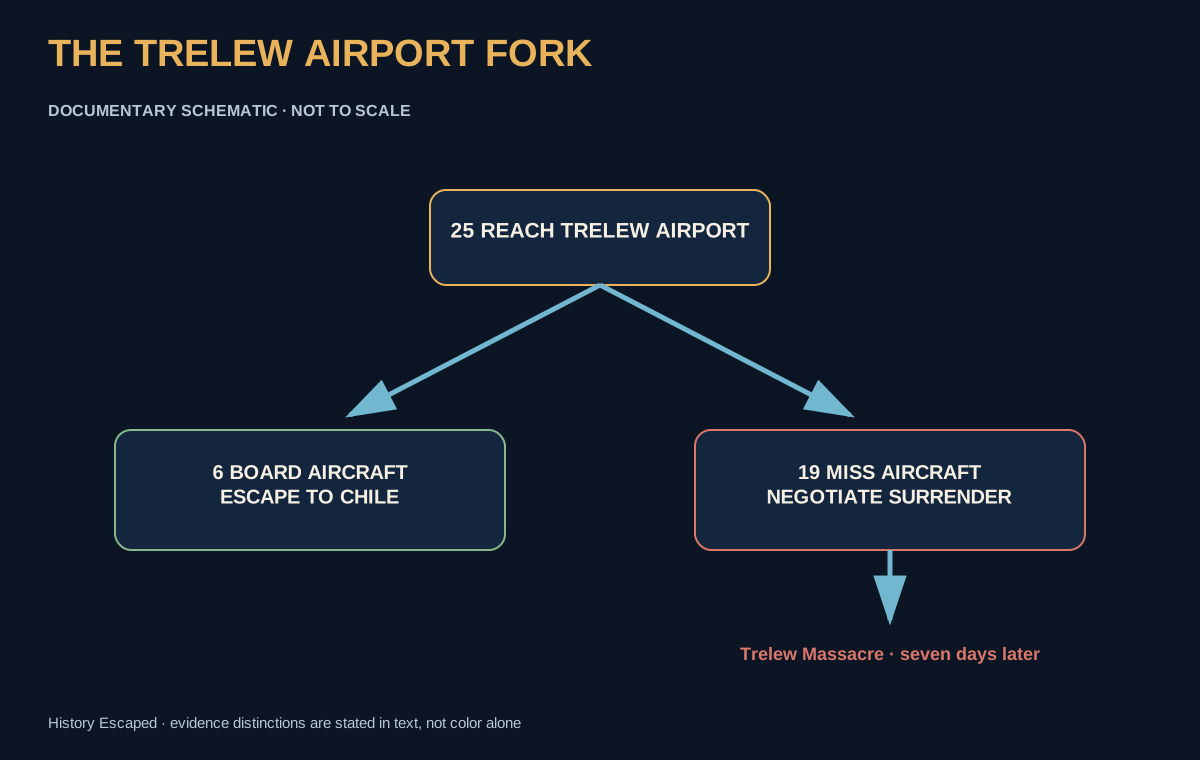
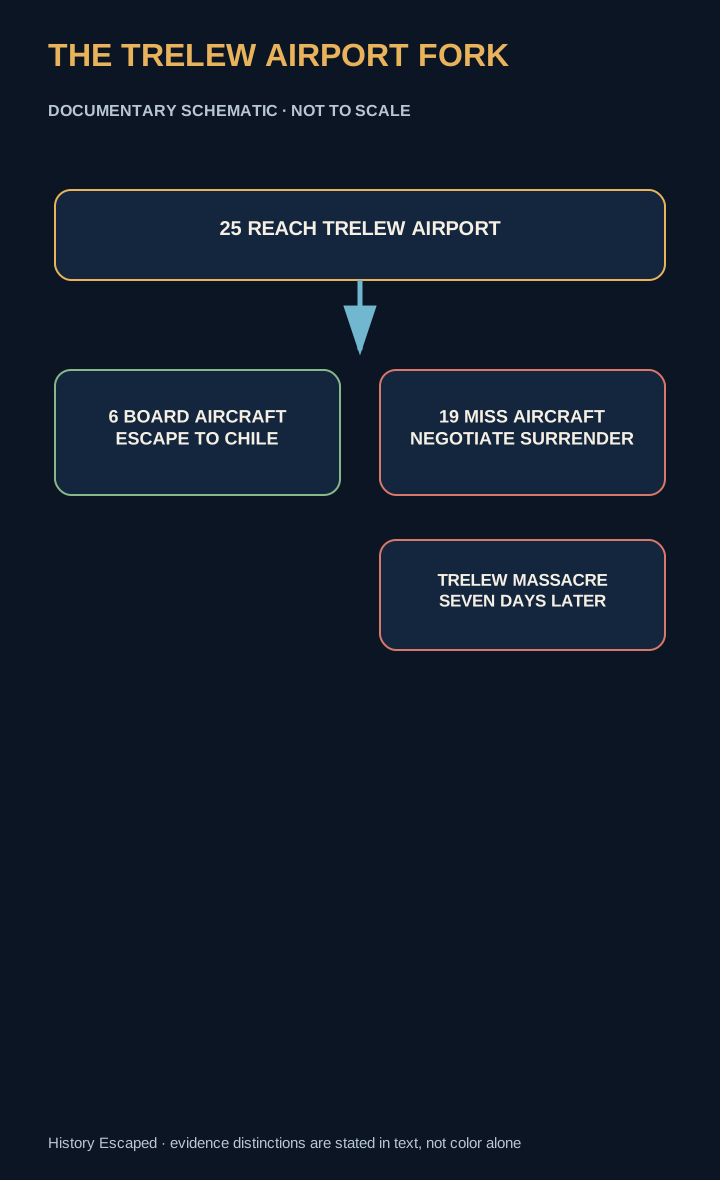
Simplified editorial reconstruction based on the cited historical record; not to scale. Uncertainty is stated directly in the visual and adjacent text.
The 2012 judgment
In 2012, the Tribunal Oral Federal in Comodoro Rivadavia convicted former naval officers Luis Emilio Sosa, Emilio Jorge del Real and Carlos Amadeo Marandino. They received life sentences for the aggravated homicides of sixteen prisoners and the attempted homicides of the three survivors.
The court classified the Trelew Massacre as a crime against humanity. That finding gives the later phase of this case a different evidentiary status from partisan descriptions produced in 1972 and 1973.
The massacre is not being called an execution merely because one political camp used that language. It is being described through a later judicial finding.
The official escape story did not survive judicial scrutiny
The federal proceedings rejected the military version that the killings resulted from another escape attempt. A 2014 appellate ruling confirmed the principal convictions and reversed two acquittals.
Argentina's Secretariat of Human Rights states that the sentences became final in 2021. The long delay matters. The judicial resolution came four decades after the event.
But it also means that a modern reconstruction does not have to choose between the military's 1972 account and a guerrilla organization's 1972 account as if both remained equally unresolved. The courts supplied a later evidentiary judgment.
What happened at Rawson still matters
Recognizing the massacre as a state crime does not require rewriting the prison break as a peaceful protest. The organizations behind the escape were armed revolutionary groups.
They seized a maximum-security prison. A prison guard, Juan Valenzuela, was killed during the takeover.
External collaborators seized a civilian aircraft. The six leaders who reached Chile escaped through an operation that used coercion and armed force.
Those facts belong in the same article. They do not justify what happened after nineteen people surrendered.
The final accounting
Outcome
Successful escapees to Chile
Six prisoners reached the aircraft and escaped Argentine custody internationally.
Airport surrender group
Nineteen reached Trelew airport after the aircraft had departed and negotiated their surrender.
Trelew Massacre victims killed
Sixteen of the surrendered detainees died after the shootings at Almirante Zar.
Trelew Massacre survivors
María Antonia Berger, Alberto Miguel Camps and Ricardo René Haidar survived the shootings.
Why the breakout partially failed
The prison takeover itself was not the decisive failure. Transportation was.
The operation had been designed around speed and coordination between prisoners and an external support network. Once gunfire disrupted communication and the larger vehicles left, most of the intended escapees no longer had a practical way to cover the road to Trelew airport before the aircraft had to leave.
The Ford allowed six leaders to reach the airport. Taxis later allowed nineteen more to get there.
That was enough to produce twenty-five prisoners outside Rawson. It was not enough to put twenty-five prisoners on the aircraft.
Why the six succeeded
The six were first through the narrowest bottleneck. They had immediate transport.
An aircraft was already under control. And once airborne, Argentina's geography ceased to be the main obstacle.
Chile introduced a diplomatic problem, but it also placed the fugitives outside direct Argentine custody. Their long-term success depended on a political decision by another state. That is why the case belongs not only to prison-escape history but also to the Cold War history of political asylum in Latin America.
Why the nineteen did not
The second group lost the race against the aircraft. Once the plane was gone, the operational logic changed.
They could not reproduce the first group's escape simply by reaching the airport. The security response was already converging on Trelew, and any attempt to obtain another aircraft would have required a new operation under rapidly worsening conditions.
They chose negotiation. Their surrender should therefore be treated as the conclusion of their failed escape—not as the beginning of the massacre.
The massacre must have its own boundary
A clean chronology makes the distinction visible: 15 August: prison break. 15 August: six leave Argentina.
15–16 August: nineteen negotiate and surrender. Following days: the nineteen are held at Almirante Zar.
22 August: sixteen are killed and three wounded survivors remain. There is a seven-day difference between the prison break and the massacre.
That span contained a surrender, a transfer and days of state detention. Removing those steps distorts the event.
Evidence discipline
What the record supports
Status labels distinguish secure conclusions from uncertainty and rejected claims. Color is never the only signal.
DISPUTED
Exactly 110 prisoners participated in the full Rawson escape attempt.
The Archivo Nacional de la Memoria describes a plan involving roughly 110 prisoners, while peer-reviewed historian Ana Trucco Dalmas describes 116 participating in the prison takeover and intended escape. The figure varies with source scope.
Sources: SRC-001, SRC-004DOCUMENTED
Twenty-five prisoners reached the Trelew-airport outcome sequence: six escaped and nineteen surrendered.
The federal prosecutor's crimes-against-humanity dossier and state human-rights records use the 25 = 6 + 19 framework.
Sources: SRC-002, SRC-003MYTH
The Rawson breakout was nonviolent.
Prison guard Juan Valenzuela was shot and killed during the takeover, and the overall operation involved armed revolutionary organizations and aircraft seizure.
Sources: SRC-004, SRC-008UNKNOWN
A specific named escape leader can be securely identified as Valenzuela's shooter from the source base used here.
The guard's death is well documented, but the present judicial and scholarly source set does not require locking a named shooter to explain the breakout.
Sources: SRC-004MYTH
The nineteen at Trelew airport were simply recaptured by pursuing forces.
Judicial and human-rights sources describe a negotiated surrender. The prisoners gave a press conference, negotiated with officials and laid down their arms.
Sources: SRC-001, SRC-002, SRC-003DOCUMENTED
The nineteen surrendered under an understanding or condition that they would be returned to Rawson prison.
Argentina's Secretariat of Human Rights explicitly states that return to the prison was a condition of surrender.
Sources: SRC-003MYTH
The Trelew Massacre was merely the final stage of the ongoing escape attempt.
The nineteen had surrendered, were transferred into naval custody and were held for six days before the 22 August shootings.
Sources: SRC-002, SRC-003MYTH
The nineteen were shot during a genuine second escape attempt from Almirante Zar.
The military government promoted an escape-attempt version, but survivor evidence and later federal judgments established sixteen aggravated homicides and three attempted homicides and classified the massacre as a crime against humanity.
Sources: SRC-002, SRC-003, SRC-008DOCUMENTED
Sixteen detainees were killed and three survived the Trelew Massacre.
The victim count is established by the judicial record and official human-rights documentation.
Sources: SRC-002, SRC-003MYTH
The six who reached Chile immediately achieved uncontested asylum.
Their arrival triggered an Argentine-Chilean extradition and diplomatic dispute before Allende's government allowed them to continue onward.
Sources: SRC-006, SRC-007DOCUMENTED
The 2012 federal court classified the Trelew Massacre as a crime against humanity.
The federal judicial and human-rights record states that the court imposed life sentences for sixteen aggravated homicides and three attempted homicides and declared the crime imprescriptible as a crime against humanity.
Sources: SRC-002, SRC-003, SRC-008Political memory
Trelew quickly became a major symbol in Argentine political culture. Armed revolutionary organizations incorporated the dead into militant memory. Public denunciations, books, pamphlets, commemorations and political slogans helped keep the case alive while official accountability remained absent.
The massacre also became part of later arguments about the development of state repression before the 1976 dictatorship. Historian Carlos Ignacio Custer cautions against reducing Trelew merely to a preview of what came after 1976. The massacre occurred in its own political setting: the final phase of the military regime known as the Revolución Argentina, growing armed militancy, and a difficult transition toward elections.
That narrower context matters. Trelew was connected to later state terrorism. It was also an event of 1972 with its own causes and political consequences.
Twenty-five, not one collective outcome
The Rawson case is easiest to understand if the twenty-five prisoners who reached the airport sequence are not treated as a single group after the breakout. Six achieved international escape.
Nineteen did not. The nineteen surrendered and entered state custody.
Sixteen of those surrendered prisoners were killed a week later. Three survived.
Those outcomes are related. They are not interchangeable.
The successful escape
For Santucho, Menna, Gorriarán Merlo, Osatinsky, Quieto and Vaca Narvaja, the operation worked. They left a high-security prison, survived the collapse of the mass transport plan, reached an aircraft, crossed an international border and avoided extradition back to Argentina.
Their path continued to Cuba. That is a historically significant successful political-prison escape. It should not disappear merely because the later massacre became the more consequential event in Argentine memory.
The failed branch
For the nineteen who followed in taxis, the escape failed at Trelew airport. They arrived too late.
They could not leave Argentina. They negotiated terms and surrendered.
That is where their escape story ends. The fact that state personnel later killed sixteen of them does not turn the airport surrender into a continuing escape attempt.
One case, two histories
The Rawson breakout and the Trelew Massacre cannot be completely separated because one created the circumstances in which the other victims came into naval custody. But they must remain analytically distinct.
The first is a history of political prisoners, armed organizations, escape planning, logistical failure, aircraft seizure and asylum. The second is a history of surrendered detainees, state custody, official deception, survivor testimony and crimes-against-humanity prosecution.
The strongest reconstruction allows both histories to remain visible. Six people escaped.
Nineteen surrendered. Seven days later, the state killed sixteen of those nineteen. That is the sequence the evidence supports.
