
Just before dawn on 6 September 1971, people began emerging through the floor of a house opposite Uruguay's most notorious prison. They had not entered the house through a door. They had come from beneath the street. Across Solano García, behind the walls of the Punta Carretas prison, more men were still moving toward the same opening.
By the time the operation ended:
111 prisoners were outside.
The escape became known as Operación Abuso. It was the largest prison breakout in Uruguayan history. But the number is only the last step of the story. The operation depended on weeks of excavation, months of prison organization, external support, a strategically chosen house, a diversion staged across other parts of Montevideo, and an internal prison system that the prisoners had learned to manipulate.
It also depended on civilians who did not volunteer to become part of the operation. The house at the end of the tunnel was occupied by an armed Tupamaro team, and its residents were confined while the final connection was completed. That fact belongs in the history alongside the engineering.
A Prison Inside a Political Crisis
Punta Carretas was a men's prison in a dense Montevideo neighborhood. By the end of the 1960s, it held large numbers of detainees connected to Uruguay's rapidly intensifying political conflict. The Movimiento de Liberación Nacional-Tupamaros, or MLN-T, was an armed revolutionary organization that had built an urban guerrilla campaign through robberies, occupations, kidnappings, sabotage, armed operations, and clandestine organization.
The state response was also escalating.
President Jorge Pacheco Areco governed under repeated emergency measures. Censorship, labor conflict, political repression, torture allegations, violent actions by armed groups of both left and right, and growing military involvement were eroding the democratic order.
This was still 1971. Uruguay's military dictatorship had not yet begun. Parliament would not be dissolved until June 1973. That distinction matters because Operation Abuso is often pulled backward into the later dictatorship and described as though the prisoners were escaping a military regime that already existed.
They were not. They were escaping a prison inside a constitutional system already under severe strain.
So Many Leaders Were Behind One Wall
By 1971, police operations had placed a substantial part of the MLN-T's experienced membership behind bars. Punta Carretas held figures who would later become central to Uruguay's political memory: Raúl Sendic. Eleuterio Fernández Huidobro.
José Mujica. Jorge Manera Lluberas. Henry Engler. Jorge Zabalza.
Mujica's later presidency has made him the most internationally recognizable name in the group. That should not rewrite the event. Operation Abuso was not “José Mujica's escape.” It was a mass prison operation involving more than a hundred prisoners and a large external support structure.

The Problem Was Not Just the Outer Wall
A tunnel out of Punta Carretas had to solve two different problems. The first was obvious:
How do you get beneath the prison perimeter?
The second came before it:
How do you move more than one hundred prisoners to the tunnel entrance without guards seeing them converge?
The answer was to alter the prison internally. Participant accounts describe prisoners opening concealed passages between cells, gradually creating a hidden circulation system behind the ordinary architecture. Walls and ceilings that officially separated prisoners became routes. The internal modifications allowed men to move toward the eventual tunneling point without walking openly through the normal prison corridors.
Later reconstructions identify Cell 73 as the critical starting location. That detail is strongly rooted in participant testimony and subsequent histories, though it is less prominent in the short official memorial summaries.
Tunnel reconstruction
From internal circulation to an occupied receiving house
The escape combined hidden movement inside the prison, a tunnel to the opposite house, and a separate diversion elsewhere in Montevideo.
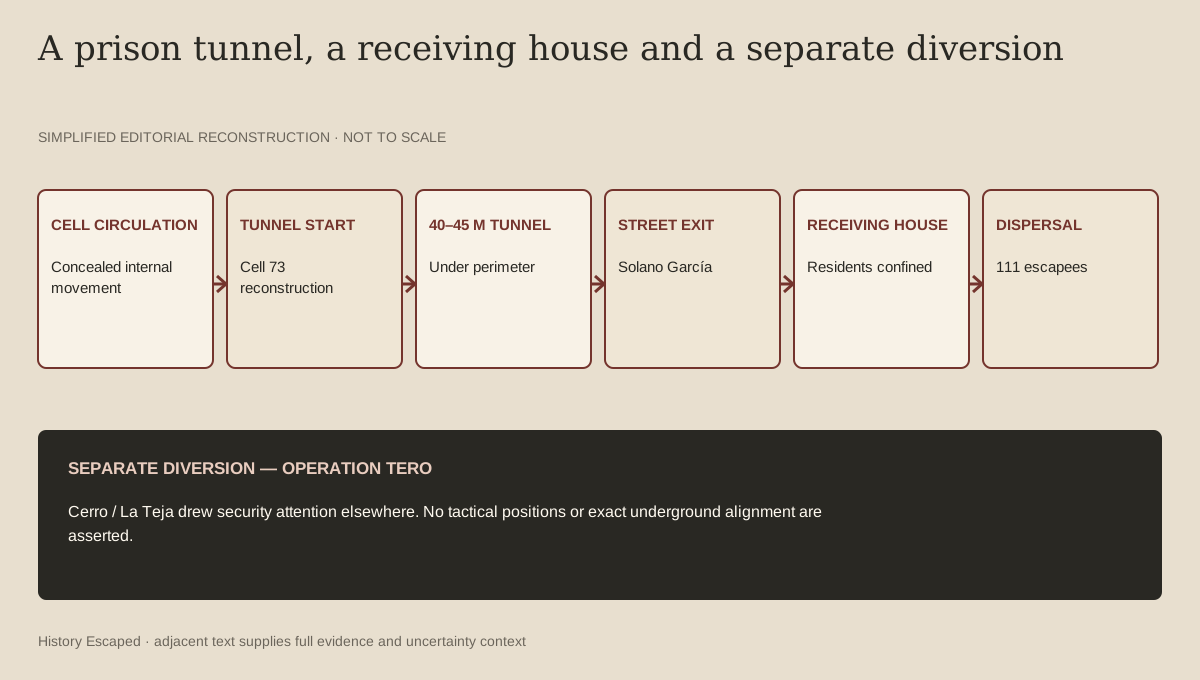
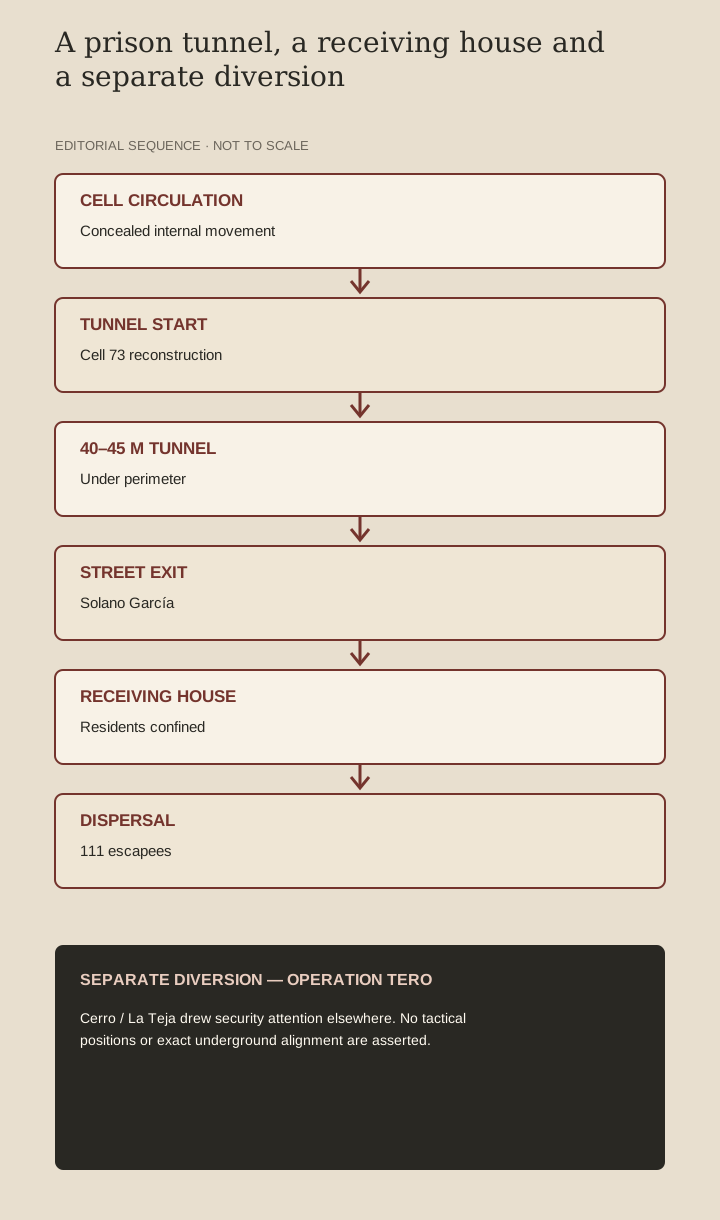
Simplified editorial reconstruction; not to scale. Tunnel length and internal mechanics vary slightly among sources, and the graphic does not recreate tactical positions.

Cell 73
The cell could not look like an obvious engineering headquarters. Participant-based histories describe the prisoners using a common prisoner in the cell to help reduce suspicion while the political prisoners organized the digging around it. From there, the excavation went down and outward. The objective lay across the prison wall and across Solano García.
The men were not simply digging toward “outside.” They were digging toward a specific urban property. That made direction everything.
The Engineer Underground
One of the prisoners was Jorge Manera Lluberas, a civil engineer and senior MLN-T figure. Participant accounts credit Manera with helping calculate the line of the tunnel and devising simple measuring devices from the limited materials available inside the prison. The problem was unforgiving. A few degrees of drift over dozens of meters could put the tunnel beneath the wrong building—or leave it short of the street-side target entirely.
The builders did not have professional tunneling equipment. They had improvised tools, prison materials, limited ventilation, and no ability to survey the route from the surface in the normal way. The official memorial description gives the finished tunnel as 45 meters. Some later accounts use approximately 40 meters.
The difference is too small to justify treating either figure as a modern laser-surveyed measurement. The safe wording is:
approximately 40–45 meters.
August 1971
A Canelones municipal memory project dates the start of principal tunnel construction to 11 August 1971. Some later journalistic accounts give an earlier date. The discrepancy probably reflects a distinction between preliminary internal preparation and the main excavation, but the surviving summaries do not justify forcing the dates into a single exact answer. What is clear is how little time the prisoners had.
The escape occurred before dawn on September 6. The main underground work therefore advanced in only a few weeks.
Material evidence
Tools of Escape
The objects used in an escape reveal how a plan worked under constraint.
- 01Essential
Improvised excavation tools
Prisoners used improvised digging equipment suited to confined clandestine work.
- 02Essential to route control
Improvised survey and level devices
Participant accounts credit Jorge Manera Lluberas with simple instruments to help maintain tunnel direction and level.
- 03Essential for mass movement
Internal cell passages
Hidden breaches between cells allowed prisoners to converge on the tunnel without normal corridor movement.
- 04Essential
Receiving house
The occupied property at Solano García 2535 provided a concealed surface exit beyond the prison wall and street.
- 05High
Operation Tero diversion
Street disturbances elsewhere in Montevideo were intended to redirect police resources away from Punta Carretas.
- 06Essential after breakout
Vehicles and safe locations
External logistics dispersed large groups of escapees after they surfaced in the receiving house.
Where Do You Put the Earth?
Every tunnel creates a second tunnel problem. The hole grows. So does the pile of earth that used to fill it. Participant recollections describe the excavated material being bagged, hauled backward, hidden, compacted, and distributed inside the prison so that guards would not suddenly discover the physical evidence of a large excavation.
The work required teams. One man could dig. Another could fill containers. Others could move spoil away from the face.
The exact team sizes differ in later retellings and are less important than the principle: Operation Abuso was an underground logistics project as much as an excavation.
Problem → response
Escape was a sequence of problems
Each response solved a practical obstacle while often creating the next one.
- 01→
Obstacle
Moving more than 100 men internally
A mass convergence through normal prison corridors would expose the plan.
Response
Prisoners created concealed connections between cells and levels.
- 02→
Obstacle
Prison perimeter and street
The escape route had to clear the cell block, prison wall, and a public street before surfacing.
Response
The tunnel ran underground toward a preselected residence across Solano García.
- 03→
Obstacle
Maintaining tunnel direction
A long clandestine excavation could drift away from the receiving house.
Response
Participant accounts describe engineering calculations and improvised surveying devices.
- 04→
Obstacle
Excavated earth
Dozens of meters of tunnel generated spoil that guards could discover.
Response
Teams moved, compacted, and concealed soil inside the prison.
- 05→
Obstacle
Poor air underground
Ventilation worsened as the tunnel extended.
Response
Workers shortened shifts and used the available underground voids and airflow described in participant accounts.
- 06→
Obstacle
Locating the tunnel from the house
The exterior team had to find the approaching passage beneath the floor without a normal survey connection.
Response
The house team used sound and downward excavation to make the final connection.
- 07→
Obstacle
Police concentration around the prison
A security response near Punta Carretas could trap escapees as they surfaced.
Response
Operation Tero attempted to draw police attention toward Cerro and La Teja.
- 08→
Obstacle
Dispersing 111 fugitives
The receiving house could not conceal the entire group for long.
Response
Exterior teams arranged vehicles and clandestine destinations, adapting when the tunnel connection ran behind schedule.
Air Becomes the Enemy
Distance created another problem. Ventilation. A narrow tunnel with workers at the face quickly becomes difficult to breathe in. Participant accounts describe shifts becoming shorter as the route extended and the air worsened.
The tunnel could not simply be widened extravagantly; every extra section meant more excavation and more soil to hide. The builders needed enough room for a person to pass and enough air to keep the excavation moving. Then they struck something unexpected.
Another Tunnel Was Already There
Forty years earlier, Punta Carretas had been the scene of another underground breakout. In 1931, anarchists and common prisoners escaped through a tunnel dug from outside the prison, associated with a coal business remembered as El Buen Trato. The earlier escape is documented by Uruguayan memory institutions. Participants in Operation Abuso later recalled that their 1971 excavation encountered part of that old passage underground.
They gave the tunnels political nicknames: Kropotkin for the anarchist tunnel. Lenin for their own. Later accounts even remember a message celebrating two ideologies meeting underground in pursuit of freedom.
That detail is memorable, but it comes from participant memory rather than a surviving engineering log. The physical existence of the 1931 tunnel is secure; the finer construction detail remains retrospective testimony.
The exact way the 1971 route encountered and used it comes from later recollection.
The House Across the Street
The tunnel's destination was a residence at:
Solano García 2535
The house stood across from the prison. The tunnel would pass under the prison's boundary and beneath the street before reaching the property. The external team needed control of the house when the prisoners arrived. Modern witness testimony makes clear what “control” meant.
The residents did not simply volunteer the property for the operation. An armed Tupamaro team occupied it. Serrana Auliso, who lived there with her mother, later recalled being confined with other women while the external team waited for the underground connection. That changed the moral geography of the escape.
Inside the prison, the operation was about getting prisoners out. Inside the house, civilians had lost their own freedom of movement so the operation could proceed. Both belong on the page.
The Final Connection Was Late
The prisoners could dig toward the house. They could not safely break upward at the wrong point. The external team had to determine where the tunnel had arrived and complete the connection from the property side. Witness and participant accounts describe listening through the floor and using sound to find the underground work.
The final meeting took longer than planned. Participants later recalled waiting for hours while the house-side excavation searched for the incoming tunnel. That delay mattered because the operation outside the prison had its own timetable. Vehicles had been prepared.
Safe locations were waiting. Drivers and support teams needed the prisoners to appear before daylight and police response made the neighborhood impossible to use. The tunnel had solved the prison. Now the house had to solve the clock.
Operation Tero
The organizers tried to give the escape more time by creating trouble somewhere else. In Cerro and La Teja, far from Punta Carretas, militants staged disturbances intended to pull police resources and attention away from the prison neighborhood. The diversion was called:
Operación Tero
Uruguay's national memory institution explicitly identifies Tero as part of the escape strategy. Later participants described barricades and burning vehicles. Some people involved in the street activity apparently did not know the deeper purpose of the action. That compartmentalization was characteristic of clandestine organization.
If one part failed or someone was detained, they could not necessarily explain the entire operation.
The final accounting
Outcome
Total escaped
The entire escape group left Punta Carretas through the tunnel.
Political/left-wing prisoners
Overwhelmingly MLN-T, with one official local-memory source identifying six men from FARO and OPR-33 rather than MLN-T.
Common prisoners
Five common/social prisoners escaped with the political group.
One Hundred and Eleven
Eventually the connection opened. The prisoners began passing through. One after another, they moved out of the prison's internal system, into the tunnel, beneath the perimeter, under the street, and upward into the house. The number is usually summarized as:
106 political prisoners and five common prisoners.
Several sources call all 106 Tupamaros. A Uruguayan municipal memory project gives a more specific breakdown:
- 100 MLN-T;
- 3 FARO;
- 3 OPR-33;
- 5 common prisoners.
The total is the same. The exact organizational classification is not. The page should preserve that difference instead of choosing whichever version makes a cleaner sentence.
The House Was Not the Finish Line
Getting into the house meant escaping the prison. It did not mean escaping Montevideo. More than one hundred fugitives appearing on a residential street would be impossible to hide. They had to be moved away quickly.
Vehicles and destinations had been prepared. Participant accounts describe truckloads and cars dispersing the men toward a network of clandestine locations. The delay in completing the tunnel connection created problems for that schedule. Some transport arrangements no longer worked exactly as planned.
The operation had to improvise at the point where its planning was supposed to be most precise. Still, the mass movement succeeded. By morning, Punta Carretas was missing 111 prisoners.
When the Prison Realized What Had Happened
The scale of the breakout transformed an institutional failure into a national political crisis. Uruguay's official memorial history records that Interior Minister Danilo Sena and Defense Minister Federico García Capurro offered their resignations. President Pacheco Areco did not accept them. Prison authorities were dismissed.
Suspicions of corruption and internal complicity followed. The more important longer-term reaction went beyond prison administration. Within days, the government increased the armed forces' role in operations against the guerrillas. Operation Abuso did not create Uruguay's political crisis.
It made the crisis harder to contain.
Not Yet the Dictatorship
Later history can flatten the chronology. Several men who escaped Punta Carretas would later endure years of brutal military imprisonment. Uruguay would enter dictatorship in 1973. The MLN-T would be militarily defeated.
Those later events can make 1971 look like a scene from a dictatorship that had already arrived. That is incorrect. The escape happened two months before Uruguay's controversial November 1971 elections. The democratic system was deeply damaged and increasingly coercive.
It was not yet formally destroyed. That distinction is essential to understanding why the breakout had such political force. It happened in public view while the constitutional state was still claiming to control the conflict.
José Mujica Was One of the Escapees
International attention often reduces Operation Abuso to one name:
José “Pepe” Mujica.
Mujica did escape Punta Carretas that morning. He was later recaptured. He escaped the prison again in April 1972 during another tunnel breakout. He was captured again and eventually became one of the nine Tupamaro leaders held as hostages under military detention for years.
Decades later he became president of Uruguay. That later biography makes him a natural entry point for modern readers. It should not make him the center of the 1971 operation. Raúl Sendic, Fernández Huidobro, Manera, Engler, Zabalza, dozens of other prisoners, exterior organizers, drivers, lookouts, and support networks all belonged to the operation.
Later celebrity can distort the chronology if it is allowed to dominate the story.
What Happened to the House
For Serrana Auliso, the escape did not become a legend overnight. It left a hole in her floor. In a 2025 interview, she recalled that the opening remained for weeks before authorities repaired it. Decades later, the floor still contained visible evidence of where the tunnel had emerged.
Her testimony adds an important corrective to the romantic language that often surrounds large prison escapes. An operation can be ingenious and coercive at the same time. A prison can fail catastrophically while civilians nearby are also victimized by the people escaping it. Historical reconstruction should be able to hold both facts.
Evidence discipline
What the record supports
Status labels distinguish secure conclusions from uncertainty and rejected claims. Color is never the only signal.
DOCUMENTED
111 prisoners escaped Punta Carretas on September 6, 1971.
The total and date are consistent across Uruguay's national human-rights memory institutions, municipal memory sources, and photographic/archive descriptions.
Sources: SRC-001, SRC-002, SRC-003, SRC-004MYTH
All 111 escapees were members of the MLN-Tupamaros.
Five were common prisoners. One municipal memory source further identifies six of the 106 political prisoners as members of FARO and OPR-33 rather than MLN-T.
Sources: SRC-004, SRC-005WELL-SUPPORTED
The tunnel was approximately 45 meters long.
The current National Honorary Commission for Sites of Memory gives 45 meters; other sources use about 40 meters.
Sources: SRC-001, SRC-003WELL-SUPPORTED
Cell 73 was the internal tunneling point.
This detail appears consistently in participant-based histories and journalism, though it is not included in the short national memorial description.
Sources: SRC-010, SRC-012WELL-SUPPORTED
The 1971 tunnel intersected an earlier anarchist escape tunnel from 1931.
The 1931 tunnel is independently documented. The physical encounter in 1971 is preserved through participant testimony and later histories.
Sources: SRC-003, SRC-008, SRC-010MYTH
Residents of the receiving house voluntarily offered the property for the escape.
Serrana Auliso's testimony states that an armed Tupamaro team occupied the property and confined the residents and other women while the final tunnel exit was completed.
Sources: SRC-011DOCUMENTED
Operation Tero was a diversion connected to the prison escape.
Uruguay's National Commission for Sites of Memory explicitly identifies the disturbances in Cerro and La Teja as a diversion intended to distract police.
Sources: SRC-001MYTH
Uruguay was already under military dictatorship when Operation Abuso occurred.
The escape occurred in September 1971 under the constitutional Pacheco Areco government. The formal rupture and parliamentary dissolution occurred in June 1973.
Sources: SRC-014, SRC-016MYTH
Operation Abuso by itself caused the 1973 dictatorship.
The escape intensified an existing political and security crisis and was followed by greater military involvement, but Uruguay's authoritarian breakdown had wider and longer-running causes.
Sources: SRC-001, SRC-014, SRC-016MYTH
José Mujica was the principal architect of Operation Abuso.
Mujica was one of 111 escapees. Planning and engineering roles were collective and participant accounts associate key roles with figures including Jorge Manera Lluberas, Eleuterio Fernández Huidobro, and others.
Sources: SRC-006, SRC-007, SRC-010UNKNOWN
The exact origin of the name Operation Abuso is known.
Participant traditions offer explanations based on the operation being an 'abuse' or extraordinary humiliation, but official memorial sources do not establish a definitive origin story.
Sources: SRC-017Evidence, Memory and Myth
Did 111 prisoners really escape Punta Carretas?
DOCUMENTED
Yes. The total is consistent across Uruguayan national and municipal memory institutions and contemporary historical summaries.
Were all 111 Tupamaros?
MYTH / OVER-SIMPLIFIED
No. Five were common prisoners.
The remaining 106 were political/left-wing prisoners overwhelmingly associated with the MLN-T. One official municipal memory source identifies 100 MLN-T, three FARO, and three OPR-33.
Was the tunnel exactly 45 meters long?
WELL-SUPPORTED / APPROXIMATE
Uruguay's current national memorial description gives 45 meters. Other sources use approximately 40 meters. Use 40–45 meters unless citing the memorial measurement directly.
Did the tunnel begin in Cell 73?
WELL-SUPPORTED PARTICIPANT TRADITION
Later participant histories consistently identify Cell 73 as the key internal tunneling point. The short official memorial pages do not supply the cell number.
Did the prisoners find an old anarchist escape tunnel from 1931?
WELL-SUPPORTED PARTICIPANT TRADITION
The 1931 tunnel escape is documented. Participants in 1971 later described intersecting the old route and nicknaming it Kropotkin.
Was the house at Solano García 2535 voluntarily offered by its residents?
NO
Modern witness testimony states that an armed Tupamaro team occupied the property and confined the residents and other women during the operation.
Was Operation Tero real?
DOCUMENTED
Yes. Uruguay's National Commission for Sites of Memory identifies the disturbances in Cerro and La Teja as a diversion designed to distract police attention from the escape.
Was Uruguay already under military dictatorship?
MYTH
No.
The breakout occurred in September 1971 under President Jorge Pacheco Areco. The parliamentary dissolution and formal dictatorship came in June 1973.
Did Operation Abuso cause the dictatorship?
MYTH / OVER-SIMPLIFIED
The escape intensified an existing security and political crisis and was followed by greater military involvement in anti-guerrilla operations. Uruguay's slide toward dictatorship had much broader causes and developments.
Was this José Mujica's personal escape plan?
MYTH
Mujica participated and escaped, but the operation involved a collective prison organization and external network. Engineering and planning roles are associated with multiple figures, including Jorge Manera Lluberas and Eleuterio Fernández Huidobro in participant accounts.
Why was it called “Abuso”?
LATER CLAIM / UNCERTAIN
Participant traditions connect the name to remarks that escaping so many men at once would be “an abuse” or outrageous humiliation of the authorities. The short official sources do not establish a single definitive origin story.
Selected chronology
Selected chronology
Earlier anarchist tunnel escape
Anarchist and common prisoners escape Punta Carretas through a tunnel dug from outside, creating an underground predecessor remembered in the 1971 story.
Operation Estrella at the women's prison
Thirty-eight women prisoners escape Cabildo through a tunnel operation shortly before Operation Abuso, demonstrating the MLN-T's ability to coordinate large prison escapes.
Principal tunnel excavation begins
One official municipal memory source dates the main internal tunnel excavation to this day; some later accounts give an earlier start for preparation or digging.
Receiving house occupied and Operation Tero staged
The external team controls Solano García 2535 while disturbances in Cerro and La Teja draw police attention away from the prison area.
111 prisoners escape
The tunnel connection opens into the house and 111 prisoners leave Punta Carretas before dispersing into clandestine transport and safe locations.
Government and prison-security crisis
Prison authorities are dismissed, cabinet resignations are offered, and the government expands military responsibility in anti-guerrilla operations.
National elections
Uruguay holds presidential and parliamentary elections amid an extraordinary climate of political and social violence.
Another Punta Carretas escape
Twenty-five prisoners escape in another tunnel operation; several had participated in the 1971 breakout and been recaptured.
Uruguay's dictatorship begins
President Juan María Bordaberry dissolves Parliament with military support, marking the formal rupture that must not be projected backward onto the 1971 escape.
Former prison becomes shopping center
After the prison's closure, the Punta Carretas complex is redeveloped as a shopping center while portions of the historic site remain visible.
Why the Escape Worked
The prison corridors could expose mass movement. The prisoners created hidden internal passages. The perimeter blocked ordinary escape. They went beneath it.
A long tunnel could drift off course. Engineering calculations helped hold direction. Digging created earth. They hid and moved the spoil.
Distance created bad air. They adjusted shifts and exploited whatever ventilation the underground route provided. The tunnel needed somewhere to surface. An external team took control of the target house.
The final connection was difficult to locate. The house team listened and dug downward. Police could flood the neighborhood. Operation Tero pulled attention toward other districts.
One hundred and eleven men emerging onto one street would be obvious. Vehicles dispersed them. The operation succeeded because no single element had to carry the entire escape. The prison organization, tunnel, exterior house, diversion, and transport plan each solved a different problem.
The same complexity also created the case's central historical tension. The prisoners escaped a coercive institution through an operation that itself used coercion against civilians outside the prison. That is not a contradiction to be edited away. It is part of what happened.