
Operation Éxito was one of the largest prison escapes in modern Chilean history.
On the evening of January 29, 1990, political prisoners inside Santiago’s Cárcel Pública began moving into a tunnel that had been excavated in secrecy for more than a year. By the time the escape was over, 49 prisoners had gotten out.
The basic fact is well documented. The details are less stable.
The Museo de la Memoria y los Derechos Humanos gives January 29 as the date, 49 escapees, a tunnel of roughly 60 meters, 24 prisoners involved in the excavation, and more than a year and a half of work. Contemporary reporting from El País confirms the 49-person escape and describes a much longer distance between the prison and the emergence point, creating the later 60-versus-80-versus-100-meter tunnel conflict.
The date also drifted in later memory. Some museum and media pages use January 30, apparently because the alarm, discovery, press coverage and recaptures unfolded after midnight. The stronger event chronology places the escape itself on the night of January 29.
The famous number “50” has a similar explanation. Contemporary reporting describes 49 people successfully reaching freedom while another man became trapped in the tunnel and was captured as guards discovered the escape. Later documentary descriptions sometimes rounded the event to 50 prisoners.
That distinction matters. Operation Éxito was not a mythic fifty-man disappearance through a perfectly measured hundred-meter tunnel. It was a real escape of 49 people, carried out during the final weeks of Augusto Pinochet’s military government, after a long clandestine excavation whose exact dimensions vary by source.
At a Glance
- Escape date: January 29, 1990.
- Place: Cárcel Pública de Santiago.
- Successful escapees: 49.
- Core tunneling group: 24 prisoners in the Museo de la Memoria account.
- Additional escapees: 25 prisoners joined once the route was opened to other political prisoners.
- Tunnel length: approximately 60 meters in the Museo de la Memoria archive; 80–100 meters in other contemporary and later accounts.
- Construction period: more than 18 months in the strongest institutional tradition.
- Political context: the escape occurred weeks before the military government transferred power to President-elect Patricio Aylwin.
- Seven escapees: contemporary and institutional sources identify seven men who had received death sentences in first instance in the Pinochet-assassination case.
- Immediate recaptures: contemporary reporting records several prisoners captured near the tunnel and river area; longer-term recapture totals vary.
A prison at the end of the dictatorship
The escape happened at a politically unusual moment.
Augusto Pinochet had lost the October 1988 plebiscite that would have extended his presidency. Elections followed in December 1989, and Patricio Aylwin was scheduled to take office in March 1990. The dictatorship was ending institutionally, but its prisons, courts and security structures had not disappeared.
Hundreds of people remained imprisoned for politically connected offenses. Some had been convicted for armed actions carried out by organizations such as the Frente Patriótico Manuel Rodríguez, or FPMR. Others faced military-court proceedings that human-rights lawyers and opposition groups argued had been shaped by torture, irregular procedure or the legal architecture of authoritarian rule.
The prisoners did not all share one political organization or one legal situation. That becomes important in the escape itself.
The core tunnel project was associated principally with prisoners connected to the FPMR, the Communist Party and the Communist Youth. But when the tunnel was finally opened, prisoners from other left-wing organizations also joined.
The escape thus began as a tightly compartmented plan and ended as a broader prison break.
Eighteen months underground
The Museo de la Memoria’s archive preserves one of the most valuable surviving physical traces of the operation: a small cart used to move excavated soil.
Its catalog description gives the core engineering history. Twenty-four prisoners worked on the tunnel for more than a year and a half. At first, soil could be moved and hidden manually. Once the tunnel advanced beyond roughly forty meters, the volume and distance made that increasingly difficult, so the prisoners built a small rail cart.
The cart later survived the demolition of the prison because the Fundación de Ayuda Social de las Iglesias Cristianas recovered it and donated it to the museum.
That object matters more than later cinematic retellings. It confirms that the tunnel was not simply a last-minute hole dug under weak supervision. It required sustained concealment, movement of large volumes of soil, structural improvisation and the cooperation of a group that had to maintain ordinary prison routines while the excavation continued.
Contemporary reporting also describes improvised ventilation, lighting and internal communication. The popular story often emphasizes ingenuity. The archival evidence supports that conclusion without requiring every later technical detail to be treated as exact.
The length problem
How long was the tunnel? The answer depends on the source.
The Museo de la Memoria archive gives 60 meters. Contemporary El País reporting describes the prisoners emerging about 100 meters from the prison, but that is a statement about distance between the prison and emergence area, not necessarily a surveyed tunnel length.
Later Chilean journalism and film-related literature often use 80 meters or “more than 80 meters.” The museum’s 1990 documentary description even refers to a tunnel of 100 meters.
Those figures should not be blended into a false average. The strongest case-local answer is: approximately 60 meters according to the museum’s preserved-object record, with contemporary and later traditions ranging roughly from 80 to 100 meters depending on what was being measured.
Because the sources appear to measure different things, the tunnel’s exact surveyed length cannot be stated securely.
January 29 or January 30?
The strongest event chronology places the escape on January 29, 1990.
The Museo de la Memoria’s archival entry says 49 political prisoners escaped on January 29. Contemporary Chilean retrospective reporting also identifies the night of January 29.
Mario Amorós’s reconstruction gives a more detailed sequence: the core group entered the tunnel around 7:30 p.m., prisoners began emerging later that night, and by midnight the first organized group had reached safe locations. The guards discovered the tunnel only after midnight.
This likely explains why many later summaries give January 30. The alarm, arrests and morning newspapers belonged to January 30 even though the escape had begun and largely succeeded the night before.
January 29 is the strongest event date; “night of January 29–30” remains accurate for the overnight sequence.
Twenty-four became forty-nine
The transition from 24 to 49 is one of the most distinctive parts of the case.
The original tunnel group had operated under tight secrecy. Once the exit was ready and the escape was underway, the route was made available to other political prisoners.
Amorós’s account says another 25 prisoners from organizations including the Socialist Party, MIR and FPMR-Autónomo joined. That yields the strongest successful-escape count: 24 planned participants + 25 additional escapees = 49 successful escapes.
This does not mean only 49 people attempted to use the tunnel.
Contemporary El País reporting describes one prisoner becoming stuck near the exit as guards finally discovered what was happening. Others behind him were then unable to continue and were captured.
That detail helps explain why some later descriptions refer to 50. The successful escape count remains 49.
The man who did not get out
The trapped prisoner is an important corrective to the triumphal version of the story.
According to El País, guards finally reached the tunnel after mounting noise and warning signs could no longer be ignored. They found a prisoner stuck in the narrow passage close to the exit, with additional men behind him.
The precise identity and sequence vary in retellings. What matters historically is that the tunnel did not simply remain invisible until everyone who wanted to leave had gone.
Discovery happened while people were still inside it.
The difference between “49 escaped” and “50 attempted” belongs to that final phase. It should remain a source distinction rather than become an invented heroic anecdote.
No gun battle
One reason Operation Éxito acquired such symbolic power was that it was fundamentally an escape rather than an armed assault on the prison.
The prisoners emerged through the tunnel and dispersed. There was no major firefight at the moment of escape.
That does not make the political background nonviolent. Several prisoners had been convicted or accused in armed operations, including the 1986 attempt to assassinate Pinochet and weapons-related cases.
But the escape mechanism itself was subterranean, covert and organizational.
That contrast shaped contemporary perceptions. Supporters saw political prisoners defeating an authoritarian prison through preparation and collective discipline. The military government and its supporters saw dangerous militants escaping lawful custody.
A neutral historical reconstruction has to preserve both the legal fact of imprisonment and the political controversy surrounding those convictions.
Seven death sentences
One number appears repeatedly in institutional and contemporary accounts: seven.
The Museo de la Memoria states that seven of the 49 escapees had been sentenced to death by the Pinochet regime. Contemporary El País reporting specifies that seven had received death sentences in first instance for participation in the 1986 assassination attempt against Pinochet.
The qualifier “in first instance” matters. It is more precise than saying seven men were awaiting immediate execution.
Their legal cases were still part of the late-dictatorship military-justice system. The escape therefore removed several of the regime’s most politically prominent prisoners from custody only weeks before the transfer of government.
How many were recaptured?
This is one of the least stable aftermath numbers.
Contemporary reporting describes six prisoners captured outside near the Mapocho area as the prison authorities reacted. Other men were stopped inside the tunnel.
Later accounts say nine of the 49 successful escapees were eventually recaptured. Wikipedia-derived summaries sometimes give 13.
These are not necessarily measuring the same period or denominator.
The six-person figure is immediate. The nine-person figure appears in the Amorós tradition for later recapture among the 49 who successfully got out. The higher number may include later captures or people intercepted during the tunnel discovery, but the source chain is too weak to treat it as a settled outcome total.
The sources securely establish 49 successful escapees; the complete long-term recapture total remains disputed.
The escape and the democratic transition
Operation Éxito occurred in the awkward interval between electoral defeat of the dictatorship and the actual transfer of executive power. That timing gave the escape meanings larger than prison history.
For supporters of the prisoners, it was a final act of resistance against a regime they did not consider legitimate.
For sectors of the incoming democratic coalition, it was more complicated. Aylwin’s government was preparing to inherit institutions still heavily influenced by the armed forces. Political-prisoner cases, military jurisdiction and amnesty were unresolved.
A mass escape could be celebrated as anti-dictatorial resistance while also creating a legal and political problem for the government about to take office.
That tension is visible in contemporary reporting. The escape was not simply “the dictatorship versus democracy.” It happened during the transition between them.
The prison disappeared, but the tunnel left objects behind
The old Cárcel Pública was later demolished. The physical tunnel did not become a preserved historic site.
What survived instead were fragments: testimony, press coverage, photographs, film and the small cart now cataloged by the Museo de la Memoria. That cart is particularly valuable because it anchors the history in a physical object.
The museum’s preserved tunnel cart is one of the strongest surviving physical traces of the operation. A newspaper front page from January 30, 1990 also survives as powerful context, but contemporary newspaper photography remains copyrighted and should not be deployed without permission.
Film changed the memory of the escape
The 2020 Chilean film Pacto de Fuga brought the story to a much wider audience. It dramatized the engineering, secrecy and interpersonal strain involved in the operation.
The film is explicitly inspired by the historical escape rather than a scene-for-scene documentary reconstruction. That matters because many public descriptions of Operation Éxito now recycle measurements, character roles and dramatic incidents that come from film publicity or retrospective storytelling.
The historical case should therefore keep cinema in the popular-culture section rather than allowing the movie to control the facts. The secure record is already remarkable enough.
What can be stated securely
A core group of political prisoners in Santiago’s Cárcel Pública spent more than a year and a half constructing a concealed tunnel. The Museo de la Memoria attributes the excavation to 24 prisoners and gives the tunnel a length of about 60 meters.
On the night of January 29, 1990, those prisoners began escaping. Another 25 political prisoners joined once the tunnel was opened to them.
Forty-nine people successfully got out.
At least one additional would-be escapee became trapped as guards discovered the tunnel.
Seven of the successful escapees had received death sentences in first instance in the Pinochet-assassination case.
The precise tunnel length, exact long-term recapture total and whether the event should be dated January 29 or 30 vary across sources. January 29, 49 escapees and 24 core tunnel workers are the strongest factual anchors.
Why Operation Éxito Matters
This is not merely a technically impressive prison break.
It is a case about the final weeks of an authoritarian regime, political imprisonment, contested legality and a transition in which old institutions still governed people who expected the political order to change.
The escape’s long preparation gave it one kind of significance. Its timing gave it another.
Forty-nine men emerged from underground while Chile was waiting for a transfer of power that had already been decided at the ballot box but had not yet happened.
The prison authorities discovered the tunnel too late.
History had not quite changed governments. The prisoners had already changed their own status.
Evidence diagram
Operation Éxito: counts, dates and evidence
Counts refer to different groups. The diagram is an evidence comparison, not a tunnel plan.
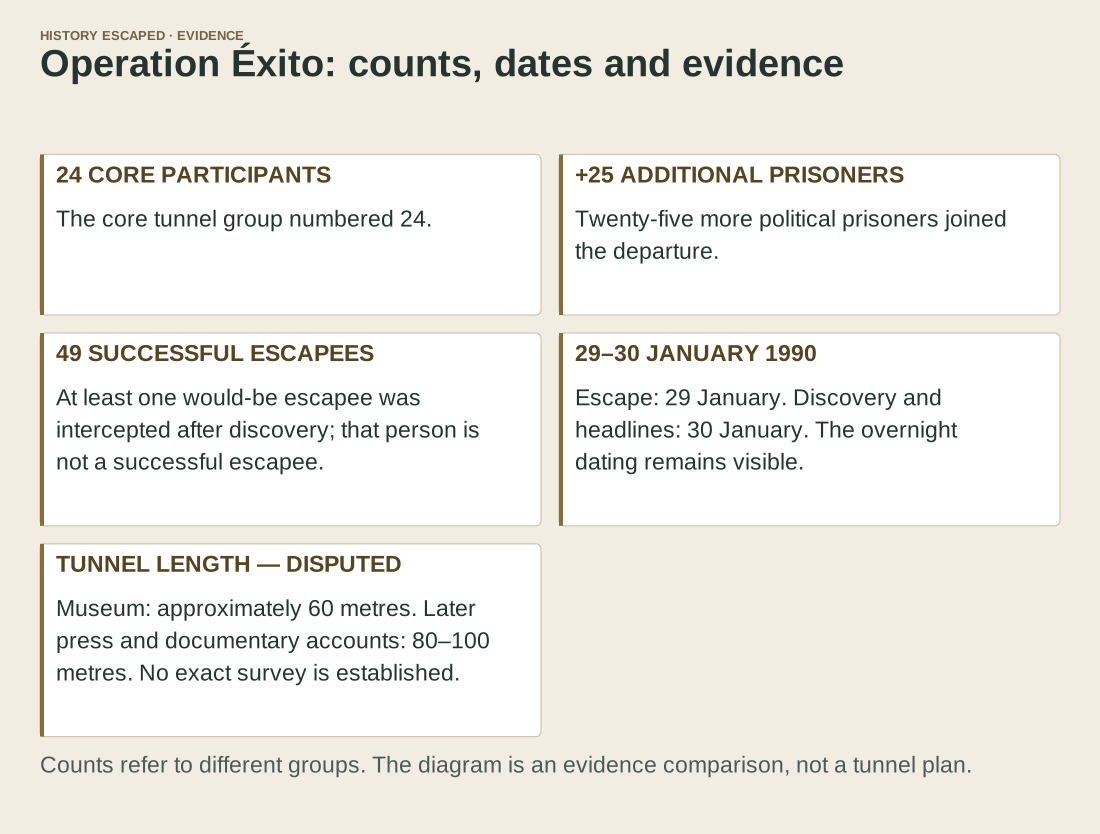
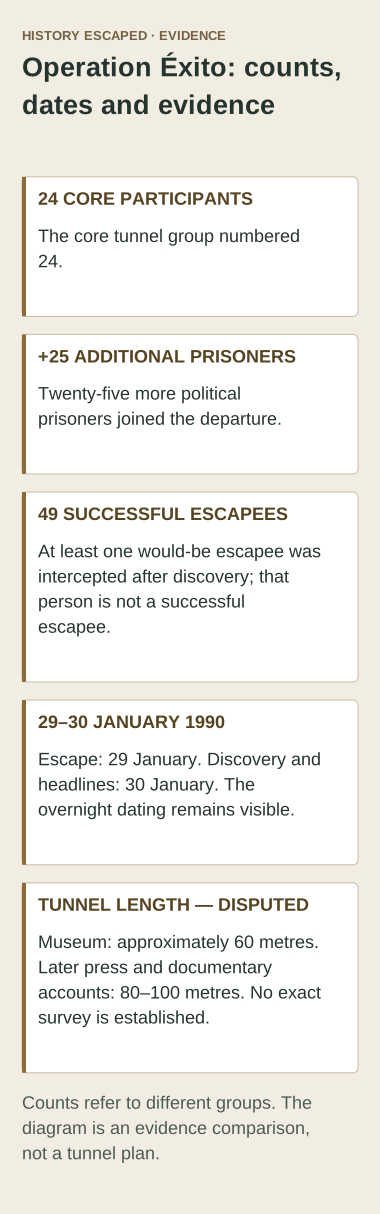
Counts refer to different groups. The diagram is an evidence comparison, not a tunnel plan.
Problem → response
Escape was a sequence of problems
Each response solved a practical obstacle while often creating the next one.
- 01→
Obstacle
Long-term concealment
The project had to survive routine inspections and normal prison activity for more than a year.
Response
Work was compartmented and disguised within ordinary prisoner routines.
- 02→
Obstacle
Excavated soil
The growing volume of earth threatened to expose the tunnel.
Response
Soil was hidden inside the prison and eventually moved using an improvised cart.
- 03→
Obstacle
Tunnel dimensions and collapse risk
Contemporary reporting describes narrow passages and multiple collapses.
Response
Prisoners reinforced sections and continued excavating despite hazardous conditions.
- 04→
Obstacle
Discovery while escape was still underway
Guards found the tunnel before every would-be escapee had cleared it.
Response
Most successful fugitives had already dispersed, but prisoners still inside or nearby were captured.
The final accounting
Outcome
Successful escapees
Core tunneling participants
Additional successful escapees
Selected chronology
Selected chronology
Pinochet loses plebiscite
Voters reject continuation of Pinochet’s presidency.
Tunnel constructed
The core group excavates and conceals a tunnel over more than eighteen months.
Aylwin elected president
Chile elects Patricio Aylwin, but Pinochet remains president until March 1990.
Escape begins
Core participants enter the tunnel and the route is later opened to additional political prisoners.
Tunnel discovered
Guards discover the escape after most successful fugitives have dispersed; several would-be escapees are intercepted.
Transfer of presidential power
Patricio Aylwin assumes the presidency, formally ending Pinochet’s presidency.
Evidence discipline
What the record supports
Status labels distinguish secure conclusions from uncertainty and rejected claims. Color is never the only signal.
DOCUMENTED
The escape occurred on January 29, 1990.
The Museo de la Memoria archival record and multiple retrospective accounts place the successful escape on the night of January 29; January 30 variants reflect the post-midnight discovery and reporting.
Sources: SRC-001, SRC-003, SRC-006MYTH
Exactly 50 prisoners successfully escaped.
The strongest institutional and contemporary sources give 49 successful escapees. A further would-be escapee became trapped as guards discovered the tunnel, while later documentary descriptions sometimes round the event to 50.
Sources: SRC-001, SRC-002, SRC-006DISPUTED
The tunnel was exactly 100 meters long.
The museum object catalog gives about 60 meters; other reporting gives 80 or 100 meters, sometimes referring to the distance between the prison and emergence point rather than surveyed tunnel length.
Sources: SRC-001, SRC-002, SRC-004, SRC-006WELL-SUPPORTED
Twenty-four prisoners formed the core tunneling group.
The Museo de la Memoria archive gives 24; another retrospective interview gives a slightly lower organizing count, so 24 is best supported but not perfectly universal.
Sources: SRC-001, SRC-004DOCUMENTED
Seven successful escapees had death sentences in first instance connected to the 1986 Pinochet assassination attempt.
Both museum and contemporary press sources preserve the seven-person figure.
Sources: SRC-001, SRC-002DISPUTED
Exactly nine of the 49 were eventually recaptured.
The Amorós tradition gives nine, while other summaries give higher totals and contemporary reporting distinguishes immediate captures from later recapture. No single long-term denominator is sufficiently secure.
Sources: SRC-003, SRC-002