
On the evening of 22 May 1938, prisoners inside the Fort of San Cristóbal on Mount Ezkaba seized key parts of the prison and opened the way out. The plan had been prepared by a small group, but the opportunity it created was suddenly offered to thousands of men who had not been part of that planning. By the time the breakout had spread beyond the walls, 795 prisoners had chosen to run.
Only three are securely documented as reaching France.
That contrast—795 out of the prison, three across the border—defines the case more accurately than the phrase “mass escape” by itself. The prison break succeeded on a remarkable scale. Long-term escape from rebel-controlled Navarre did not.
At a Glance
- Date: 22 May 1938
- Place: Fort of San Cristóbal / Fort Alfonso XII, Mount Ezkaba, near Pamplona
- Context: Spanish Civil War; rebel-controlled Navarre
- Approximate prison population: 2,487 in modern reconstruction
- Prisoners who left the fort: 795
- Planning group: small internal core; exact size varies by source
- Recaptured: at least 585 in Spain’s 2026 official declaration
- Killed during the pursuit: 206 in current Navarre institutional work; one UPNA study gives 207
- Securely documented as reaching France: 3
- Successful escapees: Jovino Fernández González, Valentín Lorenzo Bajo, José Marinero Sanz
- Possible fourth: later oral-history claim, unverified
- Alleged leaders later executed: 14
- Execution date: disputed between 8 August and 8 September 1938
- Latest known recapture: 14 August 1938
- Outcome: successful mass breach followed by overwhelming recapture, killings and a tiny long-term success group
A fortress that had become a prison
The structure on Mount Ezkaba had not been built to hold political prisoners. Construction began in 1878 after the Third Carlist War and continued until 1919, producing a large military fortification intended to protect Pamplona from attack. Advances in artillery made the project strategically outdated before it could fulfill that purpose.
The state later converted the obsolete fort into a prison. By the 1930s, cells and underground spaces designed within a military complex were being used to confine large numbers of inmates. After the military uprising of July 1936, that role expanded dramatically.
Navarre fell quickly under the control of the forces rebelling against the Spanish Republic. There was no sustained conventional front across the province, but repression was severe. Spain’s 2026 democratic-memory declaration describes the fort as a place where thousands were incarcerated for political ideas, republican loyalty, trade-union activity or membership in parties targeted by the new authorities.
Overcrowding shaped the escape
The fort had been conceived for far fewer people than it eventually contained. The 2026 declaration gives a nominal capacity of roughly 350 and says the prison held more than 3,000 people at peak periods. Modern archival reconstructions place about 2,487 inmates there when the May 1938 escape occurred.
The conditions inside were a central part of the event. Official Spanish and Navarre memory sources describe severe overcrowding, hunger, cold, persistent damp, disease, punishment, beatings and isolation. The men who escaped therefore did not begin their flight as well-fed prisoners equipped for days in mountain country.
This is important when considering what happened after the walls were opened. The failure of hundreds to reach France was not evidence that the prison breach itself had been poorly conceived. It reflected the enormous difference between taking temporary control of a prison and sustaining a cross-country escape while malnourished and under pursuit.
The plan belonged to a minority
The number 795 can create the impression of a huge coordinated conspiracy. The surviving evidence indicates something different.
Spain’s official 2026 account says the plan was devised by a small group of prisoners. Fermín Ezkieta’s specialist reconstruction, built from judicial files, prison documentation and testimony, likewise presents a core that prepared for the takeover while most prisoners remained outside the planning circle.
Sources differ over exactly how many men knew in advance. Some later reconstructions speak of several dozen committed participants. That uncertainty does not change the structure of the event: the planning group was much smaller than the population that eventually fled.
The distinction matters because the organizers could plan how to open the prison. They could not give 795 men detailed maps, clothing, food and border contacts without making the conspiracy impossible to conceal.
Sunday evening created the opening
The conspirators acted during the evening meal on Sunday, 22 May. The prison followed a routine, and the organizers used that predictable moment to confront and disarm guards and take control of important internal points.
The precise actions of individual conspirators are reconstructed most fully in later specialist work. The broad sequence, however, is supported by Spain’s current official memory declaration: the plan was activated during dinner, guards were disarmed, and prisoners were told they could flee toward France.
Once the route out was available, the escape stopped belonging only to the conspirators. Men who had not expected to face the decision that evening suddenly had to choose between remaining inside and joining a mass movement into the mountain.
About one-third of the prison population chose to leave.
795 escaped the prison
That number is unusually stable across modern Spanish sources. The 2026 Boletín Oficial del Estado, the Government of Navarre and specialist reconstructions all use 795.
It should be understood as the number who broke out of confinement, not the number who escaped the Francoist-controlled territory. The distinction is the central counting problem of the case.
Leaving the fort was a real success. Hundreds passed from imprisonment into open country, and for a short period the authorities had lost physical control of them.
Yet the fort sat on Mount Ezkaba, not on the French frontier. The prison wall was only the first barrier.
Outside, one operation became hundreds of separate escapes
The mass did not continue north as a single organized formation. Specialist evidence describes rapid dispersal as prisoners moved across the mountain and into surrounding valleys.
Many had little idea where they were. They had been transported to the fort under guard from other provinces and had no reason to know the roads, rivers or passes north of Pamplona. Some prisoners who had worked outside the fort possessed better local knowledge, and that advantage became important once the group fragmented.
Darkness could hide movement, but it also made orientation harder. Rain, mud, poor footwear and hunger compounded the problem. A man who had successfully crossed the prison threshold now had to find France across unfamiliar country while avoiding every road or settlement that might contain pursuers.
There was no waiting rescue system
The rebel authorities suspected outside assistance and investigated the possibility that the prison revolt had been coordinated with people beyond the walls. Later archival work has not produced evidence of a prepared external organization waiting to transport the fugitives to France.
That changes how the event should be understood. The internal phase was organized; the external phase was largely improvised.
Some local people helped individual escapees with food, directions or short shelter. Others assisted the authorities, belonged to political militias involved in the search, or turned fugitives over to armed forces. Local behavior varied from place to place and person to person.
The fugitives therefore entered a social landscape as uncertain as the physical one.
The pursuit began almost immediately
The authorities reacted quickly once news of the breakout reached Pamplona. The search expanded across the valleys north of Mount Ezkaba, involving the Guardia Civil, army units, Falangists, Requetés and armed civilians.
The manpower imbalance was severe. The escapees were scattered, poorly supplied and trying to avoid roads; the authorities could use vehicles, communications and local posts to close likely routes.
Recapture was only one possible result. Government of Navarre forensic work describes fugitives who were detained and then killed rather than returned alive to the fort. Bodies were buried in fields, near villages and in improvised graves across the pursuit zone.
This is why “recaptured” and “killed” must remain separate categories.
The death count has changed with the research
A figure of 206 is now common in Government of Navarre work. In 2022, for example, the regional government described Máximo Sainz Plaza as one of 206 escapees killed and stated that many were unarmed and had already been detained when they were killed.
Fermín Ezkieta’s specialist reconstruction also uses 206. An academic UPNA study of historical-memory sites gives 207, while older educational and commemorative publications have used still other totals.
The disagreement is not trivial, but neither does it make the event impossible to count. Modern research has become more precise through cemetery records, military files, municipal death records, exhumations and DNA identification. The best-supported immediate-pursuit figure is therefore around 206–207, with 206 currently dominant in Navarre institutional usage.
Using “exactly 206” without qualification would hide the continued work behind the number.
“585 recaptured” also needs a qualifier
The number 585 appears frequently in scholarship and specialist reconstructions. Spain’s 2026 official declaration uses more cautious wording: at least 585 were recaptured.
That difference matters when people try to solve the event by arithmetic. If 795 escaped, 585 were captured, 206 were killed and three reached France, the figures add to 794. The temptation is to declare that the missing person proves a fourth successful escape.
It does not.
Each total was reconstructed from imperfect documentation, and the official state source itself refuses to treat 585 as an absolute closed number. The arithmetic can highlight an unresolved record; it cannot identify an undocumented survivor.
Three men are securely documented in France
The confirmed successful group consists of Jovino Fernández González, Valentín Lorenzo Bajo and José Marinero Sanz.
They did not reach safety as a single three-man team following one standardized route. Their stories instead show how completely the mass breakout had fragmented.
Jovino Fernández moved westward through northern Navarre and eventually reached Urepel, across the border in France. The Government of Navarre dates his arrival to 4 June 1938, thirteen days after the escape.
Valentín Lorenzo and José Marinero followed a different course toward the frontier around Valcarlos/Luzaide. Specialist reconstruction indicates that they survived roughly ten days outside before finally crossing.
Three men, at least two routes, and many days of evasion separate the successful border crossings from the initial prison takeover.
Jovino Fernández did not even know the full plan
Jovino’s later recollections are valuable because they undercut the idea that everyone who succeeded must have been a principal organizer.
In the specialist source tradition, he recalled that he had not known a mass escape was about to happen. The opportunity appeared when control of the fort changed and prisoners were able to leave.
What made him successful came afterward: endurance, choices about direction, help received along the way and the ability to remain outside the tightening search for nearly two weeks.
The modern GR 225 memorial trail substantially follows his reconstructed route to Urepel. That makes it an important public-history resource, but not a literal map of the movement of all 795 escapees.
Valentín Lorenzo and José Marinero took another route
Valentín Lorenzo and José Marinero are associated with the frontier around Valcarlos. Specialist accounts describe days of hunger and exhaustion before local information helped them recognize how close they were to French territory.
Their survival is particularly useful for understanding the role of local assistance. There was no organized reception system linking the fort to the border, but isolated acts of guidance could become decisive at the final stage.
Later life took the successful fugitives into exile and, in some cases, back into the Republican war effort. Reaching France did not place them outside the consequences of the Spanish Civil War; it did, however, end the immediate pursuit that had killed or recaptured almost everyone who left with them.
A fourth survivor remains possible, not proven
Navarre educational and memorial materials sometimes mention three—or perhaps four—men reaching France. The qualification traces to later oral-history investigation concerning an unidentified man who decades afterward reportedly claimed that he had also escaped successfully and eventually lived in the United States.
The story is intriguing because the reconstructed totals have always contained uncertainties. It has not produced the level of documentary identification available for Jovino Fernández, Valentín Lorenzo and José Marinero.
The secure historical count therefore remains three. A possible fourth belongs in the evidence register, not in the headline total.
The killings did not occur in one place

Modern forensic work has transformed understanding of the pursuit. The dead were not found in one battlefield or one execution site. They were scattered across the valleys north of the fort.
Government of Navarre announcements about identified remains provide unusually concrete examples. Máximo Sainz Plaza, only recently eighteen, was captured and killed four days after the escape with other fugitives. Segundo Hernández Blanco was nineteen when he fled; his remains were identified decades later through the regional DNA program.
Emiliano Miguel Portugal, another young prisoner, was identified after exhumation near Larrasoaña. Government accounts state that he and companions had been detained before they were killed and buried nearby.
These cases explain why modern institutional language increasingly describes many deaths as killings after capture rather than casualties of an armed clash.
The manhunt lasted far longer than a weekend
The first days produced the largest wave of recaptures and deaths, but the search continued well beyond May.
Modern memory studies identify Amador Rodríguez as the latest known recapture, on 14 August 1938. By then almost three months had passed since the prison gates opened.
That long tail matters because it complicates the assumption that every escapee's fate was decided within forty-eight hours. A small number survived in hiding for weeks even though they did not ultimately reach France.
Their experience also shows that “not immediately recaptured” is not the same category as “successful escape.”
The organizers faced another layer of punishment
Seventeen prisoners were prosecuted as alleged leaders or key participants in the organization of the breakout in specialist reconstructions. Fourteen were condemned and executed.
Here the sources produce an unusual date conflict.
Spain’s 2026 BOE declaration states that the fourteen were shot in Pamplona on 8 September 1938. The Universidad Pública de Navarra’s individual archival record for Baltasar Rabanillo gives 8 August 1938, including a civil-registry date, burial information and archival citations. Fermín Ezkieta’s reconstruction also gives 8 August for the group.
The discrepancy cannot responsibly be erased simply because the newest source is official. The BOE has strong institutional authority, while the UPNA database points to individual archival documentation. Until those records are reconciled, the execution date remains disputed.
The number fourteen is much more secure than the month.
Recapture was not the end of the consequences
Returned escapees went back into a prison already defined by deprivation and disease, so recapture did not restore a neutral pre-escape status.
Fermín Ezkieta’s research identifies forty-five captured fugitives who later died in the fort between 1938 and 1943 and were not part of the immediate pursuit-death list. Some succumbed years after the breakout, including during periods when tuberculosis and other diseases remained serious problems inside the prison.
Those deaths should not be merged into the 206–207 pursuit total. They belong to a different outcome category.
Keeping the categories separate prevents the history from becoming a single inflated “death toll” and shows the sequence more clearly: men killed outside during the manhunt, men later executed after prosecution, and recaptured men who subsequently died in confinement.
The prison population was politically diverse
Modern official descriptions correctly emphasize republicans, trade unionists, left-wing activists and people punished for loyalty to the Republic. The prison population, however, should not be reduced to one party or one military identity.
Men arrived from many provinces and political backgrounds. Some had fought, some had been political or union activists, and others were caught in the broader machinery of wartime repression.
That diversity helps explain why the mass escape had no single political command once it left the walls. A prison community shared confinement without necessarily sharing one organization, one route or even prior knowledge of the plan.
Local society cannot be reduced to one role either
The search unfolded across villages where residents faced armed state forces and political militias, and where memories of 1936 repression were already fresh.
Specialist research records examples of civilians assisting fugitives and others helping the pursuit. Some families later preserved knowledge of graves; some witnesses enabled exhumations many decades later.
This complexity is important because older narratives can drift toward two equally simple stories: a countryside unanimously helping prisoners toward France, or a countryside uniformly hunting them.
Neither describes the evidence well.
The escapees entered communities divided by fear, politics, loyalty and immediate circumstance.
The fort's geography was both opportunity and trap
A mountaintop prison seems, at first glance, to offer a natural advantage after a breakout. Forest and broken terrain can hide movement much more effectively than open city streets.
The same terrain can also disorient exhausted people. Moving north meant crossing valleys and ridges without reliable maps. Avoiding roads reduced the chance of encountering patrols but also reduced access to food and accurate directions.
The three men who reached France demonstrate that the journey was physically possible. The fate of almost everyone else demonstrates how little margin existed for error once the authorities mobilized.
The fort was escaped in hours; the border required days.
The scale is easiest to understand as nested outcomes
The event produces confusion when every number is placed in one flat list. Approximately 2,487 men were imprisoned at the fort, and 795 of them left on May 22.
Within that 795, at least 585 were recaptured. Roughly 206–207 were killed during the pursuit in the strongest modern reconstructions. Three are securely documented as reaching France. A small remainder in the reconstructed totals reflects incomplete or differently classified evidence rather than a proven fourth success.
Within the recaptured population, another subgroup later faced prosecution as organizers; fourteen were executed. Still other recaptured fugitives died later in prison.
These categories overlap and nest. They cannot simply be added together as separate totals.
Why older figures differ
The record was never created for later historians as a clean statistical dataset. Authorities recorded arrests, deaths, burials and prosecutions through different institutions, often under wartime conditions. Bodies were unidentified or registered under incomplete or false names, while some deaths were recorded years later in a victim's home town.
That problem persisted after the dictatorship. Families possessed private information that official files did not, graves were unmarked, and political conditions delayed systematic recovery work.
Modern researchers have combined prison lists, judicial files, municipal civil registers, cemetery documentation, testimonies and exhumation evidence. DNA analysis has added another layer.
A number changing from 193 to 206 is therefore not necessarily evidence that one generation of historians was careless. It can reflect previously unknown identities and a more precise definition of what is being counted.
DNA work is still changing the human record
The Government of Navarre's DNA bank has identified multiple men connected to the escape.
In 2022, the government announced the identification of Máximo Sainz Plaza from a grave at Olabe. In 2024, it announced the identification of Segundo Hernández Blanco from the Elía grave. These were not abstract additions to a number; they restored names to remains recovered decades after the killings.
The forensic work also confirms a pattern described in archival research: fugitives were sometimes captured alive, moved or held briefly, and then killed.
That evidence makes the term “manhunt” insufficient if it suggests ordinary recapture alone. The pursuit included extrajudicial violence.
The GR 225 is a memorial route, not a master escape map
Navarre has developed the GR 225 as a long-distance memorial trail connecting Mount Ezkaba with the French side of the border. The route is valuable because it gives visitors a geographic sense of the distances involved and commemorates the prisoners' attempted flight.
Its relationship to the 1938 escape must nevertheless be stated precisely. The trail draws especially on the reconstructed route of Jovino Fernández to Urepel.
It does not mean that 795 men formed one column along the modern path.
Valentín Lorenzo and José Marinero are associated with a different frontier route. Most escapees never approached either crossing before they were captured or killed.
A historical map should therefore show dispersion and several broad corridors rather than trace one definitive line.
Memory of the escape became part of the landscape
A memorial to the fugitives stands on Mount Ezkaba, and annual commemorative practices have kept the event visible through decades in which the prison itself remained difficult to access and interpret.
Associations such as Txinparta, researchers, local families and public institutions contributed to identifying graves and recovering names. The Government of Navarre later integrated exhumation work, educational projects and the GR 225 into a wider democratic-memory program.
In April 2026, the Spanish state formally declared the Fort of San Cristóbal a Lugar de Memoria Democrática.
The declaration matters for more than preservation of architecture. It places the fort, the prison conditions, the 1938 escape and the subsequent killings within an official national framework of remembrance.
“One of Europe's largest prison escapes” needs a qualifier
The 2026 BOE describes the event as one of the largest prison escapes in Europe. With 795 men leaving one prison in a single evening, the description is understandable.
Comparative superlatives should still be used carefully. Different historical breakouts count participants, people who cleared a perimeter, people who remained free and people who survived in different ways.
Fort San Cristóbal is unquestionably a mass breakout of exceptional scale. Its historical importance does not depend on proving an exact continental ranking.
The more meaningful comparison is internal: 795 escaped confinement, but only three securely escaped the surrounding political and military system.
Breakout success and escape success are different questions
A prison escape usually invites one yes-or-no outcome: did the prisoner get away?
Fort San Cristóbal does not fit that structure. The organizers succeeded in opening the prison on a scale few prison conspiracies ever achieved. Hundreds of men who had not known the plan existed were suddenly outside.
For most of them, that success lasted only hours or days.
A man killed after capture had escaped the prison but not the repression surrounding it. A man recaptured in a valley had completed the breakout but not the cross-border escape. A man who survived in hiding until August had evaded capture far longer than most, yet still did not reach France.
Only three men can be securely placed on the far side of the border.
Why this belongs in escape history
The event is valuable precisely because it separates three stages that are often collapsed. First came conspiracy, when a small internal group found a way to break control of the fort; second came mass breakout, when 795 men left; and third came individual survival, as hundreds of separate attempts unfolded across hostile territory while the authorities mobilized.
The first two stages were extraordinary successes, while the third ended catastrophically for almost everyone. Fort San Cristóbal therefore should not be remembered as a failed escape simply because only three reached France, nor as a triumphant mass liberation simply because 795 cleared the prison.
It was both a large-scale prison breach and a devastatingly unsuccessful mass flight. The walls opened, but the political geography outside remained the larger prison.
Documentary reconstruction
Reconciling the mass breakout’s documented outcomes
A case-local visual focused on the historical question that the surviving evidence can answer.
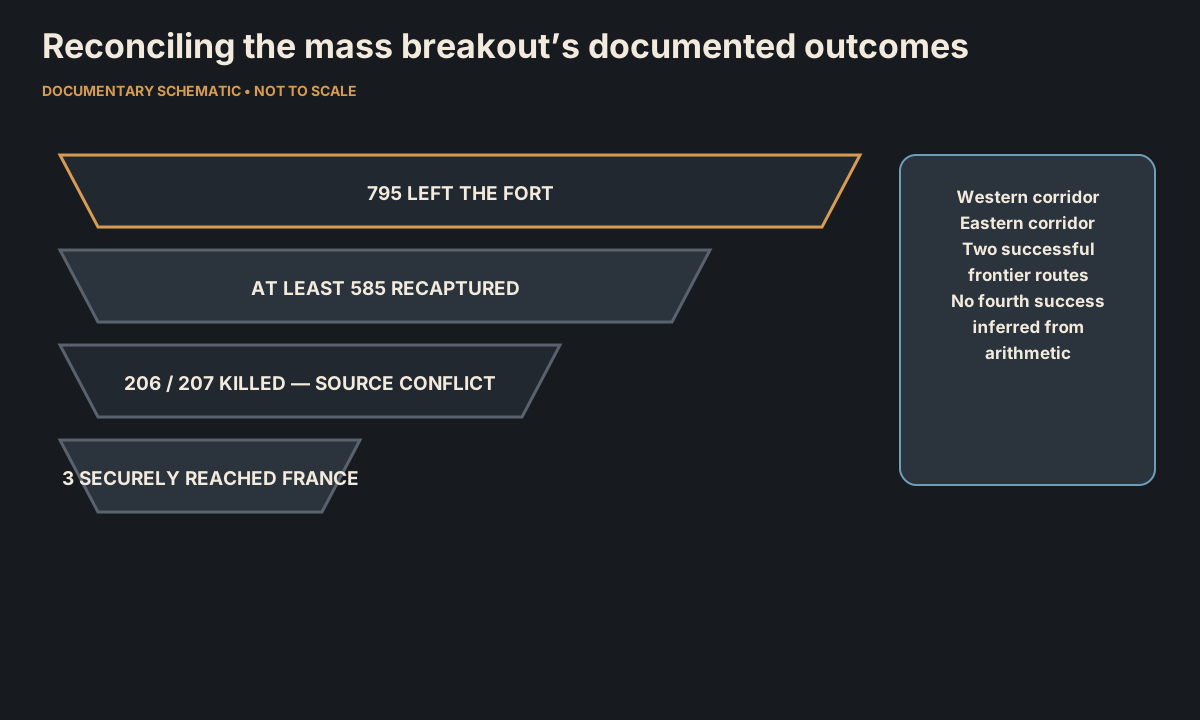
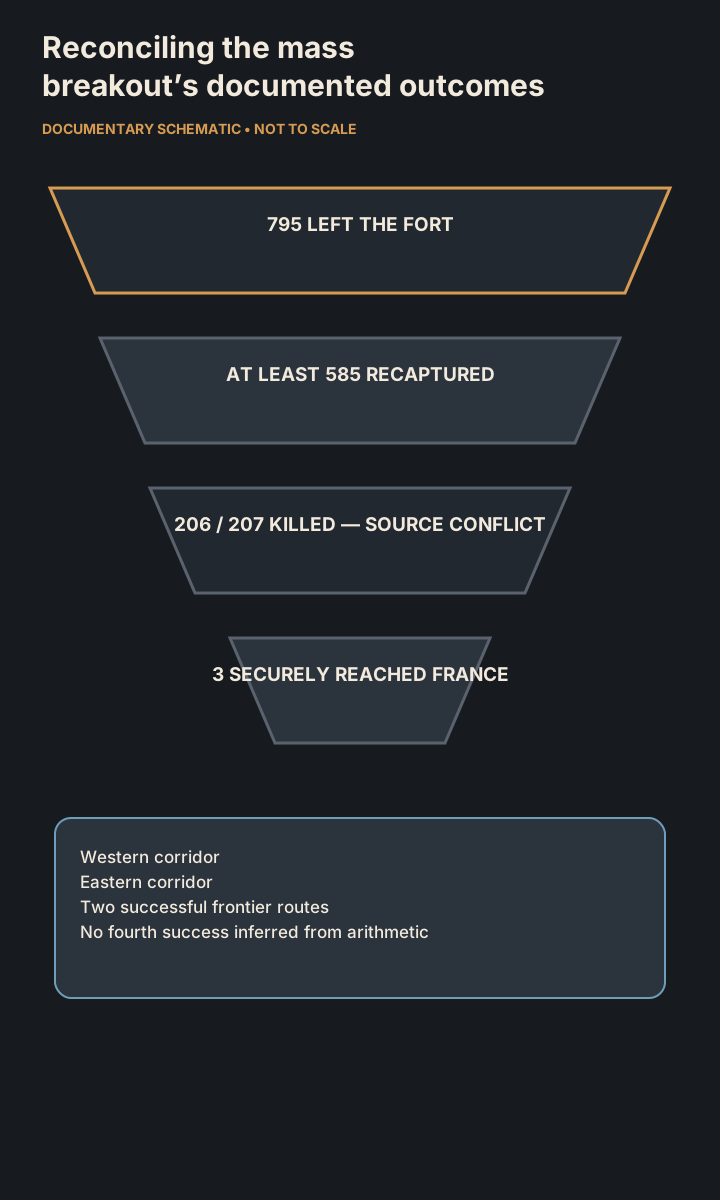
Simplified documentary reconstruction; not to scale. Evidence qualifications are written directly into the visual and explained in the adjacent text.
Evidence discipline
What the record supports
Status labels distinguish secure conclusions from uncertainty and rejected claims. Color is never the only signal.
MYTH
All 795 prisoners had helped plan the escape.
The operation was developed by a small organizing group. Specialist testimony indicates that many prisoners were surprised when doors were opened and had to decide on the spot whether to flee.
Sources: SRC-001, SRC-013, SRC-014DISPUTED
The exact number killed in the pursuit is 206 and is no longer disputed.
The Government of Navarre and Fermín Ezkieta's recent work generally use 206, while a UPNA study gives 207 and older educational or commemorative accounts have used other totals. Identification of remains and classification of deaths continue to affect the count.
Sources: SRC-005, SRC-010, SRC-011, SRC-013DISPUTED
Exactly 585 were recaptured.
585 is the standard reconstructed figure, but the 2026 BOE deliberately says 'at least 585.' Treating it as an absolutely closed exact total is stronger than the current state source warrants.
Sources: SRC-001, SRC-010, SRC-013MYTH
Four prisoners definitely reached France.
Three men are securely documented. A possible fourth emerged from later oral testimony but has not been identified and corroborated strongly enough to raise the confirmed total.
Sources: SRC-003, SRC-006, SRC-007, SRC-018MYTH
The three confirmed successful fugitives followed one shared route.
Jovino Fernández reached Urepel on a western route. Valentín Lorenzo and José Marinero reached the frontier in the Valcarlos/Luzaide area. The modern GR 225 memorial route principally follows Jovino's reconstructed journey and is not a map of all 795 escapees.
Sources: SRC-003, SRC-016, SRC-017MYTH
An organized external network was waiting to guide the 795 prisoners to France.
Rebel authorities investigated possible outside assistance, but specialist archival research has found no evidence of a prearranged external rescue organization supporting the mass breakout.
Sources: SRC-015MYTH
All prisoners knew how to reach France once they left the fort.
Many inmates had been transported from other regions under guard and had little knowledge of northern Navarre. A small number who had worked outside or knew the region had an advantage, but the mass rapidly dispersed.
Sources: SRC-013DISPUTED
The fourteen men condemned as leaders were executed on an uncontested date.
Spain's 2026 BOE declaration gives 8 September 1938. UPNA's archival database records Baltasar Rabanillo's execution on 8 August 1938, and Fermín Ezkieta's reconstruction also gives August 8 for the group. The conflict should remain visible pending further archival reconciliation.
Sources: SRC-001, SRC-009, SRC-014MYTH
The Fort of San Cristóbal was built as a prison.
It was constructed between 1878 and 1919 as a military fortification and only later converted to prison use.
Sources: SRC-001MYTH
The breakout was one unified march north under organizer control.
The initial seizure of the prison had organization, but once hundreds left the walls the escape fragmented rapidly into many groups moving with uneven information and no single operational command.
Sources: SRC-013, SRC-015MYTH
The consequences ended when prisoners were recaptured.
Fourteen alleged organizers were later executed, and specialist research identifies forty-five recaptured escapees who subsequently died in the fort between 1938 and 1943.
Sources: SRC-001, SRC-014, SRC-019MYTH
The arithmetic of 585 recaptured, 206 killed and three in France proves a fourth survivor.
Those figures come from reconstructed categories with different degrees of certainty; the BOE says at least 585 recaptured, and the death count itself varies. A one-person arithmetic remainder cannot establish an undocumented fourth border crossing.
Sources: SRC-001, SRC-005, SRC-010, SRC-018