
Bob Hoover had escaped the prison camp. Now he had a different problem.
He was sitting in a German Focke-Wulf Fw 190, flying west toward Allied territory in the final days of the Second World War. The fighter still looked German. Hoover had no normal mission briefing, no familiar cockpit routine, and no reason to expect an Allied pilot to know that the man inside the enemy aircraft was an American POW trying to get home.
Years later, Hoover would laugh at the decision. At an EAA gathering in 2016, he remembered thinking after takeoff that he might be the dumbest aviator alive.
It was an extraordinary ending to more than a year in German captivity.
It is also a story whose best-known details came largely from Hoover himself. Major aviation institutions accept the central episode: he escaped Stalag Luft I, obtained an Fw 190 and flew to Holland. The precise date, the exact airfield, the identity of the aircraft and parts of the ground escape are much less certain.
That distinction makes the real story better, not weaker.
From Spitfire Pilot to POW
Hoover entered captivity on 9 February 1944.
He had fought hard to get into combat at all. Before joining an operational fighter unit, his skill with unfamiliar aircraft had kept him useful as a test and acceptance pilot in North Africa. Eventually he joined the Spitfire-equipped 52nd Fighter Group.
Off the coast of southern France, his luck ended.
His Spitfire was hit during a fight with German Fw 190s. Hoover bailed out and spent hours in the water before German forces picked him up.
Later summaries disagree over whether the shootdown came on his 58th or 59th combat mission. That small numerical conflict is less important than what followed: the experienced pilot became a prisoner.
He eventually reached Stalag Luft I, outside the Baltic town of Barth in Western Pomerania.
By 1945 it held thousands of Allied airmen, most of them Americans. As the Red Army pushed west, the camp became crowded with prisoners transferred from other sites. News filtered through clandestine radios and camp newspapers. The prisoners knew Germany was collapsing.
They did not know exactly what the Germans would do with them before it did.
Hoover Was Not a Patient Prisoner
Hoover later described repeated attempts to escape during captivity.
The exact count changes among retellings. Some put it around fifteen; others say more than twenty. There is no reason to manufacture a precise number.
The important point is that escape was not a sudden thought that appeared in April 1945. He had tried before.
Late-war conditions finally changed the odds. The German system around Stalag Luft I was weakening. Soviet artillery could be heard in the distance. Security restrictions relaxed. Camp leadership was negotiating what would happen when the German guards could no longer hold the site.
The formal history is fairly clear about the end: on the night of 30 April to 1 May, the German camp staff withdrew and Allied prisoners took control. Soviet forces entered the Barth area immediately afterward.
Hoover’s personal chronology is less exact.
His autobiography and many institutional biographies say he escaped in April, apparently shortly before that final handover. In later interviews he sometimes minimized the feat by saying the guards were already deserting.
Those versions are not necessarily impossible to reconcile. German control could be collapsing before the formal withdrawal.
But they do mean that the article cannot responsibly put one exact date on Hoover’s departure.

The Fence
The most familiar version begins with a distraction. Hoover later said that other prisoners staged a fight, drawing the attention of guards while he and one or more companions crossed the perimeter. Later writers add a plank used to bridge or straddle wire.
The scene is plausible, and it has been repeated often enough to become part of Hoover’s established escape narrative. But it is still a later recollection rather than a surviving German guard report.
The broad sequence is clear. In late April, as German control weakened, Hoover and companions got out of Stalag Luft I and moved away from Barth. They were free of the camp. They were not yet safely back with the Western Allies.
Germany in Collapse
Hoover’s later accounts describe a countryside in disorder.
Military formations, forced laborers, civilians and refugees were all moving as Soviet forces approached. Some German civilians were more concerned with surviving the end of the war than with returning escaped American airmen to a collapsing state.
In one version, Hoover and his companions were fed by a woman who also gave them a handgun. Other retellings add bicycles.
These details fit the chaos of the moment, but they are not independently documented well enough to become hard structural facts. The sequence that matters is where the men eventually arrived. An airfield. And aircraft.
Finding the Fw 190
The Focke-Wulf Fw 190 was not an arbitrary airplane in Hoover’s story. It was one of Germany’s principal single-engine combat aircraft—and the same general fighter type he had faced when his Spitfire was shot down.
Hoover later described an airfield holding numerous damaged or abandoned German aircraft. Among them, he found an Fw 190 that appeared capable of flight and had fuel.
Major aviation institutions—including the Smithsonian National Air and Space Museum—accept that Hoover commandeered an Fw 190 for the final stage of his escape. What those institutional summaries do not establish is the aircraft’s exact identity. There is no safely sourced subtype here. No serial number.
No particular Luftwaffe unit. No exact damage report.
Even the departure airfield should be treated with caution. Stalag Luft I stood close to the Barth aviation complex, and German units still used Barth in the final days of April. That makes a Barth-area field highly plausible. It does not prove the exact runway or dispersal site used by Hoover.
The Mechanic
A dramatic later version adds one more person.
According to Hoover’s recollection as reported by the Washington Post, a German aircraft mechanic approached while Hoover and a companion were examining the airplane. Hoover’s companion had the pistol.
They compelled the mechanic to get the Fw 190 started.
Once the engine was running, a new problem became obvious. The Fw 190 was a single-seat fighter.
Hoover’s companion did not want to fly in it anyway. He continued by land. Hoover took the aircraft.
This may be exactly what happened. The Fw 190 flight is corroborated by Hoover’s autobiography, repeated firsthand retellings and major aviation institutions; the gunpoint-mechanic scene rests much more narrowly on later memory.
The two claims should not carry identical certainty.
First Flight in an Enemy Fighter
Hoover’s extraordinary advantage was not that he already knew the Fw 190. It was that he had spent years learning how to understand unfamiliar airplanes quickly.
Before combat he had test-flown and checked many aircraft types in North Africa. Later, that same ability would make him one of America’s most respected test pilots.
In April 1945 it gave him a chance to get an unfamiliar German fighter airborne. Then came the frightening part. The aircraft’s markings were still German. Hoover was heading directly toward the side of the front where Allied fighters were operating.
If one of them saw an Fw 190 and attacked before Hoover could communicate, the escape could end with friendly fire.
At EAA in 2016, Hoover said he stayed close beneath an overcast at roughly 4,000 feet. If Allied fighters appeared, his plan was to disappear into the cloud.
He headed west.
Navigation by the Landscape
Hoover did not have the navigation support of a normal combat flight. His later telling reduced the problem to one visible sign. Windmills. He knew the Netherlands had been substantially liberated, and he intended to continue west until the landscape convinced him he had reached friendly territory.
The detail has become one of the most famous parts of the story because it is so simple: a fighter pilot in an enemy airplane looking for windmills to tell him he had crossed from danger toward safety. Again, the source is Hoover.
There is no need to make it more precise by drawing a confident line across a map. The exact route is not established. The broad direction is.
West from northern Germany. Into the Netherlands.
Fuel Near Zero
By the time Hoover believed he was safely over Holland, the Fw 190 was running out of fuel. He chose an open field.
Some biographies call what happened next a crash landing. Hoover’s own detailed version was more deliberate.
He said he lowered the landing gear and touched down normally enough, then saw a ditch ahead. An aircraft hitting that obstacle on its wheels could flip over. Hoover did not want to be trapped upside down in a Luftwaffe fighter while Allied soldiers tried to determine who he was.
So, according to his EAA account, he retracted the landing gear during the rollout. The airplane settled and stopped short. It was not a conventional runway landing. But neither was it simply a loss of control.
The Pitchfork Problem
Hoover was alive, in Allied-held territory, and no longer airborne. He still looked like a German pilot who had just landed a German fighter. His repeated retelling says Dutch farmers appeared with pitchforks. They did not speak enough English to solve the misunderstanding quickly.
Then a British Army vehicle arrived. Hoover identified himself as an American. The soldiers got him out of the situation.
The pitchfork story is memorable, but like the windmills and the mechanic, it is primarily part of Hoover’s later testimony. It should be enjoyed as recollection, not disguised as a contemporary field report.
The historical outcome is secure enough without it. Hoover had reached the Western Allies.
Was It Really a “Great Escape”?
Hoover himself resisted that label.
Later in life he emphasized how weak German control had become. In one interview he said people made the episode sound like a great escape when the guards had essentially deserted.
That humility creates a useful historical correction. The feat was not comparable to escaping Stalag Luft I at the height of German power.
By late April 1945, the Third Reich was collapsing. The Red Army was approaching Barth. German guards were preparing to abandon the camp. Aircraft and military infrastructure were being left behind.
That context made Hoover’s escape possible. It does not make his decision ordinary. Even in a collapsing state, he still had to get away from the camp, survive on the ground, identify a usable airplane, get an unfamiliar Fw 190 into the air, navigate toward Allied territory, avoid being shot down by the side he was trying to reach, and land with almost no fuel.
The context reduced some risks. It created others.
Why It Worked
Hoover’s escape succeeded because his particular skill matched the opportunity the collapsing German system presented. For another prisoner, finding an Fw 190 might have meant finding an impressive but useless machine. For Hoover it was transportation. His prewar flying, military test work and experience moving between aircraft types gave him the confidence to use it without a formal checkout.
The German collapse supplied the opening. The Fw 190 supplied the range and speed. Cloud cover reduced the danger of identification. Visual navigation gave him a direction.
And once he reached friendly territory, he stopped rather than gambling on the last fuel in the tank. The most famous version of the story sounds almost impossible: an American POW steals a German fighter and flies home. The evidence supports that core. The responsible reconstruction simply refuses to pretend we know every fence, field, mechanic and minute along the way.
Escape reconstruction
How the escape unfolded
An evidence-aware sequence of the principal stages.
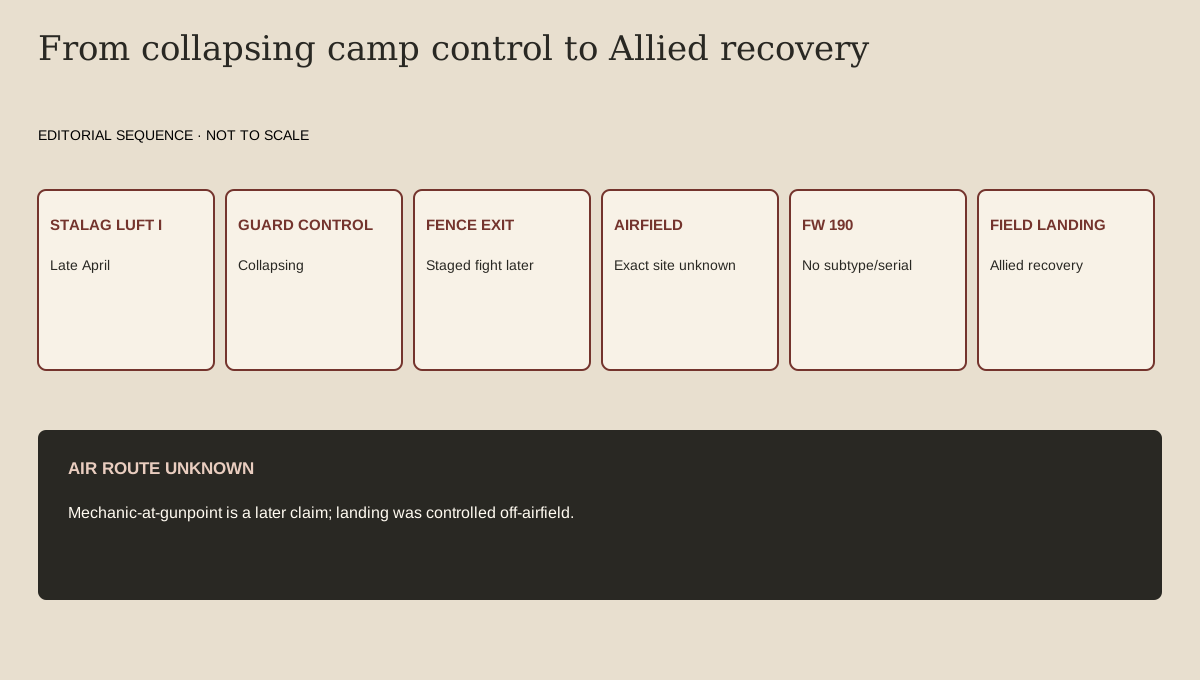
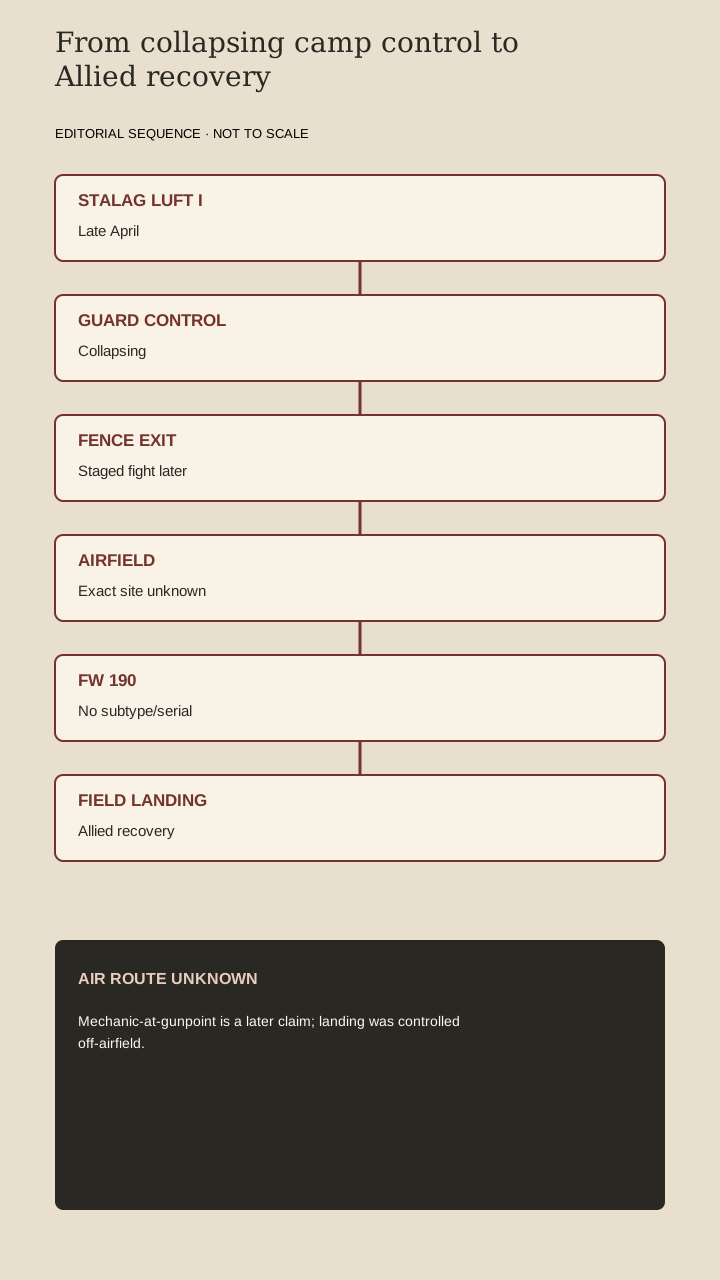
Simplified editorial reconstruction; not to scale. See adjacent text for evidence qualifications and unresolved details.
Material evidence
Tools of Escape
The objects used in an escape reveal how a plan worked under constraint.
- 01Decisive transport
Focke-Wulf Fw 190
The German single-seat fighter became the decisive transportation for the final stage of Hoover’s escape. The exact variant and serial number are not established here.
- 02Later-recollected coercion
Pistol
Hoover later recalled that he and his companion had acquired a handgun and used it to compel a German mechanic to start the aircraft.
Problem → response
Escape was a sequence of problems
Each response solved a practical obstacle while often creating the next one.
- 01→
Obstacle
POW camp perimeter
Hoover first had to leave Stalag Luft I despite fencing and remaining German guard presence during the camp’s late-war breakdown.
Response
His later narrative describes a prisoner-created distraction and a rapid crossing of the perimeter while guards were occupied.
- 02→
Obstacle
Unfamiliar enemy aircraft
The Fw 190 was not Hoover’s normal aircraft and its German markings created a new danger once he was airborne.
Response
Hoover relied on broad flying experience and visual navigation, staying close to cloud cover and heading west toward Allied-controlled territory.
- 03→
Obstacle
Risk of friendly fire
An Allied pilot encountering a Luftwaffe-marked Fw 190 could reasonably treat it as hostile.
Response
Hoover later said he flew beneath an overcast and intended to climb into cloud if Allied aircraft appeared.
- 04→
Obstacle
Low fuel and uncertain landing area
By the time Hoover recognized friendly Holland, his fuel indication was close to empty.
Response
He selected an open field rather than trying to continue to an airfield and used the landing gear to manage the touchdown before retracting it when a ditch threatened the rollout.
The final accounting
Outcome
Escaped German POW custody
Hoover left Stalag Luft I during the final collapse of German control in late April 1945.
Reached Allied-held Netherlands
He flew a German Fw 190 west and landed in territory held by the Western Allies.
Returned to Allied service
Hoover survived the war and soon entered the test-pilot career for which he became internationally known.
Evidence discipline
What the record supports
Status labels distinguish secure conclusions from uncertainty and rejected claims. Color is never the only signal.
WELL-SUPPORTED
Bob Hoover escaped Stalag Luft I and flew a German Focke-Wulf Fw 190 to the Netherlands.
The episode is described in Hoover’s autobiography and repeated first-person accounts and is accepted by the Smithsonian National Air and Space Museum, San Diego Air & Space Museum, and other major aviation institutions. However, the available source base does not provide an identified German aircraft record or Allied recovery report for the specific airframe.
Sources: SRC-001, SRC-002, SRC-003, SRC-009UNKNOWN
Hoover escaped on a precisely known date in April 1945.
Institutional biographies generally say April or late April. Stalag Luft I histories document the organized German guard withdrawal on 30 April, while Hoover’s retellings sometimes imply he left several days before Allied/Soviet arrival. No exact date is secure enough to manufacture.
Sources: SRC-002, SRC-005, SRC-006, SRC-007MYTH
The escape occurred from a fully functioning, tightly guarded camp exactly as if it were earlier in the war.
The late-April camp was in breakdown as Soviet forces approached. Hoover later minimized the drama and said guards had deserted or control was collapsing. Camp histories show an organized final guard withdrawal on 30 April, so the safest account is an escape during rapidly weakening German control.
Sources: SRC-005, SRC-006, SRC-007UNKNOWN
The precise Fw 190 variant, serial number, and departure airfield are known.
Reliable institutional sources identify only a Focke-Wulf Fw 190. The Barth area had an active military airfield and late-war Luftwaffe movements, but the sources used here do not securely identify Hoover’s specific airframe or prove the exact strip from which he departed.
Sources: SRC-003, SRC-009, SRC-011LATER CLAIM
A German mechanic was forced at gunpoint to start the Fw 190.
This detail appears in Hoover’s later recollections as reported by the Washington Post and related retellings, but it lacks independent corroboration in the institutional sources used here.
Sources: SRC-007MYTH
Hoover simply crash-landed because he could not control the unfamiliar Fw 190.
Hoover’s own 2016 account describes a deliberate field landing with fuel nearly gone. He said he retracted the gear during rollout to stop before a ditch, which is different from losing control of the airplane.
Sources: SRC-002LATER CLAIM
Hoover’s famous windmills and pitchforks ending is independently documented in contemporary 1945 records.
The story is consistent across Hoover’s later public tellings: windmills identified Holland, Dutch farmers confronted the apparent German pilot, and British troops intervened. It remains primarily Hoover’s recollection rather than a contemporaneous operational report.
Sources: SRC-002, SRC-007Selected chronology
Selected chronology
Shot down and captured
Hoover’s Spitfire was shot down off southern France. After hours in the water he was picked up by German forces and became a prisoner of war.
Imprisoned at Stalag Luft I
Hoover spent most of the remainder of the war at Stalag Luft I in Barth. Later accounts describe numerous unsuccessful escape attempts before the final one.
Hoover leaves the camp
The commonly accepted Hoover narrative places his departure from Stalag Luft I in late April, amid weakening German control. No exact day is secure enough for publication.
Fw 190 flight to the Netherlands
Hoover found and flew a German Focke-Wulf Fw 190 west to Allied-held Holland, where he made an off-airfield landing.
German guards leave Stalag Luft I
Camp histories record the organized German withdrawal and transfer of control to the Allied prisoners at the end of April. This anchors the broader chronology but does not by itself establish the precise day Hoover left.
Operation Revival evacuates the remaining POWs
The Eighth Air Force evacuated thousands of former Stalag Luft I prisoners by air after the camp’s liberation.