
On 8 February 1945, ten Soviet prisoners at the Peenemünde military complex on the Baltic island of Usedom killed their guard, seized a German Heinkel He 111, and tried to fly across the front line to Soviet-held territory. Only one of them knew how to fly.
Mikhail Petrovich Devyataev, a captured Soviet fighter pilot, had never been trained on the Heinkel. He had no German aircrew beside him, no authorized flight plan, and no safe way to ask how the unfamiliar controls worked. The other nine men had to turn a prison escape into an improvised aircrew while German personnel were still on the airfield.
The aircraft eventually lifted off. After a hazardous flight and fire from the Soviet side, the Heinkel made a forced landing in Soviet-held territory. All ten men had escaped Nazi captivity.
The basic event is exceptionally well supported. A surviving Ravensbrück camp register records Devyataev and notes his escape on 8 February. The Ravensbrück Memorial identifies the ten men as prisoners of Karlshagen I, a Ravensbrück satellite camp, and confirms that they killed a guard and escaped in a Heinkel He 111. A 2002 German radio documentary preserved recollections from Devyataev and German witnesses who had been at Peenemünde.
But the story was later wrapped in a second story: that Devyataev deliberately stole a secret V-2 command aircraft, delivered decisive rocket intelligence, and carried out something close to a planned sabotage mission. That version goes beyond the strongest evidence. The escape was extraordinary enough without it.
A Fighter Pilot Disappears Behind German Lines
Devyataev was not an amateur who happened to find an airplane.
Born in 1917, he trained as a military pilot before the German-Soviet war and became an experienced Soviet aviator. By 1944 he was serving with the 104th Guards Fighter Aviation Regiment. Russian institutional biographical sources date his final combat flight before capture to 13 July 1944, when his P-39 Airacobra was shot down during fighting in the Lviv region.
The Ravensbrück Memorial gives the capture more generally as June 1944. Because the more detailed Russian institutional chronology specifies 13 July and identifies his unit and aircraft, this article uses 13 July 1944 while preserving the discrepancy in the research notes rather than pretending the sources are identical.
Captured airmen presented a particular problem for the Nazi system. They had military skills, and Soviet prisoners of war were treated with extreme brutality. Devyataev was moved through prisoner-of-war captivity and, after an unsuccessful escape attempt, transferred to Sachsenhausen concentration camp.
At Sachsenhausen, according to the Ravensbrück Memorial, he was registered as a foreign civilian worker even though he was in fact a prisoner of war. Later Soviet and Russian accounts say he survived under the identity of another prisoner, Grigory Nikitenko. The identity-switch story is important to Devyataev’s postwar narrative, but its finer details come primarily from later recollections and commemorative biographies.
In mid-October 1944 the SS transferred him to Karlshagen I on Usedom. That name matters.
Popular English-language retellings often describe Devyataev escaping from “Peenemünde concentration camp.” There was no independent concentration camp by that formal name. Karlshagen I and Karlshagen II were satellite camps of Ravensbrück, established within the Peenemünde military complex. In 2026, the government of Mecklenburg-Vorpommern described Karlshagen I as one of two Ravensbrück satellite camps connected with the Luftwaffe installation and noted that roughly 2,000 prisoners had been deported there from 1943.
The prisoners were not simply confined beside a secret weapons center. They were forced to labor for it.
Peenemünde: Technology Built Around Coercion
Peenemünde was one of Nazi Germany’s most important military research sites. The army development center and Luftwaffe testing establishment worked on weapons that included the A4 rocket, later known as the V-2, and other experimental systems.
The technological achievement cannot be separated from forced labor.
Arolsen Archives holdings preserve transport and death records for the Karlshagen subcamp system. The modern Peenemünde memorial landscape explicitly incorporates the concentration-camp sites into its interpretation of the military complex. The German Federal Archives likewise documents Peenemünde’s role in the development and testing of the V-2.
Devyataev and other prisoners worked on or around the airfield. This gave them something a conventional prison escape rarely offers: repeated exposure to the machinery of the captor.
A plane offered freedom only if someone could make it move.
Devyataev could fly Soviet fighters. That did not mean he automatically knew a German twin-engine bomber. He therefore watched.
His postwar recollections describe studying damaged aircraft, collecting German cockpit labels, observing how crews started engines, and trying to reconstruct the sequence of controls in his head. The Alexander Pechersky Foundation’s Devyataev research project preserves this tradition and describes prisoners watching fueling, guard changes, crew routines, and which aircraft seemed most suitable.
These details are plausible and consistent with the successful escape, but much of the preparation sequence comes from later testimony rather than a surviving February 1945 planning document. The distinction matters because the success of the escape later encouraged storytellers to make the preparation look more complete than it probably was. Devyataev did not secretly train on the Heinkel.
He watched enough to try.
Escape sequence
From forced labor to a cross-front flight
The sequence explains the escape without inventing an exact flight track or documentary cockpit procedure.
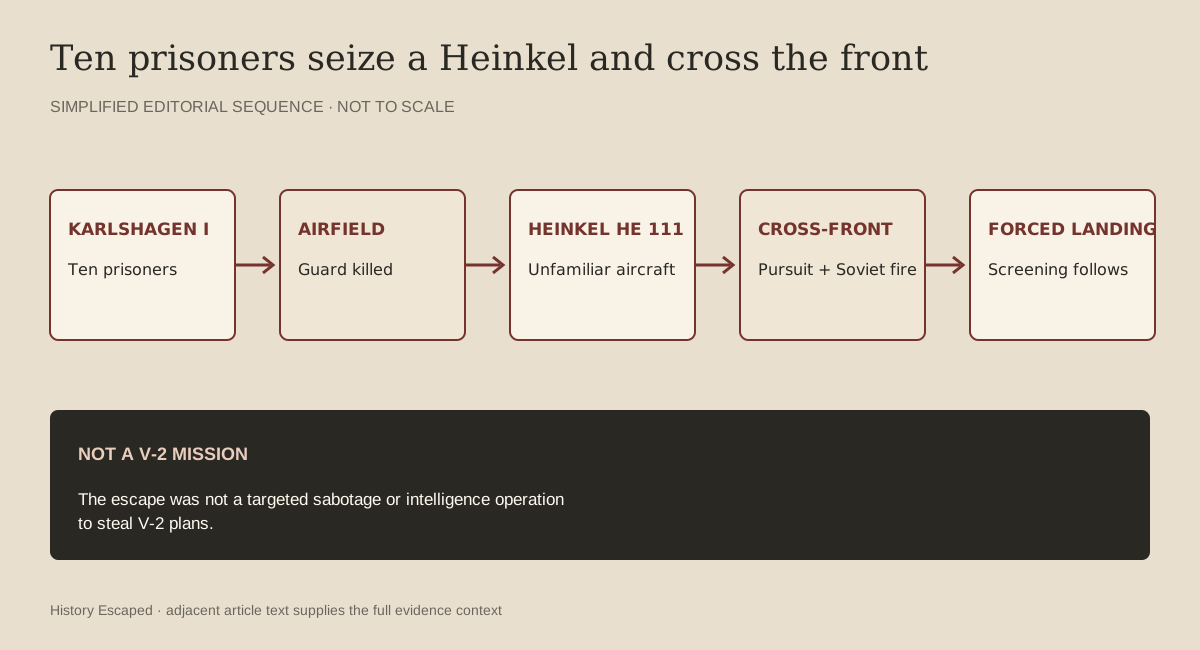
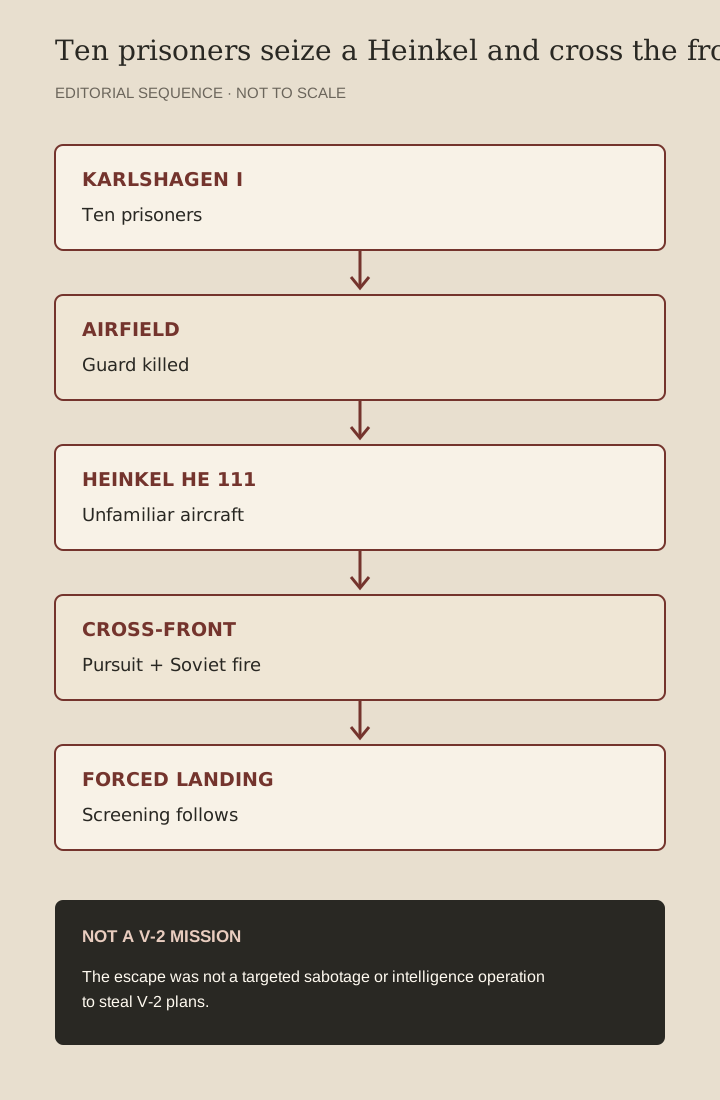
- 01
Karlshagen I
Ten prisoners prepared within a concentration-camp forced-labor satellite.
- 02
Airfield
They used observation of routines, killed a guard and reached an aircraft.
- 03
Heinkel
Devyataev improvised the takeoff in an unfamiliar Heinkel He 111.
- 04
Cross-front flight
German pursuit and Soviet fire both shaped the broad flight to Soviet territory.
- 05
Screening
A forced landing led into detention and investigation rather than instant hero status.
Not to scale. Exact flight path, landing point and several cockpit details remain uncertain.
Ten Prisoners, Not One
The escape is usually named after Devyataev because he was the pilot. It was not a solo action.
The ten men were: Mikhail Devyataev, Ivan Krivonogov, Vladimir Sokolov, Vladimir Nemchenko, Fyodor Adamov, Ivan Oleinik, Mikhail Yemets, Pyotr Kutergin, Nikolai Urbanovich, and Timofey Serdyukov.
The Alexander Pechersky Foundation’s research project has assembled biographical and archival material on the nine men who flew with Devyataev. Their backgrounds differed sharply. Some were Red Army servicemen; some had been deported into German-controlled labor; several had already attempted escape.
Ivan Krivonogov had been a Red Army lieutenant and had a history of escape planning before reaching Usedom. Vladimir Sokolov knew German and, according to the foundation project, helped Devyataev interpret labels collected from wrecked aircraft. Vladimir Nemchenko had lost an eye after an earlier escape attempt. Fyodor Adamov had passed through Auschwitz and Buchenwald before arriving at Peenemünde.
Mikhail Yemets had served as a political officer and partisan. The others brought their own experience of captivity and resistance.
Postwar fame condensed these ten lives into a phrase such as “Devyataev’s crew.” For publication, the group should be named. Devyataev’s piloting was decisive, but there would have been no aircraft to pilot without a coordinated seizure.
8 February 1945
The strongest institutional reconstruction establishes the core sequence without requiring cinematic additions.
On 8 February 1945, the group was at the Peenemünde airfield under guard. They killed the guard and moved toward a Heinkel He 111.
Later recollections add detail. Krivonogov is commonly identified as the man who struck the guard, after which one prisoner used the dead guard’s uniform to make the group look less suspicious from a distance. The men then entered the chosen aircraft.
Deutschlandradio’s 2002 documentary is especially valuable because it included not only Devyataev but German witnesses. One witness remembered watching a Heinkel make an obviously abnormal takeoff attempt at Peenemünde. The aircraft did not immediately climb properly; the procedure looked strange enough that the Germans watching it recognized something was wrong even before they knew who was flying.
Later accounts say the aircraft’s battery was missing and had to be found or connected before the engines could be started. They also describe the cockpit as a problem Devyataev had to solve under intense time pressure.
The evidence supports this sequence: The prisoners neutralized their guard, reached the aircraft, got inside, overcame startup problems, started the engines, taxied out, and attempted to take off before the airfield could stop them. The exact minute-by-minute order of every switch, battery connection, disguise move, and shouted instruction belongs largely to later recollection.

The Heinkel Problem
The Heinkel He 111 was a twin-engine aircraft designed before the war and used extensively by the Luftwaffe as a bomber and in other roles. The type’s cockpit, engine controls, procedures, and handling were substantially different from the single-engine Soviet fighters Devyataev knew.
Later Russian institutional sources usually call the stolen aircraft a He 111 H-22. The H-22 designation is plausible in the Peenemünde context because that variant was associated with air-launching the Fieseler Fi 103/V-1 flying bomb. The Tatarstan Museum-Memorial likewise identifies the aircraft as an H-22.
The German memorial sources are more conservative. They establish a Heinkel He 111 but do not, in the accessible material, independently prove the H-22 subtype or a surviving Werknummer.
That is why the subtype should not be treated as equivalent in certainty to the aircraft family itself.
The aircraft is also frequently called “Gustav-Anton.” A German 2002 witness account uses that name for the stolen Heinkel. It is useful evidence for how the aircraft was referred to locally, but readers should not be told that the letters themselves prove a particular secret V-2 role.
The deeper problem was simpler: Devyataev had to make an unfamiliar German bomber fly.
Accounts agree that the first takeoff was rough. The German witness interviewed by Deutschlandradio remembered the aircraft repeatedly failing to climb cleanly before finally getting airborne.
Later Devyataev narratives describe the control column as extremely heavy because a trim setting had been left in a position suitable for another phase of flight. They say the exhausted prisoners had to help him pull. That detail is memorable and technically plausible, but it should remain attributed to the memoir tradition rather than promoted to documentary certainty.
The core fact needs no embellishment. A starving concentration-camp prisoner who had never flown the type successfully took a German twin-engine aircraft off a German military test airfield with nine other escaped prisoners aboard.
A Pursuit, but Not the Movie Version
German personnel rapidly understood that an aircraft had been stolen.
Later retellings sometimes create a long aerial chase involving multiple named aces. The evidence is better for a narrower claim.
The Ravensbrück Memorial records that, decades later, Devyataev met Günter Hobohm, identified as the pilot of a Junkers Ju 88 that had pursued the fugitives in February 1945. The 2002 German feature also treats German pursuit as part of the eyewitness record.
That supports a real pursuit. It does not require every later story about exactly who saw the Heinkel, who had ammunition, how many interception attempts were made, or how close each aircraft came.
The escapees’ larger advantage was confusion. A German Heinkel in German markings did not automatically look like an escaped-prisoner aircraft from every direction. The farther they moved from Peenemünde, the harder it became for ground units and pilots to know what they were seeing.
Eventually the danger reversed. They were approaching Soviet forces in a German bomber.
Fired on by the Side They Were Trying to Reach
The Soviet front line presented the final contradiction of the escape. To German forces, the Heinkel was stolen. To Soviet anti-aircraft crews, it looked German because it was German.
Russian institutional biographies state that Soviet guns fired on the aircraft near the front and that Devyataev then made a forced landing in Soviet-held territory. The Ravensbrück Memorial independently confirms the forced landing and the group’s subsequent detention by Soviet counter-intelligence.
Some commemorative sources place the landing near the former German town of Woldenberg or farther north near villages whose modern identification varies across retellings. Because accessible sources do not cleanly converge on a single precise landing coordinate, this case should not publish a pin-point route map.
All ten men survived the escape flight. Freedom, however, did not mean immediate trust.
From German Captivity to Soviet Screening
The Soviet state treated returning prisoners of war with suspicion. Devyataev and his companions had crossed the front in a captured enemy aircraft after months or years under German control. Soviet counter-intelligence therefore investigated them.
The Ravensbrück Memorial states that the entire group was arrested on suspicion of collaboration after their forced landing. It further notes that Devyataev remained under investigation until September 1945 and then returned to Kazan.
A 2025 exhibition at the Museum-Memorial of the Great Patriotic War in Tatarstan displayed material from Devyataev’s FSB filtration file, no. F-30885, including SMERSH certificates, interrogation protocols, and conclusions. The existence of that file gives the post-escape investigation a much firmer documentary basis than later legends about either instant celebration or instant condemnation.
The nine other men did not all share Devyataev’s exact postwar path.
The Pechersky Foundation’s archival project records that seven members of the group—Sokolov, Kutergin, Urbanovich, Serdyukov, Oleinik, Adamov, and Nemchenko—were sent back to the front after screening. Several were killed in the final weeks of the war. Devyataev, Krivonogov, and Yemets, the officers in the group, remained outside combat while their status and ranks were investigated.
That aftermath gives the escape a harsher ending than a simple “flew to freedom” headline suggests. The men escaped one system of captivity and entered a system of suspicion shaped by Stalinist attitudes toward former prisoners of war.

The V-2 Intelligence Story
This is the point where memory, propaganda, and history most often blur.
Peenemünde was undeniably a major German rocket center. Devyataev undeniably escaped from its airfield. The captured Heinkel and the prisoners’ observations could have been of intelligence interest.
From those facts, later retellings built a much larger claim: that the escape was effectively a deliberate intelligence operation; that the aircraft was packed with unique V-2 control equipment; that Devyataev supplied exact launch-site coordinates that immediately enabled devastating Soviet attacks; and that his flight materially unlocked the postwar Soviet missile program. The Ravensbrück Memorial directly cautions against this. It states that Soviet and East German press later exaggerated the escape into a sabotage action intended to obtain V-2 launch plans, while Devyataev himself did not describe it as a targeted operation in his postwar recollections.
Even the Alexander Pechersky Foundation’s own commemorative research project—generally sympathetic to the heroic tradition—says claims about highly secret equipment aboard the Heinkel appear to have been greatly exaggerated. This does not mean Devyataev knew nothing useful.
He had worked at the site and later could describe what he had seen. Soviet specialists were intensely interested in German rocket technology after the war. There are also later accounts connecting him with Sergei Korolev and Soviet technical teams examining Peenemünde.
But the evidence does not support turning escape intelligence into a preplanned spy mission. The escape plan was aimed at getting out.
Evidence discipline
What the record supports
Status labels distinguish secure conclusions from uncertainty and rejected claims. Color is never the only signal.
DOCUMENTED
Ten Soviet prisoners escaped from Karlshagen I/Peenemünde on 8 February 1945 in a Heinkel He 111 piloted by Mikhail Devyataev.
Supported by Ravensbrück Memorial documentation, including a camp number-book entry noting Devyataev's escape, and by German eyewitness material.
Sources: SRC-001, SRC-002MYTH
The prisoners escaped from a concentration camp formally named 'Peenemünde concentration camp.'
The relevant camp was Karlshagen I, a satellite camp of Ravensbrück concentration camp within the Peenemünde military complex.
Sources: SRC-001, SRC-003, SRC-004WELL-SUPPORTED
The stolen aircraft was a Heinkel He 111 H-22.
Russian institutional and museum sources identify the H-22 subtype, while accessible German memorial sources confirm the He 111 family without independently establishing the subtype.
Sources: SRC-009, SRC-010MYTH
The escape was planned as a Soviet sabotage or intelligence mission to steal V-2 plans.
The Ravensbrück Memorial says Soviet and East German media later elevated the escape into such an operation, while Devyataev's own postwar recollections did not describe a targeted mission.
Sources: SRC-001DISPUTED
The Heinkel carried uniquely decisive secret V-2 control equipment.
This is repeated in commemorative literature, but even the Alexander Pechersky Foundation's research project says claims of highly secret onboard equipment appear greatly exaggerated. No accessible primary aircraft record was found in this pass.
Sources: SRC-008LATER CLAIM
Hitler personally declared Devyataev his enemy after the escape.
The claim appears in later commemorative sources, but this research pass found no contemporary German document establishing it.
Sources: SRC-006WELL-SUPPORTED
Günter Hobohm pursued the escaped Heinkel in a Ju 88.
The Ravensbrück Memorial identifies Hobohm as a pursuing Ju 88 pilot and records his later meeting with Devyataev.
Sources: SRC-001What the Legend Gets Wrong
“He escaped from Peenemünde concentration camp.”
Not quite.
Devyataev and the other prisoners were held at Karlshagen I, a satellite camp of Ravensbrück concentration camp, and forced to work at the Peenemünde military airfield. “Peenemünde camp” is a convenient shorthand but not the correct administrative identification.
“The ten men stole a V-2 command aircraft loaded with decisive secret equipment.”
Unproven and probably exaggerated.
The aircraft was a Heinkel He 111, commonly identified in later Russian sources as an H-22. Peenemünde was a rocket-testing center. But strong accessible evidence does not establish the popular picture of a uniquely equipped V-2 command aircraft whose onboard secrets transformed Soviet knowledge.
“The escape was a planned Soviet intelligence or sabotage mission.”
No.
The Ravensbrück Memorial specifically identifies this as a later Soviet and East German elevation of the story. Devyataev’s own postwar recollections did not describe the escape as a targeted mission to seize V-2 plans.
“Hitler personally declared Devyataev his enemy.”
This appears in later commemorative retellings, but this research pass did not locate a contemporary German document establishing such a declaration. It should not appear as fact.
“Devyataev simply jumped into a bomber and flew away.”
Also wrong. The escape depended on a ten-man group, prior observation of aircraft and airfield routines, the killing of a guard, gaining access to the Heinkel, solving startup and control problems, and surviving both German pursuit and Soviet anti-aircraft fire.
Problem → response
Escape was a sequence of problems
Each response solved a practical obstacle while often creating the next one.
- 01→
Obstacle
Concentration-camp imprisonment and forced labor
The group was held in a Ravensbrück satellite camp and worked under guard.
Response
The forced-labor assignment gave the group recurring access to the airfield environment, allowing observation of routines and aircraft before the escape.
- 02→
Obstacle
Unfamiliar aircraft
Devyataev was a fighter pilot but was not trained to operate the German Heinkel He 111.
Response
Devyataev combined his existing pilot training with observation of German aircraft procedures and assistance from the group to improvise the takeoff.
- 03→
Obstacle
German pursuit
At least one German pursuit aircraft is supported by memorial and eyewitness material.
Response
The fugitives continued in the German-marked Heinkel and evaded the pursuit long enough to reach the Soviet front; do not invent a precise chase sequence.
- 04→
Obstacle
Soviet anti-aircraft fire
Approaching Soviet lines in a German aircraft exposed the escapees to friendly fire.
Response
After being fired on near Soviet lines, the group survived the approach and made a forced landing in Soviet-held territory.
Why the Escape Worked
The escape succeeded because several vulnerabilities aligned. Devyataev had the one skill that could not be improvised after the seizure. Someone had to understand flight well enough to turn partial observation into action. The prisoners worked near the aircraft. Their forced labor gave them access to routines, equipment, and airfield geography that an isolated prisoner would never have had.
They acted as a group. One man could not realistically have controlled a guard, prepared the aircraft, dealt with startup trouble, watched for discovery, and assisted with the physical demands of the unfamiliar controls. German personnel initially saw a German aircraft doing something strange, not ten prisoners running across open country. The Heinkel became both the escape vehicle and, briefly, a disguise.
They accepted a plan with almost no safe fallback. Once the guard was killed and the aircraft was entered, the escapees were effectively committed. Failure on the runway would have meant recapture under circumstances that offered little realistic hope of survival.
That last point is important to the tone of the case.
This was not a clever aviation stunt performed in controlled conditions. It was a concentration-camp escape by men who understood that remaining in captivity could also kill them.
After Recognition Came Mythmaking
Devyataev returned to civilian life and worked in river transport in Kazan. In 1957, during the Khrushchev-era thaw, he was awarded the title Hero of the Soviet Union.
Recognition corrected one injustice while creating another historical problem.
Once the state celebrated him, the escape became useful as a heroic Soviet narrative. Details were simplified. The role of Peenemünde’s rockets grew larger. The flight could be presented not merely as prisoners saving themselves but as a strike against German secret weapons and a contribution to Soviet technological triumph.
The Ravensbrück Memorial’s interpretation is especially valuable because it preserves both sides of the story: Devyataev really did accomplish an extraordinary escape, and later political storytelling really did enlarge its strategic purpose. Those conclusions are not contradictory. The historical achievement remains remarkable when the propaganda is removed.
Ten prisoners seized a German bomber from one of Nazi Germany’s most sensitive military complexes. A pilot weakened by captivity taught himself enough about an unfamiliar aircraft to get it airborne. They crossed a wartime front and survived the landing.
That is the story worth preserving.
Selected chronology
Selected chronology
Devyataev is shot down and captured
Devyataev is shot down and captured in the Lviv-region fighting according to detailed Russian institutional chronology.
Transferred to Karlshagen I
The SS transfers Devyataev from Sachsenhausen to Karlshagen I on Usedom.
Ten prisoners seize the Heinkel
Devyataev and nine other prisoners kill a guard, seize a Heinkel He 111, and escape from Peenemünde.
Forced landing and Soviet screening
The aircraft force-lands in Soviet-held territory; the group is detained and screened by Soviet counter-intelligence.
Devyataev released from investigation
Devyataev is released from investigative detention and allowed to return to Kazan.
Hero of the Soviet Union
Devyataev receives the title Hero of the Soviet Union.