
Seven weeks after the Korean armistice, an aircraft that American pilots had spent years fighting suddenly appeared over one of their own air bases.
On the morning of 21 September 1953, a North Korean MiG-15bis came into Kimpo Air Base near Seoul from the north. It was not part of a raid. The pilot, 21-year-old Senior Lieutenant No Kum-sok, was defecting.
The arrival was dangerous precisely because almost no one at Kimpo expected it. U.S. and Australian accounts describe the MiG entering an active pattern used by F-86 Sabres and landing downwind, opposite the normal flow of traffic. The jet reached the ground intact. No surrendered and requested asylum. For the United States, the result was an extraordinary intelligence windfall: the first flyable MiG-15 it could systematically test.
The flight itself was short. Its preparation had been much longer.
A pilot with access to the border
No Kum-sok had flown for the North Korean Air Force during the Korean War. In his later memoir, he described his outward loyalty to the communist system as a survival strategy and said that he had wanted to get out for years. He first entered naval training, then aviation, in part because he believed military service might eventually give him a way to escape.
Those motives come largely from No's retrospective account, so they should not be treated like a contemporaneous diary. What is secure is that by September 1953 he was a trained MiG pilot with access to one of the most closely watched combat aircraft of the early Cold War.
That mattered because the MiG-15 had been a serious problem for United Nations air forces. Introduced into the Korean War in 1950, the Soviet-designed jet could climb rapidly, operate high, and carry heavy cannon armament. American intelligence had recovered wreckage and parts, but it still wanted an intact, flyable example for direct evaluation.
In April 1953, U.S. Far East Command tried to obtain one through a psychological operation later known as Operation Moolah. Enemy pilots were offered refuge and money for delivering a modern communist aircraft to South Korea. The published terms could total $100,000 for the first qualifying delivery.
No would eventually receive that money. Whether he knew about it before he defected is one of the central disputes in the story.
Flight sequence
A short flight whose motive remains contested
The diagram separates contemporary timing from later duration reports and from disputed claims about Operation Moolah’s causal role.
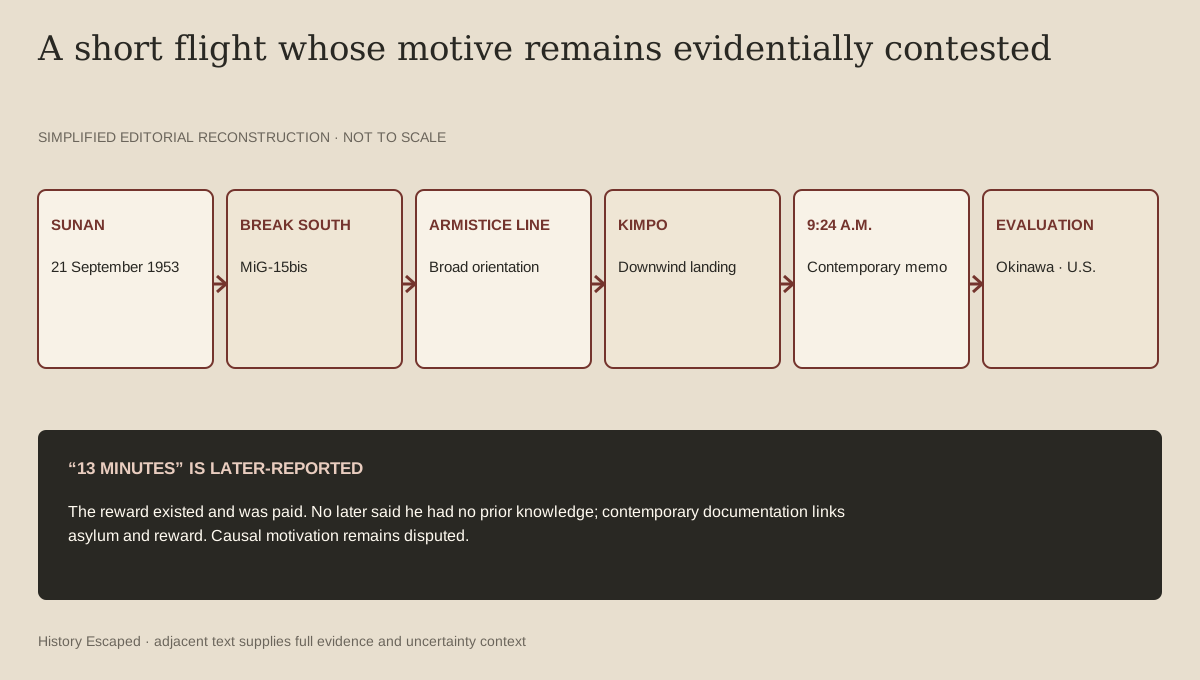
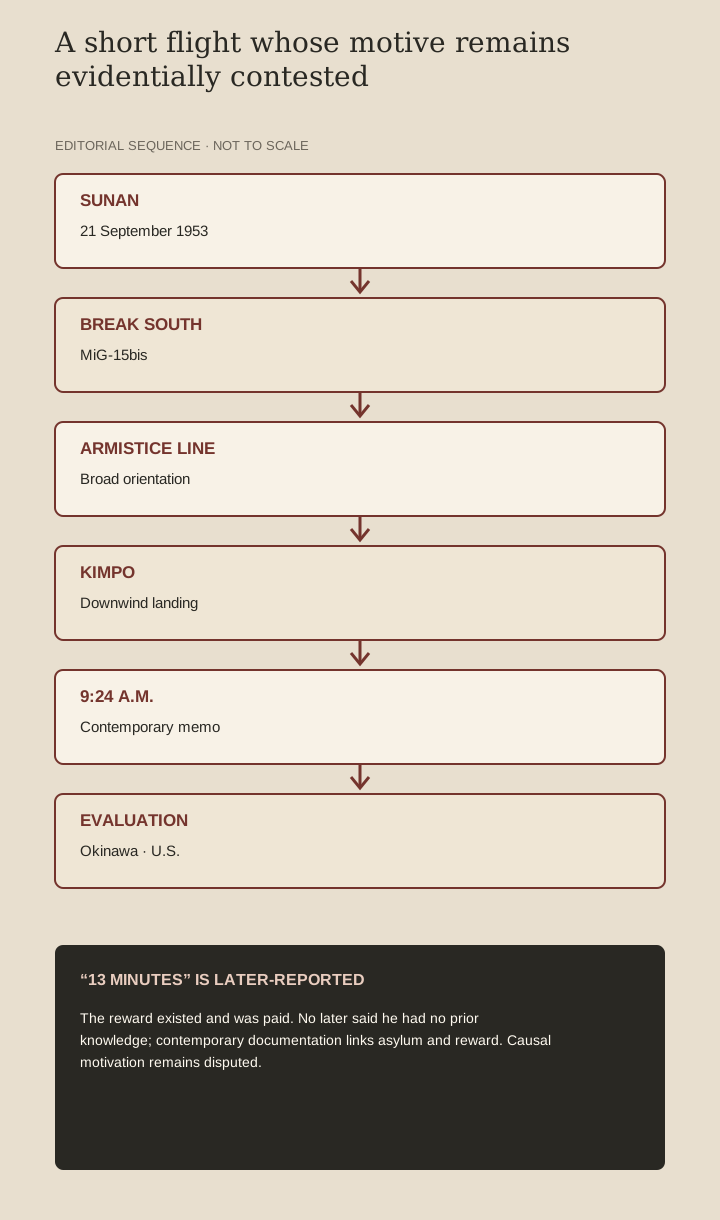
Simplified editorial sequence; not an exact flight track. Radar-maintenance, reprisal, and reward-motivation claims remain qualified.
The opportunity at Sunan
After the armistice of 27 July 1953, No's unit moved to Sunan Airfield near Pyongyang. U.S. Air Force historical accounts describe a group of newly delivered MiG-15s there and identify 21 September as the first proficiency flying from the field after the war.
No later said he had already studied the distance south and understood that the MiG could reach Kimpo. Accounts derived from his memoir add a more specific maneuver: because the first aircraft to take off might also be expected to land first, he arranged for another pilot to take the lead position. That would give him more time before his absence became obvious.
This detail is plausible and appears in Air Force histories, but its ultimate source is No's later recollection. The basic facts do not depend on it. No took off from Sunan with other North Korean aircraft. Near the end of the sortie, he broke away and headed south.
An official National Air and Space Intelligence Center history gives the flight from Sunan to Kimpo as about 13 minutes. That number is best treated as a later reported figure rather than a flight-log measurement unless a contemporaneous operational record is produced.
The risks were immediate. A North Korean pilot flying toward South Korea could be pursued by his own side. Once he crossed south, the same MiG could be engaged by United Nations fighters or anti-aircraft defenses that had every reason to treat an unidentified communist jet as hostile.
Later accounts say No benefited from an unusual piece of luck: a radar supporting the Kimpo area was temporarily down for routine maintenance. The Australian War Memorial and Air & Space Forces Magazine both repeat that detail. No contemporaneous maintenance log was identified in the sources reviewed for this case, so it should remain a qualified part of the reconstruction.
What is clear is that No reached Kimpo without being intercepted.
Problem → response
Escape was a sequence of problems
Each response solved a practical obstacle while often creating the next one.
- 01→
Obstacle
Detection or interception before reaching South Korea
A lone North Korean MiG crossing toward the Seoul area risked interception by North Korean forces, United Nations fighters, or ground defenses.
Response
No made the crossing quickly and reached Kimpo before Allied defenses intercepted him; later accounts also report that a radar was temporarily unavailable.
- 02→
Obstacle
Limited fuel and range
The newly delivered MiG-15bis aircraft at Sunan were described as lacking external fuel tanks, limiting endurance.
Response
No later said he had studied the distance and knew the aircraft's internal fuel was sufficient to reach Kimpo.
- 03→
Obstacle
Active F-86 traffic at Kimpo
Kimpo's runway and pattern were in use by U.S. F-86 Sabres when the MiG arrived.
Response
No landed downwind in the opposite direction of normal traffic, creating a hazardous but successful arrival.

The wrong-way landing
Kimpo was not empty.
F-86 Sabres were operating from the airfield when the MiG arrived. U.S. Air Force and Australian accounts describe No coming in downwind, against the normal direction of traffic. One account says the MiG and an F-86 came dangerously close while using the same runway from opposite directions.
The decision made sense only in the peculiar logic of the moment. No needed to get on the ground before defenders fully understood what they were seeing. A conventional approach could leave him exposed longer. A direct landing also forced everyone around him to make sense of the situation very quickly.
He succeeded.
Photographs taken within minutes show the MiG-15bis on the ground at Kimpo among Allied aircraft. No surrendered to United Nations personnel. A U.S. government memorandum prepared that same day records the landing at 9:24 a.m. and says the pilot asked for asylum.
The aircraft was intact enough to become exactly what American technical intelligence had wanted: a flyable example of the MiG-15bis.
Evidence discipline
What the record supports
Status labels distinguish secure conclusions from uncertainty and rejected claims. Color is never the only signal.
DOCUMENTED
No Kum-sok defected in a MiG-15bis and landed at Kimpo Air Base on 21 September 1953.
The event, date, aircraft type, and location are independently recorded by U.S. government, U.S. Air Force, Australian War Memorial, and contemporary photographic records.
Sources: SRC-001, SRC-003, SRC-006, SRC-007DISPUTED
No knew about the $100,000 Operation Moolah reward before he defected.
No later insisted that he had not seen the reward leaflets and did not know of the offer before landing; the National Museum of the U.S. Air Force repeats that account. However, a contemporaneous September 21 U.S. government memorandum states that the arriving pilot asked for asylum and the reward. The reviewed evidence does not resolve whether the memorandum reflects actual prior knowledge, an early misunderstanding, or a communication/translation issue.
Sources: SRC-001, SRC-003, SRC-009DISPUTED
Operation Moolah was the cause of No's defection.
No's later memoir describes a desire to escape that long predated the reward campaign, while contemporary U.S. records connect the reward to his arrival. It is therefore unsafe to state either that the reward caused the defection or that it was wholly irrelevant.
Sources: SRC-003, SRC-009, SRC-010LATER CLAIM
The Sunan-to-Kimpo flight took about 13 minutes.
The figure appears in an official Air Force historical account that explicitly draws on No's biography. It is useful but should not be presented as a contemporaneous flight-log measurement unless such a record is separately produced.
Sources: SRC-002LATER CLAIM
Allied radar was down for routine maintenance as No approached Kimpo.
The detail appears in later institutional and aviation-history accounts, but no contemporaneous radar maintenance record was identified in this research pass.
Sources: SRC-006, SRC-009LATER CLAIM
North Korea executed several of No's associates and commanders in retaliation.
No later reported learning from another defector that friends and commanders had been executed after his escape. Institutional secondary accounts repeat this, but the specific executions were not independently established here through North Korean or other contemporaneous records.
Sources: SRC-006, SRC-009WELL-SUPPORTED
No's mother had already reached South Korea before his defection.
Both U.S. Air Force and Australian War Memorial accounts state that she had been evacuated south during the war and that No learned after landing that she was alive.
Sources: SRC-001, SRC-006
The $100,000 question
The simplest popular version of the story says Operation Moolah worked: the United States offered $100,000 for a MiG, and No Kum-sok flew one south to claim the prize. The evidence is not that simple.
No later insisted that he had not known about the reward. The National Museum of the United States Air Force adopts that version, stating that he learned of the offer only after landing. Air & Space Forces Magazine likewise reports his insistence that neither he nor other North Korean pilots knew of the bounty.
But a contemporary U.S. memorandum dated 21 September 1953 says that the pilot asked for asylum “as well as the reward” offered by General Mark Clark.
That is a genuine source conflict. It cannot responsibly be erased in either direction.
The memorandum was written immediately, giving it strong value for what U.S. officials believed had happened. No's later account has the advantage of being the pilot's own testimony about what he knew before takeoff, but it was produced long after the event. The records reviewed here do not explain whether the September 21 notation resulted from an early misunderstanding, translation problems, information No learned immediately after landing, or genuine prior knowledge of the offer.
The safest conclusion is narrower: the reward existed, No ultimately received it, and it became entangled with the politics of his defection. It is not established that the reward caused him to fly south.
The U.S. government's own internal correspondence shows how politically awkward the issue became. Officials debated whether paying the money would make the defection look mercenary rather than ideological. Some considered encouraging No to reject the reward publicly while arranging educational and financial support by other means. Other officials argued that failing to pay would make the United States appear to break its word. The payment was eventually made.
The paperwork reveals something larger than a dispute over one check. No's escape immediately became part of a Cold War contest over propaganda, credibility, and motive.
The final accounting
Outcome
No Kum-sok
Defection succeeded. He later moved to the United States, took the name Kenneth H. Rowe, became a U.S. citizen, and worked in engineering and education.
MiG-15bis
The aircraft was transferred to Okinawa and then Wright-Patterson for testing before entering the National Museum of the United States Air Force collection.
U.S. technical intelligence
The intact MiG provided a rare opportunity to validate and refine Western assessments of the Soviet-designed fighter's capabilities and limitations.
What the MiG revealed
No's freedom and the aircraft's intelligence value were separate outcomes of the same flight.
The MiG-15bis was moved from Korea to Okinawa for evaluation. U.S. test pilots including H. E. “Tom” Collins and Charles “Chuck” Yeager flew it. A National Air and Space Intelligence Center history describes 11 test flights. The aircraft was then disassembled again and sent to Wright-Patterson Air Force Base in Ohio for further study.
The United States had already built a substantial picture of the MiG from combat experience, wreckage, and intelligence collection. Testing the intact aircraft allowed those judgments to be checked directly. The evaluation documented both the fighter's strengths and its limitations and gave American analysts rare access to a principal Soviet-designed combat aircraft of the Korean War.
The United States later offered to return the jet to its rightful owner. No country claimed it. In 1957 it entered the collection of the National Museum of the United States Air Force, where the same aircraft—serial number 2015357—remains a tangible record of the defection.
Selected chronology
Selected chronology
Operation Moolah reward announced
U.S. Far East Command publicized an offer that could total $100,000 for the first pilot to deliver a modern operational communist jet aircraft intact to South Korea.
Korean Armistice Agreement takes effect
Open hostilities were suspended. The United States still had not obtained a flyable MiG-15 for systematic testing.
No Kum-sok lands at Kimpo
No arrived in a MiG-15bis from North Korea, landed at Kimpo Air Base near Seoul, and requested asylum.
Western flight testing begins
After the aircraft was moved to Okinawa, U.S. test pilots began flight evaluation of the MiG-15bis.
MiG transferred to Wright-Patterson
The aircraft was disassembled, airlifted to Wright-Patterson Air Force Base, reassembled, and subjected to further technical evaluation.
Reward paid
After extended internal U.S. debate over how the payment should be handled and portrayed, No received the $100,000 reward.
Aircraft transferred to the Air Force museum
After no claimant accepted the U.S. offer to return the aircraft, the MiG-15bis was transferred to the National Museum of the United States Air Force.
Freedom, and the people left behind
After landing, No learned that his mother, whom he had feared dead, had already reached South Korea during the war. He later moved to the United States, adopted the name Kenneth H. Rowe, studied engineering, became a U.S. citizen, and worked in the American aerospace industry and in engineering education.
His escape also had consequences that are harder to document from outside North Korea. No later said that he learned several friends, officers, and commanders associated with him had been executed in retaliation. Institutional secondary accounts repeat his story, but the individual punishments have not been independently verified here through contemporaneous North Korean records. They should therefore be described as No's later account, not as fully documented facts.
That distinction matters because the defection is sometimes told as a clean Cold War adventure: one pilot, one jet, thirteen minutes, freedom.
The historical record is more complicated. No's flight was an individual escape from an authoritarian state, an intelligence coup, and a propaganda problem all at once. The aircraft's path to Kimpo is fairly clear. The motives attached to it—especially the role of the reward—and the reprisals that may have followed remain less certain.
What is beyond dispute is the event itself. On 21 September 1953, No Kum-sok crossed from North Korea to South Korea in a MiG-15bis, landed at Kimpo, and did not go back. The plane he brought with him became one of the most valuable pieces of foreign military equipment the United States acquired from the Korean War.