
How a Soviet interceptor pilot flew beneath radar coverage to Japan, requested asylum in the United States, and turned one of the Cold War’s most closely watched aircraft into an intelligence windfall.
The aircraft vanished from the radar picture
Shortly after 1 p.m. on 6 September 1976, Japanese air-defense radar on Hokkaido detected an unknown aircraft coming east across the Sea of Japan. It was moving toward Japanese territory at roughly 800 kilometers per hour and initially appeared at about 6,000 meters.
Japan’s Air Self-Defense Force scrambled two F-4EJ Phantom fighters from Chitose. The intruder crossed into Japanese airspace. Radio warnings were transmitted in Russian and English.
Then the aircraft went low.
The Japanese ground radar picture deteriorated. The intercepting Phantoms briefly made contact but also lost the target amid the problems of tracking a low-flying aircraft against ground clutter. By the time the Japanese system understood where the intruder had gone, a Soviet MiG-25P interceptor had landed at Hakodate Airport.
The pilot was Lieutenant Viktor Ivanovich Belenko of the Soviet Air Defense Forces. He did not want to go back.
His flight became one of the most consequential military defections of the Cold War. It was an escape from the Soviet Union, an air-defense failure for Japan, a diplomatic crisis involving Moscow, Tokyo, and Washington, and an extraordinary opportunity for Western specialists to inspect an aircraft that had inspired years of concern.
Yet the story is often told too neatly. Belenko’s precise personal motives are known mainly through his later collaboration with an American author. Some dramatic details of the landing come from contemporary journalism rather than the Japanese government’s operational account. And a later claim that Western intelligence had secretly arranged his defection has never been established as fact.
The documented sequence is remarkable enough without any of that embellishment.
The Foxbat problem
The MiG-25 had been designed as a high-speed Soviet interceptor, with reconnaissance variants also produced. To Western observers it was associated with exceptional speed, altitude, a large radar, and a formidable silhouette. Before a complete example became available for inspection, intelligence estimates had to rely on photography, electronic collection, observation, and inference.
Belenko was therefore not simply fleeing in an airplane. He was arriving with a frontline Soviet interceptor.
The aircraft’s reputation later produced an exaggerated reverse myth: that inspection in Japan revealed the MiG-25 to be a worthless technological fraud. That is not what the evidence shows.
The examination revealed a machine built according to Soviet operational priorities. It made extensive use of stainless steel rather than the large quantities of titanium that some Western observers had imagined, and its electronics included vacuum-tube technology that looked old-fashioned beside contemporary Western designs. But those choices did not make the aircraft useless. The MiG-25 remained an extremely fast interceptor whose design emphasized speed, altitude, durability, and the missions for which it had been built.
What the defection provided was something more useful than a simple verdict of “good” or “bad”: direct evidence. Physical inspection allowed specialists to replace assumptions with observed construction, systems, materials, and limitations.

A pilot looking for a way out
The official Japanese account recorded the flight Belenko described after landing. It placed his departure at about 12:50 p.m. Japan time from a Soviet Far Eastern airfield northeast of Vladivostok. Other institutional records identify him as a pilot based in the Chuguyevka area.
Belenko later gave a much fuller explanation of why he defected. In the account developed with writer John Barron, he portrayed the decision as the result of growing disillusionment with Soviet political life, military bureaucracy, restrictions, and his personal circumstances.
Those details deserve caution. The book was produced after Belenko had defected, while he was living in the United States, and it was written for a Western Cold War audience. It remains important because it preserves Belenko’s own post-defection version of his life and decision, but it is not a neutral contemporaneous diary.
What is firmly documented is simpler: he deliberately left Soviet territory, told Japanese authorities that he wanted asylum in the United States, later repeated his intention when given access to Soviet representatives, and departed Japan for the United States.
Flight sequence
Low flight, lost radar contact and an improvised destination
The diagram explains altitude and destination changes without inventing a precise GPS track or cinematic dogfight.
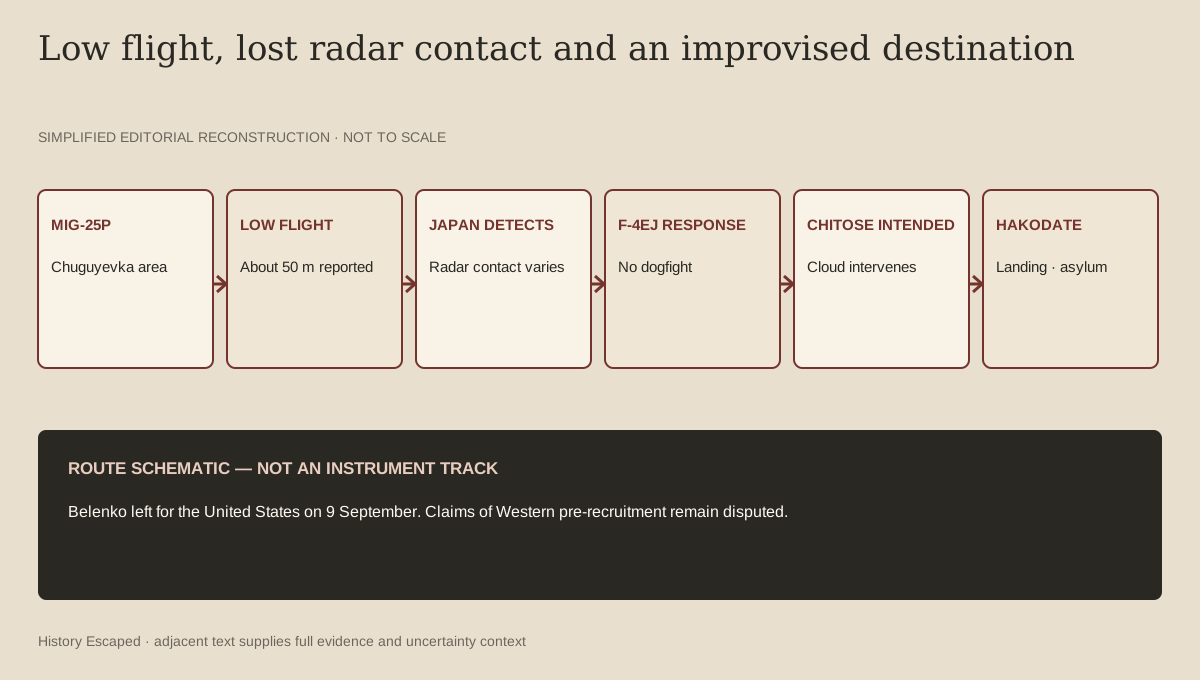
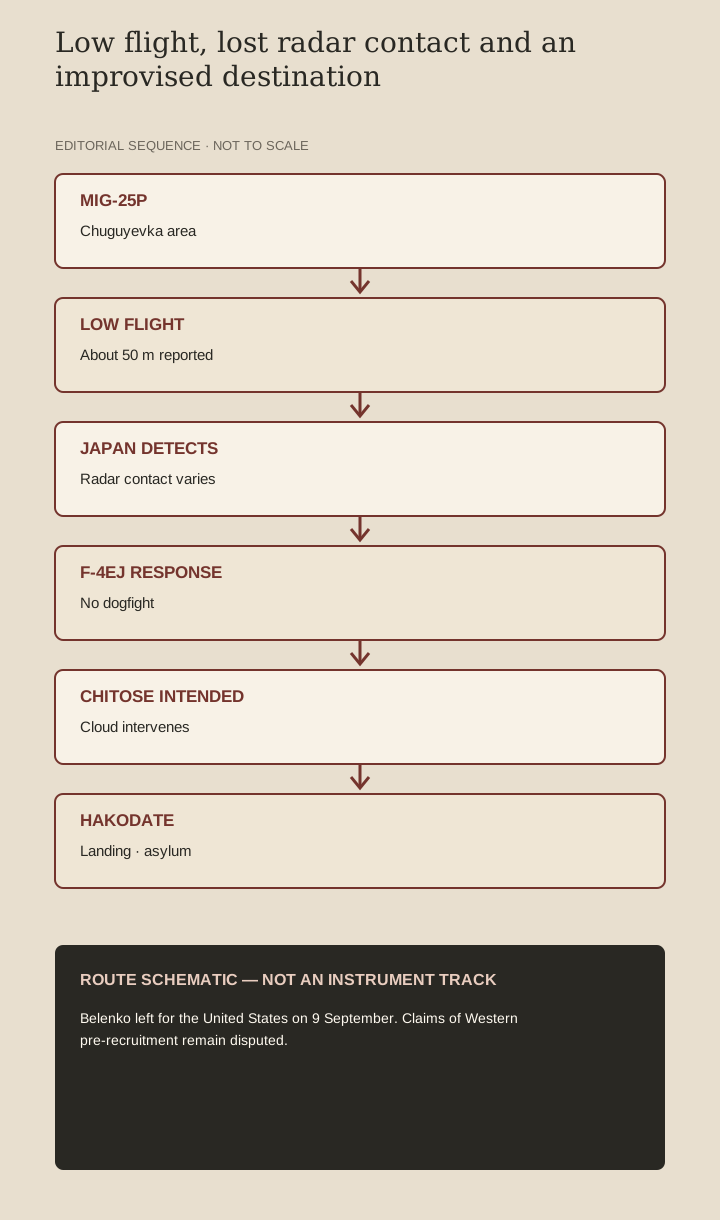
Simplified editorial sequence; not an instrument-recorded flight track. It shows no invented dogfight geometry or exact route.

The flight out of Soviet territory
According to the account preserved in Japan’s 1977 defense white paper, Belenko climbed after takeoff and then descended to an altitude of roughly 50 meters. He flew east at high speed until he believed he was beyond Soviet radar coverage.
The low altitude was central to the escape.
Ground-based radar is constrained by the curvature of the Earth, terrain, and the difficulty of detecting targets close to the surface at long range. A pilot who knew his own air-defense environment had an obvious advantage in understanding where those limitations might matter.
Once farther from the Soviet coast, Belenko climbed again—Japan’s official account gives an altitude of roughly 8,500 meters—and continued toward Hokkaido.
At 1:11 p.m., the Japanese Air Self-Defense Force’s Okushiri radar site detected the unknown aircraft about 180 kilometers west of Hokkaido. Two F-4EJ fighters were ordered up from Chitose at about 1:20.
At approximately 1:22:30, the aircraft crossed into Japanese airspace.
Japanese controllers issued warnings. The interceptors tried to find the target. But Belenko descended again, and at about 1:26 the target disappeared from the ground radar picture. The Japanese official account also records that an F-4EJ briefly acquired the aircraft before losing it after only a short contact.
This part of the story matters because later retellings sometimes transform it into a cinematic chase in which Belenko knowingly outmaneuvered Japanese fighters.
The official record supports something more technical and less theatrical. His low flight made him difficult to track with the systems Japan then had. It does not establish that every descent or turn was a deliberate tactical response to a Japanese interceptor he could see. Indeed, the Japanese account says some of his onboard switches were off and that he later reported not receiving the warnings or detecting the Japanese fighters on his own radar.
The escape succeeded partly because his flight profile exploited a real air-defense weakness, whether or not every moment of that weakness was consciously manipulated against the Japanese response.
Problem → response
Escape was a sequence of problems
Each response solved a practical obstacle while often creating the next one.
- 01→
Obstacle
Soviet radar coverage
A military aircraft leaving the Soviet Far East risked detection and interception by the air-defense system in which Belenko himself served.
Response
Belenko described descending to roughly 50 meters and flying east at high speed until he believed he had passed beyond Soviet radar coverage.
- 02→
Obstacle
Japanese interception
Japan detected the approaching aircraft and scrambled two F-4EJ fighters, while controllers issued warnings in Russian and English.
Response
The MiG’s low-altitude flight caused ground radar and the interceptors’ radar picture to break down. The official record does not establish that Belenko deliberately used every descent specifically to evade the Japanese fighters.
- 03→
Obstacle
Cloud over the intended destination
Belenko said he originally intended to land at Chitose but encountered cloud that prevented the planned approach.
Response
He descended below cloud, searched visually for another airfield, and landed at Hakodate.
Chitose was the plan; Hakodate became the landing
Belenko’s stated destination was Chitose, a major airfield on Hokkaido.
Weather complicated that plan. The Japanese record says cloud around the Chitose area prevented him from using the airfield as intended. He descended below the cloud layer, searched for another place to land, and found Hakodate Airport in southern Hokkaido.
He landed there at about 1:50 p.m.
Contemporary press reports added dramatic details: that the MiG touched down hard, suffered a blown tire, overran the runway, and stopped beyond its ideal landing area. Those reports are plausible and were published within days of the event, but the Japanese defense white paper’s operational summary is more concerned with the radar and response sequence than with a minute-by-minute reconstruction of the rollout.
The safest historical conclusion is that Belenko made an unscheduled landing at Hakodate after failing to reach his intended destination and that the landing left Japan with an intact-enough MiG-25 to secure, dismantle, examine, and eventually return. The escape itself had worked. The next problem was political.
Japan had the pilot — and the Soviet Union wanted both pilot and aircraft back
Japanese authorities took Belenko into custody and began determining whether his asylum request was voluntary.
On 7 September, Japan confirmed his desire to defect and began discussions with the United States. On 8 September, the United States informed Japan that it would accept him.
Japan also arranged for Belenko to meet Soviet representatives. That meeting mattered because it reduced the possibility that Tokyo or Washington could be accused of simply preventing a Soviet serviceman from returning home. Belenko maintained his intention to leave.
On 9 September, he departed Tokyo for the United States. The aircraft remained.
Japan faced competing pressures. The Soviet Union demanded its property back. Japanese defense officials wanted to understand how a Soviet interceptor had penetrated so far into Japanese airspace while evading effective interception. American specialists had an obvious intelligence interest in the MiG-25 itself.
Japan chose to inspect the aircraft before returning it.
The final accounting
Outcome
Defection succeeds
Japan confirmed that Belenko wanted to defect, the United States accepted him, and he left Japan for the United States on 9 September 1976.
MiG-25 examined and returned
Japan dismantled and examined the aircraft at Hyakuri with limited U.S. assistance, then returned it to the Soviet Union in November 1976.
Japanese low-altitude warning gap becomes a defense priority
The incident exposed weaknesses in low-altitude early warning and look-down interception; Japan later fielded E-2C airborne early-warning aircraft and linked the unit’s formation to the Belenko incident.
Taking apart the MiG-25
The Defense Agency took control of the aircraft and arranged for it to be moved from Hakodate to Hyakuri Air Base. Because the MiG could not simply be flown there, it was dismantled for transport. A U.S. Air Force C-5 was used to carry the disassembled aircraft from Hakodate to Hyakuri during the night of 24–25 September.
The Japanese government emphasized that the investigation remained under Japanese control. American technical assistance was permitted in a limited role.
From 25 September through 3 October, the aircraft was examined at Hyakuri.
For Japan, the investigation was not only about Soviet technology. It was also about the failure of Japan’s own detection and interception system. The MiG-25 had crossed the air-defense perimeter, gone low, disappeared from radar, and reached an airport before the defense network could regain a reliable picture of it.
For American intelligence, physical access to the aircraft answered questions that remote observation could not.
Later U.S. institutional accounts describe an aircraft that was in some respects less exotic than earlier intelligence estimates had suggested. Specialists found robust, relatively straightforward engineering: extensive stainless-steel construction, large engines, and electronics that included vacuum tubes. The findings helped refine Western understanding of what the MiG-25 could do, how it was built, and where its limitations lay.
That is a more accurate legacy than the familiar claim that Belenko “proved” the Foxbat was primitive. Intelligence value came from replacing uncertainty with detail.
The aircraft goes home
Japan did not keep the MiG-25.
After the technical examination, the aircraft was repacked for return. In November it was moved to the port of Hitachi and handed back to the Soviet side. A Soviet cargo ship departed with it on 15 November 1976.
Even the packaging count illustrates why small details should be handled carefully. The Japanese official record describes 25 packaged units, while a later CIA Museum summary refers to 30 crates. The difference has little bearing on the event’s meaning, so neither count needs to be forced into the narrative as uniquely definitive.
The important point is undisputed: Japan examined the aircraft and returned it to the Soviet Union.
The weakness Belenko exposed in Japan
The incident had a second life inside Japanese defense planning. Japan’s 1977 defense white paper identified two prominent vulnerabilities revealed by the MiG-25 incident: inadequate early warning against low-altitude penetration and shortcomings in the ability of interceptor radar to detect a low-flying target against the ground.
An airborne early-warning aircraft could address part of that problem by putting radar at altitude, extending the radar horizon and improving low-level coverage. Japan subsequently acquired the E-2C Hawkeye, and the Ministry of Defense later explicitly described the establishment of its E-2C unit as a response to the lesson of the 1976 Belenko incident.
The escape therefore changed more than intelligence estimates of a Soviet aircraft. It exposed a practical weakness in the defenses of the country where Belenko landed.
Evidence discipline
What the record supports
Status labels distinguish secure conclusions from uncertainty and rejected claims. Color is never the only signal.
DOCUMENTED
Belenko deliberately defected and voluntarily requested asylum in the United States.
Japanese authorities recorded and reconfirmed his request, arranged access to Soviet representatives, and documented his departure for the United States.
Sources: SRC-001, SRC-002, SRC-003WELL-SUPPORTED
Belenko originally intended to land at Chitose but diverted to Hakodate because of cloud.
Japan’s official defense account records this as Belenko’s explanation after the flight. The destination change is therefore well supported by an official investigation record, while still dependent on the pilot’s statement about his intent.
Sources: SRC-001DOCUMENTED
Low-altitude flight was decisive in defeating sustained radar tracking.
The Japanese defense record documents the MiG disappearing from ground radar at low altitude and describes the F-4EJ radar’s difficulty maintaining contact against ground clutter. The same report identified low-altitude warning as a central defense lesson.
Sources: SRC-001MYTH
Inspection proved that the MiG-25 was a worthless or fake 'superfighter.'
Physical examination corrected inflated Western assumptions about materials, electronics, and some capabilities, but the aircraft remained a purpose-built, very high-speed interceptor. 'Primitive' and 'worthless' are misleading summaries of what the inspection established.
Sources: SRC-005, SRC-006DISPUTED
The CIA and British intelligence had recruited Belenko in advance and arranged the defection.
A 1981 press report attributed this allegation to intelligence sources. Public Japanese records do not establish prior coordination, Japanese officials denied advance knowledge, and institutional accounts describe the arrival as a defection that created an intelligence opportunity. The available public evidence does not justify treating pre-recruitment as fact.
Sources: SRC-001, SRC-003, SRC-009LATER CLAIM
Belenko’s precise personal motives are fully recoverable from the historical record.
Detailed motives are largely known through Belenko’s post-defection collaboration with John Barron and subsequent retellings. The broad fact of voluntary defection is documented; the finer psychological and personal narrative is retrospective.
Sources: SRC-003, SRC-008WELL-SUPPORTED
The incident materially influenced Japan’s airborne early-warning modernization.
The 1977 defense white paper explicitly identified low-altitude warning deficiencies exposed by the incident, and Japan’s 2021 defense white paper states that the E-2C unit established in 1983 was formed in response to the MiG-25 defection incident.
Sources: SRC-001, SRC-011Was the defection secretly arranged by Western intelligence?
In 1981, a press report attributed to intelligence sources alleged that American and British intelligence had recruited Belenko before the flight and helped arrange the defection. The allegation is worth preserving because it directly contradicts the familiar account of a self-initiated escape. It is not, however, established fact.
The official Japanese chronology gives no indication that Japan had advance warning. Japanese officials quoted after the later allegation denied prior knowledge. The CIA’s own public museum account describes Belenko as a defector whose arrival created a sudden opportunity for exploitation, not as an acknowledged pre-planned operation. Belenko’s published account likewise presents the decision as his own.
None of those points can prove that no intelligence contact ever occurred. Intelligence history often contains gaps that public records cannot close. But the available evidence does not justify presenting pre-recruitment as documented.
The proper evidentiary status is disputed.
Why the escape worked
Belenko’s flight succeeded because several conditions aligned. First, he had access to a machine with the speed and range to cross from the Soviet Far East to Japan.
Second, he was a trained military pilot operating inside the air-defense system he intended to leave. He understood the basic problem he had to solve: getting beyond Soviet detection and interception quickly enough that he could not be turned back.
Third, low-altitude flight reduced radar effectiveness. That helped him leave Soviet coverage and later contributed to Japan losing track of him.
Fourth, the Japanese defense system had a genuine low-altitude surveillance gap. The intercepting Phantoms were not able to maintain a reliable radar contact once the MiG went low.
Finally, when weather disrupted the original plan to reach Chitose, Belenko found an alternative airport rather than continuing until fuel or geography made landing impossible.
Not every one of those factors was under his control. Weather nearly undermined the plan. Japanese tracking failures aided him in a way he may not have fully anticipated. The landing itself was improvised.
That combination is what makes the case more interesting than the simplified version.
Belenko did not execute a perfectly scripted dash from one runway to another. He used a technically informed plan to get out of the Soviet system, crossed into a foreign air-defense network that was struggling to understand what it was seeing, lost his intended destination in cloud, and improvised the final landing.
The political escape survived the improvisation. The intelligence consequences followed almost immediately.
Selected chronology
Selected chronology
MiG-25 reaches Hakodate
Belenko flies from the Soviet Far East into Japanese airspace and lands at Hakodate Airport, where he requests asylum in the United States.
Japan confirms Belenko’s intent
Japanese authorities confirm his wish to defect and begin formal discussions with the United States.
United States accepts the asylum request
The United States informs Japan that it will accept Belenko.
Belenko leaves Japan
After meeting Soviet representatives and maintaining his decision to defect, Belenko departs Tokyo for the United States.
Disassembled MiG-25 moved to Hyakuri
A U.S. Air Force C-5 transports the disassembled aircraft from Hakodate to Hyakuri Air Base for technical examination under Japanese control.
Technical examination
Japanese specialists, with limited U.S. technical assistance, examine the MiG-25 at Hyakuri.
Aircraft returned to the Soviet Union
Japan completes handover of the dismantled aircraft at Hitachi; the Soviet cargo vessel carrying it departs on 15 November.
Congress clears a path to naturalization
Private Law 96-62 removes statutory residence and physical-presence barriers and authorizes Belenko’s naturalization.
Japan establishes its E-2C airborne early-warning unit
Japan’s Ministry of Defense later describes creation of the 601st Squadron to operate E-2C aircraft as a response to the low-altitude warning lesson highlighted by the 1976 incident.
After Belenko
In the United States, Belenko underwent extensive debriefing. Congress later enacted private legislation that removed normal residence and physical-presence barriers so that he could be naturalized. He eventually became an American citizen.
He also collaborated with John Barron on MiG Pilot: The Final Escape of Lieutenant Belenko, published in 1980. The book remains central to the popular understanding of the case, but it should be read as a participant’s retrospective account produced in a strongly political Cold War publishing environment, not as a substitute for Japanese operational records.
Belenko remained in the United States and died in 2023. By then, the aircraft he had flown to Hakodate had long since returned to the Soviet Union, the MiG-25’s technical secrets were no longer secrets, and Japan had built new airborne early-warning capacity. The enduring significance of the escape lies in the way one pilot’s decision forced three governments to react at once.
For Belenko, it was a defection. For Japan, it was an air-defense warning. For the United States, it was a rare chance to inspect a Soviet interceptor from the inside out.
And for the history of escape, it was a reminder that getting out did not always mean crossing a wall or digging a tunnel. Sometimes it meant knowing exactly how low to fly.