
The Great Papago Escape: 25 German POWs, a Hidden Tunnel, and the Arizona Desert
During the night of December 23–24, 1944, twenty-five German prisoners of war disappeared from Camp Papago Park outside Phoenix, Arizona.
They did not cut their way through the fence. They did not rush a guard tower. They left through a tunnel.
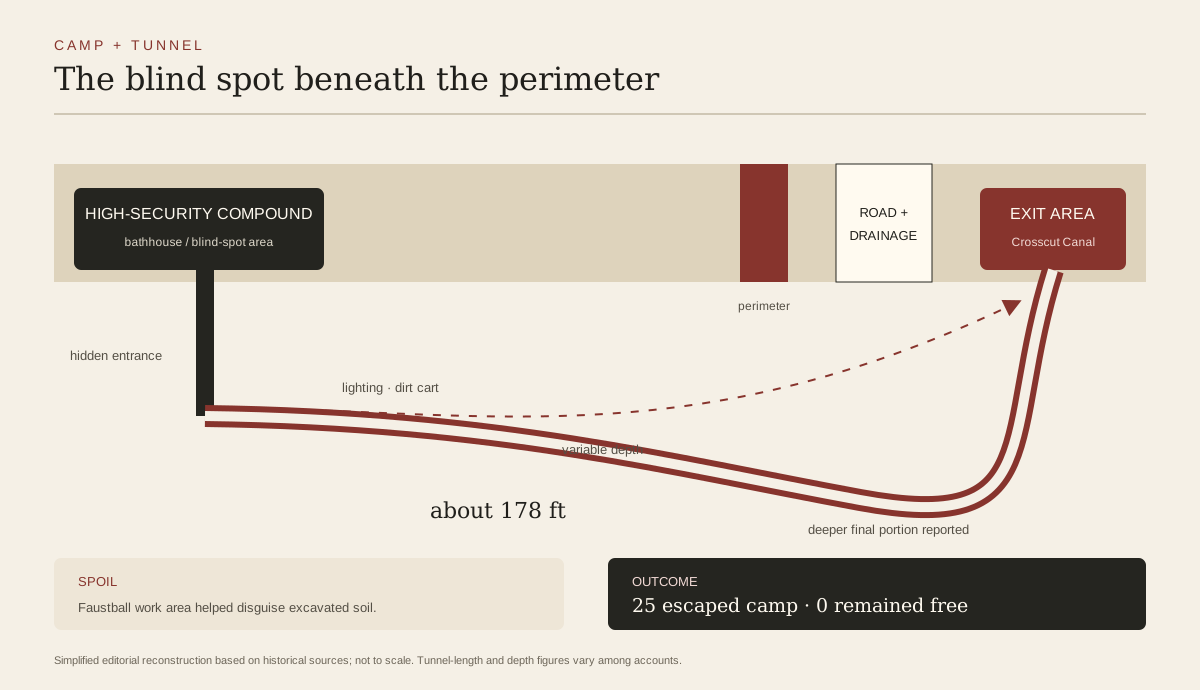
For months, prisoners in the camp's high-security compound had excavated a passage beginning near a bathhouse and extending roughly 178 feet beneath the perimeter. They worked at night, concealed the entrance, improvised tools and a dirt cart, found ways to dispose of enormous quantities of spoil, and even wired the tunnel with electric light. By Christmas Eve, twelve officers and thirteen enlisted men had crawled out and scattered into the Arizona darkness.
The tunnel had worked. Almost everything after it proved harder.
Three of the escapees carried a collapsible boat because they expected Arizona's river system to become their highway toward Mexico and, beyond it, the Gulf of California. Other groups traveled on foot through cold rain and open desert. Some attempted to approach the Mexican border. Three men instead hid close to Phoenix, with one repeatedly slipping back into Camp Papago Park by blending into outside work details to obtain food and information.
The search expanded. Military authorities, the FBI, local law enforcement, Border Patrol and Customs personnel, ranchers, civilians, and Tohono O'odham trackers all became part of the effort.
By January 28, 1945, the last fugitive—U-boat commander Jürgen Wattenberg—was back in custody. The Great Papago Escape was therefore two different stories at once. It was a remarkably successful prison breakout. It was also a complete failure as a permanent escape.
A prison camp built for difficult prisoners
By 1944, the United States held hundreds of thousands of Axis prisoners of war captured overseas. Camp Papago Park became one of the Arizona facilities used to hold German prisoners, many of them members of the Kriegsmarine.
It was not an ordinary collection of compliant POWs.
American authorities increasingly used Papago Park to concentrate prisoners considered troublesome, escape-minded, or otherwise difficult to manage. Among them were experienced German naval officers who had already spent years at war, been captured after sinkings or combat operations, and in some cases had attempted earlier escapes from American custody.
One of the most important was Jürgen Wattenberg, former commander of the submarine U-162. Wattenberg had been captured after his U-boat was sunk in September 1942. By 1944 he was at Papago Park and became central to the escape effort.
Another was Friedrich Guggenberger, a U-boat commander whose own record already included an escape attempt earlier in 1944. Guggenberger and several other German officers had escaped from custody in Arizona in February but were quickly recaptured.
The lesson was obvious: simply getting over a fence was not enough. A successful attempt had to get a large enough head start that the search could be outrun. That meant leaving without the guards seeing the escape happen.
The blind spot
The opportunity came from the layout of the high-security compound.
The prisoners identified an area near a bathhouse that was imperfectly observed from the surrounding guard towers. It was not completely invisible in every circumstance, but it offered enough protection to make a concealed tunnel entrance plausible.
The site solved only the first problem. The prisoners still had to dig from inside the compound, beneath the perimeter, and far enough beyond the fence that a man emerging from the ground would not immediately be seen by a sentry. Digging began around September 1944.
The entrance was concealed near the bathhouse beneath a movable box or structure. Work was conducted at night in rotating teams. One detailed reconstruction describes three groups of three men digging in ninety-minute shifts while another group handled the spoil.
The tunnel was narrow—less a corridor than a crawlspace. Men could not simply walk through it. Soil had to be cut loose, moved backward, lifted out, and then made to disappear inside a functioning POW camp.
And that produced the largest practical problem of all.
The problem was not digging. It was dirt.
Every foot of tunnel produced evidence.
At first, prisoners used small-scale methods. Loose soil could be flushed down toilets, hidden in roof spaces, or carried in clothing and scattered around the compound.
That was useful only while the volume remained manageable. A tunnel approaching 180 feet would produce far too much spoil to hide casually. The prisoners therefore created a reason to disturb a large patch of ground in plain view.
They persuaded camp authorities to allow them to develop an area for Faustball, a German sport related to fistball. To guards, the work could look like ordinary recreational improvement. To the tunnel crew, it provided a disposal site.
Soil from underground could be moved into the work area and mixed into the surface without producing an obvious mound beside the bathhouse.
The operation required improvisation underground as well. A shower-stall base or similar material was adapted into a small cart for moving excavated soil. Electric lighting was drawn from the bathhouse so the diggers could see underground.
What looked from the surface like prisoners improving a sports area helped conceal the physical evidence of a tunnel running beneath the camp.
Camp and tunnel reconstruction
From the bathhouse blind spot beneath the perimeter
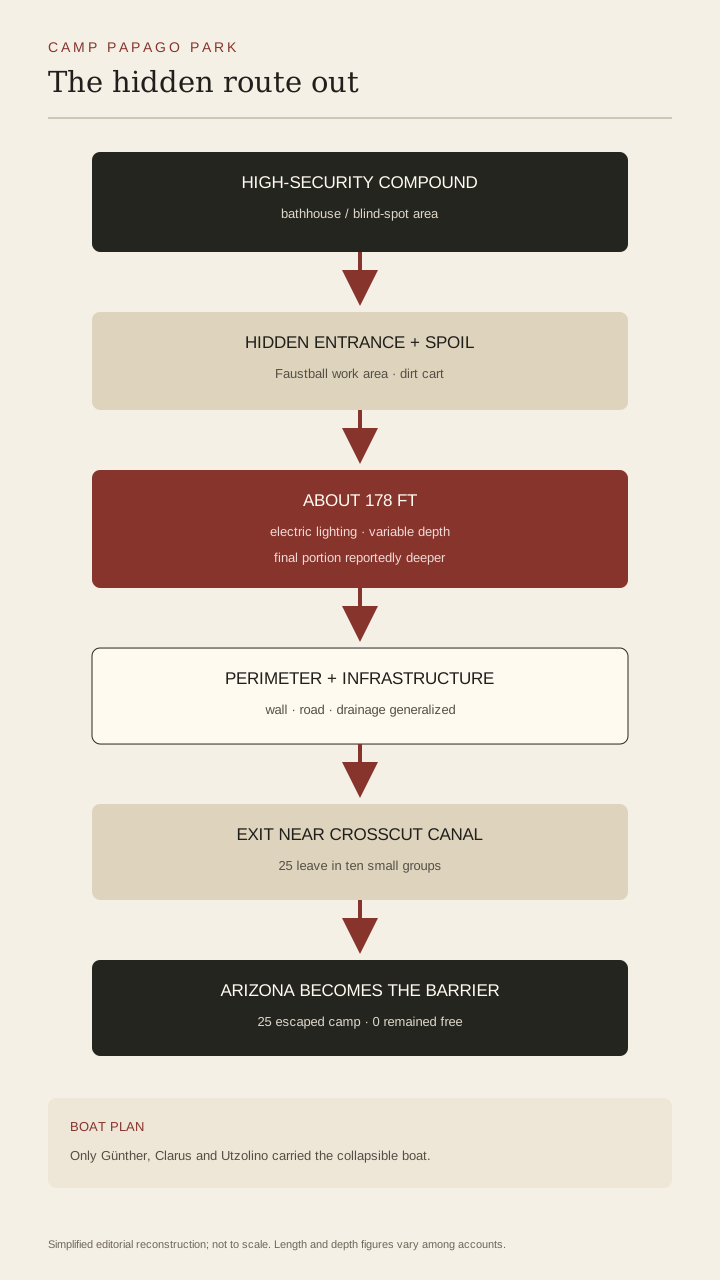
The cutaway shows a concealed entrance, variable depth, spoil disposal and the exit near the Crosscut Canal without reproducing the rights-unconfirmed 1945 engineer map.
- 01
Blind spot
A bathhouse-area work zone concealed access and helped disguise excavation.
- 02
Spoil
A Faustball court and improvised dirt cart turned waste soil into an operational problem that could be managed.
- 03
Variable-depth passage
The approximately 178-foot route reportedly descended more deeply near infrastructure rather than staying at one uniform depth.
- 04
Outside camp
Twenty-five men left in ten small groups; the Arizona landscape became the next barrier.
Simplified editorial reconstruction based on historical sources; not to scale. Tunnel-length and depth figures vary among accounts.
Going under the perimeter
The tunnel did not remain at one depth.
Modern summaries sometimes describe it as roughly six feet underground, but that oversimplifies the engineering. The entrance shaft was around that scale, while detailed accounts indicate the tunnel descended much deeper in its final section—reportedly to roughly fourteen feet—to clear features including drainage and a road near the perimeter.
By around December 20, the tunnel had reached approximately 178 feet.
The number is not perfectly uniform across the record. National Park Service material gives 176 feet; Arizona histories often round to 180; TIME, reporting shortly after the escape, called it roughly 200 feet. The differences are small enough that they appear to reflect measurement and reporting conventions rather than a fundamental disagreement about what was built.
The important fact is the scale. For roughly three months, prisoners had excavated a crawl tunnel long enough to pass beneath a guarded American POW camp without the tunnel being discovered.
Near its end, a narrow probe was used to establish whether the planned exit had reached safe ground. The exit was then camouflaged until escape night.
The tunnel was ready. But the men still had to decide what happened after they came out of it.
Material evidence
Engineering and preparation
Improvised tools, spoil handling, lighting, maps and one three-man boat plan served different parts of the operation.
- 01Essential to sustained covert excavation.
Improvised digging tools
Available camp materials were adapted for excavation of the narrow tunnel.
- 02Reduced the difficulty of moving excavated soil through the confined passage.
Improvised dirt cart
A small cart reportedly adapted from shower-related material helped move spoil through the tunnel.
- 03Allowed night excavation and finishing work in the tunnel.
Electric tunnel lighting
Electricity was extended from the bathhouse to illuminate underground work.
- 04Solved the expanding spoil-disposal problem.
Faustball court work area
A permitted recreation-area project created cover for distributing large quantities of excavated soil.
- 05Illustrates the escapees' extensive post-breakout planning and one of its major geographical miscalculations.
Collapsible boat
A wood-and-canvas craft built in sections small enough to pass through the tunnel for a three-man river escape plan.
- 06Necessary for attempts to travel through Arizona without immediate identification as POWs.
Maps and improvised papers
Escapees accumulated geographic information, supplies and documentation intended to support movement outside the camp.
Maps, money—and a boat
A tunnel that ended outside the fence was only the beginning.
Mexico lay to the south, but Arizona was an unforgiving place to cross on foot in winter. Roads, towns, ranches, military installations, and law-enforcement networks created detection risks. Water and food had to be considered. German accents could expose fugitives in civilian settings.
The escapees accumulated maps and supplies and developed false or improvised papers. Some money was obtained through transactions with guards, including the sale of fabricated souvenirs or memorabilia.
The most unusual plan belonged to Wilhelm Günther, Wolfgang Clarus, and Friedrich Utzolino. They believed the river system could solve the distance problem.
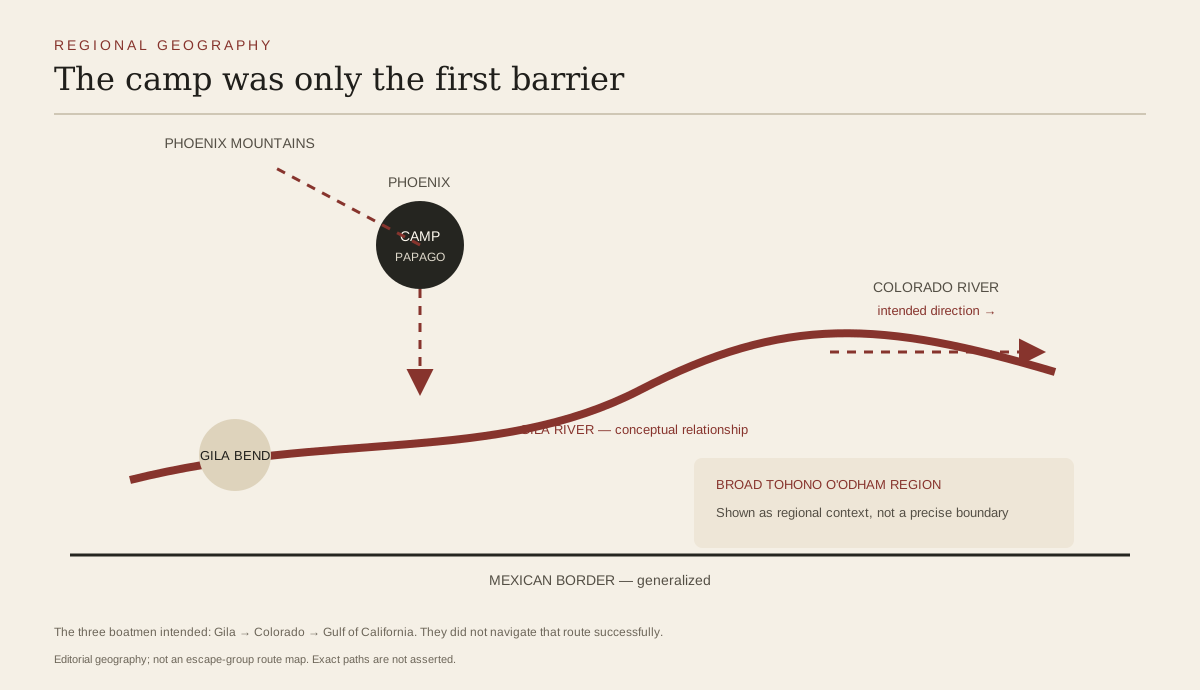
Their concept was to reach the Gila River, follow it west toward the Colorado, and continue toward the Gulf of California. From there, in theory, movement toward Mexico would become easier.
They therefore built a collapsible boat from wood and canvas.
The design had one severe constraint: every component had to fit through the tunnel. The craft was broken into short sections—no longer than roughly eighteen inches according to the detailed reconstruction—so the parts could be carried underground and reassembled outside.
On paper, it was one of the most imaginative pieces of the escape. It also depended on an assumption the prisoners had not adequately tested: that the Arizona rivers they saw on maps would behave like navigable rivers when they reached them.
December 23
The escape was timed for the Christmas period, when routines and attention might be disrupted. A noisy celebration in the compound helped mask unusual sounds and movement.
The 25 men divided into ten teams of two or three rather than emerging as one large group. That arrangement reduced congestion and allowed the fugitives to disperse quickly once outside.
Shortly before 9 p.m. on December 23, the first team—Jürgen Quaet-Faslem and Friedrich Guggenberger—entered the tunnel.
The crawl was not quick. A man moving through the narrow passage with supplies could take around forty minutes.
Team followed team.
Outside, Arizona's winter weather complicated the departure. Rain had fallen, and the men emerged into cold, wet conditions around the Crosscut Canal area.
By roughly 2:30 a.m. on December 24, all 25 were out.
The high-security compound still contained guards, fences, towers, and prisoners. But the escape group was gone.
The camp did not immediately understand what had happened
The timing mattered.
Normal counting and accountability procedures did not instantly reveal a twenty-five-man absence. German officers inside the camp also exploited formalities and confusion to slow the accounting process.
Meanwhile, the fugitives were already spreading across the region. One of the ironies of the escape is that authorities began receiving pieces of the answer before they fully understood the question.
Herbert Fuchs, one of the escapees, surrendered relatively quickly. Others were encountered or gave themselves up as the first day progressed.
By the evening of December 24, camp authorities knew they were dealing with a major mass escape. The FBI and other agencies were brought into the search.
The tunnel was subsequently found and examined. The scale of the security failure was now visible underground.
Arizona became the second prison
The escapees had beaten the camp's architecture. They now faced the landscape.
The distances involved were larger than many of them had appreciated. Sparse settlement did not mean easy concealment: a stranger could become more noticeable, not less, in an isolated community. Winter rain and cold complicated travel. Supplies ran down. Feet and legs failed. German accents were dangerous anywhere conversation was unavoidable.
The search widened through southern Arizona.
Military personnel were joined by the FBI, sheriffs, police officers, Border Patrol and Customs personnel, civilians, and others familiar with the region. Rewards were offered for locating or capturing the escaped prisoners.
Period reporting also records an important role for Tohono O'odham trackers, referred to in 1940s newspapers under the older term “Papago.” Members of the community helped locate escapees in southern Arizona, including fugitives moving through country they hoped would bring them closer to Mexico.
Modern treatment should use the present name Tohono O'odham while preserving the historical camp name, Camp Papago Park.
The river that was not a highway
The three boatmen soon confronted the gap between a map and a landscape.
Their collapsible craft had already been affected by the rain. The canvas reportedly shrank, making assembly more difficult.
Worse, the Gila River was not the broad navigable waterway their plan required.
Sections were shallow, muddy, or otherwise unsuitable for the journey they had imagined. The boat that was supposed to spare them a long desert march became largely useless.
The three abandoned the river strategy and continued overland. They were eventually captured in the Gila Bend area.
A frequently retold detail says the men were discovered while washing underwear or clothing near water. It is plausible within the later reconstruction and has become part of Papago lore, but it is not important enough to carry the historical interpretation. The real failure was larger: their transport plan had been built around an inaccurate picture of the river system.
The boat was clever. The geography was decisive.
Almost to Mexico
Other groups made considerably more progress. Guggenberger and Quaet-Faslem traveled south through difficult country and came within roughly ten miles of the Mexican border before they were captured on January 6.
That made their attempt one of the strongest demonstrations that the mass escape had not been merely symbolic. Some of the prisoners genuinely came close to reaching the international boundary.
But every mile south also drew them deeper into a search zone where law enforcement, border personnel, local residents, ranchers, and Indigenous trackers were looking for strangers. Reaching Mexico required more than endurance. It required moving through human networks that the prisoners did not control.
The men who stayed near Phoenix
Wattenberg chose a different strategy. Rather than making an immediate dash for the Mexican border, he remained surprisingly close to the prison with Walter Kozur and Johann Kremer. The three established a crude hiding place in the hills north of Phoenix, described in later histories as a shallow cave or concealed shelter. Their plan depended on a remarkable security weakness.
Outside work details moved prisoners beyond the main confines of the camp. Kremer learned that he could exploit the system by blending with such details, effectively slipping back into the prisoner population to collect food, news, and other supplies before leaving again.
For a time, the method worked. It inverted the logic of escape. Instead of putting as much distance as possible between himself and the prison, Kremer repeatedly used the prison as a supply base.
The system eventually collapsed after a surprise inspection and tighter accounting exposed his manipulation. Kremer was caught, and Kozur was then captured around a supply point.
Wattenberg was alone.
The last fugitive
By late January, Wattenberg had been free longer than any of the other twenty-four men. He eventually entered Phoenix itself. Later accounts describe him eating in a restaurant and spending time in a hotel lobby, attempting to pass within civilian surroundings despite the obvious risk posed by his accent and limited ability to explain himself.
That risk caught up with him. On January 28, 1945, Wattenberg was taken back into custody. Depending on whether one counts from the night the escape began or from the early hours of December 24, he had remained at large for roughly five weeks—commonly summarized as about thirty-five or thirty-six days. With his recapture, the Great Papago Escape was over.
All twenty-five men who had crawled through the tunnel had been returned to American custody.
Camp breakout · no permanent escape
25prisoners escaped Camp Papago Park
Escaped Camp Papago Park
Twenty-five German POWs successfully passed through the tunnel during the night of 23–24 December 1944.
Permanent escapees
Every escapee was recaptured or surrendered; none permanently escaped U.S. custody.
Last escapee recaptured
Jürgen Wattenberg was the final fugitive returned to custody on 28 January 1945.
Did the escape fail?
That depends on which question is being asked. If the question is whether the prisoners successfully escaped Camp Papago Park, the answer is unequivocally yes. Twenty-five POWs passed through a tunnel under a guarded perimeter and dispersed before the camp understood the scale of the breach. If the question is whether any of them permanently escaped American custody or reached safety outside the United States, the answer is no.
Every man was recaptured or surrendered. That distinction matters because the event is sometimes retold as either an astonishing success or an almost comic failure. Historically, it was both more impressive and less successful than either simplification suggests.
The prisoners identified a real blind spot. They organized months of covert labor. They solved the problem of spoil disposal. They brought electricity underground. They maintained secrecy. They moved twenty-five men out through a passage only a few feet wide. Some remained free for weeks, and at least one pair got close to Mexico.
But the plan beyond the fence was far less robust than the engineering beneath it.
Why Camp Papago Park was vulnerable
The escape exposed weaknesses that extended beyond one unobserved patch of ground.
The camp had concentrated experienced and escape-minded prisoners together. That made administrative sense from one perspective: difficult men could be watched in a specialized compound.
It also created a planning group with exactly the skills and motivation needed for a complex breakout.
Recreational and work privileges gave prisoners access to materials and opportunities that could be repurposed. Accountability systems could be manipulated. Guards did not discover that a major excavation project was underway beneath a compound they believed they controlled.
The greatest security failure was therefore not simply that no one saw the tunnel mouth. It was that the prisoners were able to create an entire covert logistical system around it.
Problem → response
Escape was a sequence of problems
Each response solved a practical obstacle while often creating the next one.
- 01→
Obstacle
Guard-tower surveillance
The compound was watched from perimeter towers.
Response
The planners exploited a relative blind spot near the bathhouse to conceal the tunnel entrance.
- 02→
Obstacle
Excavated soil
A nearly 180-foot tunnel produced far more spoil than could be casually hidden.
Response
The prisoners combined small-scale concealment with surface dispersal associated with development of a Faustball court.
- 03→
Obstacle
Drainage and road near the perimeter
The tunnel had to clear physical infrastructure near the outer camp boundary.
Response
The final portion descended substantially deeper before rising toward the exit.
- 04→
Obstacle
Prisoner counts
Routine accountability could reveal missing men.
Response
The escape was timed around the Christmas period and internal confusion/formality delayed a definitive accounting long enough to increase the fugitives' head start.
- 05→
Obstacle
Arizona distance and terrain
Open desert, winter weather and long distances separated Papago Park from the Mexican border.
Response
Escapees divided into small groups, carried supplies and attempted different routes.
- 06→
Obstacle
Unsuitable river conditions
The three boatmen found that the Gila River did not provide the navigable route imagined from their maps, while rain damaged or distorted the canvas craft.
Response
They abandoned the river strategy and continued overland before being recaptured.
- 07→
Obstacle
Expanding search network
Military, federal, state, local, civilian and Indigenous searchers increasingly covered routes toward Mexico and areas around Phoenix.
Response
Some prisoners surrendered; others attempted concealment, avoided settlements or shifted routes, but all were eventually found.
The manhunt and the people often left out of the story
Popular versions of the escape tend to focus on Wattenberg, the tunnel, and the boat. The recapture story was much broader.
The search drew on agencies and communities across Arizona. Period newspapers specifically credited people then described as “Papago” trackers with locating or helping capture German escapees.
The terminology requires care today. The community is the Tohono O'odham Nation; the older name appeared in federal and newspaper usage during the period and survives in the historical name Camp Papago Park.
Their role should not be reduced to a colorful footnote. The escapees were attempting to move through landscapes that local people understood far better than they did.
That difference in knowledge became another part of the security system outside the fence.
Evidence discipline
What the record supports
Status labels distinguish secure conclusions from uncertainty and rejected claims. Color is never the only signal.
WELL-SUPPORTED
The Papago tunnel was exactly 178 feet long.
178 feet is the strongest modern detailed figure, but institutional and contemporary sources give approximately 176, 180 or 200 feet. 'About 178 feet' is the safest public wording.
Sources: SRC-003, SRC-005, SRC-006, SRC-008, SRC-013MYTH
The escape happened on a single calendar date, 24 December 1944.
The breakout began on the evening of 23 December and continued past midnight into 24 December. The precise historical formulation is the night of 23–24 December 1944.
Sources: SRC-003, SRC-004, SRC-009MYTH
The planned river route led to the Gulf of Mexico.
One modern institutional summary gives the Gulf of Mexico, but the Colorado River historically reaches the Gulf of California. The intended Gila-to-Colorado route therefore pointed toward the Gulf of California and Mexico.
Sources: SRC-002, SRC-014MYTH
All 25 escapees planned to use the collapsible boat.
The collapsible craft was built for a three-man group: Wilhelm Günther, Wolfgang Clarus and Friedrich Utzolino.
Sources: SRC-003MYTH
The camp immediately detected the disappearance of 25 prisoners.
Accountability was delayed and authorities did not immediately recognize the scale of the escape. Some prisoners had already surrendered or been encountered before the full breakout was established.
Sources: SRC-003, SRC-004, SRC-005MYTH
All 25 men were Nazi officers.
The group included 12 officers and 13 enlisted men. Individual ideological commitments should not be assigned without specific evidence.
Sources: SRC-003UNKNOWN
A functioning outside Gestapo network enabled the mass breakout.
Authorities investigated outside assistance and contemporary reporting mentioned suspicions, but available evidence does not establish that a large external network built or enabled the tunnel escape.
Sources: SRC-001, SRC-003, SRC-005The numbers that changed in retelling
Several facts about the Great Papago Escape appear in multiple forms.
The tunnel is described as 176, 178, 180, or approximately 200 feet long depending on the source. The escape is dated December 23, December 24, or “Christmas Eve” depending on whether a source records when the first team entered the tunnel or when the final men emerged. Wattenberg is described as free for thirty-five or thirty-six days depending on counting method.
These are not reasons to abandon precision. They are reasons to define it. The most defensible reconstruction is:
- tunneling began around September 1944;
- the completed passage measured about 178 feet;
- the first escape teams entered during the evening of December 23;
- all twenty-five were outside by the early hours of December 24;
- the last fugitive, Wattenberg, was back in custody on January 28, 1945.

A tunnel that outlived the prison camp
Camp Papago Park eventually disappeared as a POW facility, and the Phoenix metropolitan area grew around the landscape where the escape occurred. The story survives through maps, photographs, oral histories, historical markers, archival records, and local memory.
One of the most valuable surviving images is an official U.S. Army photograph of the tunnel entrance after its discovery. It strips away decades of legend. There is no cinematic set, no exaggerated underground chamber—only the physical opening of a route that prisoners built quietly while guards watched the camp above them.
The Great Papago Escape deserves to be remembered for precisely that combination of competence and miscalculation. Underground, the prisoners understood their problem with extraordinary clarity. Above ground, they had escaped into a much larger one.
Selected chronology
Tunnel, breakout and recapture
German naval POWs arrive at Papago Park
Camp Papago Park increasingly receives German prisoners, including naval personnel and men considered escape risks.
Earlier U-boat officer escape
Several German naval officers, including Friedrich Guggenberger and August Maus, make an earlier escape attempt in Arizona and are recaptured, underscoring the repeated escape threat.
Papago tunnel digging begins
The mass-escape tunnel project begins near the compound bathhouse.
Tunnel reaches escape length
The passage is completed at approximately 178 feet and its exit beyond the perimeter is concealed.
The breakout begins
The first escape team enters the tunnel shortly before 9 p.m.; ten teams move through during the night.
All 25 are outside
By roughly 2:30 a.m., the last of the 25 escapees has emerged and the groups disperse.
Scale of escape established
After delayed accountability and early surrenders/captures, camp authorities recognize the mass breakout and a large search intensifies.
Guggenberger and Quaet-Faslem captured
The pair are captured after moving to within roughly ten miles of the Mexican border.
Phoenix hiding system collapses
The arrangement allowing Johann Kremer to obtain supplies through work-detail manipulation is exposed; Kremer and Walter Kozur are recaptured.
Wattenberg recaptured
Jürgen Wattenberg, the last of the 25 escapees still free, is captured in Phoenix.