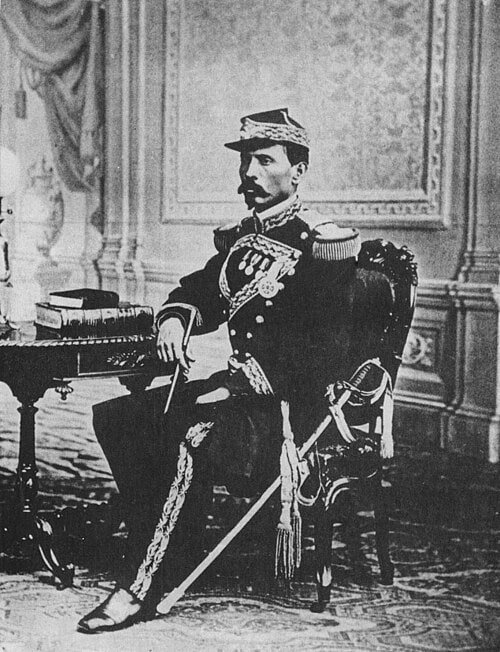
Porfirio Díaz's second escape from Puebla is one of the most famous episodes of his military career—and one of the easiest to turn into legend. The central event is secure. On the night of 20–21 September 1865, while held as a prisoner of war by imperial forces in Puebla, Díaz escaped from the former Jesuit complex known as the Colegio Carolino or Convent of La Compañía. Imperial authorities immediately telegraphed orders for his recapture and offered a reward.
The famous mechanics are less secure. Díaz later described ropes, a dark rooftop, a sentry above the convent, a descent near a stone saint, a pen full of startled pigs, and a gendarme who passed at exactly the wrong moment. That account is extraordinarily detailed, but most of those details survive through Díaz's own retrospective memoir. A contemporary official paper trail proves the escape and the subsequent manhunt without independently proving every step across the roof.
That difference—between a documented escape and a memoir-driven reconstruction—is the key to telling the story responsibly.
At a Glance
- Escape: Night of 20–21 September 1865
- Prison: Convent of La Compañía / Colegio Carolino, Puebla
- Status: Republican general held as a prisoner of war after the fall of Oaxaca
- Why "second escape": Díaz had already escaped French custody in Puebla after the 1863 siege
- Broad method: Planned nighttime escape from the Carolino, followed by movement to prepared civilian support outside the prison
- Memoir method: Ropes to the roof, movement past sentries, and descent from the convent complex
- Immediate imperial response: Telegraphic recapture orders and a 1,000-peso reward
- Post-escape outcome: Díaz reached supporters in the countryside and returned to the Republican campaign
- Central source conflict: Contemporary documents establish the escape and manhunt; Díaz's memoir supplies most of the celebrated physical details
From Oaxaca to captivity
By early 1865 Díaz was one of the most important Republican commanders still resisting the French intervention and the empire of Maximilian. His base at Oaxaca had become a major obstacle to imperial control of southern Mexico.
Marshal François Achille Bazaine brought a stronger force against Oaxaca. Díaz ultimately concluded that continued resistance inside the city could no longer succeed and surrendered in February 1865. He and other Republican officers became prisoners of war and were taken north toward Puebla.
The surviving chronology in Díaz's archive places his transfer as a prisoner between 10 and 28 February. Once in Puebla, Austrian forces attached to the imperial army took responsibility for many of the Republican officers.
Díaz was not held in a single place for the entire captivity. His memoir and later institutional histories place him first at the fort of Loreto, later at the convent of Santa Catarina, and finally at the former Jesuit complex of La Compañía—the building that became known as the Colegio Carolino.
This movement matters because later retellings sometimes merge the sites into one "Puebla prison." The successful September escape belongs specifically to the Carolino phase.
The escape that did not happen at Santa Catarina
Díaz's memoir claims that he had already begun preparing a different escape while confined at Santa Catarina. He described digging beneath his bed and concealing the work beneath improvised supports and brickwork.
The transfer to La Compañía ended that plan before it could be used. No independent prison record in the source set confirms the tunnel, so it belongs to the memoir evidence rather than the documented mechanics of the final escape.
Once at the Carolino, Díaz experienced a period of comparatively relaxed treatment. He later credited Baron Juan de Csismandia, an officer in the imperial service, with granting him considerable freedom inside Puebla while still treating him as a prisoner. Díaz's own description is important because it does not portray Csismandia as the man who secretly freed him. On the contrary, Díaz said the officer's confidence created a personal obligation that made escape more difficult while Csismandia held responsibility for him.
The situation changed after Count Thun resumed command. Díaz wrote that Thun tightened the guard, ordered windows closed, increased sentry duty, and kept rooms illuminated. Whether every detail is exact, the contrast between the two command regimes became central to Díaz's explanation of why he accelerated the plan.
Why September 20
Díaz said he originally intended to leave on September 15, his birthday. He abandoned that date because the Independence celebrations meant unusually bright streets and more activity near the prison.
He then chose September 20.
That date is independently supported far more strongly than most of the mechanics. The UNAM edition of Díaz's archive preserves imperial and administrative telegrams issued on September 21 reporting that he had fled during the night. One circular from Count Thun announced that the prisoner of war Porfirio Díaz had escaped and ordered the strongest possible surveillance for his recapture.
Another imperial communication offered 1,000 pesos to whoever apprehended him.
The documentation leaves a small dating nuance. Díaz titled the event "Second Escape from Puebla — 20 September 1865." The imperial circular, dated September 21, said he had fled "this night," while other official messages said that he had escaped that day or that morning. The clearest modern formulation is therefore the night of September 20–21, with September 20 retained as the conventional event date.
A support network already in place
The escape was not simply an athletic feat performed without preparation.
Díaz said that horses and saddles had been placed in a rented house under another name. A trusted servant and a guide were waiting there. He also identified Lieutenant Colonel Guillermo Palomino and Major Juan de la Luz Enríquez as the only fellow prisoners who knew the immediate plan.
According to the memoir, Palomino and Enríquez kept the other officers occupied with a card game so they would not wander through the corridors and notice Díaz preparing to leave.
The wider political network can be documented independently. Justo Benítez, a close Díaz associate who had been captured with him, had already been released after accepting a neutrality obligation. Benítez then traveled north on political business for Díaz. A Mexican diplomatic communication from New York on September 18 reported that Díaz had been preparing to return to the campaign and was expected to escape from prison.
That letter is especially important because it predates the actual breakout. It demonstrates that Díaz's political re-entry into the Republican war was being prepared before imperial authorities discovered he was gone.
The rooftop story
Díaz's memoir says that after the evening silence signal he took several reatas—ropes used for lassoing—and went to an open or roofless part of the convent complex. He threw ropes upward and used another to catch a stone architectural feature, then climbed onto the roof.
He described moving low across uneven vaulted roofing while avoiding noise from pieces of glass and staying out of a sentry's view. At one point, he said, he had to cross part of the residence associated with the prison chaplain.
The final descent has generated one of the case's most persistent local legends. A commemorative plaque in Puebla says that Díaz escaped using a cable tied to a statue of San Ignacio.
That is not what Díaz's memoir says.
His account identifies a stone statue of San Vicente Ferrer near the corner he intended to use. He wrote that the statue moved when tested, so he chose not to trust it and instead fixed the rope to the stone pedestal at the corner of the building.
This is a useful example of why commemorative plaques cannot automatically control the reconstruction. Even if Díaz's memoir is accepted, the familiar modern inscription changes both the saint and the anchoring point.
Pigs, a dagger, and the limits of memory
The memoir becomes still more dramatic during the descent. Díaz says he chose to lower himself into an enclosed undeveloped lot rather than directly into the street because he feared being seen.
Only after starting down did he discover that pigs were penned below.
He then recalled that a dagger slipped from his belt and fell among the animals, producing enough noise that he feared discovery. After waiting for them to settle, he climbed toward the street but had to withdraw when a gendarme passed by checking doors.
Finally, Díaz said he reached the street and moved rapidly toward the house where the horses, servant, and guide were waiting.
These details make the escape memorable. They also sit almost entirely on Díaz's autobiographical authority.
The Archivo Histórico Universitario of the Benemérita Universidad Autónoma de Puebla has explicitly examined the problem. Its historical publication reproduced Díaz's account alongside criticism by Francisco Bulnes, who argued that the escape had become part of a heroic Díaz mythology. Bulnes did not deny that Díaz escaped; he questioned whether the spectacular rooftop story should be accepted merely because the later president told it.
That distinction remains sound. Imperial records prove that Díaz was gone. They do not record pigs, a falling dagger, glass on the roof, the exact sentry position, or the statue.
Did Maximilian secretly let him go?
Another tradition attempts to solve the improbability of the memoir by reversing the story: perhaps Díaz did not really defeat the guards because Maximilian wanted him allowed to escape.
Bulnes discussed this claim through the French writer Émile de Kératry, who suggested that the emperor may have ordered officials to facilitate Díaz's departure. Even Bulnes concluded that Kératry did not provide satisfactory historical proof.
The contemporary administrative evidence also creates a problem for a simple secret-release theory. Count Thun's command circulated recapture orders almost immediately. A 1,000-peso reward was offered, officials in surrounding districts were alerted, and Mexican imperial ministries telegraphed Puebla, Veracruz, Orizaba, Tehuacán, and Oaxaca seeking Díaz.
It is still possible to imagine hidden decisions not reflected in ordinary paperwork, but the evidence used here does not establish them. The claim that Maximilian deliberately engineered the escape therefore remains disputed rather than part of the secure narrative.
The same caution applies to a later story that Csismandia personally discovered the escape and simply let Díaz go. Díaz's own memoir treats Csismandia's earlier leniency as separate from the final operation and places the actual escape after Thun had reimposed stricter custody.
The manhunt confirms the escape
The strongest contemporary evidence begins once Díaz was missing.
Count Thun's circular called him a fugitive prisoner of war and ordered his recapture. A municipal notice at Acatzingo repeated the thousand-peso offer. Imperial ministries transmitted the alert through the region.
Other reports began trying to locate him. By September 23, information reaching authorities in the Tepeaca area placed Díaz at a ranch around Tlacotepec with several companions and a rapidly growing mounted following. The report claimed roughly two hundred horses had joined him, but intelligence figures of this kind should not be treated as precise headcounts.
Díaz's own memoir gives a more orderly itinerary: September 21 toward the ranch of Colonel Bernardino García, September 22 at Tehuitzingo, September 23 at Piaxtla, and later movement deeper into Republican territory.
The two traditions agree on what matters most. The escape did not leave Díaz hiding indefinitely inside Puebla. Within days he had reached the countryside and was rebuilding a military network.
Why this was his second Puebla escape
The title "Second Escape from Puebla" refers to an earlier episode during the French intervention.
After the Republican surrender of Puebla in May 1863, Díaz refused to accept the parole arrangement demanded by the French. He later described slipping out of temporary custody in civilian clothing and leaving the city with Republican companions.
The 1865 escape was fundamentally different. This time Díaz had spent months in imperial captivity after surrendering Oaxaca. Guards had moved him through several secure locations, the imperial authorities already understood his military importance, and his return to the field had been planned as part of a larger Republican recovery.
That is why the second escape acquired greater strategic significance.
It also explains why the later Porfirian political culture had every incentive to remember the incident in its most dramatic form. The future president's own memoir presented an image of patience, physical daring, careful planning, personal honor toward a generous enemy, and immediate return to national service.
Those qualities may all have been present. The historian's task is simply to separate what Díaz remembered from what the surviving contemporary record independently demonstrates.
What can actually be called documented
The hard documentary core is strong.
Díaz was captured after the fall of Oaxaca in February 1865. He was transported to Puebla and held successively at several sites. He was imprisoned at the former Convent of La Compañía/Colegio Carolino by September. He escaped during the night of September 20–21. Imperial authorities immediately launched a regional manhunt and offered a reward. Within days he was again moving with Republican supporters outside Puebla.
The physical route across the Carolino roof is plausible and deeply embedded in the historical tradition, but it is primarily Díaz's later account. The abandoned Santa Catarina tunnel, the glass on the roof, the chaplain's residence, the unstable statue, the pigs, the lost dagger, and the passing gendarme should therefore be read as autobiographical reconstruction unless independent corroboration emerges.
The result is still a strong escape story without requiring every detail to be literally verified. Porfirio Díaz disappeared from a guarded imperial prison in central Puebla and survived the search that followed. The question is not whether he escaped. It is how much of the famous route belongs to the night of September 20, 1865—and how much belongs to the political memory built around it afterward.
Evidence discipline
What the record supports
Status labels distinguish secure conclusions from uncertainty and rejected claims. Color is never the only signal.
DOCUMENTED
Porfirio Díaz escaped imperial custody in Puebla during the night of 20–21 September 1865.
Díaz's archive preserves contemporary imperial telegrams announcing his escape, ordering his recapture, and offering a reward.
Sources: SRC-002LATER CLAIM
The complete rope-and-rooftop route described in Díaz's memoir can be independently verified.
The memoir supplies the detailed physical sequence. Contemporary imperial records prove the escape and manhunt but do not independently document the roof route, pigs, dagger, glass, or sentry choreography.
Sources: SRC-001, SRC-002, SRC-003DISPUTED
Díaz escaped using a cable tied to a statue of San Ignacio.
A modern commemorative plaque gives San Ignacio and a cable. Díaz's memoir instead names San Vicente Ferrer and says he rejected the unstable statue itself, securing the rope to its stone pedestal.
Sources: SRC-001, SRC-005DISPUTED
Emperor Maximilian secretly ordered Díaz's guards to let him escape.
The theory appears in later literature associated with Émile de Kératry, but even contemporary critics of Díaz's memoir found the evidence inadequate. The immediate imperial manhunt and reward weigh against treating a centrally ordered release as established fact.
Sources: SRC-002, SRC-003DISPUTED
Baron Csismandia personally allowed Díaz to walk out during the successful escape.
Later popular accounts sometimes credit Csismandia directly. Díaz's own memoir instead says Csismandia's earlier leniency imposed a personal restraint on him, while the final escape followed Count Thun's return and tighter security.
Sources: SRC-001, SRC-003WELL-SUPPORTED
Díaz had already prepared to resume the Republican campaign before the escape.
A September 18 diplomatic communication concerning Justo Benítez reported that Díaz was preparing to escape and return to command, independently supporting the memoir's description of an outside network.
Sources: SRC-006MYTH
The 1865 event was Díaz's first escape from captivity in Puebla.
Díaz had escaped French custody in Puebla in May 1863 after the Republican surrender of the city, making the 1865 episode his second Puebla escape.
Sources: SRC-001Evidence diagram
Contemporary records and the later memoir tradition
Contemporary records establish the escape and manhunt; the celebrated roof mechanics depend mainly on Díaz’s memoir.
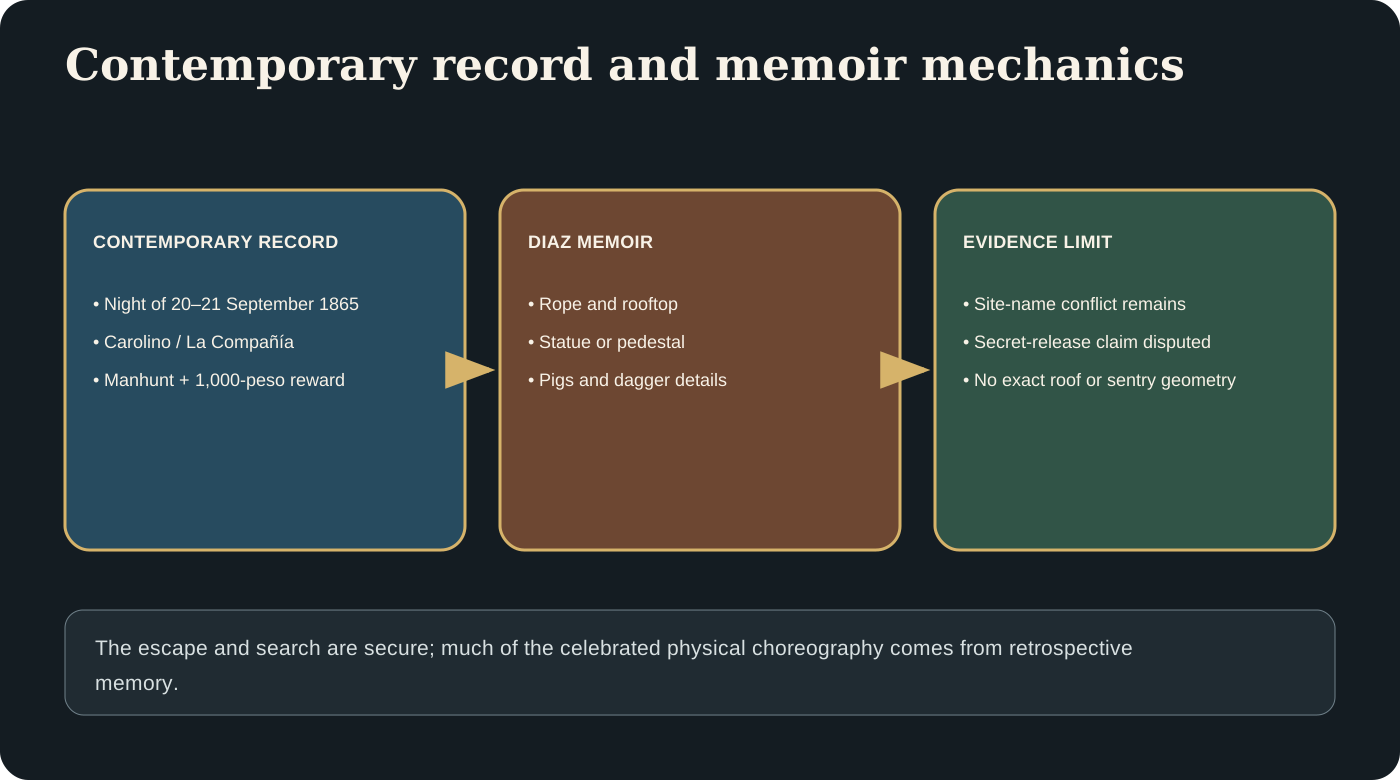
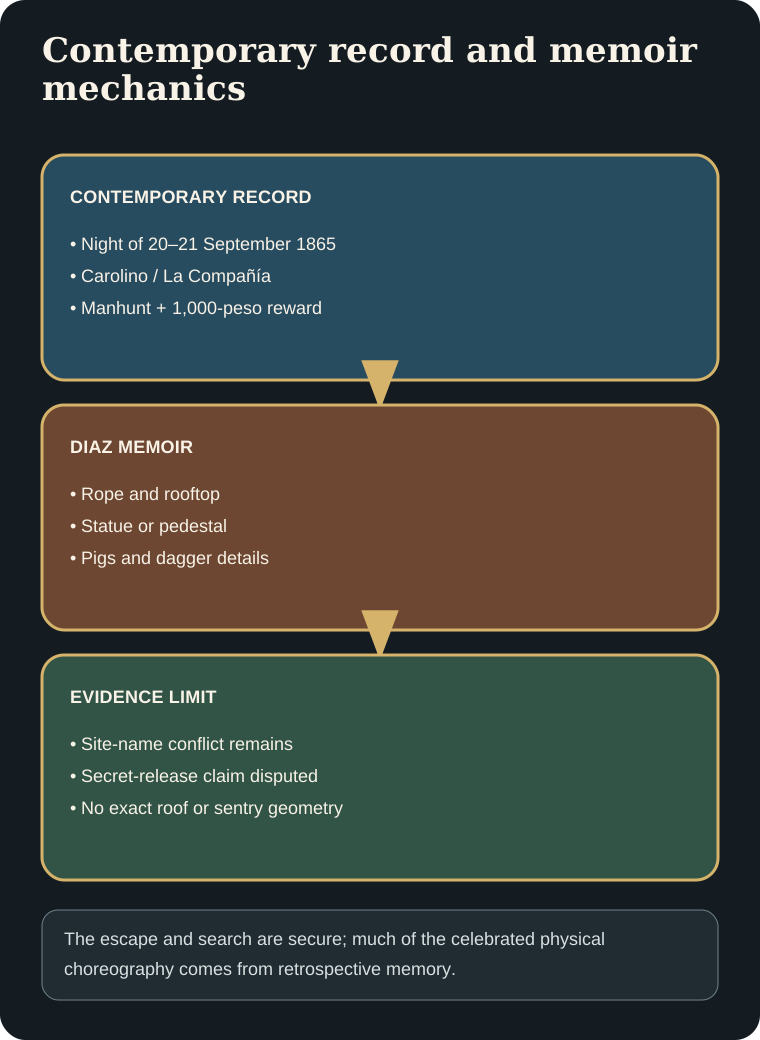
Contemporary records establish the escape and manhunt; the celebrated roof mechanics depend mainly on Díaz’s memoir.