
By the time people began crawling through Tunnel 29, water was already part of the journey. The passage beneath Berlin had taken months to build.
It had to cross from a hidden construction base on the West Berlin side of Bernauer Straße to a basement at Schönholzer Straße 7 in East Berlin. It had to stay concealed from the East German border system above it. It had to carry air, light, tools, excavated soil, and eventually human beings.
And throughout the project, water repeatedly threatened to make the entire route useless. On 14 September 1962, the builders finally reached the East Berlin basement. Over that night and the next, 29 people crawled to West Berlin. The tunnel survived just long enough.
A Border That Kept Getting Harder to Cross
The Berlin Wall did not begin as the mature concrete-and-watchtower system remembered from later decades. On 13 August 1961, East German authorities closed the sector border through Berlin. Barbed wire, police lines, blocked streets, sealed buildings, and new barriers divided neighborhoods that had functioned as one city. Bernauer Straße became one of the most visible places where that division cut directly through ordinary life.
The street itself belonged to West Berlin. Buildings on its southern side stood in East Berlin.
During the first weeks after the closure, people escaped through the border buildings. Some jumped from windows toward the western sidewalk.
East German authorities responded. Entrances were sealed. Windows were bricked up. Residents were removed.
The border became harder to cross above ground. So escape helpers looked below it.
Why Bernauer Straße Became Tunnel Country
The geography of Bernauer Straße made it one of the centers of tunnel activity. The Berlin Wall Memorial records at least ten escape-tunnel projects in the area between 1962 and 1971, although only a small number became successful escape routes. Digging a tunnel did not automatically solve the Wall. It created a new list of problems.
A starting cellar had to hide months of work. The route had to cross the frontier underground. The East Berlin end had to emerge somewhere concealed. Nobody on the eastern side could expose the operation before the escapees arrived.
And the tunnel itself had to remain physically usable. Tunnel 29 nearly lost that last battle.

The Factory at Bernauer Straße 78
The western construction base was a disused factory property at Bernauer Straße 78.
Some institutional references use 78/79, reflecting the site or parcel description. The Berlin Wall Memorial's current tourguide uses 78.
The exact address variation is less important than the building's function. It gave the diggers a hidden basement from which they could work east. The project involved students, refugees from East Germany, and other escape helpers. The Chronicle of the Wall puts the digging group at roughly thirty people.
Later accounts sometimes describe a wider circle around them. No one person built Tunnel 29.
Luigi Spina and Domenico Sesta
Two of the project initiators were Italian students: Luigi Spina and Domenico Sesta. They became central not only to the construction but to the decision that made Tunnel 29 different from almost every other early Wall tunnel. They made an agreement with American television.
NBC would help finance the operation. In exchange, NBC would film it. That decision would eventually make Tunnel 29 famous around the world. Before there could be a film, however, there had to be a tunnel.
Hasso Herschel Had Someone to Bring Out
For Hasso Herschel, the Wall was not an abstract Cold War symbol. His sister was still on the other side. Herschel had lived in East Germany, endured years of imprisonment, and eventually escaped to West Berlin using false documents. Once west, he became involved in organized escape assistance.
Tunnel 29 offered the possibility of bringing out his younger sister Anita and her family. Berliner Unterwelten records that Anita escaped through Tunnel 29 with her husband and their eighteen-month-old daughter. That family connection was common among the builders. People dug because somebody they knew could not simply cross the street anymore.
Joachim Rudolph and the Student Digging Network
Another major participant was Joachim Rudolph. Like many of the young people involved in escape assistance, Rudolph belonged to a world split by the Wall. Students who had previously moved across Berlin for education, relationships, employment, and family life suddenly faced a controlled international frontier inside their city. Later memorial interpretation identifies Rudolph as one of the important planners and builders of Tunnel 29.
The labor itself was repetitive. Dig. Support. Move soil.
Extend air and electricity. Measure direction. Then do it again. For months.
How Long Was Tunnel 29?
This should be an easy question. It is not. The Chronicle of the Wall calls Tunnel 29 120 meters long. Berliner Unterwelten describes it as roughly 130 meters.
A current Berlin.de presentation connected to the documentary Tunnel der Freiheit uses 135 meters. A near-contemporary 1962 account in The New Yorker described approximately 400 feet, which is close to 122 meters. The disagreement is too small to change the history and too real to hide. The best description is:
roughly 120–135 meters
or, more simply:
about 130 meters
The route matters more than the last few meters of measurement.
Keeping a Passage Open Underground
Tunnel 29 was not simply a hole in the soil. The builders had to create an underground working system. Near-contemporary reporting describes:
- timber reinforcement;
- electric lighting;
- alarm arrangements;
- mechanical ventilation;
- improvised use of available equipment.
Later tunnel histories describe pumps and other equipment added as groundwater became a worsening problem. The passage was cramped. It was not designed for comfort. Its purpose was to keep a human-sized route open long enough to connect the two sides of Berlin.
The challenge became harder with every meter. More distance meant: more spoil; more material;
more air needed; more chance of losing direction; and more tunnel available to flood.
The Water Starts Winning
The official Berlin Wall Memorial emphasizes the water. Leakage repeatedly disrupted construction and almost caused the project to fail. Some later accounts describe damaged or encountered water lines. Others emphasize the wet soil and continual pumping.
The precise source of every inflow is less secure than the larger fact:
water threatened the tunnel throughout the project.
The builders continued. That decision explains what the escapees would eventually face. Tunnel 29 did not become a dry, finished corridor. People crawled through mud and infiltrating water to reach the West.
Finding the East Berlin Basement
The eastern target was Schönholzer Straße 7. That distinction matters. An escape tunnel was only useful if it surfaced inside a location that could hide people entering it. Break through in an exposed courtyard, and border forces could see the route.
Break into the wrong building, and months of digging could be wasted. On September 14, the Tunnel 29 builders reached the basement. The underground connection was complete. Now the project switched direction.
The builders had dug:
West → East
The escapees would move:
East → West
The People Waiting in East Berlin
The operation was designed around people, not an open public entrance. Intended escapees had to be brought to Schönholzer Straße without creating a crowd that would attract attention. Among them was Anita Moeller, Hasso Herschel's sister. Another was Eveline Schmidt, later Eveline Rudolph.
Berliner Unterwelten records that Eveline was twenty-one and escaped with her husband Horst Schmidt and their one-year-old daughter Annett.
Her family had been directly disrupted by the Wall. Horst could no longer continue his studies in West Berlin after the border closure.
The tunnel provided a route that official travel rules did not.
September 14–15
The escapes occurred over two nights. One by one, people entered the East Berlin basement. Then they descended into the tunnel. There was no room to walk normally.
They moved through the confined passage toward Bernauer Straße. Water and mud made the journey harder. Children had to be brought through with adults. At the western end, the escape helpers received them.
By the end of the operation:
29 people had reached West Berlin.
That number gave the tunnel its name.
The Camera Was Already There
Most famous escape footage is made after the event. Tunnel 29 was different. NBC had been involved before the escape occurred. Its camera team had documented the project and was present as people came through the tunnel.
The agreement had been made because tunneling cost money. Wood cost money. Equipment cost money. Electrical systems and pumps cost money.
The student network did not have unlimited resources. Spina and Sesta sold the filming rights. The money helped keep the project moving. The cameras then captured an event that might otherwise have survived mainly through photographs and testimony.
A Moral Argument Inside the Escape-Helper Community
Not everyone involved approved. The Chronicle of the Wall records that some of the tunnel diggers later distanced themselves from the commercial arrangement. Their objection was not to the escape. It was to making escape assistance into something that could appear profitable.
This was a real argument in West Berlin. Escape helpers operated in a difficult space. They needed:
- vehicles;
- tools;
- buildings;
- false papers;
- tunnel equipment;
- fuel;
- money.
Media organizations wanted extraordinary stories. Those two realities could support each other. They could also create incentives that made people uncomfortable. Tunnel 29 therefore belongs to the history of journalism as well as the history of the Wall.
NBC's The Tunnel
NBC broadcast the finished documentary on December 10, 1962. The Paley Center catalogues the program as an NBC News special titled The Tunnel. It ran approximately seventy-nine minutes. Reuven Frank produced and wrote the program.
Piers Anderton narrated and co-wrote it. Ray Lockhart directed it. For viewers far from Berlin, the documentary turned an underground engineering project into direct evidence of what the Wall meant to people trying to leave East Germany. The footage gave Tunnel 29 an afterlife that many other escape tunnels never received.
Was NBC's Involvement Purely Helpful?
There is no simple answer. The financing materially assisted the project. The resulting footage preserved unique evidence. Twenty-nine people reached West Berlin.
Those facts are real. So was the internal criticism. The safest historical conclusion is not that NBC “bought an escape” or that the media question was irrelevant. It is that Tunnel 29 was one of the first major cases in which escape assistance and international television became directly entangled.
That is part of why the operation became famous. It is also why the funding deserves its own evidence note.
Why the Tunnel Closed
The escape could not continue indefinitely. Water had already made the passage increasingly difficult. The Berlin Wall Memorial says the route was filled with mud and leaking water during the escape. Once the tunnel became known in western reporting, East German security had another reason to search for it.
The Stasi learned about the tunnel from the western press. Eleven days after the escape, the physical route was discovered when the ground collapsed in an East Berlin courtyard. By then, the 29 were already in the West.
It Was Not the First Tunnel Escape
Tunnel 29's name and media fame sometimes make it sound like the first underground breach of the Wall. It was not. Other successful tunnel escapes had occurred earlier in 1962. On January 24, twenty-eight people escaped near Glienicke through a much shorter tunnel.
In June, another major tunnel operation in the Heidelberger Straße area brought dozens of people out. Tunnel 29 belongs to an intense early period of underground escape activity as the Wall hardened and above-ground options disappeared. Its importance comes from the combination of:
- scale;
- engineering;
- family rescue;
- water-threatened execution;
- and unprecedented television documentation.
It Was Not Tunnel 57
Tunnel 29 and Tunnel 57 are often grouped together because both ran beneath the Bernauer Straße border area. They were different projects.
Tunnel 29
1962 Bernauer Straße 78 → Schönholzer Straße 7 29 escapees NBC documentation roughly 120–135 meters depending on source
Tunnel 57
1964 Bernauer Straße 97 → Strelitzer Straße 55 57 escapees deeper, longer route in most institutional descriptions ended after Stasi discovery and the fatal shooting of Egon Schultz The two cases are directly related. It should not merge their engineering details.
Evidence, Myth and What the Sources Actually Support
Did 29 people escape through Tunnel 29?
DOCUMENTED
Yes. Institutional Berlin Wall histories consistently record twenty-nine people escaping on September 14 and 15, 1962.
Was the tunnel exactly 120 meters long?
DISPUTED
The Chronicle of the Wall uses 120 meters. Berliner Unterwelten uses about 130 meters. A current Berlin.de description uses 135 meters. Use roughly 120–135 meters or about 130 meters.
Did Hasso Herschel build Tunnel 29 by himself?
MYTH
No. Herschel was an important organizer and builder, but the project involved roughly thirty diggers and helpers. Luigi Spina, Domenico Sesta, Joachim Rudolph, and others played substantial roles.
Was Tunnel 29 the first tunnel escape beneath the Berlin Wall?
MYTH
No. Successful tunnel escapes had already taken place earlier in 1962.
Was Tunnel 29 dug from East Berlin toward the West?
MYTH
The main construction proceeded from the West Berlin side toward East Berlin. The escapees then travelled through it in the opposite direction.
Did the tunnel stay dry?
MYTH
Water infiltration repeatedly threatened the project. The escapees crawled through mud and leaking water.
Did NBC become involved only after the escape?
MYTH
NBC was involved before the breakout, providing money in exchange for film rights and documenting the project.
Did every tunnel builder approve of NBC's financing?
DOCUMENTED
No. The Chronicle of the Wall records that part of the digging group later distanced itself from the commercialization of escape assistance.
Did NBC pay exactly 50,000 Deutsche Mark?
WELL-SUPPORTED
Modern quality journalism gives the figure as 50,000 DM, while the core institutional sources confirm the financial agreement without stating the amount in their brief summaries. The exact figure should not be treated as more important than the documented financing relationship.
Was the tunnel discovered immediately after the 29 escaped?
MYTH
The Berlin Wall Memorial states that the Stasi physically discovered it eleven days later after the ground collapsed in a courtyard.
Is the 2001 film Der Tunnel a documentary reconstruction of Tunnel 29 alone?
MYTH
The feature film was inspired by Tunnel 29 but combines and dramatizes multiple Berlin Wall escape histories. The Chronicle of the Wall explicitly warns that it does not follow the historical facts consistently.
Why the Escape Worked
The Wall made above-ground movement increasingly difficult. The helpers went under it. The route was too long for a crude unsupported hole. They added support, lighting, ventilation, and other systems.
The distance created water problems. They kept pumping and digging. The tunnel had to surface in a concealed East Berlin location. They reached Schönholzer Straße 7.
The intended escapees could not simply gather publicly. The operation coordinated their arrival. The tunnel was already wet. They used it anyway.
The route would not remain usable. Twenty-nine people crossed before it was lost. And because cameras had been present underground, the world did not merely hear afterward that the escape had happened. It saw people emerge from beneath the Berlin Wall.
Escape reconstruction
How the escape unfolded
An evidence-aware sequence of the principal stages.
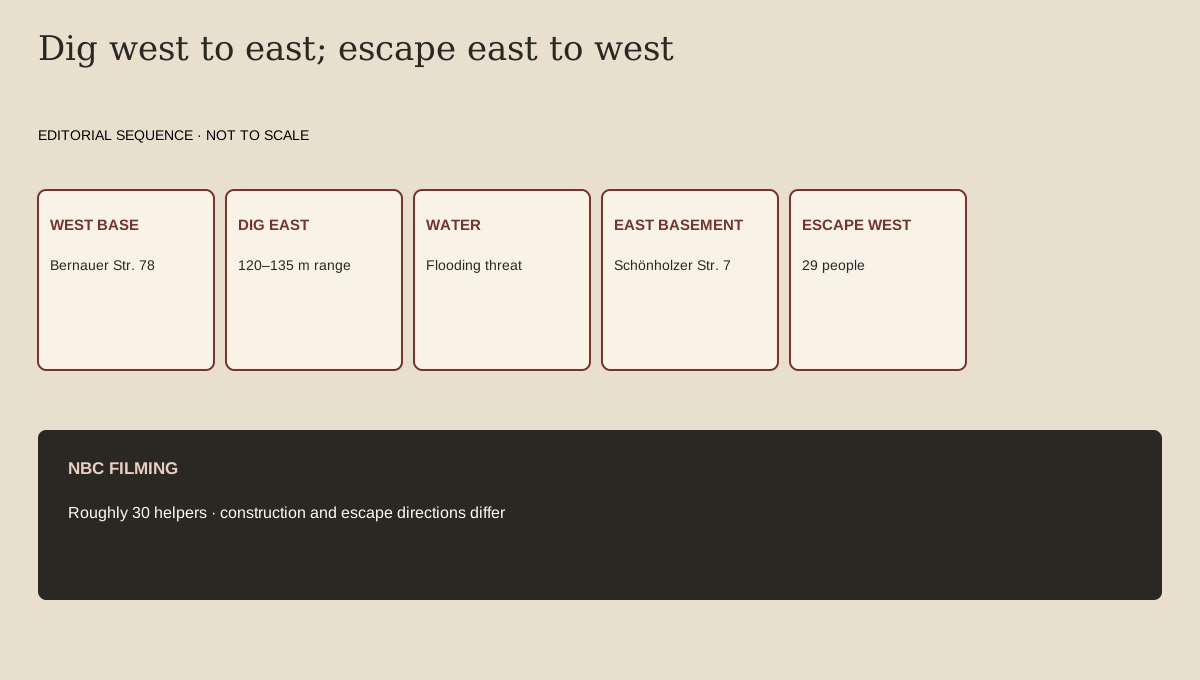
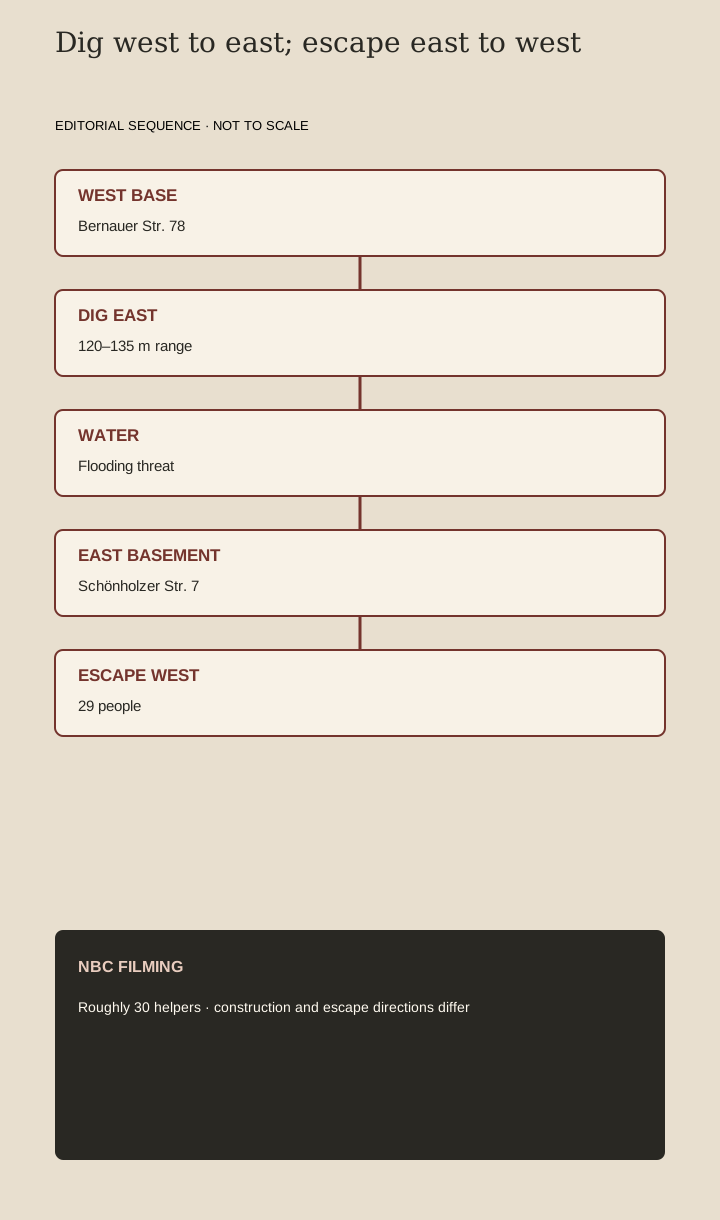
Simplified editorial reconstruction; not to scale. See adjacent text for evidence qualifications and unresolved details.
Material evidence
Tools of Escape
The objects used in an escape reveal how a plan worked under constraint.
- 01Essential
Excavation tools
Hand and powered digging equipment advanced the tunnel through difficult soil over a multi-month construction period.
- 02Essential
Timber reinforcement
Wooden structural support helped keep the long underground passage from collapsing.
- 03Essential
Ventilation
Mechanical ventilation supplied air as the underground distance increased.
- 04High
Electric lighting
Electrical lighting allowed digging and movement deep inside the passage.
- 05Essential
Water-control equipment
Pumps and improvised water-control measures were used as leakage and flooding threatened the tunnel.
- 06High
NBC funding
Film-rights financing helped pay for materials and equipment while giving NBC access to document the operation.
Problem → response
Escape was a sequence of problems
Each response solved a practical obstacle while often creating the next one.
- 01→
Obstacle
Hardened Berlin Wall border
By 1962, above-ground escape opportunities were becoming increasingly dangerous as East German authorities strengthened the border.
Response
The escape-helper group chose a route beneath the border rather than through it.
- 02→
Obstacle
Long underground distance
The builders had to reach a concealed East Berlin basement more than one hundred meters away.
Response
They organized months of digging and added structural and mechanical systems to support the route.
- 03→
Obstacle
Water infiltration
Leakage and flooding repeatedly threatened construction and later made the escape passage muddy and difficult.
Response
The builders continued excavation with pumps and water-control measures and used the route while it remained passable.
- 04→
Obstacle
Need for a concealed East-side exit
A tunnel that surfaced in an exposed location could be discovered before anyone escaped.
Response
The builders aimed for and reached the basement of Schönholzer Straße 7.
- 05→
Obstacle
Financing
A long tunnel required substantial materials and equipment that the student network could not easily fund.
Response
Spina and Sesta sold filming rights to NBC, an arrangement that financed the project but later caused internal controversy.
- 06→
Obstacle
Secrecy after completion
Once the tunnel became public knowledge, East German security could search specifically for the route.
Response
The 29 escaped before physical discovery; the Stasi located the tunnel eleven days later.
The final accounting
Outcome
People who escaped through Tunnel 29
Twenty-nine East German citizens reached West Berlin through the tunnel on September 14 and 15, 1962.
Evidence discipline
What the record supports
Status labels distinguish secure conclusions from uncertainty and rejected claims. Color is never the only signal.
DOCUMENTED
Twenty-nine people escaped through Tunnel 29 on September 14 and 15, 1962.
The Chronicle of the Wall, Berlin Wall Memorial, and specialist memorial sources agree on the total and dates.
Sources: SRC-001, SRC-002, SRC-003DISPUTED
Tunnel 29 was exactly 120 meters long.
The Chronicle of the Wall uses 120 meters, Berliner Unterwelten about 130 meters, Berlin.de 135 meters, and near-contemporary reporting approximately 400 feet. The route is secure but the published measurements vary.
Sources: SRC-001, SRC-003, SRC-006, SRC-008MYTH
Hasso Herschel built Tunnel 29 by himself.
Herschel was a major participant, but institutional sources describe a collective project involving roughly thirty helpers and initiators including Luigi Spina and Domenico Sesta.
Sources: SRC-001, SRC-004MYTH
Tunnel 29 was the first successful tunnel escape beneath the Berlin Wall.
Other successful tunnel escapes occurred earlier in 1962, including the January 24 escape of twenty-eight people.
Sources: SRC-009, SRC-015MYTH
The main Tunnel 29 excavation proceeded from East Berlin toward West Berlin.
The principal construction base was in West Berlin at Bernauer Straße 78 and the builders dug toward Schönholzer Straße 7 in East Berlin. Escapees later moved through it in the opposite direction.
Sources: SRC-001, SRC-002DOCUMENTED
Water infiltration seriously threatened Tunnel 29.
The Berlin Wall Memorial states that water leakage made construction difficult and nearly caused failure; escapees later crawled through mud and infiltrating water.
Sources: SRC-002MYTH
NBC became involved only after the twenty-nine people had escaped.
NBC financing and camera access were arranged during construction, and the network recorded the tunnel project and the arrival of escapees.
Sources: SRC-001, SRC-006, SRC-007WELL-SUPPORTED
NBC paid 50,000 Deutsche Mark for filming rights.
Modern quality journalism repeatedly gives 50,000 DM. The controlling institutional sources independently confirm that NBC financing was provided in exchange for film rights but do not state the exact sum in their concise overviews.
Sources: SRC-001, SRC-013MYTH
All Tunnel 29 builders approved of the NBC financing agreement.
The Chronicle of the Wall records that part of the digging group later publicly distanced itself from commercializing escape assistance.
Sources: SRC-001MYTH
East German security physically discovered Tunnel 29 immediately after the escape.
The Berlin Wall Memorial states that the Stasi learned of the tunnel from western reporting and physically found it eleven days later after a courtyard collapse.
Sources: SRC-002MYTH
The 2001 feature film Der Tunnel reproduces Tunnel 29 exactly.
The Chronicle of the Wall describes the film as based on Tunnel 29 while combining other spectacular Wall escapes and not consistently following the historical facts.
Sources: SRC-016Selected chronology
Selected chronology
The Berlin sector border is closed
East German authorities begin sealing the border through Berlin, creating the system that becomes the Berlin Wall.
Tunnel 29 construction begins
Students, refugees, and other escape helpers begin a multi-month excavation from Bernauer Straße 78 toward East Berlin.
NBC financing enters the project
Luigi Spina and Domenico Sesta sell film rights to NBC, providing financial support in exchange for access to the tunnel project.
Builders reach Schönholzer Straße 7
The tunnel breaks into the intended East Berlin basement and the escape operation begins.
Twenty-nine people escape
Men, women, and children crawl through the wet tunnel and reach West Berlin.
Stasi discovers the physical tunnel
After western publicity reveals the existence of the operation, East German security physically locates the route when ground collapses in a courtyard.
NBC broadcasts The Tunnel
NBC airs Reuven Frank's documentary using footage recorded during construction and the escape.
Memorial plaque unveiled
A commemorative plaque marking Tunnel 29 is unveiled at Schönholzer Straße 7.