
On August 2, 1943, smoke rose above Treblinka. A Polish railway worker, Franciszek Ząbecki, photographed it from outside the camp. He could not see everything happening behind the fences. Neither could the prisoners.
The revolt had begun before the appointed time. Some groups had weapons. Others were still waiting for them. Buildings were burning.
Guards were firing. Hundreds of people were moving toward the perimeter at once. For prisoners who had spent months inside a killing center built to leave almost no witnesses, the uprising was not based on confidence that they could defeat the SS. It was based on a different calculation.
The camp was being emptied. The Germans were burning evidence. The remaining prisoners understood what that meant. If they waited, they expected to be murdered.
So they built an underground inside an extermination camp and tried to create, for as many people as possible, one opening through a system designed to produce none.
Treblinka was built to leave almost no survivors
Treblinka II was not an ordinary prison camp. It was an extermination center. The distinction is essential. German authorities created it during Operation Reinhard, the campaign to murder the Jewish population of the General Government and surrounding territories.
Most deportees arriving at Treblinka were killed shortly after arrival. Only a comparatively small group was selected temporarily for forced labor. Those prisoners sorted the property taken from victims. They worked in workshops.
They maintained parts of the camp. Others were forced into tasks connected directly to the mass killing operation and the destruction of evidence. Their survival was never a stable condition. It was an administrative delay.
A prisoner could be kept alive while useful and murdered when no longer needed. By 1943, that logic became impossible to ignore.
The prisoners could see the camp changing
Treblinka had murdered hundreds of thousands of people in an extraordinarily short period. By early 1943, the pace of incoming transports had changed. The Germans were also exhuming bodies from mass graves and burning them. This was part of a wider effort to destroy evidence of mass murder.
The prisoners did not need access to German strategic orders to understand the danger. The work they were being forced to perform was erasing the reason the Germans still needed them. The closer the camp came to completing its work, the closer the remaining prisoner workforce came to being disposable. That fear shaped the uprising more than any expectation of military victory.

Resistance did not begin on August 2
The revolt was months in preparation. A secret organization developed first among prisoners in the main camp. A separate group emerged in the extermination area. Eventually the networks connected.
The Treblinka Museum describes prisoners organizing in small groups, often called “fives.” That structure made sense in a camp where movement was controlled and discovery could lead to immediate killing. The underground could not operate like a normal resistance organization. It had no secure headquarters.
It had no safe supply line. It existed inside the institution trying to kill everyone who belonged to it.

Work assignments became communication routes
The German camp hierarchy gave some prisoners limited responsibilities. That system was intended to make Treblinka operate more efficiently. The prisoners turned fragments of it against the camp. A carpenter could move somewhere another prisoner could not.
A tailor could enter a storage area. A kitchen worker might observe a guard routine. A doctor or prisoner functionary could sometimes move between groups. Jankiel Wiernik's work as a carpenter gave him unusual access to different areas.
Later sources describe him as one of the people who helped connect the resistance groups in separate camp sectors. Recent scholarship has also shown that women prisoners used work access and social assumptions about their roles to carry information, monitor guard movement, and support resistance. The underground was therefore built partly out of the camp's own forced-labor structure.
The first weapons plan failed
Julian Eliasz Chorążycki was a physician. He was also one of the early members of the Organizing Committee. Prisoners collected money and valuables with the hope that Ukrainian guards might be bribed into providing weapons. The plan collapsed.
In April 1943, SS deputy commandant Kurt Franz discovered a large amount of money in Chorążycki's possession. Treblinka Museum's reconstruction, based on survivor accounts, says a struggle followed and Chorążycki took poison. He died before the uprising he had helped prepare. The underground had lost one of its earliest organizers.
It did not dissolve. That is one of the most important features of the Treblinka resistance. Leadership could be killed. The organization had to survive the loss.
New leaders continued the plan
Marceli Galewski, the Jewish camp elder in the main camp, became one of the central organizers. Sources disagree even about his first name—some use Marceli, others Alfred—which is a reminder of how incomplete Treblinka's documentation became after the Germans destroyed the camp. Želomir Bloch helped link resistance activity across camp sectors.
Dr. Berek Lajcher arrived only in May 1943 after the destruction of the Węgrów ghetto.
According to Samuel Rajzman's later account, Lajcher joined the underground almost immediately and became one of the revolt's leaders. Samuel Rajzman himself was part of the conspiracy. So was Jankiel Wiernik. Others were involved whose names appear only occasionally in the surviving record.
The uprising did not have one mastermind. It had a changing committee trying to preserve a plan while people around it were continually being murdered.
Women were part of the resistance too
For decades, accounts of Treblinka often made the surviving prisoner population sound almost entirely male. Recent archival work has complicated that picture. Historian Chad Gibbs has used trial statements, survivor interviews, spatial analysis, and previously underused testimony to reconstruct women's roles in resistance. Bronka Sukno, a prisoner whose work in the tailor shop allowed movement between key spaces, carried information.
Dr. Irena Lewkowski appears in resistance-related testimony connected to efforts to protect conspirators and deal with informants.
Women working in kitchens and spaces used by guards had access to information and locations that male prisoners did not always have. Some later male testimony minimized or even denied the presence of long-term women prisoners despite evidence that women were there. That silence became part of the history too. The uprising was remembered through a survivor archive that was itself incomplete.
The prisoners needed weapons
The central problem was obvious. The camp was guarded by armed SS personnel and Trawniki-trained auxiliaries. The prisoners were almost entirely unarmed. An earlier attempt to buy weapons had failed.
So the underground shifted to the camp's own armory. The plan depended on getting inside shortly before the revolt. A duplicate key was prepared. On August 2, selected prisoners entered the weapons store and began removing firearms, ammunition, and grenades.
This is often told as the moment the uprising became possible. It was also the point at which the plan became extremely fragile. Weapons had to be distributed. Groups had to be in position.
Fuel had to be prepared. People in different sectors had to understand the signal. The camp's routines had to remain normal until the last moment. Then the timetable broke.
Why August 2
The underground chose a Monday. Treblinka Museum notes that regular deportation transports did not arrive on Mondays. The day was extremely hot. Several later accounts say that some German and Ukrainian personnel were away from their usual positions, including men who had gone toward the Bug River.
That reduced the camp's immediate guard presence. The prisoners hoped to use the temporary weakness. The plan was larger than a rush toward the fence. They intended to take weapons.
Set structures on fire. Attack guards. Coordinate resistance between camp sectors. Create mass confusion.
Then escape into the surrounding countryside. Some versions also describe hopes of linking with prisoners at the nearby Treblinka I labor camp and reaching partisan forces. The plan was ambitious because a narrow plan offered too little chance of survival.
The revolt began before the scheduled signal
Shortly before four in the afternoon, SS guard Kurt Küttner confronted or detained prisoners connected to the underground. Recent scholarship and survivor testimony differ in the exact sequence. The central fact is clear. The conspirators believed the plan was about to be exposed.
Waiting for the appointed hour now carried a new risk. Interrogation could destroy the underground before it acted. Shots were fired. Many prisoners interpreted them as the signal.
The uprising had started. But it had started too early. Some prisoners had not received weapons. Some were not in their assigned places.
The carefully coordinated plan became a chaotic revolt. That premature start probably reduced what the prisoners could accomplish. It may also have prevented the conspiracy from being crushed before anything happened at all.
Fire changed the camp
Prisoners attacked guards and set structures ablaze. Fuel ignited wooden buildings. Smoke rose high enough to be visible from outside. That is what Ząbecki photographed.
The image is extraordinary because Treblinka produced almost no visual record of its own destruction while the camp still operated. The photograph does not show the people running. It does not show the underground. It does not show who lived or died.
It shows the physical consequence of resistance: the killing center was burning.
The gas chambers survived
This is one of the most important corrections to the popular version. The uprising did not destroy Treblinka completely. The fires damaged major camp structures. They created confusion.
They helped open the possibility of escape. But the gas chambers remained intact. That mattered because German authorities continued killing people there after August 2. Transports from the Białystok ghetto arrived later that month.
Their passengers were murdered. The uprising accelerated the camp's decline. It did not end Treblinka's killing operation that afternoon.
The perimeter became the next barrier
As the camp burned, prisoners ran. Guards fired from fortified positions. Barbed wire and other obstacles remained. Some prisoners had weapons.
Many did not. The purpose was no longer to hold territory inside Treblinka. It was to get beyond the camp before the Germans restored control. Samuel Willenberg later described prisoners trying to cross the perimeter amid bodies and wire.
Jankiel Wiernik also escaped in the uprising. Samuel Rajzman reached the surrounding area. Others died before getting out. The scale is one of the hardest parts of the event to reconstruct.
How many prisoners were there?
There is no single uncontested number. The Treblinka Museum currently uses a figure of about 840 prisoners present on August 2. A 2025 museum commemoration stated that 105 of them did not participate. That would imply participation by the large majority of the remaining camp population.
United States Holocaust Memorial Museum summaries often say about 1,000 Jewish prisoners participated. Those figures cannot simply be merged into a precise total. The evidence base is too incomplete. Treblinka was destroyed.
The German perpetrators tried to erase records. Survivor testimony was collected at different times and under different conditions. The correct conclusion is not that one institution must be careless. It is that counting the prisoners in a killing center deliberately stripped of its records is difficult.
How many escaped?
The same problem appears again. The Treblinka Museum generally uses about 200 prisoners escaping. Several USHMM summaries also use about 200. But a USHMM Treblinka key-dates page states that more than 300 escaped and that roughly two-thirds were later recaptured and killed.
Samuel Rajzman's museum biography gives a range of 200–300. These are major sources. They disagree. The disagreement is part of the evidence.
The article does not need a neat number more than the history needs one. The evidence supports this conclusion:
roughly two hundred to several hundred prisoners broke out, and many were later recaptured or killed.
Breakout was not the same as survival
Treblinka stood in German-occupied Poland. Getting outside the fence did not put an escapee in friendly territory. Police units, gendarmes, military personnel, camp guards, and collaborators searched the region. Some fugitives hid in forests.
Some approached villages. Some were betrayed. Some were killed by Germans or others. Some found people willing to hide them.
Some joined partisan formations. The uprising therefore had two escape problems. The first was the camp. The second was occupied Europe.
Samuel Rajzman's group was found
Rajzman knew the region around Węgrów. After escaping, he hid with other fugitives in nearby forest. His Treblinka Museum biography records that the Germans found the group while he was away looking for food. The others were killed.
Rajzman survived because he was absent. Later, with other Jews, he found shelter with a local farmer and remained hidden until the end of the war. That story shows why the number who crossed the fence is not the number who survived. Every day after August 2 created another chance for capture.
Wiernik carried Treblinka's story out with him
Jankiel Wiernik escaped too. He made his way back toward Warsaw and survived underground. In 1944, while the war was still being fought, his account appeared in Polish under the title Rok w Treblince—A Year in Treblinka. It was quickly translated.
That publication is one reason the uprising matters beyond the number of people who survived it. Treblinka had been designed to murder witnesses. A witness escaped. Then he wrote.
The Germans had tried to destroy both people and evidence. Wiernik became evidence they failed to erase.
Willenberg survived long enough to become a witness for decades
Samuel Willenberg was twenty years old in 1943. He was wounded during the breakout but reached the countryside. He survived the remainder of the German occupation and later took part in the 1944 Warsaw Uprising. For decades afterward he testified, wrote, and made sculpture about Treblinka.
When he returned to the site for commemorations, he represented a category that had once seemed almost impossible: a prisoner selected to work inside Treblinka who had escaped the camp and lived into old age. His survival should not turn the uprising into a story with a reassuring ending. It should show exactly how rare the ending was.
The survivor count is still changing
For many years, histories repeated a figure of sixty-eight Treblinka survivors. That number came from an important but incomplete list assembled by survivor and editor Alexander Donat. Recent research has expanded the known record substantially. In 2025, Chad Gibbs reported identifying 262 named survivors of Treblinka through several different paths.
Seventy of those named survivors escaped during the August revolt. Others escaped earlier, were transferred elsewhere before being murdered, or survived through other exceptional circumstances. Gibbs explicitly warns that no list can ever be considered complete. That warning should govern the article.
The proper question is not:
What is the final exact number?
It is:
What can the current evidence support, and why have the numbers changed?
Women are one reason the old lists were incomplete
Gibbs's research also exposes another source problem. Women prisoners were frequently marginalized in postwar accounts. Some women who survived sexual exploitation or coercion had powerful reasons not to discuss what happened. Male survivors did not always mention women's presence or resistance roles.
Later historians then inherited an archive skewed toward male testimony. Bronka Sukno and Sonia Lewkowicz are two women known to have been in Treblinka during the uprising and survived. Other women survived Treblinka through different paths. The archive did not simply forget names randomly.
Trauma, shame imposed by others, gender assumptions, and the structure of postwar testimony affected who became visible. That means counting is not only arithmetic. It is source criticism.
Many uprising leaders did not survive
The conspiracy's leadership paid heavily. Berek Lajcher was killed during the revolt. Other organizers died during the breakout or in its aftermath. Galewski did not survive the war.
The outcome makes it especially misleading to turn one surviving witness into the single author of the uprising. Wiernik mattered. Rajzman mattered. Willenberg mattered.
They survived to tell us about people who could not. Their testimony is strongest when it restores a collective, not when it replaces the dead with the names of the living.
The Germans resumed killing
After August 2, the camp was damaged and the prisoner workforce reduced. But Treblinka did not instantly cease functioning. Later in August, transports carrying Jews from the Białystok ghetto reached the camp. The gas chambers had not been destroyed.
The deportees were murdered. That fact is essential to the outcome classification. The prisoners succeeded in revolting. A substantial number escaped.
The camp burned. The operation was disrupted. But the revolt did not liberate Treblinka or permanently disable its killing machinery on August 2.
The camp was then dismantled
The uprising took place while Operation Reinhard was already moving toward completion. The Germans had already been exhuming and burning bodies. They were already trying to erase traces of the killing sites. After the revolt, dismantling accelerated.
Treblinka Museum chronology dates the completion of liquidation to November 17, 1943. The final Jewish prisoners forced to dismantle the site were murdered. The Germans ploughed the area. They planted crops.
They built a farmhouse from materials taken from the destroyed camp. The goal was to make the extermination center disappear into ordinary landscape.
Did the uprising close Treblinka?
Yes and no. If “close” means the revolt forced an immediate end to killing, the answer is no. Killings continued. If it means the uprising materially damaged the camp, depleted the prisoner workforce, demonstrated that Treblinka could no longer be operated as before, and accelerated the process of liquidation, then it clearly mattered.
But the Germans were also nearing the end of Operation Reinhard's mass-deportation phase and were already destroying evidence. The most accurate interpretation preserves both processes. Treblinka was already moving toward closure. The revolt made that closure more urgent and more difficult for the perpetrators to control.
The uprising was not spontaneous
The early gunfire can make the event look improvised. It was not. The exact moment of outbreak was improvised. The organization behind it had taken months.
Prisoners created cells. They developed cross-camp communication. They tried one weapons plan and lost Chorążycki. They rebuilt.
They found a way into the armory. They chose a day. They prepared fuel. They allocated responsibilities.
Then Küttner's intervention forced them to act before the system was fully in place. The distinction matters because “spontaneous revolt” hides the most difficult achievement. The prisoners had built an underground inside Treblinka.
The revolt did not have one mastermind
There is a recurring temptation in escape history to find one planner. Treblinka resists that structure. Chorążycki helped organize and died months before the revolt. Galewski used his position inside the prisoner hierarchy to protect and coordinate people.
Bloch linked groups. Lajcher became a leader after arriving late. Rajzman participated and survived. Wiernik connected camp areas.
Women whose names were later pushed out of the narrative carried information and used access to spaces essential to the conspiracy. The uprising survived because no single person's death could erase every relationship. That was the point of organization.
What the Ząbecki photograph proves—and what it does not
The famous image of smoke is powerful because it was made on the day itself. It proves that structures inside Treblinka were burning. It gives a visual anchor for an event otherwise known mostly through testimony and postwar reconstruction. It does not show the entire camp.
It cannot count participants. It cannot settle how many reached the forest. It cannot tell us who set each fire. It should be used as evidence, not as a substitute for evidence.
That is a useful rule for the entire case.
Why the count conflicts should stay visible
A reader may find it frustrating that one authoritative source says about 200 escapees while another says more than 300. That frustration is part of the history. The perpetrators destroyed records. Many prisoners died during or after the revolt.
Some survivors never gave testimony. Different institutions count different stages—people who crossed the perimeter, people who evaded the first manhunt, people who were later recaptured, people alive at war's end. Recent archival research continues finding names. A clean total would make the page easier to design.
An honest range makes it better history.
What actually succeeded
The uprising did not accomplish every objective. The gas chambers survived. Most prisoners did not survive the breakout and war. The camp was not liberated.
The nearby labor camp was not taken. Yet the revolt did achieve things the Treblinka system was built to prevent. Prisoners organized collectively. They stole weapons from their captors.
They burned part of the killing center. They broke through the perimeter. Some survived. Some gave evidence.
A photograph recorded the smoke. A memoir reached print before the war ended. Treblinka had been designed to murder people and then erase the fact that they had been there. The uprising created witnesses.
That may be its most enduring success.
Why Treblinka belongs in escape history
Calling the event only an escape would make it too small. Calling it only an uprising would miss the survival problem at its center. The prisoners were not trying simply to seize the camp. They were trying to create a mass opening in a place where individual escape had usually brought collective punishment and death.
The revolt was the method. Escape was one of its central purposes. And even then, reaching the other side of the wire was only the beginning. The story therefore has three stages:
organize inside a killing center
break the camp's control
survive the occupied world outside it
Very few reached the third stage. Enough did to make Treblinka fail at one thing the Germans considered essential. It did not eliminate every witness.
Escape reconstruction
How the escape unfolded
An evidence-aware sequence of the principal stages.
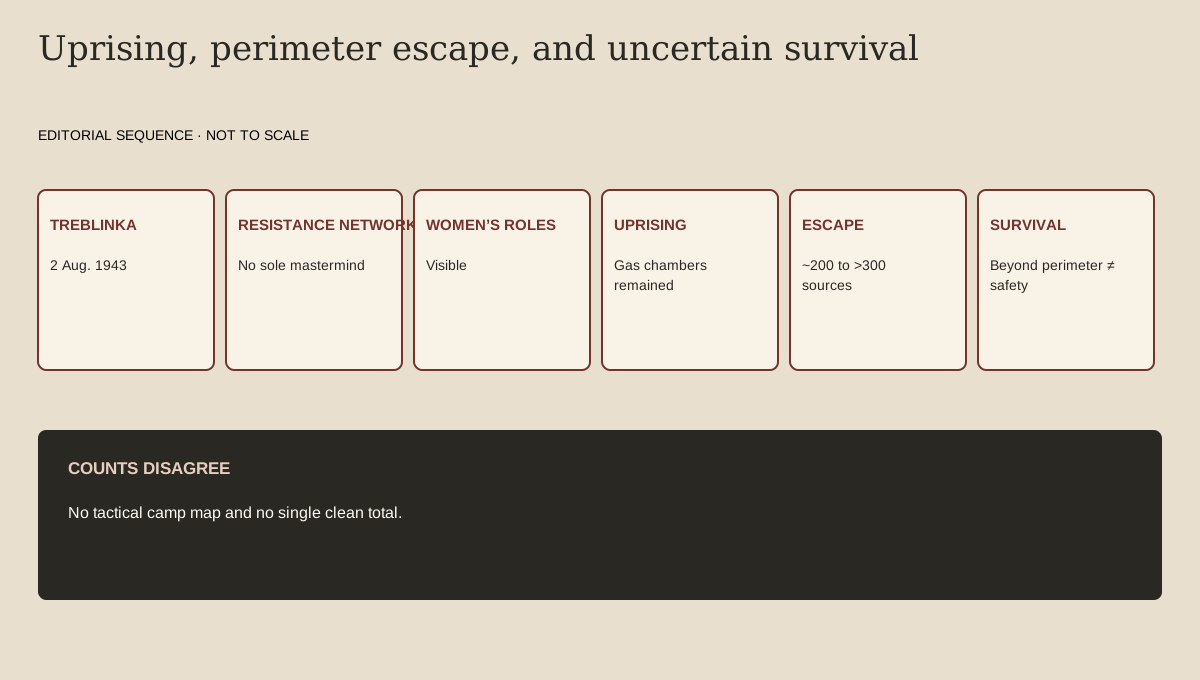
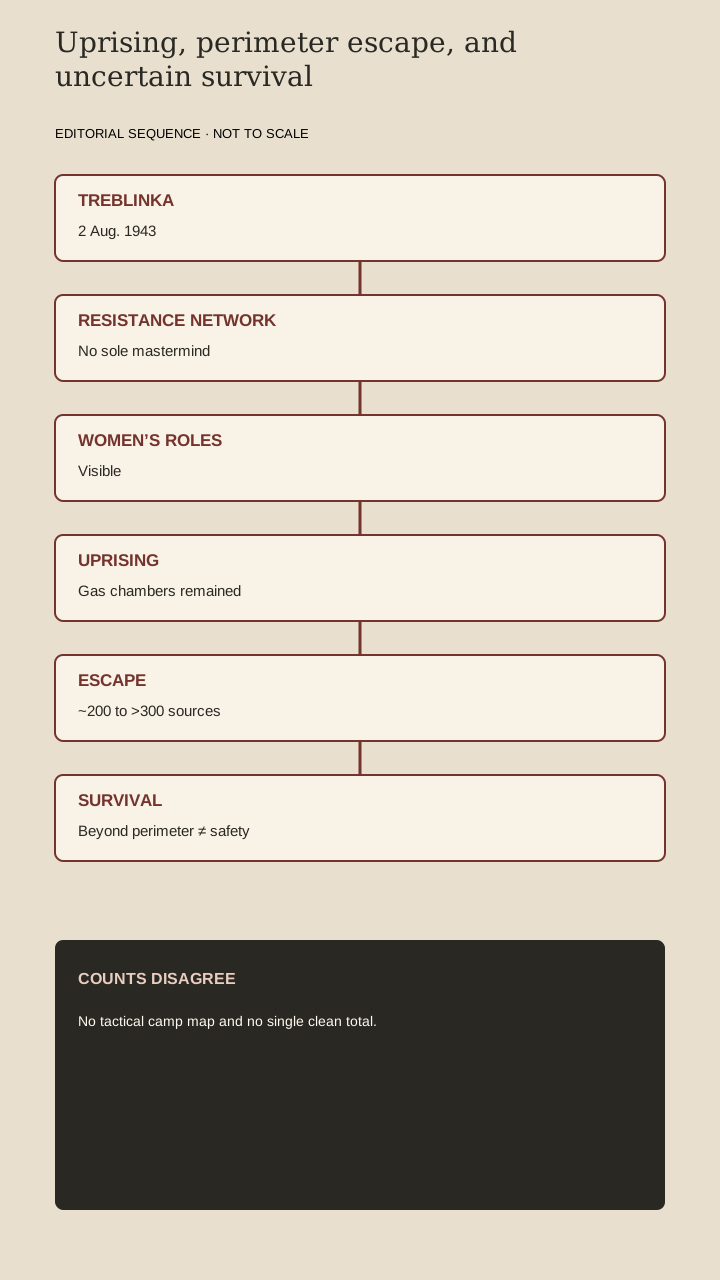
Simplified editorial reconstruction; not to scale. See adjacent text for evidence qualifications and unresolved details.
Material evidence
Tools of Escape
The objects used in an escape reveal how a plan worked under constraint.
- 01The uprising depended on collective preparation under a system designed to isolate, terrorize, and frequently replace the prisoner workforce.
Organizing Committee
A secret prisoner leadership network connecting people whose work positions gave access to different areas and groups.
- 02Small-cell organization limited how much information any one arrest or betrayal could expose.
Cells of five
The Treblinka Museum describes prisoners forming small groups of roughly five people during preparation.
- 03It gave a prisoner population with almost no weapons access to a limited number of firearms, grenades, and ammunition.
Duplicate armory key
Conspirators gained clandestine access to the SS weapons store using a duplicated key shortly before the revolt.
- 04Fire created confusion, damaged infrastructure, and produced the uprising's most visible physical effect.
Fuel and fire
Prisoners accumulated or accessed fuel intended to ignite camp buildings during the revolt.
- 05Those permissions created communication routes inside a camp designed to prevent free movement and cooperation.
Work-position mobility
Certain prisoners could move between workshops, kitchens, storage spaces, medical areas, or camp sectors because of their forced-labor assignments.
Problem → response
Escape was a sequence of problems
Each response solved a practical obstacle while often creating the next one.
- 01→
Obstacle
The camp was designed for murder, not long-term prisoner survival
Treblinka's forced-labor prisoners understood that their temporary survival depended on German operational needs and could end whenever those needs disappeared.
Response
The underground treated uprising and mass escape as a collective attempt to create a chance of survival before the remaining workforce was murdered.
- 02→
Obstacle
Prisoners were segregated by work and camp sector
The main camp and extermination area had different prisoner groups, fences, schedules, and guard systems.
Response
Organizers used prisoners with unusual work mobility, including Wiernik and others, to carry information and link resistance groups.
- 03→
Obstacle
Weapons were controlled by SS and guards
The prisoners had almost no legal or routine access to firearms.
Response
After an earlier bribery plan failed, conspirators prepared covert access to the armory and stole a limited supply shortly before the uprising.
- 04→
Obstacle
The conspiracy was nearly exposed before the scheduled hour
Kurt Küttner detained prisoners connected to the underground, creating fear that interrogation would reveal the plan.
Response
Resistance members began the revolt early rather than wait for the full timetable, sacrificing coordination to avoid losing the operation entirely.
- 05→
Obstacle
Guard towers and perimeter defenses remained active
Many prisoners trying to leave faced fire from guards and physical obstacles around the camp.
Response
The mass rush, fires, limited armed resistance, and simultaneous movement created enough disorder for a substantial minority to reach the surrounding countryside.
- 06→
Obstacle
Leaving the camp did not mean reaching safety
The surrounding area remained under German occupation and a broad manhunt began after the breakout.
Response
Survivors dispersed into forests and villages, sought local aid, hid under false identities, or connected with partisan networks.
The final accounting
Outcome
Prisoners who reached the area outside the camp
The number is disputed. Current Treblinka Museum material generally uses about 200, while USHMM publications range from about 200 to more than 300.
Named revolt escapees identified as war survivors in recent scholarship
Chad Gibbs's 2025 research identifies seventy named Treblinka survivors who got out during the revolt; the author stresses that any survivor list remains incomplete.
Uprising leaders killed
Several major organizers, including Berek Lajcher, were killed during the revolt or its immediate aftermath; the leadership paid an exceptionally high price.
Gas chambers destroyed by the uprising
The fire damaged camp structures, but the gas chambers remained usable and murders resumed before final liquidation.
Long-term effect on camp operations
The uprising damaged the camp and depleted its prisoner workforce, and German authorities accelerated the dismantling process. It did not end killing immediately.
Evidence discipline
What the record supports
Status labels distinguish secure conclusions from uncertainty and rejected claims. Color is never the only signal.
MYTH
Treblinka prisoners went passively to their deaths without organized resistance.
Prisoners created a secret Organizing Committee, developed cells in multiple camp sectors, attempted to obtain weapons, prepared an armed revolt, and launched a mass breakout on August 2, 1943.
Sources: SRC-002, SRC-004, SRC-013DISPUTED
Exactly 1,000 prisoners took part in the uprising.
USHMM summaries commonly say about 1,000 prisoners participated. The Treblinka Museum's more recent reconstruction places about 840 prisoners in the camp and in 2025 stated that 105 did not participate. Differences reflect evolving reconstruction and the fragmentary source base.
Sources: SRC-002, SRC-006, SRC-023DISPUTED
Exactly 200 prisoners escaped.
The Treblinka Museum and some USHMM summaries use about 200. A USHMM key-dates page states that more than 300 escaped, while Samuel Rajzman’s museum biography gives 200–300. The surviving sources support a range rather than one falsely precise total.
Sources: SRC-002, SRC-003, SRC-011MYTH
Only sixty-eight Treblinka survivors existed after the war.
The long-repeated figure derives from an older survivor list. Chad Gibbs's recent archival research has identified 262 named Treblinka survivors through multiple survival paths, including seventy who escaped during the revolt, and explicitly cautions that the total can never be complete.
Sources: SRC-013MYTH
The uprising destroyed Treblinka's gas chambers and ended killing on August 2.
The fires destroyed or damaged wooden structures but not the gas chambers. Deportees from the Białystok ghetto were murdered at Treblinka later in August before the Germans completed dismantling the site.
Sources: SRC-003, SRC-005, SRC-007MYTH
The revolt was improvised spontaneously on August 2.
The uprising was prepared over months. What was improvised was the early start: the revolt began before the planned hour when prisoners feared that Kurt Küttner's actions would expose the conspiracy.
Sources: SRC-004, SRC-009, SRC-013, SRC-014MYTH
One single leader masterminded the Treblinka uprising.
The resistance passed through multiple leaders and committees. Chorążycki helped launch the early conspiracy and died months before the uprising; Galewski, Bloch, Lajcher, Rajzman, Wiernik, and others held different responsibilities. The operation was collective and changed over time.
Sources: SRC-004, SRC-009, SRC-010, SRC-014MYTH
Women played no role in the Treblinka resistance.
Recent archival scholarship shows that women prisoners carried information, used their work access to monitor spaces, helped protect conspirators, and participated in weapons-related resistance activity. Earlier male-centered testimony and historiography often obscured those roles.
Sources: SRC-013MYTH
All prisoners who escaped the camp were quickly recaptured.
The German manhunt killed and recaptured many, but a significant minority survived the war. Recent research identifies seventy named war survivors who got out during the revolt.
Sources: SRC-001, SRC-013DISPUTED
The uprising alone caused the Germans to close Treblinka.
The revolt damaged the camp and accelerated liquidation, but the extermination of most target populations under Operation Reinhard was already nearing completion and evidence-destruction operations were underway. The closing should be understood as both a preexisting process and one hastened by the uprising.
Sources: SRC-001, SRC-005, SRC-007, SRC-017Selected chronology
Selected chronology
Treblinka II begins mass killing operations
The extermination center begins receiving deportation transports during Operation Reinhard.
Organizing Committee forms
Prisoners in the main camp establish a secret resistance organization that later links with a smaller group in the extermination area.
Chorążycki dies
An early effort to obtain weapons through bribery collapses after SS deputy commandant Kurt Franz discovers money held by Julian Chorążycki; Chorążycki dies, but the underground continues.
Berek Lajcher reaches Treblinka
After the destruction of the Węgrów ghetto, Lajcher is deported to Treblinka and soon joins the resistance leadership.
Fear of liquidation intensifies
As corpse-burning nears completion and transports decline, prisoners believe the Germans will soon kill the remaining labor force and erase the camp.
Final preparations
The underground positions members, prepares fuel and tools, and removes weapons from the SS armory using duplicated access.
The uprising begins early
A confrontation involving SS guard Kurt Küttner creates fear that the conspiracy will be exposed. Gunfire starts before every group is ready.
Fire and mass breakout
Prisoners attack guards, set buildings on fire, and rush the perimeter. Hundreds reach the area outside the camp according to competing postwar estimates.
Manhunt
German security forces and auxiliaries search the region. Many escapees are captured and killed; others hide, join partisan groups, or receive civilian assistance.
Killings resume
Transports from the liquidated Białystok ghetto reach Treblinka after the uprising. The gas chambers, which had survived the revolt, are used again.
Treblinka II liquidation completed
The Germans finish dismantling the camp, murder the remaining Jewish Restkommando prisoners, and disguise the site as a farm.
Wiernik publishes an early survivor account
Jankiel Wiernik's A Year in Treblinka is published by the Polish underground and then translated, providing one of the earliest detailed accounts by an escapee.