
The Sobibor Uprising and Mass Escape: How Prisoners Broke Out of a Nazi Killing Center
On the afternoon of 14 October 1943, prisoners inside the Nazi German killing center at Sobibor began a revolt built around a difficult premise: before hundreds of prisoners could escape, the camp's armed command structure had to be disrupted from inside.
The conspirators did not begin by charging the fences. Their plan was quieter and more controlled. Selected SS personnel would be drawn one by one into workshops and storerooms, killed before a general alarm could spread, and stripped of weapons. Communications would be cut. The larger prisoner population would assemble as though for an ordinary roll call. If the deception held long enough, the prisoners would move toward the main gate before the remaining guards understood that the camp had been thrown into revolt.
For part of the afternoon, the plan worked.
Deputy commandant Johann Niemann was killed after being lured into a workshop. Other camp personnel were attacked elsewhere. But the conspirators could not remove every intended target, and the final phase did not remain secret long enough to produce the orderly departure they had envisioned. The remaining guards opened fire. The escape became a mass breakout through barriers and across a perimeter that included mined ground.
About 300 prisoners escaped the camp itself. German forces recaptured and killed at least about 100 during the pursuit. Others died in the weeks and months that followed. About 50 escapees survived the war.
Those numbers make Sobibor one of the most consequential prisoner uprisings and mass escapes of the Holocaust. But its significance is not simply numerical. The uprising shows how people held in a place designed for mass murder constructed a clandestine organization, combined local knowledge with military experience, exploited the routines of their captors, and forced a narrow opening where almost none existed.
Sobibor Was Not a Conventional Prison
Understanding the escape requires first understanding the place from which the prisoners were trying to escape.
Sobibor was one of the Nazi German killing centers created as part of Operation Reinhard, the campaign to murder the Jews of the General Government in occupied Poland and other European Jews deported into the region. The camp's central function was not long-term incarceration. Most deportees sent there were murdered soon after arrival.
A comparatively small group of prisoners was selected for forced labor. They sorted clothing and possessions stolen from murdered victims, maintained workshops, handled camp infrastructure, and performed other tasks that kept the killing center functioning. Their continued survival was temporary and conditional. They worked within the same system that was murdering the people arriving around them.
The physical organization of the camp reinforced German control. Different functions were separated into camp sectors. Prisoners in the area associated with the gas chambers and disposal of bodies were especially isolated. Fences, armed guards, towers, controlled gates, and a mined perimeter made a spontaneous mass flight extraordinarily dangerous.
Individual escape attempts had occurred. They could also bring lethal reprisals against prisoners who remained. A plan for a large-scale escape therefore faced two problems at once: how to get out, and how to prevent the Germans from suppressing the attempt before hundreds had a chance to move.
By 1943 another fear sharpened the urgency. Prisoners knew that the pattern of transports was changing. Accounts circulated about what had happened to Jewish labor prisoners from Bełżec after that killing center was dismantled. If Sobibor's role was ending, the remaining prisoners had strong reason to believe that the Germans would murder the witnesses who had been forced to work there.
The problem was no longer simply whether escape was dangerous. Remaining in the camp offered no reliable path to survival.
Leon Feldhendler and the Underground
A clandestine resistance group developed among prisoners at Sobibor during 1943. Leon Feldhendler, a Polish Jew from Żółkiewka who had held a leadership role in his pre-deportation community, emerged as one of its central figures.
The underground considered escape possibilities under severe constraints. Any plan discussed too widely could be discovered. A failed action could lead to executions. A successful escape by only a few might provoke retaliation against everyone else.
That made a mass escape both morally compelling and operationally difficult.
The group needed people who knew the camp: routines, buildings, work assignments, the personalities and habits of the SS men, and the points where guards expected prisoners to be. Yet it also needed military experience—the ability to turn knowledge of the camp into a sequence of coordinated actions.
That second element arrived in late September 1943.
A transport from Minsk brought a group of Jewish Soviet prisoners of war to Sobibor. Among them was Alexander Pechersky, a Red Army officer. The existing underground made contact with him and other Soviet POWs. The collaboration that followed was essential: Feldhendler and the established prisoners possessed local knowledge and clandestine connections; Pechersky and the soldiers contributed military organization and a framework for simultaneous action.
The uprising should therefore not be reduced to a single heroic mastermind. Pechersky became the principal operational leader of the final plan, but he entered a camp in which resistance organization already existed. Sobibor's revolt emerged from the combination of those networks.
Problem → response
Escape was a sequence of problems
Each response solved a practical obstacle while often creating the next one.
- 01→
Obstacle
Armed SS and auxiliary guard force
The prisoners were confined by armed personnel, towers, fences, and a gate system designed to prevent escape.
Response
The conspiracy sought to reduce the command structure quietly before the remaining guards knew an uprising was underway.
- 02→
Obstacle
Minefield and perimeter defenses
Parts of the camp perimeter were mined, making a direct uncontrolled breakout especially dangerous.
Response
The preferred plan relied on leaving through the gate; once that failed, prisoners were forced to accept the risks of the perimeter.
- 03→
Obstacle
Compartmentalized camp
Prisoners in the killing area known as Lager III were segregated and could not be incorporated effectively into the main conspiracy.
Response
The uprising was organized among reachable prisoner groups; the exclusion of Lager III was a brutal structural limitation, not an editorial omission.
- 04→
Obstacle
Secrecy versus mass participation
A mass escape needed hundreds of people to move at once, but telling hundreds in advance risked discovery.
Response
Only a restricted group knew the plan in advance, with the wider prisoner population to be informed at the last possible moment.
- 05→
Obstacle
Survival after the fence
Reaching the forest was not the same as reaching safety. Escapees faced German pursuit, lack of food and shelter, hostile or dangerous civilians, and the difficulty of joining partisan formations.
Response
Survivors hid with local assistance, moved in small groups, or joined partisan units; outcomes varied dramatically.
The Central Problem: How Do Hundreds Escape Before the Alarm Spreads?
A direct attack on the perimeter was the simplest idea and probably the worst one.
The prisoners did not possess enough firearms to overpower the camp guard force in an open battle. The towers and perimeter defenses favored the guards. The camp's mined areas made an uncontrolled rush still more dangerous. If guards had several minutes of warning, they could concentrate fire on prisoners trapped inside the enclosure.
The conspiracy therefore tried to reverse the sequence. Instead of beginning with the escape and fighting whoever blocked it, the prisoners would first weaken the German command structure without announcing that an uprising had begun.
The camp's own routines created the opportunity. SS personnel used prisoner workshops and had access to clothing, footwear, furniture, and belongings stolen from deportees. A German could be told that a coat, uniform, pair of boots, or other desirable item was ready for him. He would then enter a workshop at a specified time, potentially separated from other armed personnel.
Inside, a small prisoner team could attack.
The choice of axes and similar tools was not primitive improvisation in the sense of an unplanned riot. Such tools were available in the work environment and could be used without the immediate gunfire that would have announced the revolt across the camp. If several targets could be eliminated in different locations within a short period, the prisoners might create the illusion that the afternoon remained normal.
Their firearms would come partly from the men they killed and from other opportunities to obtain weapons.
Communications were another target. Cutting telephone or electrical connections could slow the ability of surviving personnel to understand events and call for help.
Then came the most ambitious part: the prisoners would gather in the ordinary rhythm of the camp, and the mass departure would begin under the cover of routine. The plan depended on time, not on defeating the whole guard force. Every isolated SS man who failed to return, every schedule that shifted, and every unexpected person who appeared in the wrong place consumed that time.
The Revolt Was Supposed to Happen a Day Earlier
Survivor Esther Raab later recalled that the prisoners had prepared themselves for the uprising on 13 October. The date mattered because the conspirators were trying to exploit the absence of some of Sobibor's most dangerous German personnel.
Then an unexpected group of SS men arrived from another location.
Their presence introduced too many unknowns. The conspirators postponed the revolt.
The next day they tried again.
That delay is a small detail with large implications. It shows that this was not an eruption caused by a single confrontation. The prisoners were making operational decisions in real time. They had a plan, recognized when conditions had changed, and were willing to risk postponement rather than launch under circumstances that had suddenly become worse.
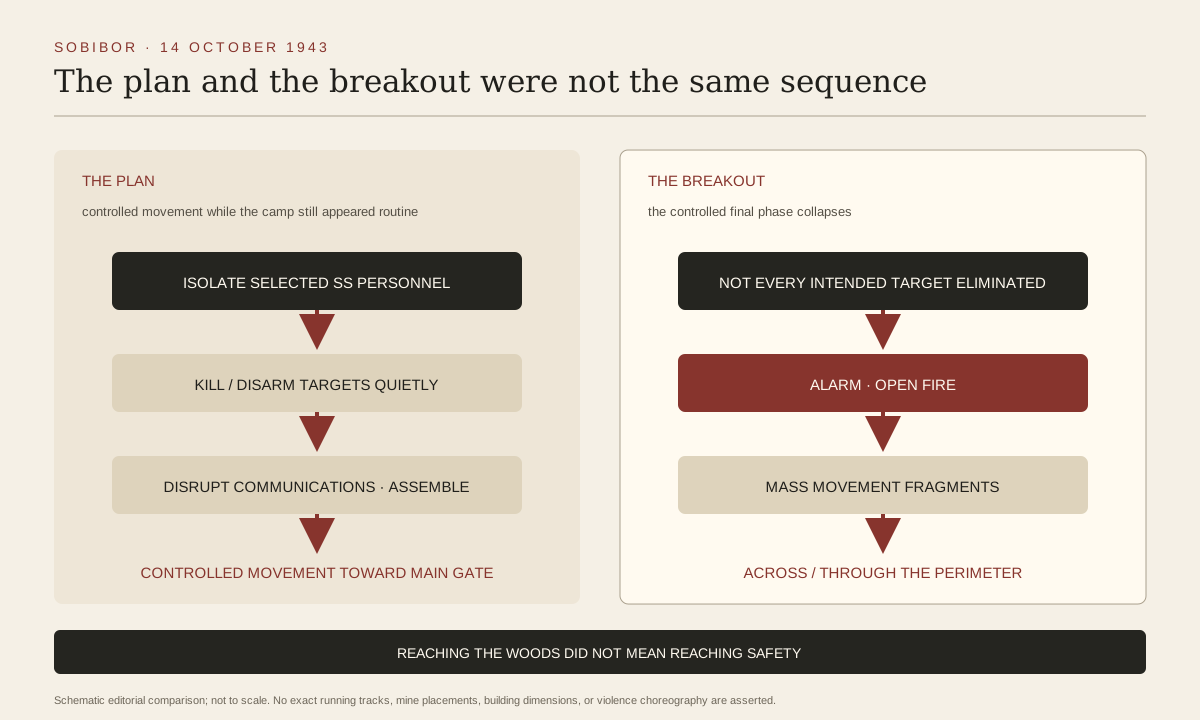
Plan and breakout
The plan—and what happened when it fractured
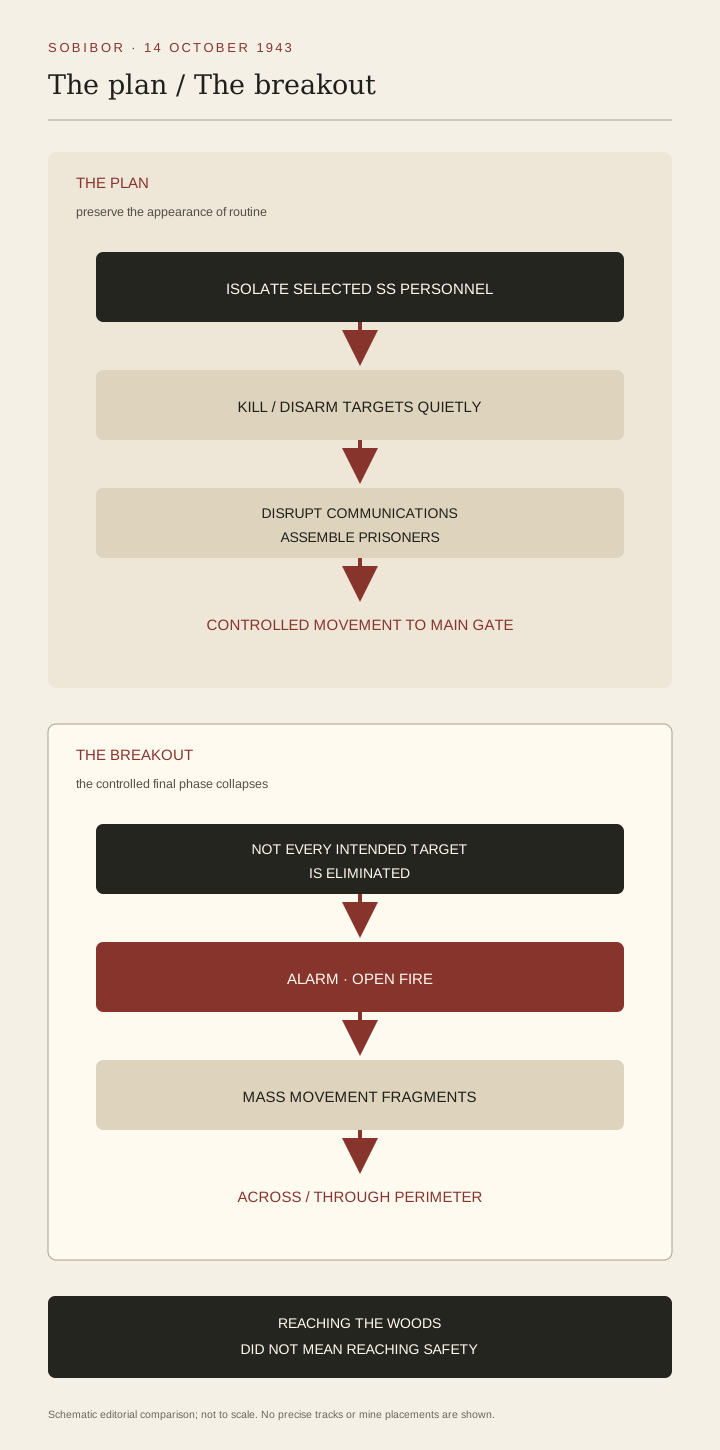
The two-state schematic separates the intended controlled gate movement from the fragmented mass breakout after the alarm and open fire.
- 01
Planned: isolate
Selected SS personnel would be drawn into workshops and disarmed or killed quietly.
- 02
Planned: preserve routine
Communications would be disrupted before prisoners assembled for controlled movement toward the main gate.
- 03
Actual: plan fractures
Not every intended target was eliminated; alarm and open fire destroyed the controlled final phase.
- 04
Actual: mass breakout
The breakout fragmented across and through the perimeter.
- 05
Beyond the camp
Reaching the woods did not mean reaching safety; pursuit and survival continued.
Schematic based on institutional, survivor and scholarly sources; not to scale. It does not invent individual running tracks, mine positions, building dimensions or violence choreography.
About 4:00 P.M.: The Quiet Phase Begins
At approximately four in the afternoon on 14 October, the coordinated attacks began.
One of the most important targets was Johann Niemann, an SS officer serving as deputy commandant. Niemann was lured into a workshop on the pretext connected with clothing or fitting. There he was killed with an axe.
The exact identity of the prisoner who struck Niemann has been rendered inconsistently in later retellings. Pechersky's 1944 statement identifies the Soviet POW Alexander Shubayev. Because early testimony and later popular narratives do not always align on individual actions, the strongest version of the story is not to decorate the scene with uncertain dialogue or invented choreography. What is secure is the operational fact: Niemann entered an isolated prisoner work area as intended and was killed before the camp as a whole had gone into alarm.
Other targeted personnel were killed in similar ambushes elsewhere.
The United States Holocaust Memorial Museum's detailed account counts 11 members of the SS staff, including Niemann, killed during the uprising, as well as at least two auxiliaries. The Museum and Memorial in Sobibór gives a different categorized total: nine SS men and two watchmen. Specialist histories contain still other formulations.
The disagreement does not alter the basic reconstruction. Multiple members of the camp staff were deliberately isolated and killed in a coordinated span of time. The exact classification and total should not be presented as perfectly settled when institutions themselves do not use identical numbers.
For the conspirators, the important measure was not a body count. It was whether enough armed authority had been removed to allow hundreds of prisoners to reach the exit before the surviving guards reacted.
The Plan Begins to Fracture
Not every intended target appeared where expected.
Karl Frenzel, one of the camp's most feared SS men, was not successfully drawn into the planned trap. Other disruptions introduced uncertainty. A body or signs of violence could be discovered. The unusual behavior of prisoners could be noticed. A surviving guard could raise the alarm.
The longer the covert phase continued, the less stable it became. Accounts differ in small details of the transition, but they agree on the larger transformation: the conspirators could not preserve the fiction of an ordinary afternoon through the entire final phase. That meant they lost the element on which the original escape design depended most.
The planned departure had relied on prisoners assembling in a controlled way and moving toward the main gate before the remaining guards could organize. Once suspicion spread, the gate ceased to be simply a point on a route. It became a defended bottleneck.
The uprising moved from deception to open breakout.
The Camp Breaks Open
The wider prisoner population began to move.
Some prisoners had known elements of the plan. Many had deliberately been kept uninformed until the last possible moment. That secrecy had protected the conspiracy from discovery, but it also meant that when the plan broke down, hundreds of people had to understand almost instantly that the camp was in revolt and that this might be their only chance.
The scene cannot be reconstructed as one neat line of escapees following one route.
Remaining guards opened fire. Armed prisoners returned fire in some places. People ran toward exits, fences, and whatever gaps seemed possible. Barriers were climbed or forced. The perimeter included mined areas. Prisoners fell to gunfire and explosions.
The crucial distinction is between the plan and the breakout that actually occurred.
The conspirators had not designed the uprising around sending hundreds of people deliberately through a minefield. Their intended solution to the perimeter problem was to use deception, a disrupted command structure, and the gate. Crossing fences and mined ground was the emergency result of the final plan collapsing under alarm and fire.
About 300 prisoners got out of the camp. That was not the end of the escape. It was the beginning of a second problem.
Outside the Fence Was Not Safety
Once beyond Sobibor, the escapees entered forests, villages, fields, and an occupied landscape filled with danger.
German authorities organized a large pursuit. SS, police, and German military forces participated in the manhunt. At least about 100 escapees were recaptured and killed.
Others died under circumstances that were more diffuse but no less lethal. Escapees needed food, shelter, knowledge of the terrain, and people willing to help them at enormous risk. Some were betrayed to the Germans. Some were killed by civilians or partisan groups. Antisemitism and the violent conditions of occupation made survival uncertain even after the camp's fences disappeared behind them.
Other escapees joined partisan formations.
The resulting survival figure is stark. Of approximately 300 who escaped the camp, about 50 survived the war.
Some specialist survivor lists use a narrower figure of 47. Stichting Sobibor, for example, pairs an estimate of 365 escapees with 47 wartime survivors. Major institutional accounts use rounded figures of about 300 and about 50. Those numbers are best understood as estimates rather than artificial precision the source record cannot support.
The Prisoners Who Could Not Join the Breakout
A mass-escape narrative can unintentionally make the people who escaped seem like the whole camp. They were not.
Sobibor's compartmentalized structure left some prisoners—especially those isolated in the killing area commonly called Lager III—outside the practical reach of the main conspiracy. Earlier resistance efforts existed there, including an attempted tunnel according to specialist reconstructions, but the prisoners in that sector were not integrated into the 14 October plan.
Others elsewhere in the camp did not or could not run when the uprising began. The Germans murdered the prisoners who remained.
This is one reason the Sobibor story requires sensitive treatment. The uprising was an extraordinary act of resistance, but it occurred inside an ongoing process of mass murder. It did not transform the camp into a conventional battlefield with two comparable forces. Prisoners were attempting to survive and resist within a killing center whose entire structure had been created by Nazi Germany to murder Jews.
The Germans Dismantle Sobibor
After the revolt, German authorities proceeded to dismantle the killing center and erase evidence of what had happened there. The relationship between the uprising and the closure needs careful wording.
A simple version says that the uprising caused Sobibor to close. That captures part of the immediate sequence but oversimplifies the larger chronology. Operation Reinhard's killing operations were already winding down, the volume and purpose of transports had changed, and the camp's future had been under consideration. Construction connected with a proposed ammunition-related function had also been underway.
The revolt nonetheless made continued operation in the previous form untenable and became inseparable from the final dismantling.
Prisoners brought from Treblinka were forced to participate in removing structures and traces of the killing center. They too were murdered.
The Germans attempted to erase the site physically. They could not erase the testimony of the people who had escaped.
What the Uprising Achieved
Sobibor was not a military victory in any conventional sense.
Most of the prisoners who escaped the camp did not survive the war. Prisoners who remained were murdered. The German occupation apparatus continued mass killing elsewhere.
Yet judging the uprising only by the percentage of escapees who survived misses its historical importance. First, hundreds got out of a killing center designed to make organized escape nearly impossible.
Second, the prisoners demonstrated a sophisticated understanding of how to attack an asymmetric security system. They did not try to match the guards' firepower. They attacked routine, information, timing, and command. They used the SS men's own privileges and expectations to isolate them.
Third, survivors carried evidence outward. Sobibor's perpetrators attempted to destroy the camp and obscure the crime. Escapees became witnesses whose accounts helped reconstruct both the mechanics of mass murder and the mechanics of resistance.
Finally, the uprising complicates a persistent and historically false image of Holocaust victims as passive. Resistance took many forms, and armed uprising was possible only under rare and terrible circumstances. At Sobibor, prisoners organized one of the most significant revolts in a Nazi killing center.
Evidence discipline
What the record supports
Status labels distinguish secure conclusions from uncertainty and rejected claims. Color is never the only signal.
WELL-SUPPORTED
About 300 prisoners escaped Sobibor during the uprising.
The approximate figure is used by USHMM and the Sobibór Museum. Specialist reconstructions sometimes give a higher figure, including 365, illustrating why the number should remain approximate.
Sources: SRC-001, SRC-002, SRC-007, SRC-014WELL-SUPPORTED
About 50 Sobibor escapees survived the war.
Major institutional histories use approximately 50, while specialist survivor accounting narrows the figure to 47. A single exact survivor count is not universally settled.
Sources: SRC-001, SRC-007, SRC-014DISPUTED
The uprising killed exactly 11 SS personnel plus at least two auxiliaries.
USHMM states 11 members of the SS staff and at least two auxiliaries in its detailed account. The Sobibór Museum timeline gives nine SS men and two watchmen. Other specialist accounts give still other formulations. The existence and operational impact of multiple coordinated killings are certain; the exact categorized total is not harmonized across authorities.
Sources: SRC-001, SRC-007, SRC-014MYTH
The original plan was simply to rush through the minefield.
The operational plan described by Pechersky and later histories aimed to neutralize key personnel and use normal assembly and the main gate. The dangerous rush through fences and mined ground resulted from the breakdown of the final phase.
Sources: SRC-001, SRC-009, SRC-015DISPUTED
The uprising alone caused the Nazis to decide to close Sobibor.
Sobibor's operational future was already changing as Operation Reinhard wound down, and parts of the site were being adapted for other purposes. The revolt decisively shaped the immediate aftermath and dismantling, but simple one-cause wording should be avoided.
Sources: SRC-002, SRC-011, SRC-015MYTH
Pechersky's early postwar-era accounts can be used without qualification for every statistic.
Pechersky's 1944 statements are exceptionally valuable primary evidence for his plan, timing, participants, and his own experience, but some victim totals and other figures reflected wartime hearsay and are inconsistent with later scholarship. They must be used claim by claim.
Sources: SRC-009, SRC-011Evidence: What We Know, What Varies, and What Should Not Be Simplified
How many prisoners escaped?
Well-supported: about 300.
The United States Holocaust Memorial Museum and the Museum and Memorial in Sobibór both use an estimate around 300. Some specialist accounts give higher totals, including 365. Because the camp was in open revolt, people left by different paths, some were killed at or just beyond the perimeter, and later survivor accounting is reconstructed from incomplete records, an exact single figure should not be presented as indisputable.
How many survived the war?
Well-supported: about 50.
This is the institutional consensus figure used by USHMM and the Sobibór Museum. Specialist lists sometimes identify 47. The difference is small in scale but important methodologically: it is evidence that the apparently simple question “how many survived?” depends on definitions and reconstructed individual fates.
Exactly how many German and auxiliary personnel were killed?
Disputed in exact categorization and total.
USHMM's detailed uprising account says 11 members of the SS staff were killed and notes at least two auxiliaries. The Sobibór Museum timeline gives nine SS men and two watchmen, and other accounts vary. The secure conclusion is that numerous camp personnel were killed in a coordinated operation, with Niemann specifically identified; the exact categorized total remains disputed.
Was the minefield the original escape route?
No.
The best evidence indicates that the preferred plan was to neutralize key personnel, gather the prisoners, and use the main gate before the remaining guards understood the situation. Running through fences and the dangerous perimeter happened when the orderly exit became impossible.
Did the revolt cause Sobibor to close?
Partly, but not as a single-cause explanation.
The revolt accelerated and shaped the camp's final liquidation. But German plans and Operation Reinhard itself were already changing. “The uprising forced the Germans to dismantle Sobibor immediately afterward” is safer than implying that no closure process existed before 14 October.
Is Pechersky's own testimony reliable?
Indispensable, but claim-specific.
Pechersky's 1944 statements are among the most valuable early sources for the organization of the revolt. They record his plan, timing, participants, weapons, and movements very close to the event. They also contain estimates of the number murdered at Sobibor that modern scholarship does not accept. This is normal evidence work: a primary witness can be extremely strong for events he directly experienced and weak for aggregate information he knew only through rumor.
Why Sobibor Matters
The Sobibor uprising is sometimes compressed into a sentence: prisoners killed guards and 300 escaped. That summary is true enough to obscure the most important part.
The prisoners' achievement was not simply that they ran. It was that they recognized the structure keeping them imprisoned and constructed a plan around its weaknesses.
The guards had guns, towers, fences, and mines. The prisoners had access to workshops, knowledge of routine, the ability to communicate secretly, a small number of usable weapons, and the captors' confidence that prisoners could be summoned, ordered, and exploited indefinitely.
The uprising turned those ordinary features of the camp against the people who controlled it.
The plan did not survive intact. Its final phase failed. The prisoners still broke out.
For about 50 of them, that opening lasted long enough to survive the war and tell the world what Sobibor had been.
Selected chronology
Underground, uprising and aftermath
Underground resistance develops
Prisoners at Sobibor organize clandestinely as fears increase that the camp's labor prisoners will eventually be murdered.
Jewish Soviet POWs arrive from Minsk
Alexander Pechersky and other Jewish Red Army POWs arrive and establish contact with the existing underground.
Planned revolt is postponed
Survivor testimony and specialist reconstruction indicate that the uprising had been intended for 13 October but was delayed after unexpected SS visitors appeared at the camp.
Coordinated killings begin
Conspirators begin luring targeted camp personnel into workshops. Johann Niemann is among the first major targets killed.
The mass breakout begins
The intended orderly final phase collapses; prisoners rush the perimeter as remaining armed personnel fire.
Manhunt and killings
German SS, police, and military forces pursue escapees. At least about 100 are recaptured and killed; others die or are betrayed in the following weeks and months.
Dismantling of Sobibor
The Germans proceed with dismantling the killing center and attempting to erase evidence of its operation.