
On 21 July 1944, a Polish political prisoner in an SS uniform walked into the work area of a Jewish prisoner at Auschwitz, announced that she was wanted for interrogation, and escorted her toward an exit from the camp's guarded zone. The uniform was stolen. The pass was forged. The supposed SS man was Jerzy Bielecki; the prisoner beside him was Cyla Cybulska. Their escape succeeded.
Two prisoners inside different parts of the same system
Jerzy Bielecki entered Auschwitz on 14 June 1940 in the first transport of Polish political prisoners sent from Tarnów. He was registered as prisoner number 243. He had been arrested after attempting to leave German-occupied Poland and reach Polish forces being organized abroad.
Cyla Cybulska came to Auschwitz under a different and far more directly genocidal system of persecution. A Jewish woman from Łomża, she had been confined in the Zambrów ghetto and was deported to Auschwitz on 19 January 1943. After selection she was registered in the camp as prisoner number 29558. Auschwitz records identify her in the camp under the surname Stawiska.
By 1944 Bielecki was working in a grain warehouse near the main camp. A small group of women prisoners was assigned there to repair grain sacks. Cybulska was among them. The two met through that work arrangement and developed a secret relationship. Later, when the women were transferred to a neighboring staff building, they continued finding opportunities to meet.
The relationship matters to the story, but it should not turn the escape into a sentimental legend. Cybulska was a Jewish prisoner in a camp where Jewish deportees faced systematic murder. Bielecki was a Polish political prisoner who had already survived four years of concentration-camp imprisonment. Their plan developed inside a system designed to isolate, exploit, terrorize, and kill its prisoners.
The problem was not simply getting beyond a fence
Auschwitz was not a single building with one door to defeat. The camp complex used layers of guarded space, work details, fences, sentries, identification systems, and a wider security zone. Even a prisoner who could move between work areas still had to explain why he was moving, why another prisoner was with him, and why a guard should allow them beyond the controlled perimeter.
Bielecki's plan therefore depended less on physical force than on impersonation. He needed to look like someone whose authority would be obeyed automatically.
A fellow Polish prisoner, Tadeusz Srogi, worked in an SS clothing store. Bielecki asked him to join the escape. Srogi declined, but he helped in a way that became essential: according to the Auschwitz Museum, he supplied Bielecki with an SS uniform and an SS pass.
The pass created another problem. Camp passes changed color periodically. A pass that looked correct one week might immediately attract suspicion the next. Bielecki therefore prepared several versions in different colors. The museum's account states that a prisoner working in the camp printing shop supplied the appropriate type for the documents.
That detail changes the character of the escape. It was not the work of a solitary mastermind operating in a vacuum. The final act involved Bielecki and Cybulska, but its preparation depended on assistance from other prisoners who accepted serious risks without sharing in the escape itself.
Preparing to become an SS man
The surviving account allows the disguise phase to be reconstructed with unusual clarity.
Bielecki hid the uniform and some supplies in the attic of the grain-warehouse building. On the afternoon of 21 July, he asked the SS man supervising his work for permission to step away briefly, claiming that prisoners from the butcher shop had obtained sausage for him. The guard agreed after Bielecki promised him a share.
Bielecki then reached the hidden clothing, removed his striped prisoner uniform, and dressed as an SS man. In later testimony preserved by the Auschwitz Museum, he recalled wearing sunglasses and a field cap and placing a piece of metal into an otherwise empty pistol holster so that the holster would not look flat. He also carried clothing and footwear intended for Cybulska.
The distinction between the documented structure of the escape and remembered detail matters here. The SS disguise and forged pass are supported across institutional accounts. Small details of appearance, exact movements through the building, and the object placed in the holster come from Bielecki's later testimony. They are plausible and valuable evidence, but they remain retrospective testimony rather than a minute-by-minute contemporary record.
The false interrogation
Disguised as an SS functionary, Bielecki went to the building where Cybulska was working.
The role he chose was calculated to discourage questions. He presented himself as a member of the Political Department, the camp Gestapo, and indicated that Cybulska was required for interrogation. The supervising woman did not recognize him as a prisoner. Cybulska was called out, and Bielecki began escorting her away.
For the impersonation to work, Cybulska had to behave like a prisoner under SS control. Bielecki had to behave like an SS man whose authority no one wished to challenge. Other prisoners they passed reportedly removed their caps in the expected gesture of deference. Each ordinary reaction helped sustain the disguise.
They moved in the direction of the Raisko subcamp area, where there was an exit from the large outer guard chain. This is an important correction to a common visual assumption about Auschwitz escapes: Bielecki and Cybulska were not simply walking out through the iconic main gate of Auschwitz I. The institutional reconstruction places their exit elsewhere in the guarded camp zone, near Raisko.
At the checkpoint Bielecki presented the forged pass. On 21 July the required pass color was pink, and he had prepared the correct version. The document passed inspection. The two prisoners were allowed through.
There was no tunnel breakthrough, firefight, or cutting of electrified wire. The central barrier was administrative. Bielecki and Cybulska crossed it by making the camp's own system of uniforms, paperwork, hierarchy, and obedience work against itself.
Beyond the guard chain
Getting through the checkpoint did not mean they were safe.
The escape would have been discovered, and the surrounding region remained under German occupation. Roads, settlements, police controls, and searches could all expose them. Bielecki also feared moving directly toward Kraków, where he had lived before the war and where authorities might expect him to go.
His testimony describes a deliberately indirect route. They moved mainly at night, crossed fields, avoided settlements and roads, and initially traveled south before turning east and north. The exact path is not recoverable closely enough to justify a precise modern route map.
After nine nights of walking, they reached the area of Bachowice near Spytkowice. There they received assistance from a local man, Stanisław Kosowski, who connected them with a woman who helped them across the border into the General Government. Once across, they were able to move more openly. They crossed the Vistula by ferry near Czernichów and continued toward Bielecki's family connections.
On 1 August 1944 they reached the home of Bielecki's relative Jan Marus in Muniakowice, in the Miechów region.
That journey is sometimes retold as a sequence of dramatic set pieces. The surviving evidence supports a simpler account. They traveled for days under extreme physical strain, relied on rural concealment and civilian help, and avoided the routes most likely to be watched.
Escape did not mean immediate security
The two had left Auschwitz, but German occupation continued around them.
Cybulska was eventually placed with the Czernik family in Przemęczany, where she could remain hidden. Bielecki later joined a partisan unit of the Polish Home Army and fought until the end of the war.
The separation was practical, but it became permanent for decades. Cybulska later received information that Bielecki had been killed. After the war she left Poland and eventually settled in the United States. Bielecki survived in Poland and built a postwar life of his own.
They did not see each other again until 1983.
The reunion became one of the best-known parts of their story. Associated Press reporting later described how Cybulska, after telling the story of her escape in the United States, learned that Bielecki was alive in Poland. Contact was re-established, and they met again after thirty-nine years. Those postwar details illuminate the long aftermath of the escape, but they should not overshadow what had made the separation necessary in the first place: both had escaped a concentration camp into a country that was still at war and still under Nazi rule.
What is firmly documented — and what requires caution
The central facts of the escape are strong.
Auschwitz-Birkenau records the date as 21 July 1944. The museum identifies Bielecki as prisoner 243 and Cybulska as prisoner 29558. It preserves Bielecki's detailed testimony and reproduces camp telegrams sent on 22 July announcing that each prisoner had escaped. Yad Vashem independently records the rescue and recognized Bielecki as Righteous Among the Nations on 27 June 1985.
The disguise and forged-pass mechanism is also well supported. So is the involvement of Tadeusz Srogi in providing material for the disguise and pass.
More caution is needed with exact dialogue and some personal moments. Later interviews and memoirs supply vivid language about what the pair said to one another, what Bielecki thought while approaching the checkpoint, and how they behaved at particular moments on the road. Such details can be meaningful testimony, but they were recorded decades after the event. A historical reconstruction should attribute them rather than convert them into omniscient narration.
The same caution applies to the word "rescue." Bielecki's actions plainly helped save Cybulska's life, and Yad Vashem formally honored him for doing so. Yet describing the event only as one man rescuing one woman would erase Cybulska's own agency and the network of prisoners and civilians who helped make survival possible after the checkpoint. She had to maintain the deception, endure the flight, move through occupied territory, and continue hiding after the pair separated.
Why the escape worked
The plan succeeded because several vulnerabilities aligned.
Bielecki had access created by his work assignment. Srogi had access to SS clothing and documentation. Another prisoner could supply printing material. The forged pass matched the changing color system. The false identity placed Bielecki inside a feared institution—the Political Department—whose asserted authority discouraged scrutiny. Cybulska's role as a prisoner supposedly being escorted for interrogation made their movement look normal rather than suspicious.
Most importantly, the deception survived the checkpoint. Once beyond the outer guard chain, the problem changed from defeating camp security to evading German pursuit across occupied territory.
Their success should not make the plan appear safe. A failed document check, recognition by an SS man, an unexpected question, or discovery during the days of travel could have led to recapture and death. The failed escape of Edward Galiński and Mala Zimetbaum only weeks earlier demonstrates how narrow the margin could be: they too left the camp using an SS-disguise escort method, but were later captured and returned to Auschwitz.
Bielecki and Cybulska were not safe because the method was inherently reliable. They were fortunate enough to make each stage work before the system could close around them again.
After Auschwitz
Cybulska survived the war in hiding and later emigrated to the United States. Bielecki survived partisan service and remained in Poland. Their 1983 reunion transformed the escape into a widely told story of wartime love and separation.
Two years later, Yad Vashem recognized Bielecki as Righteous Among the Nations for saving Cybulska.
The historical importance of the escape lies beyond its dramatic disguise. It demonstrates how concentration-camp control could sometimes be breached through knowledge of routine rather than brute force; how prisoner cooperation could create opportunities inside a system built to destroy solidarity; and how escaping the perimeter was only the first stage of survival.
On 21 July 1944, the forged uniform and pass got Jerzy Bielecki and Cyla Cybulska out of Auschwitz. The rest of their survival depended on endurance, secrecy, assistance, and the ability to stay beyond the reach of the regime they had escaped.
Escape reconstruction
How the escape unfolded
An evidence-aware sequence of the principal stages.
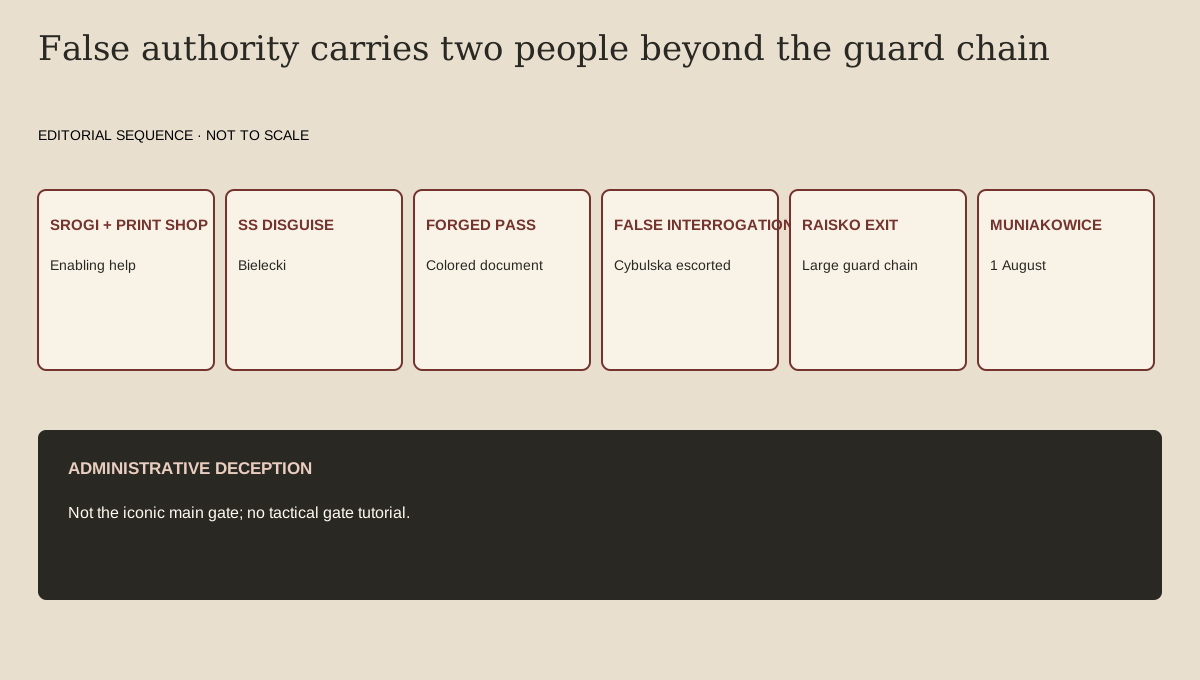
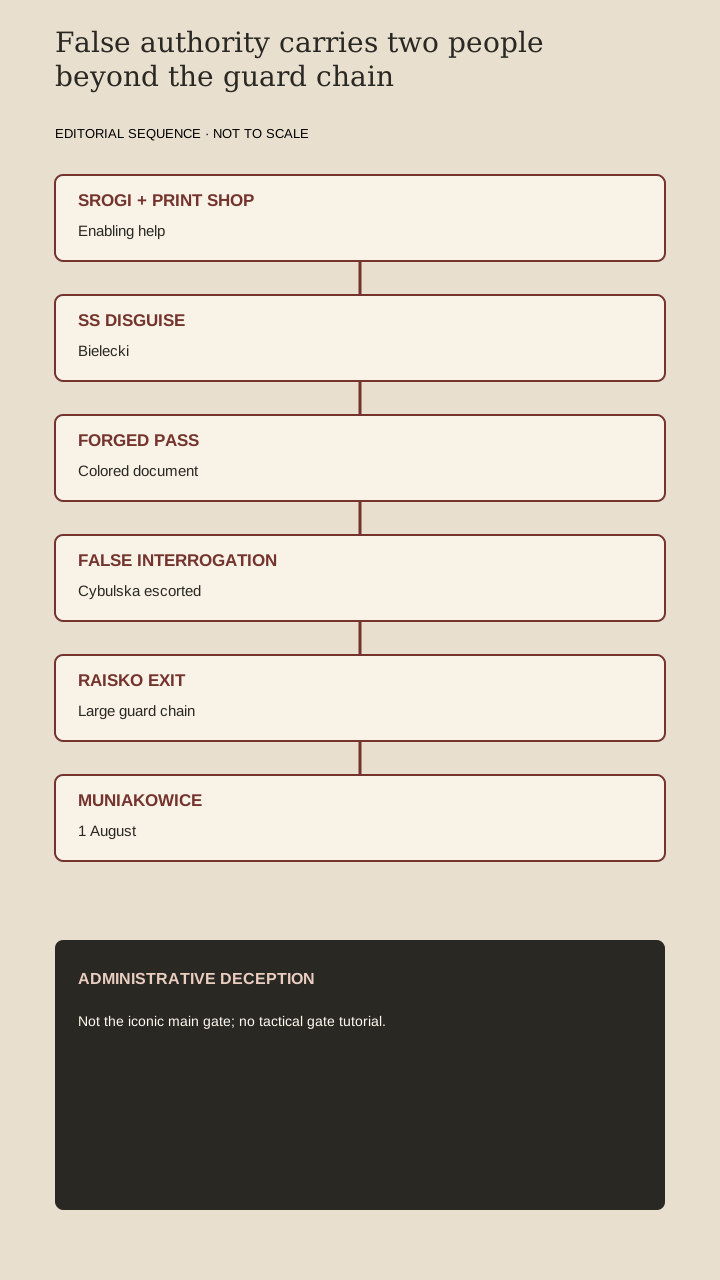
Simplified editorial reconstruction; not to scale. See adjacent text for evidence qualifications and unresolved details.
Material evidence
Tools of Escape
The objects used in an escape reveal how a plan worked under constraint.
- 01Essential disguise
SS uniform
A uniform supplied through Tadeusz Srogi enabled Bielecki to impersonate an SS functionary.
- 02Checkpoint access
Forged pass
Bielecki prepared passes in multiple colors because the authorized pass color changed periodically; the correct pass was presented on escape day.
- 03Document preparation
Printing type
A prisoner working in the camp printing shop supplied type used to prepare the forged documents.
- 04Post-escape survival
Civilian shelter network
Local civilians and Bielecki's relatives helped the fugitives move, hide, and survive after leaving the camp security zone.
Problem → response
Escape was a sequence of problems
Each response solved a practical obstacle while often creating the next one.
- 01→
Obstacle
SS-controlled movement
Prisoners could not move freely through the guarded camp zone.
Response
Bielecki impersonated a Political Department functionary escorting Cybulska for interrogation.
- 02→
Obstacle
Changing pass colors
The color of authorized SS passes changed periodically, making a static forgery risky.
Response
Bielecki prepared several pass versions in different colors and carried the correct color on 21 July.
- 03→
Obstacle
Checkpoint inspection
The pair still had to convince a guard to let them beyond the large guard chain.
Response
Bielecki maintained the SS disguise and presented the forged pass while Cybulska acted as a prisoner under escort.
- 04→
Obstacle
Pursuit in occupied territory
Leaving the camp did not remove the risk of German searches, checkpoints, or denunciation.
Response
They avoided roads and settlements, traveled mainly at night, and relied on civilian assistance and hiding places.
The final accounting
Outcome
Escaped Auschwitz
Bielecki and Cybulska both passed beyond the camp security zone on 21 July 1944 and avoided recapture.
Survived the war
Cybulska survived in hiding and Bielecki survived after joining a Home Army partisan unit.
Evidence discipline
What the record supports
Status labels distinguish secure conclusions from uncertainty and rejected claims. Color is never the only signal.
DOCUMENTED
Bielecki and Cybulska escaped Auschwitz on 21 July 1944.
The Auschwitz-Birkenau State Museum gives the date and reproduces camp telegrams sent the following day reporting each escape; Yad Vashem independently records the event.
Sources: SRC-001, SRC-003DOCUMENTED
The escape depended on an SS disguise and forged pass.
The mechanism appears in the Auschwitz Museum reconstruction based on its archival holdings and in Yad Vashem's independent account.
Sources: SRC-001, SRC-003MYTH
Bielecki escaped entirely through his own preparations.
Tadeusz Srogi supplied the SS uniform and pass, and another prisoner connected to the camp printing shop supplied type for the forged documents.
Sources: SRC-001MYTH
The pair walked out through Auschwitz I's famous main gate.
The Auschwitz Museum places their route toward an exit from the large guard chain near the Raisko subcamp area, not the iconic main gate.
Sources: SRC-001WELL-SUPPORTED
Bielecki and Cybulska were romantically attached before the escape.
Auschwitz-Birkenau describes them as having fallen in love; Yad Vashem describes a close relationship, and both later testimonies support the relationship.
Sources: SRC-001, SRC-003, SRC-005LATER CLAIM
Exact dialogue and minute-by-minute emotional details in popular retellings are fully documented contemporaneously.
Many vivid details come from testimony and interviews recorded decades after the escape. They should be attributed rather than narrated as independently verified contemporaneous fact.
Sources: SRC-001, SRC-005MYTH
The pair remained together through the end of the war.
They separated after reaching safety. Bielecki later joined a partisan unit and Cybulska survived in hiding; they did not reunite until 1983.
Sources: SRC-001, SRC-003, SRC-005Selected chronology
Selected chronology
Bielecki arrives at Auschwitz
Jerzy Bielecki reaches Auschwitz in the first transport of Polish political prisoners and is registered as prisoner 243.
Cybulska is deported to Auschwitz
Cyla Cybulska is deported from the Zambrów ghetto to Auschwitz and registered as prisoner 29558 after selection.
Bielecki and Cybulska meet
Their work assignments bring them into contact in the grain-warehouse area, where they form a secret relationship.
Escape from Auschwitz
Bielecki, disguised as an SS functionary, escorts Cybulska out under a false interrogation pretext and passes the Raisko-area checkpoint with a forged pass.
Reach Muniakowice
After nine nights of evasive travel and civilian assistance, the pair reach Bielecki's relative Jan Marus in Muniakowice.
Both survive
Cybulska survives in hiding with Polish civilians; Bielecki serves with a Home Army partisan unit and survives the war.
Reunion after decades
Bielecki and Cybulska meet again in Poland after approximately thirty-nine years apart.
Yad Vashem recognition
Yad Vashem recognizes Jerzy Bielecki as Righteous Among the Nations for saving Cybulska.