
The Vrba–Wetzler Escape from Auschwitz: How Two Prisoners Carried Evidence of Mass Murder to the Outside World
On 7 April 1944, Rudolf Vrba and Alfred Wetzler disappeared inside Auschwitz-Birkenau.
They did not make an immediate dash for open country. They did something more calculated: they hid.
The two Slovak Jewish prisoners entered a concealed space in the unfinished BIII section of Birkenau, an area prisoners called “Mexico.” Other prisoners covered the opening. Tobacco was scattered around the hiding place. Then Vrba and Wetzler stayed almost motionless while the SS searched for them. Alfred Wetzler later said they remained concealed for about eighty hours. [SRC-001]
Only after the intensive search had been reduced did they emerge. That was the first part of the escape. The second was getting to Slovakia alive. The third was making people believe what they had seen.
By the end of April, their testimony had become the document now known as the Vrba–Wetzler Report, one of the most important wartime eyewitness accounts of Auschwitz. It described a camp that was not merely a place of imprisonment and forced labor but a major center of systematic mass murder. Copies traveled through clandestine and diplomatic channels to Jewish organizations, Allied governments, the International Red Cross and the Vatican. By June, information from the report was appearing in the press. [SRC-002] [SRC-003] [SRC-004]
The escape therefore cannot be understood simply as two men getting out of a prison. They escaped with information that Nazi Germany was trying to keep behind barbed wire.
Two prisoners who knew how Auschwitz worked
Alfred Wetzler had arrived at Auschwitz from Slovakia on 13 April 1942. He was registered as prisoner 29162 and was eventually employed as a block clerk in Birkenau. [SRC-001] [SRC-012]
Rudolf Vrba was born Walter Rosenberg. After arrest and imprisonment in Slovakia, he was deported through the Lublin-Majdanek camp system and arrived at Auschwitz at the end of June 1942. He received prisoner number 44070. [SRC-001] [SRC-006]
Both survived long enough to acquire something extremely dangerous in a place built around isolation, deception and killing: knowledge.
Vrba worked for a period in the prisoner detail that sorted property taken from deportees. He saw transports arrive, saw people separated from their belongings, and learned how selections worked. Wetzler’s positions likewise gave him access to the internal routines and records of the camp. Their later report combined direct observation with information accumulated during nearly two years of imprisonment. [SRC-006] [SRC-009]
By 1944, Auschwitz had become the largest Nazi concentration-camp complex. Auschwitz II-Birkenau also functioned as a killing center. Modern research estimates that Nazi Germany murdered about 1.1 million people in the Auschwitz complex, approximately one million of them Jews. [SRC-005] [SRC-010]
Vrba and Wetzler did not have access to the postwar archives from which those totals would later be reconstructed. They had what they had seen. And they wanted to get it out.
Material evidence
Enabling objects
A prepared bunker, civilian clothes and tobacco supported the operation; tobacco's exact effect on search dogs is not treated as proven.
- 01The core physical mechanism of the escape.
Prepared bunker
A concealed cavity in the unfinished BIII ('Mexico') sector allowed the escapees to remain inside the broader camp zone while the SS searched for them.
- 02Helped the escapees move outside the prisoner environment.
Civilian clothing
Civilian garments were obtained through prisoners working with clothing stores and prepared for use after the pair left concealment.
- 03A documented concealment measure, though its precise effectiveness cannot be measured.
Tobacco
Tobacco was scattered around the bunker opening as part of the effort to frustrate tracking by search dogs.
The escape plan depended on waiting
Escaping Auschwitz was extraordinarily difficult. The camp complex had multiple security zones, electrified fences, armed guards, watchtowers and an SS response system designed to hunt down missing prisoners. Captured escapees could be tortured and executed, and reprisals could extend to other prisoners or people suspected of helping them. [SRC-005]
Vrba and Wetzler’s plan exploited one feature of that response. Instead of trying to cross the wider camp security area while the alarm was at its peak, they would disappear into a hiding place and wait for the most intensive search to pass.
They did not create that possibility alone. The Auschwitz-Birkenau State Museum identifies other prisoners as having constructed the concealed bunker in the unfinished BIII sector. Mendel Eisenbach later showed it to Vrba. Prisoners also helped obtain civilian clothing and information useful for the escape. [SRC-001]
The hiding place sat in the unfinished section prisoners called Mexico.
On 7 April, Vrba and Wetzler entered it. Other prisoners concealed the opening. Then the waiting began.
Escape sequence
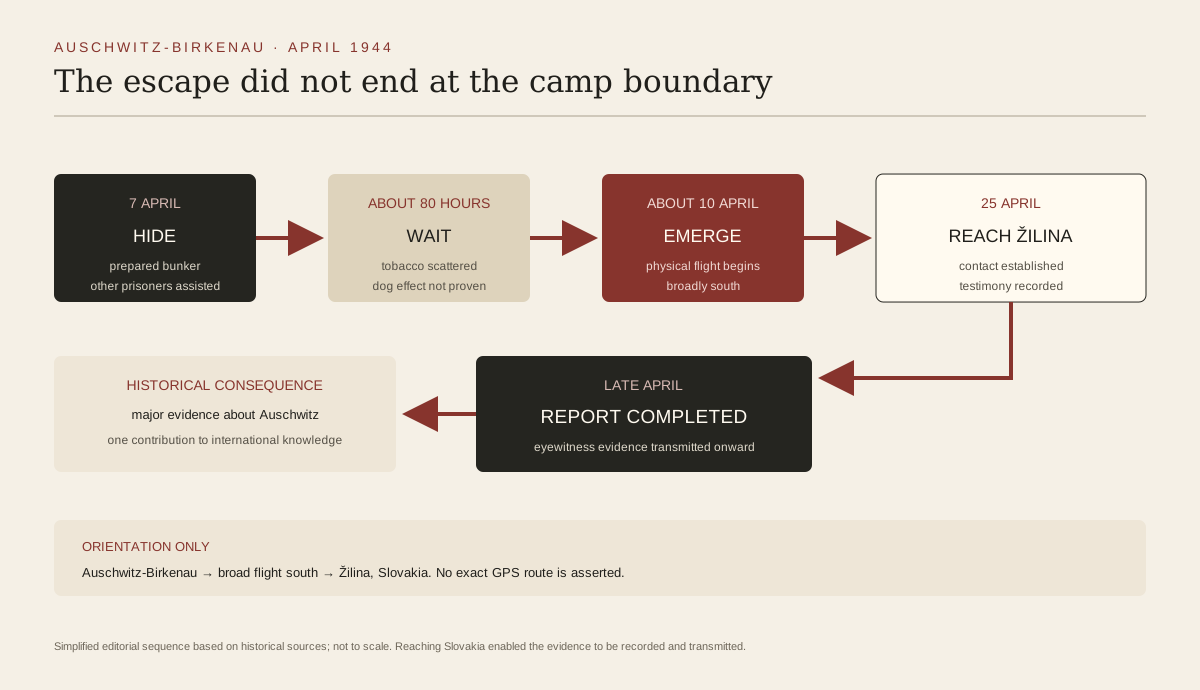
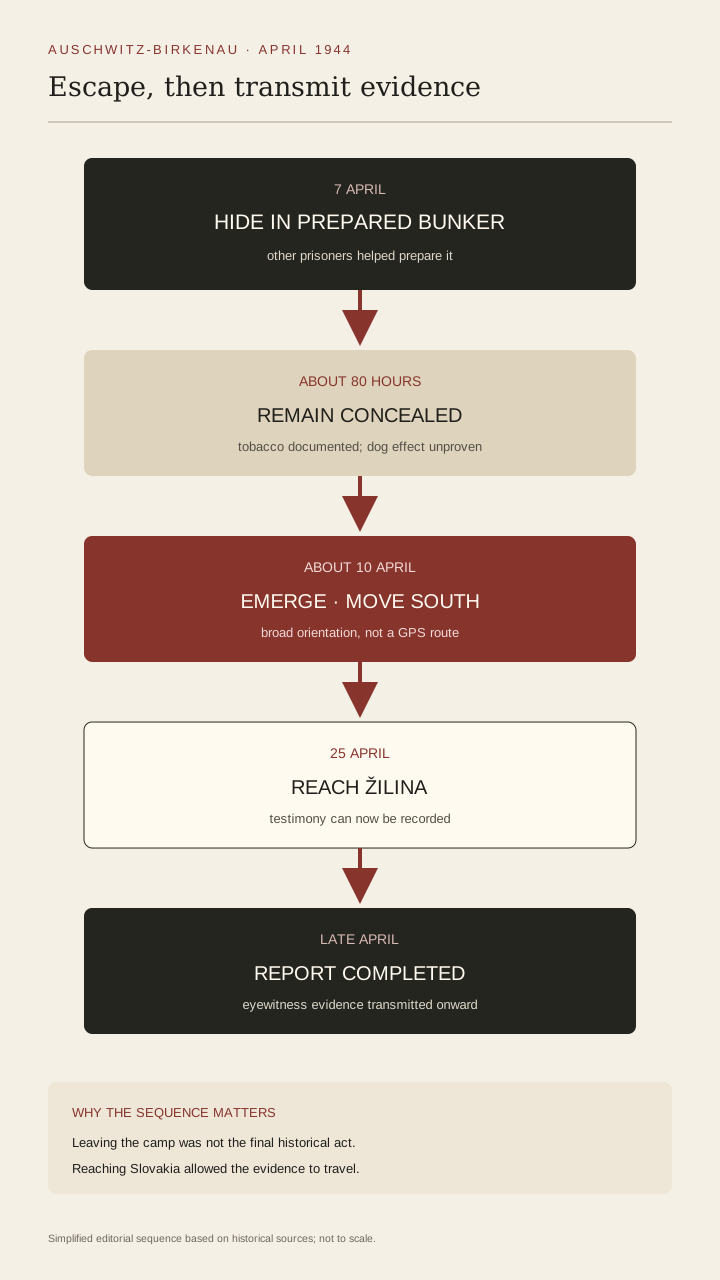
Hide, escape, reach Slovakia, transmit evidence
Leaving the camp was only the first half of the operation. The sequence continues through the journey south and production of the eyewitness report.
- 01
Hide
Other prisoners helped prepare and provision the bunker; Vrba and Wetzler entered it on 7 April.
- 02
Wait
They remained concealed for about 80 hours while the immediate search continued.
- 03
Reach Slovakia
After emerging around 10 April, they travelled south and reached Žilina on 25 April.
- 04
Transmit evidence
Their testimony became a major eyewitness report completed in late April.
Simplified editorial sequence based on institutional and survivor sources; not to scale. It shows broad orientation rather than an exact travel route or bunker geometry.

Eighty hours inside “Mexico”
Wetzler later described the concealment in testimony preserved by the Auschwitz-Birkenau State Museum. The opening was covered after the two men entered. Tobacco was scattered on the ground around the bunker. During the evening, the camp siren signaled that their absence had been noticed. The men withdrew into a tighter section of the hiding place and remained there while the search proceeded above and around them. [SRC-001]
They were particularly afraid of search dogs. They were not found.
Wetzler estimated that they spent about eighty hours in the bunker. [SRC-001]
That figure explains an apparent contradiction found in simplified accounts of the escape. The escape is conventionally dated 7 April 1944, the day the two men disappeared into the hiding place. But they did not immediately leave the larger Auschwitz area. They emerged only after roughly three days, on 10 April, once the SS search had been reduced. [SRC-001]
Their plan had transformed the search itself into a problem of timing.
The SS were looking for men they assumed had already fled. For most of the search, the two men were still there.
Problem → response
Escape was a sequence of problems
Each response solved a practical obstacle while often creating the next one.
- 01→
Obstacle
Immediate SS manhunt
The escapees' absence triggered an intensive search inside and around Auschwitz-Birkenau.
Response
Instead of immediately running from the camp, they remained concealed in the prepared bunker for about 80 hours.
- 02→
Obstacle
Camp security zones
Leaving the prisoner compound did not automatically mean leaving the guarded Auschwitz complex and its search perimeter.
Response
They waited until the most intensive search had subsided before emerging and heading south.
- 03→
Obstacle
Travel through occupied territory
The two fugitives still had to reach Slovakia without legal papers or safe public movement through German-controlled territory.
Response
They moved cautiously and received assistance from Polish and Slovak civilians.
- 04→
Obstacle
Making extraordinary testimony credible
The escapees' information concerned a killing system whose scale was difficult for outsiders to comprehend and whose details needed to withstand scrutiny.
Response
Jewish Council representatives questioned Vrba and Wetzler carefully, compared their independently given information, and prepared a detailed written report for transmission.
South toward Slovakia
After leaving the bunker, Vrba and Wetzler moved around the camp from the west and headed south. [SRC-001]
The surviving institutional record supports the broad route far more securely than it supports an exact day-by-day path. Polish and Slovak civilians assisted them during the journey. They eventually crossed into Slovakia and reached Žilina on 25 April 1944. [SRC-001] [SRC-009]
Modern commemorative routes identify intermediate locations, but later memorial geography cannot be turned into a perfectly documented 1944 GPS trail.
The essential fact is more important. Two men who had spent almost two years inside Auschwitz had crossed from German-occupied Poland into Slovakia carrying no official archive, no camera and no captured SS files.
They carried memory.
The problem after escape: proving Auschwitz
Freedom did not automatically make their information credible.
In Žilina, Vrba and Wetzler met representatives of the Slovak Jewish Council. Their accounts were taken down in detail and compared. The resulting report was prepared in Slovak and German. The FDR Presidential Library identifies Oscar Krasniansky and Gisela Steiner of the Slovak Jewish Council as responsible for typing and translating the German version. [SRC-003]
The report described the geography and organization of Auschwitz and Birkenau; prisoner registration and numbering; living and working conditions; arriving transports; selections; gas chambers and crematoria; mass killing; national origins of deportees; and estimates of the number murdered. [SRC-003] [SRC-006]
The report was remarkable not because no information about Nazi mass murder had previously escaped occupied Europe. Important reports and warnings had already reached the Allies through Polish underground networks, Jewish organizations, diplomats, escapees and other witnesses.
Its importance lay in its detail, its eyewitness basis and its description of Auschwitz from men who had just escaped the camp. [SRC-002]
Evidence discipline
What the record supports
Status labels distinguish secure conclusions from uncertainty and rejected claims. Color is never the only signal.
MYTH
Vrba and Wetzler simply ran out of Auschwitz on 7 April 1944.
On 7 April they entered a prepared bunker within the unfinished BIII sector. Wetzler's testimony states that they remained concealed for about 80 hours before emerging and beginning the journey south.
Sources: SRC-001MYTH
Vrba and Wetzler built the escape bunker entirely by themselves.
The Auschwitz-Birkenau State Museum identifies other prisoners, including Mordka Cytryn and a prisoner named Abram, as builders of the bunker, and states that Mendel Eisenbach showed the hiding place to Vrba.
Sources: SRC-001MYTH
The Vrba–Wetzler Report's estimate of about 1.765 million Jews killed at Birkenau by April 1944 is the modern accepted Auschwitz death toll.
The figure belongs to the escapees' wartime estimate based on what they could observe and learn as prisoners. Modern historical research estimates that approximately 1.1 million people were murdered at Auschwitz, about one million of them Jews.
Sources: SRC-006, SRC-011, SRC-012DISPUTED
The Vrba–Wetzler Report alone caused Miklós Horthy to stop the Hungarian deportations and therefore can be credited with an exact number of lives saved.
The report's information contributed to international knowledge and pressure, but historians debate the timing, pathways, decision-making and relative weight of the many political and diplomatic factors involved. Claims that the report single-handedly produced Horthy's decision or saved a precisely knowable number of people exceed what the evidence can securely establish.
Sources: SRC-004, SRC-005, SRC-013, SRC-014MYTH
The term Auschwitz Protocols refers only to the Vrba–Wetzler Report.
The protocols as circulated by the U.S. War Refugee Board combined the Vrba–Wetzler Report with reports from other Auschwitz escapees, including Jerzy Tabeau and Arnošt Rosin and Czesław Mordowicz.
Sources: SRC-002, SRC-004A wartime report, not a perfect postwar history
The Vrba–Wetzler Report was evidence produced under extraordinary circumstances. That does not mean every figure in it matches later archival research.
The men estimated that approximately 1,765,000 Jews had been killed at Birkenau between April 1942 and April 1944. [SRC-006]
That total is much higher than the modern accepted estimate for the entire Auschwitz complex. Current scholarship places the number murdered at Auschwitz at about 1.1 million people, including approximately one million Jews, over the camp’s full history. [SRC-005] [SRC-010]
The difference should not be hidden. Nor should it be used to dismiss the report.
Vrba and Wetzler were prisoners attempting to reconstruct an industrialized killing process from transport arrivals, registration numbers, camp observations, conversations and limited access to internal information. They had no surviving Nazi statistical archive in front of them.
Their central description—that Auschwitz-Birkenau was being used for systematic mass killing, including murder in gas chambers—was true. Historical reliability requires distinguishing what those witnesses established from what later research refined.
Why the report mattered in 1944
The report moved through several channels. Auschwitz-Birkenau records that it reached Allied governments, the World Jewish Congress, the International Red Cross and the Vatican. [SRC-002]
The FDR Presidential Library traces a later English-language version to the United States War Refugee Board. It also documents how information from the report began appearing through Swiss media channels in June 1944, helping intensify international pressure over the deportation of Hungarian Jews. [SRC-003] [SRC-004]
Timing mattered brutally. Germany occupied Hungary on 19 March 1944. Deportations began on a massive scale in May. Hundreds of thousands of Hungarian Jews were deported in a matter of weeks, most to Auschwitz. [SRC-013]
By early July, Hungarian Regent Miklós Horthy ordered the deportations halted.
The Vrba–Wetzler Report was part of the information that fueled international protest and political pressure surrounding that decision. [SRC-003] [SRC-004]
But the familiar statement that “Vrba and Wetzler saved 200,000 Jews” compresses a much more complicated history. Recent Yad Vashem scholarship specifically reassesses when Jewish leaders in Hungary received the report, what they did with it, why warnings were not immediately transformed into a mass public campaign, and how international pressure developed later. [SRC-011]
The historically responsible conclusion is narrower and stronger: Vrba and Wetzler escaped Auschwitz, produced a major eyewitness report, and that report materially contributed to the international information and pressure surrounding efforts to stop further deportations.
The report reached the United States
In October 1944, Roswell McClelland, working for the American mission in Switzerland, sent English translations of the Auschwitz reports to John Pehle, director of the U.S. War Refugee Board.
The War Refugee Board distributed copies in November under the title German Extermination Camps—Auschwitz and Birkenau. The reports were published in the United States later that month. [SRC-003]
The publication grouped the Vrba–Wetzler account with other escapee reports, including testimony associated with Jerzy Tabeau and the later escapees Arnošt Rosin and Czesław Mordowicz. Together they became known as the Auschwitz Protocols. [SRC-003]
That terminology can create another common misunderstanding. The “Auschwitz Protocols” were not a single text written entirely by Vrba and Wetzler. Their report was one of several reports combined and circulated together.
What happened to Vrba and Wetzler
Both men remained in Slovakia. They later joined partisan forces and survived the war. [SRC-009]
Wetzler eventually returned to the name Alfred Wetzler after using the false identity Jozef Lánik. Walter Rosenberg adopted the name Rudolf Vrba, the identity by which he became internationally known. He later became a scientist and professor in Canada and continued to testify about Auschwitz for decades. [SRC-009]
Their later lives matter, but they should not obscure the specific achievement of April 1944.
The escape was not completed when two prisoners left the Auschwitz security zone. It was completed when information that the camp system had been designed to imprison with them crossed the border too.
Why this escape deserves reconstruction
Many escapes are remembered because of a tunnel, a disguise, a wall or a lock.
The Vrba–Wetzler escape turned on a different insight. The men did not first defeat the search by outrunning it. They survived it by remaining hidden inside the space the SS believed they had already left.
Then they traveled south. Then they testified. For a historical reconstruction, all three stages matter:
hide → escape → report
Remove the third stage and the case becomes incomplete.
Selected chronology
From disappearance to report
Wetzler arrives at Auschwitz
Alfred Wetzler arrives at Auschwitz and receives prisoner number 29162.
Walter Rosenberg arrives at Auschwitz
The man later known as Rudolf Vrba records his arrival at Auschwitz on 30 June 1942 and receives prisoner number 44070.
Vrba and Wetzler disappear into the bunker
The two prisoners enter the prepared hiding place in BIII ('Mexico') and other prisoners conceal the opening.
They emerge after roughly 80 hours
After surviving the concentrated search period, the escapees leave the bunker and begin moving south away from Auschwitz.
They reach Žilina
Vrba and Wetzler reach Slovakia and meet representatives of the Slovak Jewish Council in Žilina.
The Vrba–Wetzler Report is completed
Their independently checked testimony is assembled into the document now known as the Vrba–Wetzler Report. A Žilina memorial source dates completion to 27 April.
Information reaches the international press
Material from the report circulates through Swiss and other channels and begins appearing widely in Allied and neutral press coverage.
War Refugee Board publication receives wide U.S. circulation
The U.S. War Refugee Board's publication German Extermination Camps—Auschwitz and Birkenau, incorporating the Vrba–Wetzler material and other escapee reports, is released to the American press.