
The disguise worked because it made the scene look ordinary.
On 24 June 1944, a man in an SS uniform appeared to be escorting a female prisoner away from Auschwitz II-Birkenau. The prisoner wore work overalls and carried a white washbasin on her head. A pass supported the impression that she belonged outside the immediate camp enclosure on a work assignment.
The “SS man” was Edward “Edek” Galiński, prisoner number 531. The woman was Mala Zimetbaum, prisoner number 19880. They crossed beyond the guarded zone. For almost two weeks, they were free of Auschwitz.
Their escape is often remembered as one of the camp’s great love stories. The relationship mattered: Galiński changed an earlier escape plan so that he and Zimetbaum could leave together. But romance is not enough to explain the event, and it can distort the setting if allowed to dominate it.
Auschwitz was a system of imprisonment, forced labor, persecution and mass murder. Zimetbaum was Jewish. Galiński was a Polish political prisoner. Their escape was an attempt to get out of that system alive.
It succeeded at the perimeter. It did not secure lasting freedom.
Two Prisoners with Unusual Mobility
Galiński had been inside Auschwitz for years before the escape.
Born in 1923, he was arrested as a teenager and brought to Auschwitz on 14 June 1940 in the first transport of Polish political prisoners. He received number 531 and worked in trades that included metalworking and fitting.
Zimetbaum arrived later.
She had been born in Poland in 1918 and moved with her family to Antwerp, Belgium. German authorities arrested her in September 1942 during the persecution and deportation of Belgian Jews. After detention at Malines, she was deported to Auschwitz and registered in Birkenau as prisoner 19880.
Her command of several languages led to work as a translator and messenger in the women’s camp.
Those assignments did not make either prisoner free. They did, however, give them more movement inside the camp complex than many prisoners possessed.
The Auschwitz-Birkenau State Museum places the beginning of their relationship around the turn of 1943 and 1944. By then, Galiński was already thinking about escape.
A Plan That Existed Before Mala Joined It
Galiński’s original partner was fellow prisoner Wiesław Kielar. The concept was bold but simple: one prisoner would dress as an SS man and escort the other outside as though taking him to work.
Preparations had gone far enough that an SS uniform and pistol had been secretly obtained. The Auschwitz Museum connects those materials to Edward Lubusch, a former SS-Rottenführer who had been associated with the camp metalworking shop.
After Galiński became close to Zimetbaum, the plan changed. Kielar did not go. Mala would. Kielar nevertheless remained involved in the preparations.
That history matters because the disguise was not an improvisation invented on the morning of the escape. It was a method developed in advance around a weakness in the camp’s security system: guards did not merely react to fences and uniforms. They reacted to recognizable institutional roles.
An SS man escorting a prisoner to work belonged to the world they expected to see.

24 June 1944
Auschwitz archival material allows the initial sequence to be reconstructed with unusual detail. Galiński moved toward a potato warehouse near the women’s camp sector and changed into the SS uniform.
Zimetbaum approached a small building near the Blockführerstube. Later testimony says another prisoner pretended to repair a lock in an SS lavatory so that Mala could enter and change clothes without attracting attention.
She emerged wearing dark work overalls. On her head was a white porcelain washbasin.
That object may sound almost theatrical in a later retelling, but the Auschwitz Museum preserves prisoner testimony describing it. The basin made the disguise more credible: Mala did not appear to be a woman attempting to vanish. She looked like a prisoner performing labor while being supervised.
Galiński appeared in uniform. The pair came together. Then the supposed SS escort led the supposed work prisoner outward.
The Pass and the Guard Chain
A uniform alone was not enough.
The Auschwitz Museum says the escape also depended on a stolen and falsified SS pass or pass form associated with Zimetbaum. Together, the clothing, papers and work-detail scenario created the bureaucratic appearance of legitimacy.
They passed beyond the large guard chain surrounding the camp zone. There was no cut fence. No tunnel. No armed attack on a sentry.
The physical defenses were bypassed through impersonation.
A museum reconstruction has the pair leaving in the direction of Budy. Camp telegrams went out the next day announcing that prisoners 531 and 19880 were missing.
The search had begun.
Zakopane or Slovakia
The first plan had pointed toward Zakopane. Wiesław Kielar had a sister there, giving the escapees a potential contact once they were away from Auschwitz.
According to the Auschwitz Museum, Mala persuaded Edek to change course. They moved instead toward Slovakia, where she had relatives.
That decision pushed them toward the mountain and border region south of Bielsko. The surviving institutional accounts say very little that safely reconstructs their daily movements during the next twelve or thirteen days. That silence matters.
Popular versions sometimes turn the interval into a complete journey with precise hiding places, paths and conversations. The evidence available here does not support that level of certainty.
What can be said is that they remained outside the camp for nearly two weeks and moved toward the Slovak border. Then they encountered a German patrol.
Was It 6 July or 7 July?
Even the date of recapture requires qualification.
One current Auschwitz Museum educational page says the pair were arrested by a border-guard patrol on 7 July 1944. The same presentation describes a later Auschwitz telegram reporting that date.
Another Auschwitz-Birkenau State Museum reconstruction gives 6 July. That version has a striking piece of physical evidence behind it: in Block 11, an inscription probably made by Galiński records their names, prisoner numbers and the date 6.VII.1944. Yad Vashem’s source-critical treatment of Mala’s story also cites historian Danuta Czech’s Auschwitz Chronicle for 6 July.
The difference is only a day, but it should not be erased. The evidence supports stating that Mala Zimetbaum and Edek Galiński were captured on 6 or 7 July 1944, in or near the Bielsko/Beskid region.
Did Edek Choose Capture?
One of the most famous parts of the story comes next.
In the later reconstruction, Mala was walking ahead when the patrol stopped her. Edek had not yet been noticed. He could have withdrawn and continued alone.
Instead, he joined her. It is a powerful scene because it changes the meaning of the recapture from simple bad luck into a decision not to abandon the other person. The Auschwitz-Birkenau State Museum includes this version in its public reconstruction, and it has become central to the memory of the pair. But the evidentiary standard should remain clear.
The precise capture scene survives through testimony and later reconstruction, not through a contemporaneous patrol report that establishes every movement beyond doubt. It can be told. It should be told as a later-supported account, not as an unquestionable camera-like record.
Back to Auschwitz
The escapees were returned to the camp complex. They were placed in separate cells in Block 11 at Auschwitz I, the camp prison.
The Gestapo investigation focused not only on the two fugitives but on the people and materials that had made the escape possible. The SS uniform, pistol, pass and internal assistance demonstrated that the pair had not acted in isolation.
Auschwitz Museum accounts state that despite prolonged interrogation and torture, neither Mala nor Edek revealed the names of the prisoners or others who had helped them. The Block 11 evidence is unusually personal. Museum documentation records Galiński’s name, Mala’s name, both prisoner numbers and the disputed capture date scratched into a cell wall. Wiesław Kielar later preserved locks of their hair wrapped in paper bearing their names and numbers.
The escape had failed in the long term. Its preparation network remained protected.
Edek’s Execution
The evidence for Galiński’s final moments is stronger than many of the later legends around the pair because Wiesław Kielar witnessed the execution and later testified about it. Auschwitz Museum sources place Galiński’s hanging in the men’s camp at Birkenau on 15 September 1944.
Kielar recalled that Galiński tried to bring about his own death before the formal reading of the sentence had finished by pushing himself from the stool with the noose around his neck. He was lifted back up until the execution procedure could continue.
He then attempted to shout a patriotic phrase before the hanging was completed. Thousands of prisoners were present. The later testimony describes prisoners responding with a collective gesture of respect. The exact words should not be embellished beyond the testimony.
The central fact is secure: the SS publicly executed Galiński by hanging.
Mala’s Death Is Less Certain
Mala Zimetbaum’s final moments generated several versions. They share one central event. Before the planned public execution could proceed, she cut her wrists.
Auschwitz Museum testimony describes the action disrupting the execution ceremony. Guards intervened and she was removed.
After that, the accounts diverge. One witness cited by the museum said Mala died from blood loss in the prisoners’ hospital. Other women remembered her being taken toward a crematorium and dying during the journey. Another tradition says she was shot near the crematorium.
The English Auschwitz reconstruction summarizes the shooting version as probable. The Polish museum treatment is more explicit about the conflicting testimonies.
That disagreement should remain unresolved. It is not historically responsible to turn one survivor’s memory into a certainty simply because it produces the cleanest ending.
Did Mala Carry Evidence of Auschwitz?
Another recurring claim says Mala intended to bring documents proving the crimes of Auschwitz to the outside world. The idea is plausible in the sense that her messenger position exposed her to information and she was remembered as someone who used her relative freedom inside the women’s camp to assist other prisoners. But plausibility is not proof.
Yad Vashem’s source-critical examination of her story records disagreement among survivor accounts about whether she actually took documentary material with her. The escape already has a documented purpose that requires no additional legend: two prisoners were trying to get free and reach safety. Unless stronger direct evidence emerges, secret documents should remain a disputed part of the story rather than a required element of the reconstruction.
More Than a “Love Story”
Mala and Edek did love one another. Auschwitz Museum sources say so plainly, and their relationship changed the composition of an existing escape plan.
Ignoring that would flatten the history. Making it the entire history would flatten it in another direction.
Mala was a Jewish prisoner inside a camp that was simultaneously a concentration camp and a center of mass murder. Edek was a Polish political prisoner who had been confined since the camp’s first Polish transport in 1940. Their opportunities, choices and punishment existed inside a system designed to dominate and destroy human beings.
The remarkable feature of the escape is not merely that two people in love walked out together. It is that prisoners learned enough about the operation of that system to imitate one of its routines. Uniform. Pass.
Escort. Work object. Authority and subordination made visible in exactly the form guards expected. For several minutes on 24 June 1944, the system recognized its own disguise and let them through.
Why the Escape Worked—and Why It Ultimately Failed
The escape worked because it attacked procedure rather than structure. Galiński did not need to defeat the fence if he could appear to possess the authority to cross it.
Zimetbaum did not need to appear free. She needed to appear legitimately unfree: a prisoner being taken somewhere under guard.
The basin, overalls and pass were effective because they supported that relationship. Internal helpers made the transformation possible. Once beyond the guard chain, however, the problem changed.
The pair were now fugitives moving through German-controlled territory with an international border still ahead of them. Their absence was known. Search notices were circulating. The SS could expand the hunt far beyond the immediate camp.
They gained nearly two weeks. They did not reach lasting refuge. That outcome places the case in a difficult category: the camp escape itself succeeded, while the larger effort to obtain permanent freedom did not. Mala Zimetbaum and Edek Galiński crossed the perimeter of Auschwitz on 24 June 1944.
The fact that they were later recaptured does not undo that achievement. It does define its limits.
Escape reconstruction
How the escape unfolded
An evidence-aware sequence of the principal stages.
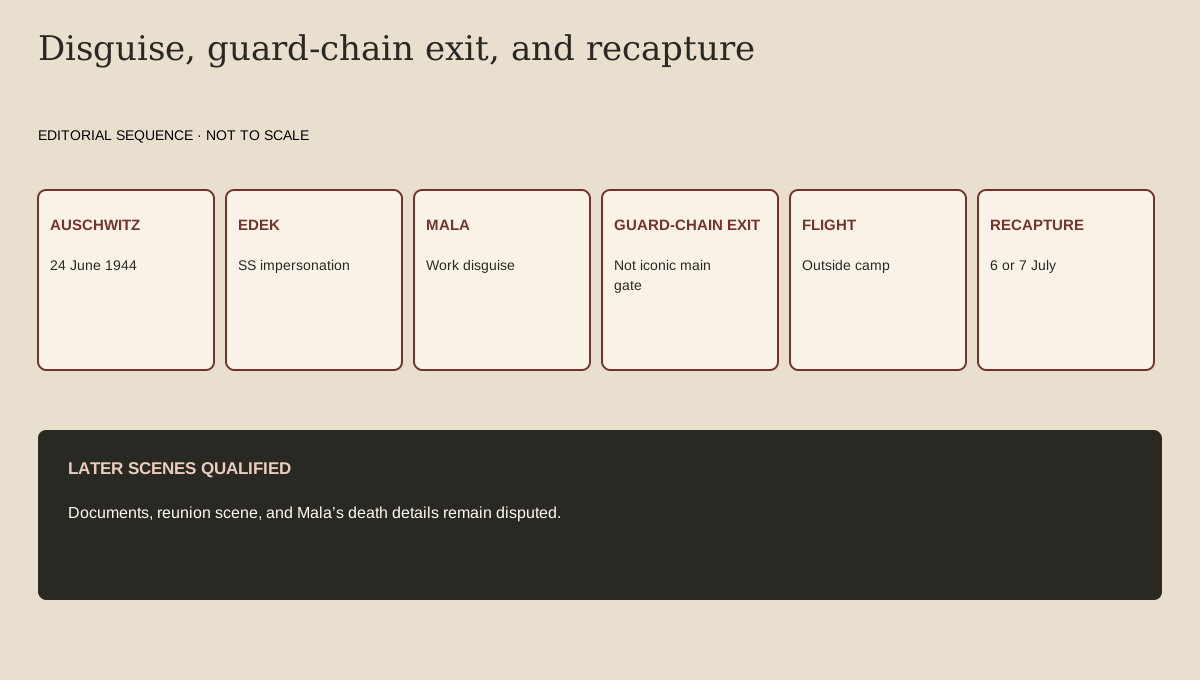
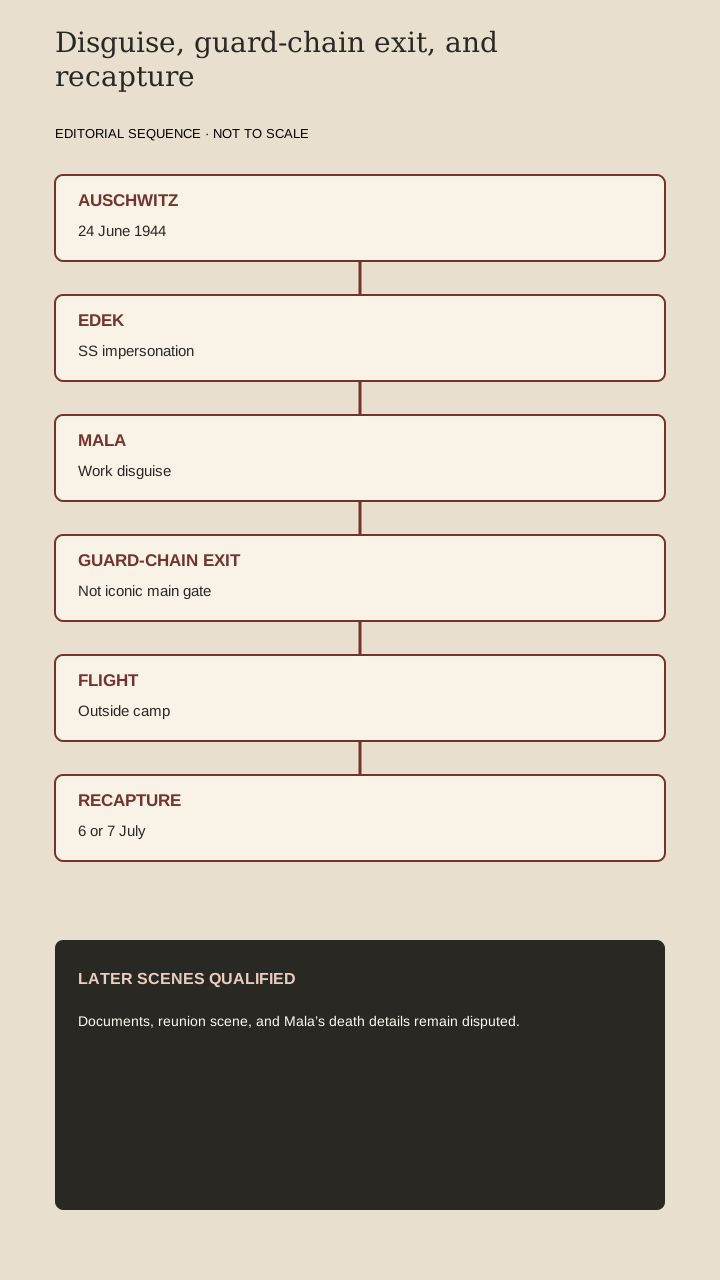
Simplified editorial reconstruction; not to scale. See adjacent text for evidence qualifications and unresolved details.
Material evidence
Tools of Escape
The objects used in an escape reveal how a plan worked under constraint.
- 01Core disguise
SS uniform
The uniform transformed Galiński from a visibly imprisoned Polish prisoner into the apparent authority figure in the pair’s escort deception.
- 02Gate legitimacy
Falsified SS pass
A stolen and falsified pass or pass form helped support the appearance that Galiński was legitimately taking a prisoner beyond the guarded zone.
- 03Prisoner-role disguise
Work overalls and washbasin
Zimetbaum’s overalls and the washbasin reinforced the cover story that she was a prisoner being escorted to outside work rather than an escapee.
Problem → response
Escape was a sequence of problems
Each response solved a practical obstacle while often creating the next one.
- 01→
Obstacle
The closed guarded zone around Birkenau
Prisoners could not simply walk through the outer guard chain without an authorized reason and credible escort.
Response
The escape used an SS impersonation and work-detail cover story instead of physically breaching the fences.
- 02→
Obstacle
Recognizable prisoner status
Both escapees were registered prisoners whose absence would trigger a camp search.
Response
Galiński concealed his status with an SS uniform; Zimetbaum appeared to remain in a prisoner work role while carrying an ordinary work object.
- 03→
Obstacle
Need for an external destination
Getting beyond the guard chain did not create durable safety in German-occupied territory.
Response
They moved toward Slovakia rather than remaining near Auschwitz, but were intercepted before reaching secure refuge.
- 04→
Obstacle
Interrogation after recapture
The Auschwitz Political Department sought to identify the network that had supplied the escape materials and assistance.
Response
The Auschwitz Museum states that neither Zimetbaum nor Galiński revealed the names of those who had helped them.
The final accounting
Outcome
Camp perimeter escaped
On 24 June 1944, Zimetbaum and Galiński successfully crossed beyond Birkenau’s guarded zone.
Recaptured
They were captured in the Bielsko/Beskid region on 6 or 7 July while heading toward Slovakia.
Returned to Block 11
Both were brought back to Auschwitz, imprisoned in Block 11, and subjected to interrogation and torture.
Killed at Auschwitz
Galiński was hanged on 15 September 1944. Zimetbaum cut her wrists before the intended execution; the surviving accounts of her final death differ.
Evidence discipline
What the record supports
Status labels distinguish secure conclusions from uncertainty and rejected claims. Color is never the only signal.
DOCUMENTED
Mala Zimetbaum and Edek Galiński escaped Auschwitz II-Birkenau on 24 June 1944.
The date is supported by Auschwitz archival telegrams, museum records, prisoner testimony, and multiple institutional reconstructions.
Sources: SRC-001, SRC-002, SRC-003DOCUMENTED
The escape relied on Edek impersonating an SS man who was escorting Mala to outside work.
Auschwitz Museum evidence consistently identifies the SS uniform, worker disguise, washbasin, and false escort scenario as the central mechanism.
Sources: SRC-001, SRC-003DISPUTED
They were recaptured on exactly 7 July 1944.
One Auschwitz educational page cites a camp telegram recording capture on 7 July. Another museum reconstruction gives 6 July and notes Galiński’s Block 11 inscription with that date; Yad Vashem’s scholarly discussion also cites Danuta Czech for 6 July.
Sources: SRC-001, SRC-003, SRC-004, SRC-006LATER CLAIM
Edek had a clear opportunity to escape alone when Mala was stopped, but voluntarily surrendered because he would not leave her.
The story is prominent in later museum and survivor-based retellings, but the precise moment of capture is reconstructed from testimony rather than a contemporaneous operational record. It should be presented as a powerful later account, not an independently documented fact.
Sources: SRC-003, SRC-004DISPUTED
Mala carried documentary proof of Nazi mass murder out of Auschwitz during the escape.
This appears in some survivor traditions, but Yad Vashem’s source-critical treatment notes contrary testimony and does not treat the documents story as established. It should not be built into the escape mechanism without stronger direct evidence.
Sources: SRC-004DISPUTED
Mala was certainly shot beside a crematorium after cutting her wrists.
The Auschwitz Museum records conflicting survivor accounts: one says she died from blood loss in the camp hospital; others say she died while being transported to a crematorium or was shot near it.
Sources: SRC-001, SRC-005MYTH
Their story should be understood primarily as a romance.
Their relationship shaped the escape plan, but treating Auschwitz chiefly as the setting for a love story obscures the camp’s system of persecution, forced labor, mass murder, torture, and execution. The escape should remain centered on prisoner agency and evidence.
Sources: SRC-001, SRC-004, SRC-007Selected chronology
Selected chronology
Galiński arrives in the first Polish prisoner transport
Edward Galiński entered Auschwitz in the first transport of Polish political prisoners and received prisoner number 531.
Zimetbaum arrives at Auschwitz
After arrest in Antwerp and detention at Malines/Mechelen, Mala Zimetbaum arrived at Auschwitz and was registered in Birkenau as prisoner 19880.
Mala and Edek meet
Their camp duties gave each somewhat greater movement than many other prisoners, and the Auschwitz Museum places the beginning of their relationship around the turn of 1943 and 1944.
Escape from Birkenau
Galiński, disguised as an SS man, escorted Zimetbaum—dressed as a worker and carrying a washbasin—through the guarded zone using the false work-detail scenario.
Camp authorities circulate escape notices
Auschwitz archival telegrams dated 25 June record the escape and the search for Zimetbaum and Galiński.
Recaptured near Bielsko
Museum sources differ by one day: a Block 11 inscription and one Auschwitz reconstruction give 6 July, while another Auschwitz archival presentation cites a capture telegram recording 7 July.
Galiński is executed
Auschwitz Museum sources identify 15 September as the date of Galiński’s public hanging in the men’s camp at Birkenau.
Zimetbaum dies after disrupting her planned execution
Witnesses agree that Zimetbaum cut her wrists before the planned execution, but accounts conflict over her subsequent treatment and precise manner of death.