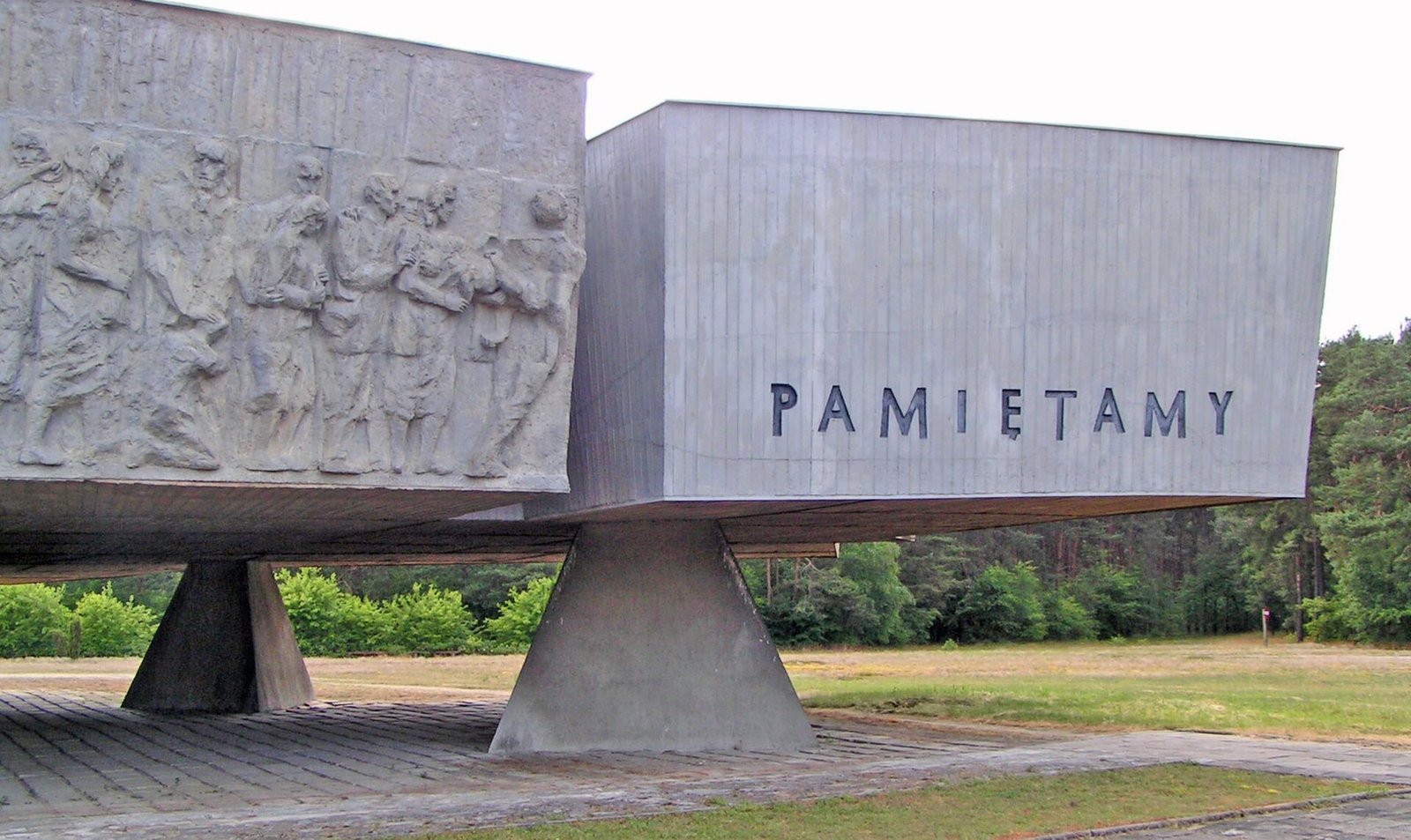
The known escapes from Chełmno did not form a single breakout. They happened in separate moments, under different conditions, and with different immediate consequences. In January 1942, only weeks after mass killing began at the site, forced laborers escaped and tried to tell other Jews what they had seen. Three years later, as the Germans prepared to abandon and destroy the killing center, two prisoners survived the attempted murder of the remaining labor detail and got away.
Those two escape waves created two different kinds of evidence. The 1942 escapees carried warnings into ghettos and underground networks while the killing was still underway. Szlama Ber Winer’s testimony reached the Warsaw ghetto, where members of Oneg Shabbat recorded it and incorporated it into one of the earliest detailed reports on Chełmno. The January 1945 escapees, Szymon Srebrnik and Mieczysław Żurawski, survived to describe the final liquidation and later contributed to postwar investigations.
Current United States Holocaust Memorial Museum research identifies seven Jewish men known to have escaped successfully from Chełmno: five in 1942 and two in January 1945. The museum at Chełmno preserves a wider record of more than a dozen known escape attempts and ten identified men associated with those attempts. Those figures are not contradictory. They count different things: successful escape, attempted escape, and the smaller body of survivors whose testimony was preserved.
That distinction matters because Chełmno was not a detention camp from which prisoners ordinarily expected eventual release. It was a Nazi German killing center created to murder deported Jews and Roma. The men who escaped had generally been temporarily selected for forced labor connected to the killing process. Escape meant getting out before the same system killed them, and in several cases trying to make knowledge of that system travel farther than they could.
At a Glance
- Killing center: Chełmno nad Nerem, called Kulmhof by the German occupiers
- First period of operation: December 1941–April 1943
- Second period: June 1944–January 1945
- Known successful Jewish escapees: 7
- Successful escapees in 1942: Abram Rój, Michał (Mordechai) Podchlebnik, Szlama Ber Winer, Yerachmiel Widawski, Yitzhak Justmann
- Successful escapees in January 1945: Szymon Srebrnik and Mieczysław Żurawski
- Broader escape-attempt record: more than a dozen attempts; Chełmno Museum currently identifies ten men by name
- Earliest documented successful escape in this sequence: Abram Rój, 16 January 1942
- Winer and Podchlebnik: escaped on 19 January 1942
- Final liquidation: night of 17–18 January 1945
- Remaining forced laborers at liquidation: 47 in the stronger current USHMM and Chełmno Museum synthesis
- Known survivors of that liquidation: Srebrnik and Żurawski
A Killing Center With Almost No Margin for Escape
Chełmno began killing operations in December 1941. Nazi German authorities established the site in the Warthegau to murder Jews from the surrounding region and, later, large numbers of Jews deported from the Łódź ghetto. Current USHMM estimates state that at least 152,000 Jews and about 4,300 Roma were murdered there, along with an unknown number of other victims.
The killing process was designed to leave very few witnesses. Deportees were brought to the manor area at Chełmno, murdered in gas vans, and their bodies transported to the Rzuchów Forest area. Small groups of Jewish prisoners were temporarily kept alive for forced labor connected to this system. Their survival was provisional.
This helps explain why the Chełmno escape record looks different from escapes from ordinary prisons or even many concentration camps. The men who fled were not breaking from a stable prisoner population that had existed for years. They were moving through a system intended to destroy both the deportees and many of the forced laborers who knew how the killing worked.
The Germans also worked to keep Chełmno secret. Deception accompanied deportation, and later the SS destroyed buildings, documents and human remains in an effort to erase evidence. Escapees therefore became unusually important historical sources because their knowledge left the site while the perpetrators were still trying to conceal it.
Abram Rój: 16 January 1942
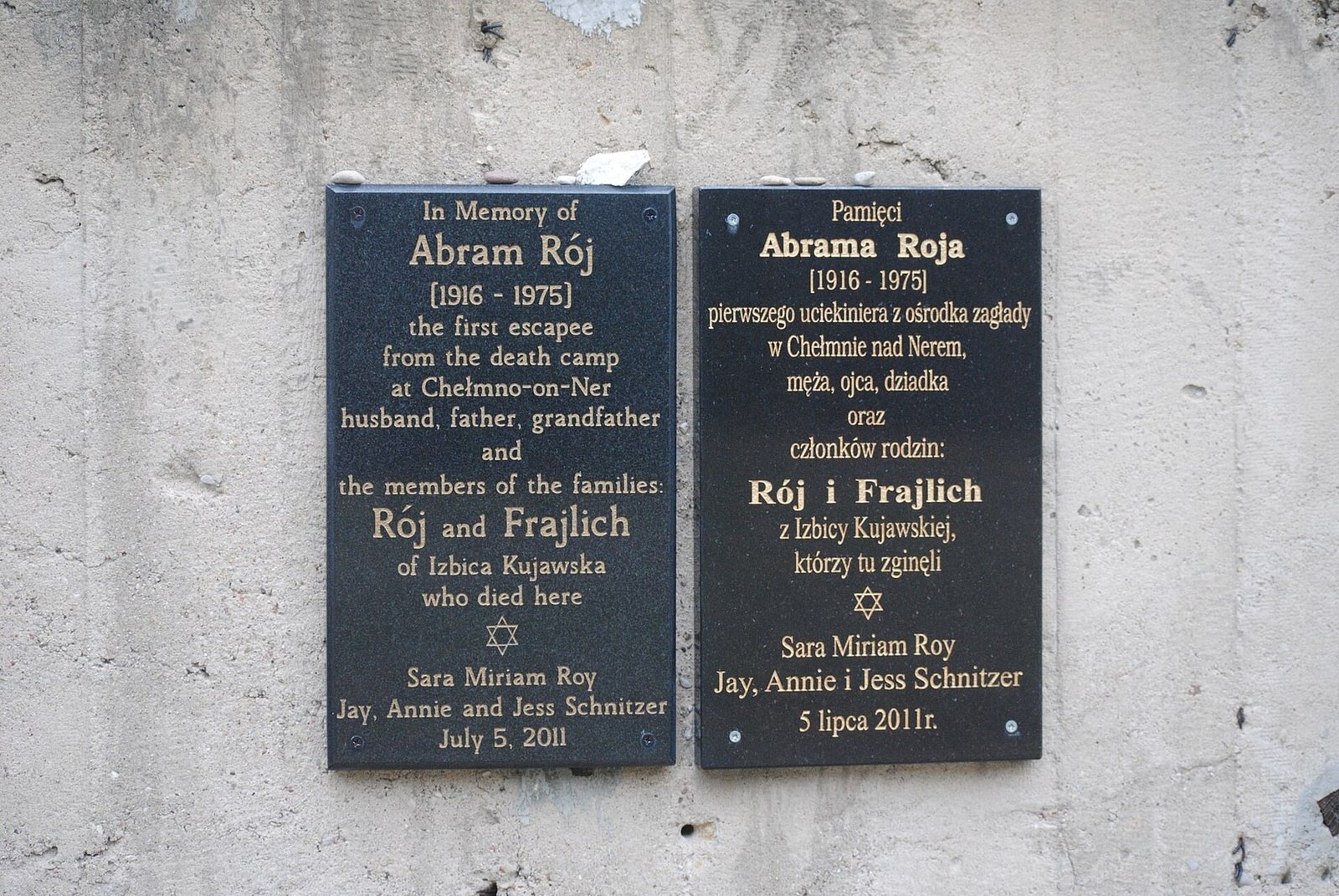
Chełmno Museum identifies Abram Rój of Izbica Kujawska as the first of the best-documented successful escapees from the killing center. On the evening of 16 January 1942, he got out of the cellar of the manor where forced laborers were being held.
The surviving public summaries do not support a detailed reconstruction of every movement he made once outside. That uncertainty should remain visible. What is important is the sequence created by his success.
Three days later, according to the museum, Rój’s example encouraged other forced laborers to make their own attempts. Szlama Ber Winer and Michał Podchlebnik both escaped on 19 January while being transported toward the forest work site.
Rój survived the war. His escape is less richly documented in surviving testimony than Winer’s or Podchlebnik’s, but it belongs at the beginning of the Chełmno escape chronology because the museum’s current research explicitly places it there.
19 January: Winer and Podchlebnik
Winer and Podchlebnik escaped on the same date, but the evidence should not be compressed into a single coordinated stunt unless a source establishes that coordination.
The Chełmno Museum says that both men fled during transport toward the Rzuchów Forest. The Jewish Historical Institute gives a specific account for Winer: he escaped through a small opening in the vehicle carrying him. The museum’s reconstruction of Podchlebnik, drawing on his own postwar testimony, records a different physical action: he cut the canvas covering the vehicle and jumped out before he could be stopped.
Those details are compatible with two men exploiting the vulnerabilities of forced-labor transport on the same day, but they do not justify inventing a shared minute-by-minute plan.
Podchlebnik initially hid in a nearby barn. His testimony later described receiving food, a cap, a shave and directions from a local Polish farmer whose name he did not know. He reached Grabów and eventually moved into the General Government. Later he hid in the countryside for many months and survived the war.
Winer also reached Grabów on the day of his escape. What he did next made his escape historically consequential far beyond his own survival.
Winer’s Warning in Grabów
Winer later wrote that escape was tied to the desire to tell others what was happening at Chełmno. The Jewish Historical Institute records that on 19 January he reached a rabbi in Grabów. Word spread, and local Jews gathered to hear him describe what he had witnessed.
Warnings from Chełmno did not begin and end with one man. USHMM’s current synthesis says that the 1942 escapees tried to warn Jews in surrounding communities and that news of the mass murder reached both Grabów and the Łódź ghetto in January 1942.
The existence of a warning did not mean that targeted communities suddenly had a safe or obvious course of action. Jews in German-occupied Poland lived under coercion, starvation, forced relocation, sealed ghettos, police violence and severe restrictions on movement. German authorities also used deception about “resettlement” and labor. Information could be incomplete, difficult to verify, or almost impossible to act upon.
This point is essential to any account of the warning network. The historical question is not why people who heard warnings failed to perform an imagined easy escape. There was no easy escape from the machinery of occupation. The significance of the Chełmno escapees lies in the fact that they pushed accurate information into communities and underground networks despite those constraints.
From Winer to Oneg Shabbat
Within weeks, Winer reached the Warsaw ghetto. There he came into contact with Hersz and Bluma Wasser, members of the underground documentation group known as Oneg Shabbat, organized around historian Emanuel Ringelblum.
Bluma Wasser recorded Winer’s detailed account in February 1942. In the archive he was associated with the name or pseudonym “Grojanowski,” which is why older scholarship often refers to the Grojanowski Report.
Oneg Shabbat did more than preserve his words. The group compared testimony, gathered additional information and incorporated material from Winer into a report titled “Events in Chełmno,” dated 25 March 1942.
The Jewish Historical Institute describes that report as drawing on Winer’s testimony and other sources, including information associated with Uszer Taube. That matters because the warning chain should not be simplified into “one escapee wrote one report and the world learned the truth.” Winer supplied exceptional firsthand evidence, but the report was an underground documentation project that combined and processed evidence.
In March, according to the JHI reconstruction, the report was passed to representatives of the Polish Home Army. Information from Chełmno also entered Bund channels. A Bund leadership letter dated 11 May 1942 was carried out of occupied Poland by Swedish businessman Sven Norrman and reached London in early June. JHI notes that part of the Bund material had been drawn from the Oneg Shabbat Chełmno report.
USHMM summarizes the international transmission more directly: the Oneg Shabbat report based on Winer’s account was smuggled to the Polish government-in-exile in London. Both descriptions point to the same larger reality—Winer’s evidence entered overlapping Polish-Jewish and Polish underground information networks that carried news west.
By 2 July 1942, information derived from the Chełmno evidence appeared in The New York Times, on page six.
Warning Did Not Save Winer
The survival of Winer’s testimony can create the false impression that its author survived with it.
He did not.
Oneg Shabbat members helped Winer leave Warsaw because remaining there was dangerous. He traveled to the Zamość region. In early April 1942, he sent further information concerning the killing center at Bełżec.
After the liquidation of the Zamość ghetto on 11 or 12 April, Winer himself was deported to Bełżec and murdered there. A later message from his nephew Abram Bajler informed Bluma and Hersz Wasser of his death.
His testimony survived because Oneg Shabbat preserved it. The archive was buried in Warsaw during the Holocaust and recovered after the war.
The contrast is central to the case. Escape from Chełmno gave Winer enough time to warn others and create a documentary record. It did not give him durable safety under Nazi rule.
The Other 1942 Escapees
Current USHMM research identifies two additional successful Chełmno escapees later in 1942: Yerachmiel Widawski and Yitzhak Justmann.
Chełmno Museum likewise names Justmann and Widawski among the men known to have attempted escape during the first period and states that both survived the war. The museum also lists a Goldman from Kłodawa and a man recorded uncertainly as Sgiem Chabus of Kutno among the identified would-be escapees.
The source base for the successful departures of Justmann and Widawski is much thinner in readily accessible public material than it is for Winer and Podchlebnik. Their names and successful escape status are secure enough for inclusion because the current USHMM synthesis explicitly counts them among the five successful 1942 escapees. Exact dates, route geometry and mechanics should not be invented.
This is where the distinction between known successful escapees and the broader attempt record becomes most useful. Chełmno Museum says that historians know of more than a dozen attempts but currently know the identities of only ten men. Not all ten succeeded.
The seven-person USHMM figure is therefore not a rival estimate of the same denominator. It is a narrower category: men known to have escaped successfully.
Six Survived the War; Winer Did Not
Among the seven successful escapees identified in the current synthesis, six are known to have survived the war.
Chełmno Museum states that Rój, Podchlebnik, Justmann and Widawski survived from the first-period escape group. The two January 1945 escapees, Srebrnik and Żurawski, also survived the final destruction of the camp and lived to give evidence afterward.
Winer was the exception. His murder at Bełżec underscores how precarious “successful escape” was in occupied Poland.
This is another denominator that should remain separate. Seven men are known to have escaped Chełmno successfully; six are known to have survived the Holocaust. The first number measures escape from the killing center. The second measures survival beyond it.
Chełmno Reopens
The Germans ended Chełmno’s first killing period in April 1943 and destroyed the manor. The killing center was reactivated in 1944 as the Germans completed the destruction of the Łódź ghetto.
Again, Jewish forced laborers were kept alive temporarily to perform work connected to the site. Among them was Szymon Srebrnik, a teenager from the Łódź ghetto.
By January 1945, the military situation had changed dramatically. Soviet forces were approaching, and the SS moved to eliminate remaining witnesses and abandon Chełmno.
The strongest current synthesis from USHMM and Chełmno Museum places 47 Jewish forced laborers at the center of the final liquidation. An older Yad Vashem overview gives 48 and states that three escaped. That older formulation should not be silently erased, but the newer museum research and detailed survivor record support 47 remaining prisoners and two known successful escapees.
The Night of 17–18 January 1945
The liquidation was an attempt to murder the remaining forced laborers, not an organized mass escape.
Chełmno Museum describes prisoners being taken from the granary in small groups and shot outside. Srebrnik was among the first group. He was shot, lost consciousness and was left for dead.
The prisoners still inside understood what was happening and resisted. Amid the violence and confusion, Mieczysław Żurawski got out of the granary. He was wounded in the leg but escaped through the camp boundary and fled toward the forest.
Srebrnik regained consciousness and managed to move away from the execution area. He hid in a barn.
The resistance inside the granary continued. German personnel ultimately set the building on fire, killing the remaining prisoners. USHMM’s current count is stark: of 47 remaining forced laborers, 45 were killed, leaving Srebrnik and Żurawski as the two known survivors of the liquidation.
The mechanics should not be turned into an action sequence. The important historical distinction is that the two men survived different moments within an attempted extermination of the remaining witnesses. Żurawski escaped during the resistance and confusion; Srebrnik survived being shot and then got away.
Why Some Older Sources Say Three Escaped
Holocaust reference works were built over decades from survivor testimony, German records, investigations, trial evidence and later archival reconstruction. As that evidence was reconciled, counts changed.
An older Yad Vashem overview states that 48 Jewish prisoners remained when the Germans liquidated the camp and that three escaped. Current USHMM material instead gives 47 remaining, 45 killed and two survivors: Srebrnik and Żurawski. Chełmno Museum’s recent specialist work also identifies those two as the successful escapees of the final night.
The newer 47/45/2 formulation is therefore the stronger current synthesis. The older 48/three tradition remains historically relevant because it shows that the numerical record was not always presented consistently.
There is no value in averaging the figures. A count of 47 and a count of 48 cannot be reconciled by inventing a midpoint, and an unidentified third successful survivor should not be created simply because an older overview once used that number.
Escapees as Evidence
Chełmno Museum notes that only four of the identified escapees left accounts that were written down. Those surviving testimony traditions became disproportionately important because Nazi authorities destroyed so much evidence and murdered so many potential witnesses.
Winer’s wartime testimony is the earliest and most extraordinary example. It became evidence before the killing center had even completed its first months of operation.
Podchlebnik’s postwar testimony supplied a detailed survivor account of the first period. Srebrnik and Żurawski described the second period and the camp’s final liquidation. Władysław Bednarz’s postwar investigation in Koło gathered crucial survivor evidence during 1945.
The testimony did not remain confined to local investigations. In 1961, both Podchlebnik and Srebrnik testified at the trial of Adolf Eichmann in Jerusalem. Their appearances carried memories of Chełmno into one of the most internationally visible Holocaust trials.
The documentary chain therefore runs in two directions. In 1942, escape made warning possible while murder was ongoing. After 1945, survival made reconstruction and prosecution possible after the perpetrators had tried to erase the site.
What the Warning Network Could—and Could Not—Do
It is tempting to judge wartime warnings by whether they produced immediate mass flight. That standard misunderstands the environment in which the warnings circulated.
Chełmno’s escapees offered evidence of a reality that Nazi authorities were actively disguising. Oneg Shabbat and other underground networks worked to collect, verify, preserve and transmit that evidence. The information reached local Jewish communities, Warsaw, Polish underground channels, London and eventually Western media.
But knowledge did not dissolve German power.
Jews in the Warthegau and General Government faced sealed ghettos, deportation orders enforced at gunpoint, collective punishment, poverty, hunger, hostile or dangerous territory outside the ghettos, and severe restrictions on movement. Even when people believed reports of mass murder, the available choices could remain catastrophically narrow.
The escape and warning network should therefore be understood as resistance through survival, testimony and information. It did not “fail” because it could not by itself stop the Holocaust.
Winer’s evidence was preserved because others listened, wrote, copied, transmitted and buried it. The Wassers and the wider Oneg Shabbat group were essential links. So were the underground couriers and political networks that moved information out of occupied Poland.
The network mattered because the perpetrators did not succeed in making Chełmno unknowable.
Seven Successful Escapes, More Than a Dozen Attempts
The cleanest present-day count is seven known successful Jewish escapees.
That number is useful only if its limits are kept visible. Chełmno Museum knows of more than a dozen attempted escapes and has identified ten men associated with those attempts. Some attempts failed. Some details survive only fragmentarily. A few names have uncertain spellings in the surviving record.
The seven successful men currently identified by USHMM are:
Abram Rój — escaped 16 January 1942 and survived the war.
Szlama Ber Winer — escaped 19 January 1942, warned Jews in Grabów and supplied the testimony behind the Oneg Shabbat Chełmno report; murdered later in 1942 at Bełżec.
Michał (Mordechai) Podchlebnik — escaped 19 January 1942 and survived the war.
Yerachmiel Widawski — escaped later in 1942 and survived the war.
Yitzhak Justmann — escaped later in 1942 and survived the war.
Szymon Srebrnik — survived the January 1945 execution attempt and escaped; later testified about Chełmno.
Mieczysław Żurawski — escaped during the January 1945 liquidation and survived; later gave evidence about the final phase.
This is not a roster of equivalent experiences. The source depth differs sharply from one man to another. Their common historical significance is narrower: each got out of a killing center designed to leave almost no Jewish witnesses alive.
What the Chełmno Escapes Established
The escapes did not stop Chełmno. They did not produce a single dramatic uprising that liberated the forced laborers. They did not guarantee survival.
What they did was breach secrecy.
In January 1942, men escaped almost immediately after the killing center began operating and carried eyewitness knowledge outward. Winer’s account entered one of the Holocaust’s most important underground archives within weeks. Information derived from that evidence moved through Polish-Jewish and Polish resistance networks and reached the West while mass murder continued.
In January 1945, two men survived the Germans’ final attempt to eliminate the remaining Jewish forced laborers. Their survival helped preserve evidence of the second operating period and the killing center’s destruction.
The later historical record depends heavily on these improbable survivals. Seven successful escapes are known today, but the deeper story is a chain of people who turned escape into warning and survival into evidence.
Chełmno’s perpetrators tried to murder the witnesses and destroy the traces. They did not succeed in either task completely.
Evidence discipline
What the record supports
Status labels distinguish secure conclusions from uncertainty and rejected claims. Color is never the only signal.
MYTH
Only two or three people ever escaped successfully from Chełmno.
Older summaries often focused on the best-known witnesses. Current USHMM research identifies seven known successful Jewish escapees: five in 1942 and two in January 1945.
Sources: SRC-001, SRC-004MYTH
Chełmno Museum's ten identified escapees means ten men are known to have escaped successfully.
The museum's ten-name figure belongs to a broader record of more than a dozen escape attempts. It includes unsuccessful attempts. USHMM's seven-person figure is the current successful-escape count.
Sources: SRC-001, SRC-004DOCUMENTED
Abram Rój escaped before Winer and Podchlebnik in January 1942.
Current Chełmno Museum research dates Rój's escape to the evening of 16 January and Winer's and Podchlebnik's escapes to 19 January.
Sources: SRC-004MYTH
Winer's testimony alone created a single direct report that traveled unchanged from Warsaw to London.
Winer's testimony was foundational, but Oneg Shabbat incorporated it with other evidence. Related information moved through overlapping Polish underground and Bund channels before reaching London.
Sources: SRC-001, SRC-002, SRC-003MYTH
The fact that warnings circulated meant Jewish communities had a realistic, general option to escape deportation.
Information circulated under conditions of extreme coercion, sealed ghettos, armed German control, deprivation, deception, and severe constraints on movement. Knowledge and practical ability to evade deportation were not equivalent.
Sources: SRC-001, SRC-002MYTH
Winer survived the Holocaust because he escaped Chełmno.
Winer escaped Chełmno and transmitted crucial evidence but was later deported to the Bełżec killing center and murdered there in April 1942.
Sources: SRC-001, SRC-002DISPUTED
Three prisoners are securely known to have escaped during the final liquidation of Chełmno.
An older Yad Vashem overview gives 48 remaining prisoners and three escapees. Current USHMM and Chełmno Museum research uses 47 remaining, 45 killed, and two known successful escapees: Srebrnik and Żurawski.
Sources: SRC-001, SRC-006, SRC-008MYTH
Szymon Srebrnik escaped before the Germans attempted to kill him.
The stronger survivor and museum record states that he was shot, lost consciousness, was left for dead, regained consciousness, and then got away.
Sources: SRC-001, SRC-006, SRC-007Evidence diagram
How escape became evidence
The 1942 warning wave and 1945 survivor testimony are distinct evidence pathways with different denominators.
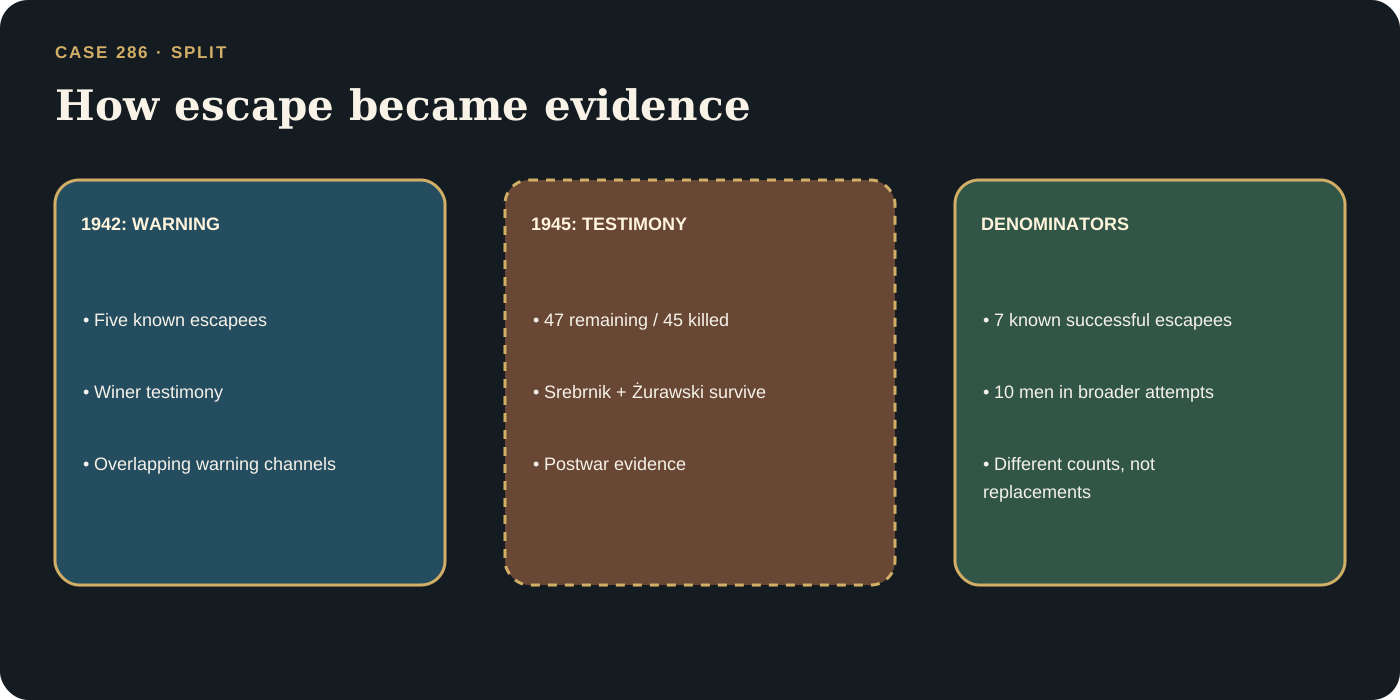
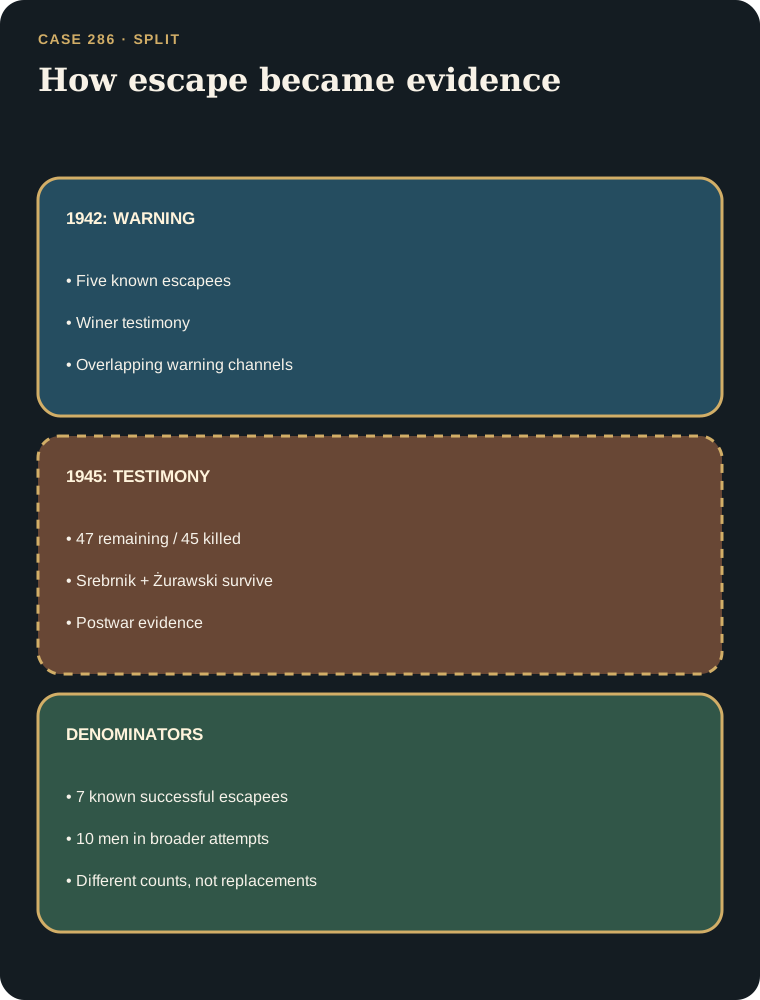
The 1942 warning wave and 1945 survivor testimony are distinct evidence pathways with different denominators.