Janowska’s final Jewish prisoner revolt is often described as a single uprising on November 19, 1943. The evidence is more complicated.
As the Germans liquidated the Jewish prisoner population around Janowska in Lwów, two linked armed revolts unfolded in closely connected places. One occurred among prisoners at Janowska itself while mass executions were taking place. The other — and better documented as a mass escape — was carried out by Jewish prisoners of the Sonderkommando 1005 “Death Brigade,” who had been forced to exhume and burn bodies as part of the Nazi effort to destroy evidence of mass murder.
Recent Janowska scholarship treats these as two distinct but near-simultaneous uprisings. That distinction solves several problems that shorter accounts leave tangled. It explains why some sources describe a revolt inside the camp while others place the breakout near the Lysynychi forest. It also helps explain radically different escape totals. A modern scholarly reconstruction by Waitman Wade Beorn gives approximately fifty prisoners escaping with the Death Brigade, while older or popular accounts sometimes claim around 120. A Lwów memorial-book tradition says only “a few tens” got away.
Those numbers should not be averaged. They may describe different groups, different stages of the same liquidation, or a later merging of two uprisings into one story.
What is secure is the larger history. By November 1943 the Germans were murdering the remaining Jewish forced laborers around Janowska and eliminating witnesses to earlier mass killings. Prisoners understood that their own deaths were approaching. Some chose armed resistance. Some broke away. Many were hunted down and murdered.
Leon Weliczker — later Leon Wells — was among those who escaped the Death Brigade. He survived months in hiding and became one of the most important witnesses to both Janowska and Sonderaktion 1005.
At a Glance
- Canonical date: November 19, 1943, with important adjacent-date variants in survivor-derived literature.
- Canonical framing: Two linked uprisings during the November liquidation, not one monolithic revolt.
- Main camp revolt: Jewish prisoners rose inside Janowska while liquidation shootings were underway.
- Death Brigade revolt: Sonderkommando 1005 prisoners revolted at a separate work/camp site near the Lysynychi forest and attempted a mass escape.
- Strongest modern Death Brigade escape count: Approximately 50, based on Beorn’s peer-reviewed reconstruction.
- Other traditions: “A few tens” in the Lwów memorial-book tradition; around 120 in widely repeated later summaries.
- Long-term survivor count: Unknown. The number of people who initially escaped is not the same as the number who survived subsequent searches, recapture, hiding and the rest of the war.
- Named survivor: Leon Weliczker Wells.
- Liquidation killings: Thousands of Jews were murdered. USHMM states that at least 6,000 surviving Jews from various forced-labor camps in Galicia were killed during the Janowska liquidation.
Janowska was more than one kind of camp
Janowska is difficult to summarize because it did not fit neatly into one category. The camp complex stood on Janowska Street in German-occupied Lwów, today Lviv in Ukraine. It developed around a German Equipment Works facility using Jewish forced labor and became a prison, a labor camp, a transit point for deportation and a site of mass killing.
That combination is why historian Waitman Wade Beorn describes Janowska as a hybrid camp. People classified as useful laborers could be held there temporarily or for longer periods. Others passed through on the way to killing centers, especially Bełżec. Large numbers were also murdered locally, particularly in the Piaski area north of the camp.
The camp’s urban location gave it another unusual feature. Prisoners often had prior knowledge of the city, relatives nearby or contacts beyond the wire. Those connections sometimes made escape possible.
The Germans knew that too. According to Beorn’s recent research, SS authorities tried at points to deter escapes by threatening relatives of fugitives. For prisoners whose families were still reachable, the decision to flee could therefore endanger people outside the camp as well as the person attempting escape. By late 1943, that system was collapsing into outright liquidation.
The Nazis were destroying evidence
The Death Brigade emerged from a different stage of the Holocaust. As Soviet forces moved westward and evidence of Nazi mass murder became increasingly dangerous to the perpetrators, the SS expanded Sonderaktion 1005, an operation designed to erase traces of earlier killings. Jewish prisoners and other forced laborers were compelled to open mass graves, remove bodies, burn them and reduce remaining bones and ash so that killing sites would become harder to identify.
Janowska became an important base for this work in the Lwów region. The name “Sonderkommando 1005” can create confusion because it can refer to the German operation or command structure as well as to prisoner work details forced to carry out the physical labor. Survivor literature often called the Jewish prisoner group near Janowska the Death Brigade.
Leon Weliczker was assigned to it in 1943. He understood the logic of the work from inside. Men forced to destroy evidence of murdered Jews were themselves dangerous witnesses. Once the graves were emptied and the work neared completion, there was little reason to expect the Germans to leave them alive. The Death Brigade’s revolt grew from that expectation.
Leon Weliczker had already escaped Janowska once
Weliczker’s biography makes the November breakout especially unusual. Born in Lwów in 1925, he entered Janowska as a teenager. During an earlier imprisonment he escaped after surviving a sequence that had placed him among prisoners marked for death.
Beorn’s reconstruction shows that he later returned to Lwów after learning what had happened to members of his family. He was arrested again during the destruction of the Jewish community and returned to Janowska.
This second imprisonment placed him in Sonderkommando 1005. His later memoir, published in English as The Janowska Road, became one of the foundational firsthand accounts of the camp and the Death Brigade. The United States Holocaust Memorial Museum has republished the work and describes it as one of the major surviving accounts of Jewish life in the Holocaust.
Weliczker also testified at Adolf Eichmann’s trial in Jerusalem in 1961. The importance of his testimony is not that memory eliminates uncertainty. It does not. Its importance is that someone who had been forced into the evidence-destruction operation survived long enough to describe it.
The date problem
November 19, 1943 is the strongest date for the uprising and mass escape. The United States Holocaust Memorial Museum uses that date. Beorn’s 2018 peer-reviewed article also dates the Sonderkommando breakout to November 19.
David Alan Rich’s detailed German-language study places the Death Brigade revolt in the night from November 18 to November 19. His chronology then says that from November 19 the remaining Jewish prisoners at Janowska were being taken in groups for execution at Piaski, where another prisoner revolt broke out amid the liquidation.
That makes November 19 the best anchor date for the two-event sequence. But not every survivor-derived source agrees.
Beata Przymuszała, working from Weliczker’s early autobiographical text, gives November 20 as the date on which he escaped the Death Brigade. Jay Winter’s Remembering War, reconstructing the episode through Weliczker’s memory, gives November 21.
The difference should remain visible. Holocaust chronology often depends on records created under persecution, early testimony, later memoir and postwar legal reconstruction. A one- or two-day difference is not evidence that the revolt did not happen. It is evidence that the surviving record was created under extreme conditions and later stabilized differently by different historians. November 19 is therefore best treated as WELL-SUPPORTED, not artificially upgraded into absolute certainty.
The Death Brigade revolt
The broad mechanics are consistent across the strongest traditions. The prisoner detail believed its forced work was ending and that its members would be murdered. Prisoners prepared collectively to resist. During the night, they turned on guards and broke away toward the surrounding city and wooded areas.
There is no need to reproduce guard positions, distraction schemes or other operational details from later memoir reconstructions. The historically important point is simpler. The prisoners created a moment in which a guarded work detail ceased to function as a captive unit.
Beorn’s peer-reviewed 2018 study states that the Sonderkommando killed a guard and that approximately fifty prisoners escaped, including Weliczker. Jay Winter, drawing closely on Weliczker’s account, also gives about fifty men getting away initially. A Lwów memorial-book account describes a Death Brigade of roughly 150 and says a few tens escaped. These independent traditions cluster far more closely around dozens than around the often-repeated claim that 120 escaped.
Where does “120 escaped” come from?
The figure is common enough that it cannot simply be ignored. It appears in popular summaries of Janowska and is sometimes presented as the number of Sonderkommando prisoners who successfully broke out. The problem is that stronger recent scholarship does not use it for the Death Brigade breakout.
There are several ways the discrepancy may have developed. The prisoner brigade itself changed size over time. Some accounts give approximately 120–150 men in the unit. Separate prisoners also escaped during the uprising inside the main camp. Later summaries frequently compress the two revolts into a single event.
Beorn’s own broader public history of Janowska refers to a mass prisoner revolt allowing more than one hundred Jews to escape, while his peer-reviewed discussion of the Death Brigade specifically says approximately fifty. That is not necessarily a contradiction. It may reflect two different denominators.
The responsible conclusion is therefore not “120 is impossible.” It is that 120 cannot safely be published as the secure number of Death Brigade escapees. For that event, approximately fifty is better supported.
The second uprising was inside Janowska
The Death Brigade breakout was not the only revolt. Rich’s reconstruction says that the escape and the resulting disorder were followed by an intensified German liquidation of remaining Jewish forced laborers in Lwów. Beginning November 19, surviving Jewish prisoners from Janowska were taken toward Piaski in groups for execution.
During that controlled killing process, prisoners inside the camp revolted. Beorn’s 2024 discussion is unusually explicit about the distinction. He describes two simultaneous armed uprisings: an uprising in Janowska itself and a second, more successful mass escape by Sonderkommando 1005 prisoners at a nearby forest work site.
The camp uprising appears to have been less systematically planned than the Death Brigade breakout. Prisoners escaped from it too.
The available open-source evidence does not support a clean, independently verified count for those escapees. That is another reason not to pour every person who got out during those days into a single number.
The two revolts were connected by timing, knowledge and the German liquidation.
They were not the same physical event.
Liquidation was already underway
The uprisings did not create the Nazi decision to kill Janowska’s remaining Jewish prisoners.
The liquidation belonged to a wider 1943 campaign to murder surviving Jewish forced laborers and eliminate evidence of earlier killings. That sequence matters ethically as well as chronologically.
It would be misleading to imply that the Germans massacred thousands only in retaliation for the escape. The prisoners were resisting an exterminatory process already underway.
Rich estimates that 5,000–6,000 Jews were shot over roughly two days in the immediate liquidation operation he reconstructs.
USHMM uses a broader denominator. It states that SS personnel and local auxiliaries murdered at least 6,000 surviving Jews from various forced-labor camps in Galicia when Janowska was liquidated in November.
Those figures should not be merged as if they measure exactly the same group.
Both communicate the scale. The uprisings occurred inside a mass killing operation measured in thousands.
Escape did not mean survival
Getting beyond the guards was only the first stage.
Rich describes a large German search operation after the Death Brigade breakout. Many fugitives were recaptured and murdered, along with other Jews still hiding in and around Lwów.
USHMM summarizes the outcome more starkly: a few succeeded in escaping, but most were recaptured and killed.
That language may refer broadly to prisoners involved in the November revolt rather than Beorn’s narrower approximately-fifty initial breakout count. It nevertheless captures the critical distinction between initial escape and durable survival.
No trustworthy source located for this case provides one stable number for Death Brigade escapees who ultimately survived the war.
That number should remain UNKNOWN. Leon Weliczker is securely documented as a survivor.
Others survived as well, but using an uncertain handful as though it were a settled final denominator would be false precision.
Hiding after the breakout
Weliczker’s escape did not lead quickly to safety.
Beorn’s 2024 monograph reconstructs the months that followed. A Polish man, Wojciech Kalwiński, hid Weliczker and twenty-three other Jews in a concealed cellar beneath a barn.
They remained there for months.
In July 1944, with German power collapsing in the region, Weliczker emerged and returned to Lviv. That group of twenty-four should not be turned into “the twenty-four survivors of the Janowska uprising.”
Beorn’s description identifies the people hidden by Kalwiński, not a closed roster of Death Brigade escapees. They had arrived at hiding through different wartime paths.
The number proves something else: escape depended on people outside the camp as well as on the act of breaking away.
For Weliczker, the revolt opened a route out of German custody. Kalwiński’s shelter helped make that freedom durable.
The evidence was meant to disappear
The irony of the Death Brigade revolt is that the prisoners had been assigned to destroy historical evidence.
The Nazis wanted graves emptied and the physical traces of mass murder reduced. Instead, some of the people forced to carry out that work survived to testify about it.
Weliczker’s postwar record became unusually extensive. He wrote about the experience early, published a memoir, testified at the Eichmann trial and later appeared in German proceedings concerning Janowska personnel.
His papers are preserved at Yale University Library.
In the 1961 Eichmann proceedings, the question of resistance itself surfaced directly. The prosecutor asked why Jewish prisoners had not revolted earlier. Weliczker’s testimony and later historical work point to the constraints hidden by that question: armed guards, collective punishment, relatives used as leverage, starvation, uncertainty and the fear that an unsuccessful move would kill not only the person attempting it but others as well.
By November 1943, those calculations had changed.
The prisoners of Sonderkommando 1005 expected death whether they resisted or not.
Janowska did not literally disappear in November
Another common simplification is that the November revolt “ended Janowska.”
It ended the camp’s principal period as a major Jewish forced-labor and killing complex, but parts of the site continued to function.
Beorn’s scholarship notes that Janowska continued on a much smaller scale into 1944 and was formally integrated into the concentration-camp system late in its existence. Other categories of prisoners remained there as Soviet forces advanced.
The Red Army entered Lviv in July 1944.
Soviet investigators then documented the camp and nearby killing sites. Photographs from the Extraordinary State Commission show the landscape that investigators encountered after liberation.
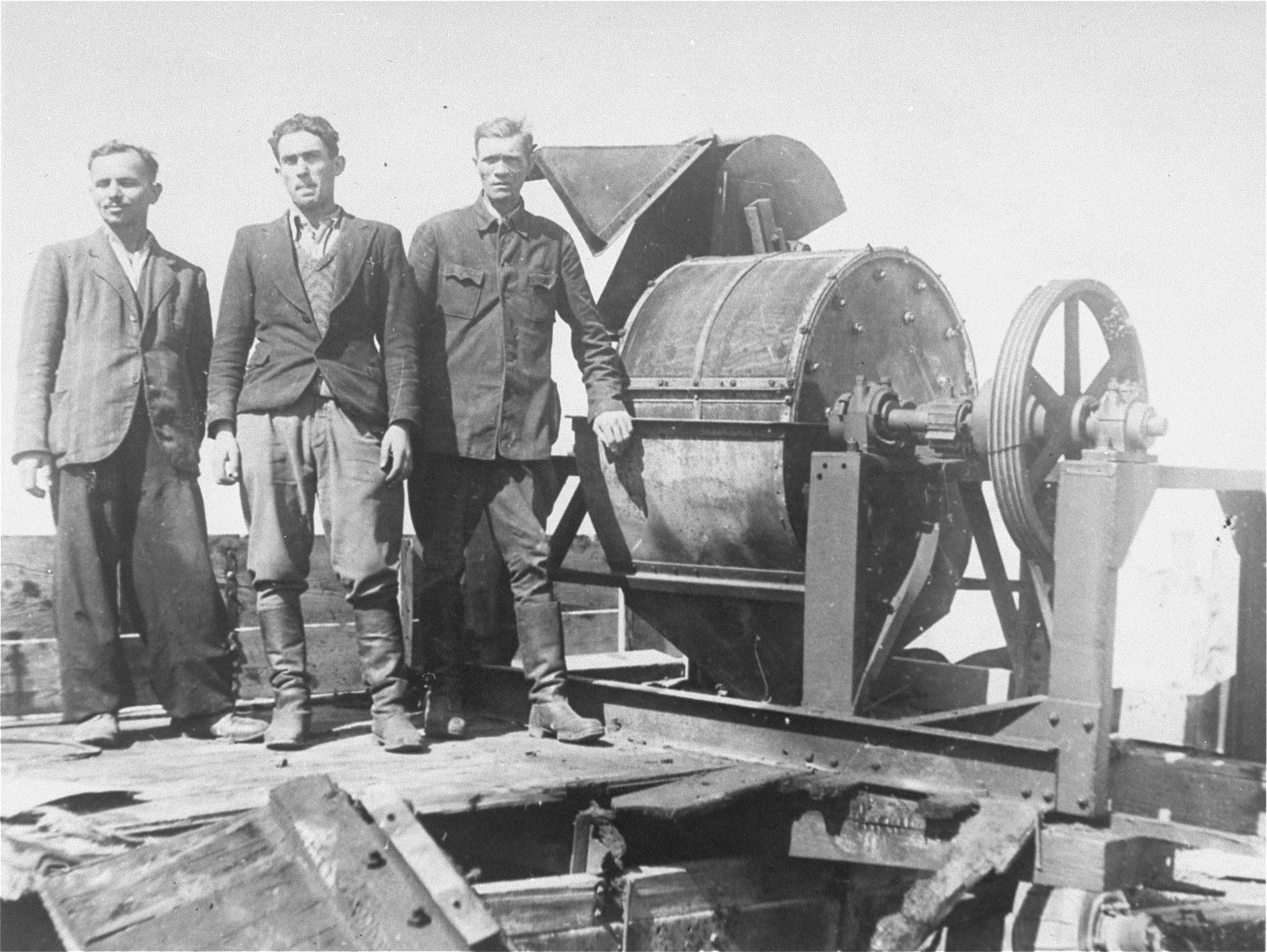
Another 1944 photograph shows surviving Jewish prisoners associated with Sonderkommando 1005 beside equipment used in the destruction of human remains.
These images are evidence of the aftermath. They are not images of the uprising itself.
Why two uprisings matter
Treating the November events as two linked revolts changes the story.
A single “Janowska uprising” encourages a tidy narrative: one prisoner group revolted, one mass escape followed, and one count can be attached to it. The stronger evidence shows something less tidy and more revealing.
Different groups of Jewish prisoners faced the same liquidation from different spaces. The Death Brigade, isolated by the work of destroying evidence, organized a breakout at its external work site. Prisoners still inside Janowska rose while the Germans were taking people away to be shot.
Resistance was not one command structure moving through one plan.
It emerged from prisoners recognizing that continued compliance no longer offered survival.
That also explains why exact numbers are so hard to stabilize. Escapees from one revolt, escapees from the other, men initially free but later recaptured, and people who survived in hiding are not interchangeable categories.
What can be stated securely
By November 1943, Nazi authorities were liquidating Janowska’s remaining Jewish prisoner population and completing Sonderaktion 1005 work around Lwów.
Jewish prisoners revolted. The strongest recent scholarship identifies two linked armed uprisings.
The Sonderkommando 1005 Death Brigade rose at a separate work site near the Lysynychi forest. The best modern scholarly count says approximately fifty prisoners escaped initially, including Leon Weliczker Wells.
A second uprising broke out among Jewish prisoners inside Janowska during the liquidation shootings. Some prisoners escaped there as well, but no sufficiently secure count should be published for them.
November 19 is the best-supported central date, with adjacent variants preserved in memoir-based scholarship.
Thousands were murdered during the liquidation. Many people who escaped initially were hunted down and killed.
Weliczker survived.
What the revolt accomplished
The uprisings did not stop the liquidation of Janowska.
They did not defeat the German occupation of Lwów. They did something narrower that mattered enormously.
They broke the Nazi plan that every witness to the evidence-destruction operation could be murdered into silence.
A survivor carried knowledge of Sonderaktion 1005 through hiding, liberation, memoir and courtroom testimony. That is why the Janowska escape cannot be measured only by how many people crossed a fence or reached a forest.
For some prisoners, escape created the possibility of survival.
For history, it preserved witnesses the perpetrators intended to erase.
Evidence discipline
What the record supports
Status labels distinguish secure conclusions from uncertainty and rejected claims. Color is never the only signal.
MYTH
There was one single, geographically unified Janowska uprising in November 1943.
Recent Janowska scholarship distinguishes an uprising inside the camp from the more successful Death Brigade revolt at a separate nearby Sonderkommando 1005 site.
Sources: SRC-004, SRC-005WELL-SUPPORTED
November 19, 1943 is the best canonical date for the Death Brigade revolt.
USHMM and Beorn’s peer-reviewed article use November 19, while Rich places the breakout on the night of November 18–19. Weliczker-derived scholarship also preserves November 20 and November 21 variants.
Sources: SRC-001, SRC-002, SRC-005, SRC-007, SRC-008WELL-SUPPORTED
Approximately fifty Death Brigade prisoners escaped initially.
Beorn’s peer-reviewed study says approximately fifty, and Winter’s reconstruction from Weliczker’s memory also gives about fifty; the Lwów memorial-book tradition says a few tens.
Sources: SRC-002, SRC-006, SRC-008DISPUTED
Approximately 120 Death Brigade prisoners escaped.
The figure is widely repeated in later summaries, but stronger sources place the Death Brigade breakout around fifty or a few tens. The higher figure may reflect brigade size, escapees from the separate camp uprising, or later merging of the two revolts.
Sources: SRC-002, SRC-004, SRC-006MYTH
All or nearly all people who initially escaped survived the war.
German forces conducted an intensive search and many fugitives were recaptured and murdered. No reliable final survivor denominator was found.
Sources: SRC-001, SRC-005MYTH
The November uprisings caused the Nazi decision to liquidate Janowska.
The liquidation and evidence-destruction program were already underway. The revolts occurred because prisoners faced imminent murder, not before the liquidation decision existed.
Sources: SRC-001, SRC-005DOCUMENTED
Leon Weliczker Wells survived the Death Brigade breakout and later testified publicly.
His survival is documented in scholarly history, archival papers, his memoir and Eichmann-trial testimony.
Sources: SRC-002, SRC-003, SRC-009, SRC-010, SRC-011MYTH
The twenty-four Jews hidden by Wojciech Kalwiński were exactly the surviving members of the Death Brigade breakout.
Beorn states that Kalwiński hid Wells and twenty-three other Jews. That group is not established as a complete roster of Death Brigade escapees or survivors.
Sources: SRC-003Evidence diagram
Two linked revolts during one liquidation
Parallel evidence cards distinguish the Death Brigade breakout from the Janowska camp uprising and their different count traditions.
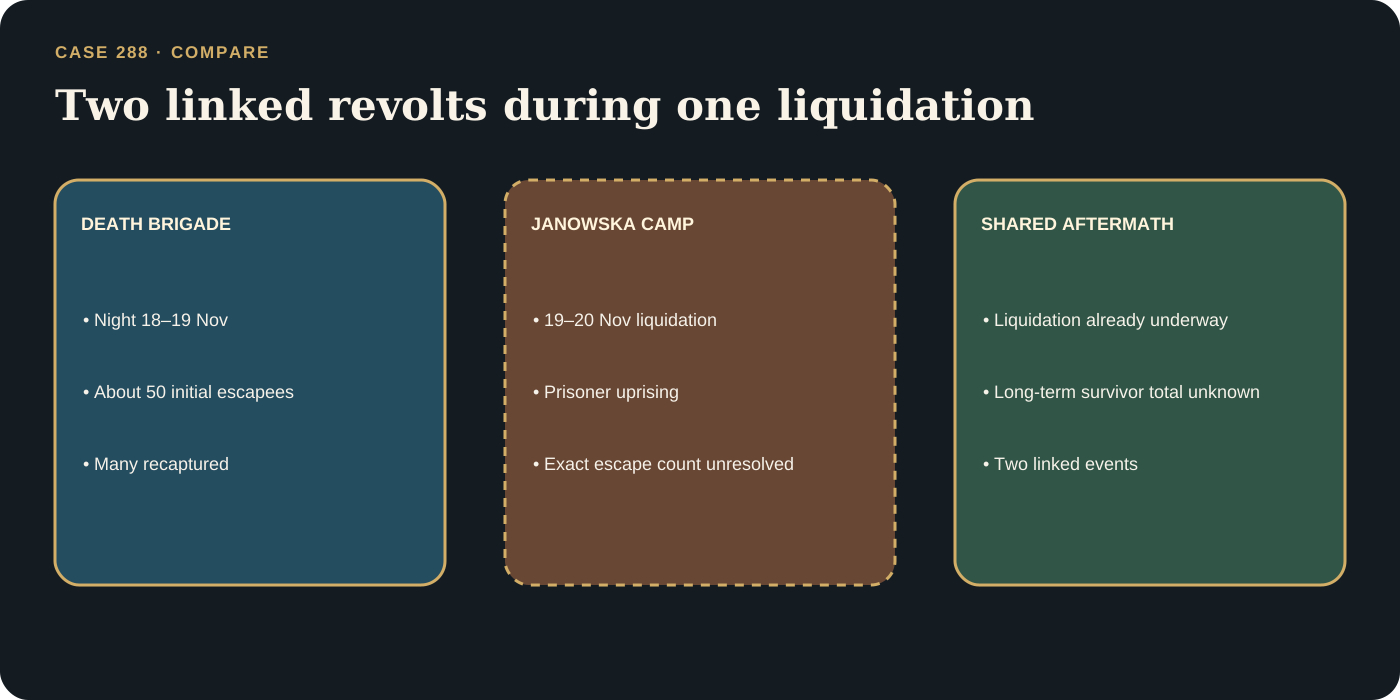
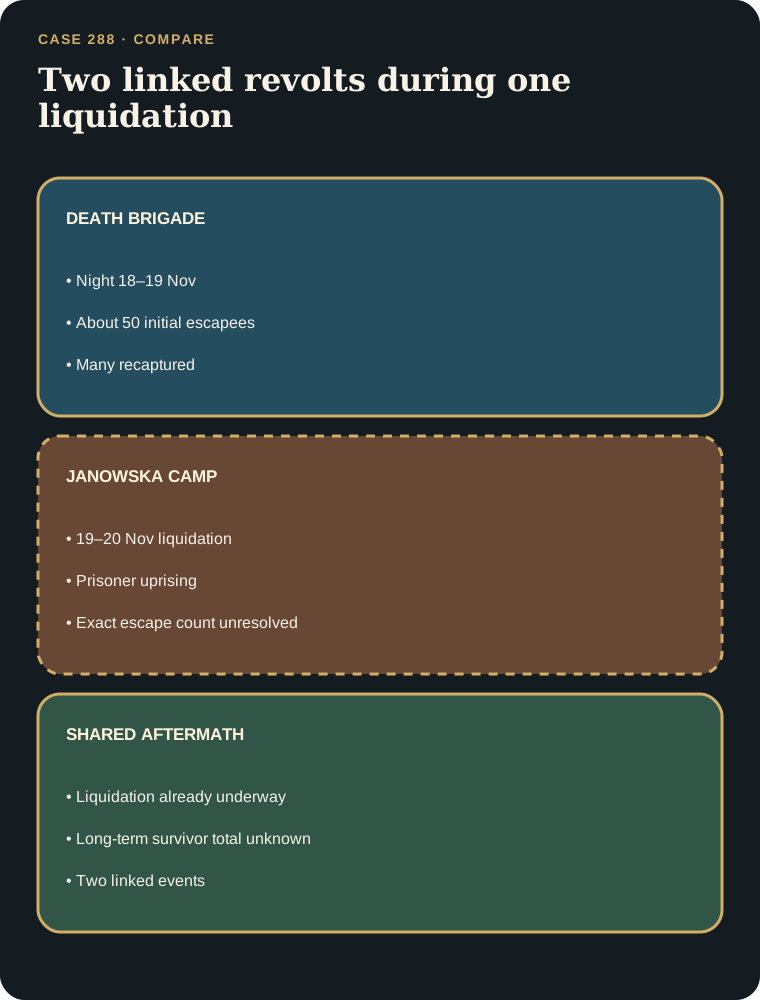
Parallel evidence cards distinguish the Death Brigade breakout from the Janowska camp uprising and their different count traditions.