
On 7 October 1944, Jewish prisoners forced to work in the gas chambers and crematoria of Auschwitz-Birkenau turned on their guards. The revolt began around Crematoria IV and V, spread to men attached to Crematorium II, and produced the largest organized mutiny and mass escape attempt in the history of Auschwitz. By the end of the day, roughly 450 members of the Sonderkommando were dead, three SS men had been killed, and Crematorium IV had been badly damaged by fire.
The event is often compressed into a cleaner story: four women smuggled gunpowder into the camp, the Sonderkommando blew up a crematorium, hundreds escaped, and the revolt crippled the machinery of murder. Nearly every part of that summary contains something true, but the surviving evidence makes the full story more complicated. The explosive-smuggling network was larger than four women, the best recent reconstruction emphasizes fire rather than a successful demolition charge at Crematorium IV, and the men who broke through the fences did not achieve lasting freedom.
At a Glance
Date: 7 October 1944
Place: Auschwitz II-Birkenau, German-occupied Poland
Participants: Jewish prisoners of the Sonderkommando, with Soviet prisoners of war and a wider prisoner resistance network involved in preparations
Immediate trigger: A planned SS reduction of the Sonderkommando by approximately 300 prisoners
Escape attempt: Approximately eighty or more men from the Crematorium II group broke through the fences and fled south
Durable escape: No participant in the 7 October mass breakout is known to have reached lasting freedom
Sonderkommando losses: About 450; a roster-based reconstruction gives 451
SS losses: Three killed and roughly ten or more wounded
Material result: Crematorium IV was severely damaged by fire and later dismantled
Handling note: Holocaust-sensitive; the revolt is treated as resistance under conditions of coerced participation in mass murder, not as an adventure narrative
Prisoners Forced Into the Killing Process
The Auschwitz Sonderkommando consisted mainly of Jewish prisoners whom the SS forced to work in and around the gas chambers and crematoria. Their tasks included moving the bodies of murdered victims, preparing them for cremation, operating the ovens or burning pits, and disposing of ashes. The SS isolated these prisoners because they were direct witnesses to the extermination process and periodically murdered groups of them to eliminate witnesses.
That knowledge shaped the revolt. By 1944, members of the Sonderkommando understood that their relatively better food or temporary exemption from selection did not amount to safety. The killing of earlier groups showed that their own survival was provisional, and the shrinking number of deportation transports after the mass murder of Hungarian Jews made another reduction increasingly likely.
The size of the unit had expanded dramatically during the Hungarian deportations, reaching roughly 900 men. In September 1944 the SS murdered about 200 members of the Sonderkommando, reinforcing the expectation that another liquidation would follow. By early October, about 660 to 663 men remained.
A Revolt Planned Under Isolation
Plans for organized resistance developed over months, although the evidence does not support a single neat command structure or one universally accepted timetable. Sonderkommando prisoners had contacts with other resistance circles in Auschwitz and wanted weapons or explosives that might allow them to damage the crematoria, attack guards, break the fences, and create a chance for a wider uprising or mass flight. Soviet prisoners of war assigned to the crematoria were valued because they had military experience.
The most famous supply line ran through Jewish women working at the Weichsel-Union-Metallwerke, usually called the Union munitions factory. Women there removed tiny quantities of explosive material and passed them through a clandestine chain toward Birkenau. Róża Robota, who worked in a clothing detail and had underground contacts, became one of the key intermediaries connecting the women to the Sonderkommando.
Four women became the best-known names because the SS later arrested and executed them: Robota, Ala Gertner, Regina Safirsztajn, and Ester Wajcblum. Their courage is well documented, but reducing the entire operation to those four erases other participants. Holocaust institutions and survivor testimony indicate that additional women helped move the material, even though the exact membership of the network cannot now be reconstructed with certainty.
The explosive material mattered to the plans. Prisoners fashioned primitive grenades and contemplated damaging crematoria and furnaces, but the later phrase “they smuggled dynamite and blew up Crematorium IV” goes beyond what the strongest recent reconstruction can establish. The distinction matters because it changes the event from a single successful demolition to a desperate uprising in which planned sabotage, improvised weapons, fire, and escape unfolded at once.
The Selection That Forced the Decision
On 7 October, the Sonderkommando learned that about 300 men were to be removed. Officially, such transfers could be described as reassignment to work elsewhere; previous experience gave the prisoners little reason to believe that explanation. The Auschwitz Museum’s reconstruction places the selected group largely among men connected with Crematoria IV and V and shows that resistance leaders had to decide whether to act immediately or continue waiting for conditions they considered more favorable.
The original hopes for a broader uprising were difficult to realize. Coordination among the crematoria was imperfect, not every prisoner or functionary agreed about when to fight, and the selection was scheduled in daylight rather than at night, when escape might have been easier. The action that followed was therefore not a flawless execution of a settled master plan.
Shortly after 1 p.m., SS men assembled the prisoners near Crematorium IV and began identifying those who were to be taken away. The exact first blow varies in retellings, but the broad sequence is secure: resistance began, prisoners attacked guards with work tools and whatever weapons they had, and SS personnel opened fire. The confrontation turned the threatened selection into open revolt.
Fire at Crematorium IV
Some prisoners retreated into Crematorium IV and set the building on fire. The blaze spread into its wooden roof, producing the smoke that had been envisioned as a signal for wider action. The SS summoned reinforcements and a prisoner fire brigade while armed guards fought and shot men in the crematorium courtyard.
This is one of the places where later shorthand has obscured the evidence. USHMM and many popular accounts say that the Sonderkommando “blew up” the crematorium with explosives smuggled by the women. Auschwitz-Birkenau State Museum research instead reconstructs the decisive damage at Crematorium IV as a fire set during the revolt; the smuggled explosives had been used in preparations and primitive grenades, but a successful demolition charge at Crematorium IV is not required to explain the building’s destruction.
That correction does not diminish the women’s role. The smuggling operation was a sustained resistance effort carried out under extraordinary danger, and the material it supplied gave the prisoners options they would otherwise have lacked. It does mean that the article of faith sometimes repeated in popular history—that the women’s powder directly detonated and destroyed a functioning gas chamber—should be treated with caution.
Crematorium IV was also not a fully functioning centerpiece of the killing system on 7 October. Its furnaces had suffered serious defects, and Auschwitz Museum research describes the building as out of operation and being used partly as quarters for Sonderkommando prisoners. Burning it was still a powerful act against the physical space of extermination and against the SS, but the revolt did not remove one quarter of Auschwitz’s active killing capacity in a single stroke.
The Men at Crematorium II Break Out
The fighting and smoke were visible elsewhere in the crematoria zone. At Crematorium II, prisoners realized that the revolt had begun and that SS units were moving to secure the area. They attacked a German prisoner functionary, attempted to draw SS men into the building, and tried to carry out part of the sabotage plan.
Three men remained behind to attempt to detonate the crematorium furnaces, but the effort failed. The larger group—approximately eighty or more prisoners—turned toward escape. They cut the fencing around the crematorium area and also cut through fencing at the adjacent women’s camp, apparently hoping to open a route for other prisoners as well.
The fugitives ran south through the Birkenau camp zone toward the area of Pławy and Rajsko. This was a real mass breakout from the immediate fenced enclosure, but it was not yet freedom: the wider Auschwitz security zone extended beyond the prisoner compounds, and SS pursuit units were rapidly deployed. Geography, daylight, ponds and farm installations in the camp zone, and the arrival of armed pursuit forces sharply reduced the fugitives’ chances.
Most of the group was intercepted and killed roughly a kilometer and a half from the crematorium area. Older accounts sometimes describe the fugitives reaching a barn near Rajsko and being killed there; the detailed modern reconstruction places the decisive pursuit within the broader camp interest zone and cautions against treating every later narrative detail as equally secure. The essential outcome is not disputed: the breakout did not produce a known survivor who reached durable freedom.
There is, however, an important qualification to the phrase “all were killed in the pursuit.” A German police telegram sent on 8 October listed three men from the previous day’s events as still being sought. Research presented by Auschwitz historian Igor Bartosik indicates that they had escaped the immediate killing zone, although none is known to have survived; one was probably recaptured and killed weeks later. The difference is small numerically but important historically because it distinguishes an immediate escape from a lasting one.
Why the Numbers Do Not Line Up Perfectly
The most defensible casualty figure comes from the change in the Sonderkommando roster. About 663 men were present before the revolt and about 212 remained afterward, a loss of 451. Auschwitz Museum materials often round that figure to about 450, while USHMM breaks the total into nearly 250 killed during the fighting and another 200 shot after the revolt had been suppressed.
Those numbers count different stages of the violence. Men died during the fight at Crematorium IV, during the escape and pursuit, and in executions after the SS had regained control. Precise allocation among those categories is not possible, and the surviving documentation does not justify pretending that every death can be assigned to one clean column.
The escape count has its own problem. Detailed Auschwitz research places the main breakout from Crematorium II at approximately eighty or more men, while a broader USHMM killing-center summary says “several hundred prisoners escaped.” The more specific figure fits the reconstructed route and the surviving German pursuit evidence better, so approximately eighty or more is used here for those who physically broke through the fences in the mass escape.
Three SS guards were killed and roughly ten or more were wounded. The SS losses were small beside the number of prisoners murdered, but they demonstrate that the revolt was not merely symbolic defiance. Prisoners whom the Nazi system had deliberately isolated and condemned as disposable witnesses killed armed members of the camp apparatus and forced a large security response inside Birkenau.
Reprisals and the Women Who Supplied the Explosives
The revolt did not end when the shooting stopped. The SS investigated the Sonderkommando resistance and the origin of the explosive material, arrested additional prisoners, and tortured suspects. Members of the Sonderkommando identified during the investigation were murdered, including prisoners held in Block 11.
The investigation also reached the women connected to the Union factory supply chain. Róża Robota, Ala Gertner, Regina Safirsztajn, and Ester Wajcblum were imprisoned, interrogated, tortured, and ultimately hanged in public. Yad Vashem and the current USHMM Auschwitz chronology date their execution to 6 January 1945; some other respected sources give 5 January, so the one-day discrepancy remains part of the record.
Their execution occurred only weeks before Auschwitz was abandoned and liberated. The four have become emblematic of women’s resistance at Auschwitz, but their commemoration is strongest when it preserves the larger network around them. They were central figures in the discovered chain, not proof that clandestine resistance depended on only four isolated actors.
What the Revolt Changed—and What It Did Not
The physical result was significant but narrower than some retellings suggest. Crematorium IV was badly damaged by fire and was never restored to normal service; the SS later dismantled what remained. Yet the other killing facilities did not stop operating because of the uprising, and mass gassing at Auschwitz continued into October–November 1944 before the SS halted it and began dismantling the extermination installations as the Soviet front approached.
The sequence is important when judging claims that the revolt “ended the gas chambers.” Crematorium IV was already defective and out of operation on the day of the revolt, and Heinrich Himmler’s later order to destroy the crematoria belonged to the broader German effort to liquidate the camp and conceal evidence as military defeat approached. There is no basis for assigning that later decision solely to the prisoners’ uprising.
The revolt’s significance rests elsewhere. It was organized resistance by prisoners whom the SS had forced into the closest possible proximity to the process of mass murder and then intended to kill as witnesses. Their actions breached the camp fences, killed guards, damaged a crematorium, and created a documentary record that contradicts any portrayal of Sonderkommando prisoners as passive participants in their own destruction.
It was also a failed escape. Approximately eighty or more men made it beyond the immediate fenced enclosure, but none is known to have secured durable freedom from the 7 October breakout. Calling that failure does not reduce the event to its survival rate; it simply preserves the distinction between breaking a barrier and escaping the Auschwitz security system altogether.
The Evidence Left Behind
Reconstructing the revolt depends on an unusual combination of sources. German camp records preserve traces of the SS response, including the 7 October report of a mass escape, the 8 October pursuit notice, and later garrison material naming SS casualties. Survivor testimony and manuscripts written by Sonderkommando prisoners add perspectives that the perpetrators’ paperwork could never supply.
Those sources do not always fit perfectly together. Later summaries differ over which crematorium groups actively revolted, how explosives were used, how many men crossed the fences, and whether Crematorium IV was “blown up” or burned. The Auschwitz-Birkenau State Museum’s recent work by historian Igor Bartosik is especially important because it brings archival documents into direct comparison with testimony rather than choosing one tradition and ignoring the other.
That approach leaves a history with fewer cinematic certainties but stronger foundations. On 7 October 1944, threatened prisoners rose against the SS, Crematorium IV burned, men from Crematorium II cut their way through the fences, and the SS killed approximately 450 members of the Sonderkommando during the revolt, pursuit, and reprisals. Four women later executed for the explosives network became some of its most recognizable faces, while the wider resistance network and the men who died in the breakout remain harder to individualize.
The revolt did not liberate its participants or stop Auschwitz by itself. It did something historically different: inside a system built to erase both victims and witnesses, prisoners created an armed rupture, attempted mass escape, damaged part of the killing complex, and left enough evidence for the event to be reconstructed after the SS tried to destroy the camp and its records.
Evidence discipline
What the record supports
Status labels distinguish secure conclusions from uncertainty and rejected claims. Color is never the only signal.
WELL-SUPPORTED
About 451 Sonderkommando prisoners were killed or otherwise lost from the unit as a result of the revolt and its suppression.
A roster-based reconstruction compares approximately 663 members before the revolt with about 212 afterward. Other institutions round the result to about 450 and differ in how they divide fighting deaths from later executions.
Sources: SRC-004, SRC-011WELL-SUPPORTED
Approximately eighty or more prisoners physically broke through the fences in the main mass escape from Crematorium II.
This is the detailed Auschwitz Museum reconstruction. Broader summaries saying several hundred escaped are not used for the breakout count because they do not match the more granular archival sequence.
Sources: SRC-001, SRC-002, SRC-006DISPUTED
Every fugitive was killed immediately during the 7 October pursuit.
Most fugitives were killed during the pursuit, but a German notice on 8 October listed three men still at large. None is known to have achieved durable freedom, and one was probably recaptured and killed later.
Sources: SRC-002DISPUTED
Smuggled explosives directly blew up Crematorium IV.
USHMM and many later summaries use 'blew up' language, while the Auschwitz Museum's newer reconstruction says prisoners set fire to Crematorium IV and that an attempted furnace detonation occurred at Crematorium II. Explosives were unquestionably part of the preparation and primitive grenades, but the exact mechanism of Crematorium IV's destruction is less certain.
Sources: SRC-001, SRC-002, SRC-005DISPUTED
All four Birkenau crematoria revolted in the same coordinated action.
Some institutional summaries use broad wording covering all main crematoria. The detailed Auschwitz reconstruction places the initial revolt around IV/V, active breakout and sabotage at II, and no equivalent successful action at III after coordination broke down.
Sources: SRC-002, SRC-006MYTH
Exactly four women formed the entire explosive-smuggling network.
Four women were arrested and executed, but USHMM and survivor-based accounts identify a wider network and at least one additional woman whose identity is uncertain.
Sources: SRC-008MYTH
The revolt ended mass gassing at Auschwitz by destroying an operating crematorium.
Crematorium IV was already out of operation by October 1944, other killing facilities continued to function afterward, and the later dismantling of the crematoria occurred within the SS withdrawal and evidence-destruction process.
Sources: SRC-012, SRC-013WELL-SUPPORTED
The four women were executed on 6 January 1945.
Yad Vashem and the current USHMM Auschwitz chronology use 6 January. Some respected sources give 5 January, so the one-day conflict should remain visible in explanatory copy.
Sources: SRC-007, SRC-009, SRC-018Documentary reconstruction
The revolt, breakout and conflicting counts
A case-local editorial visual clarifies the evidence structure without adding false precision or reusable operational detail.
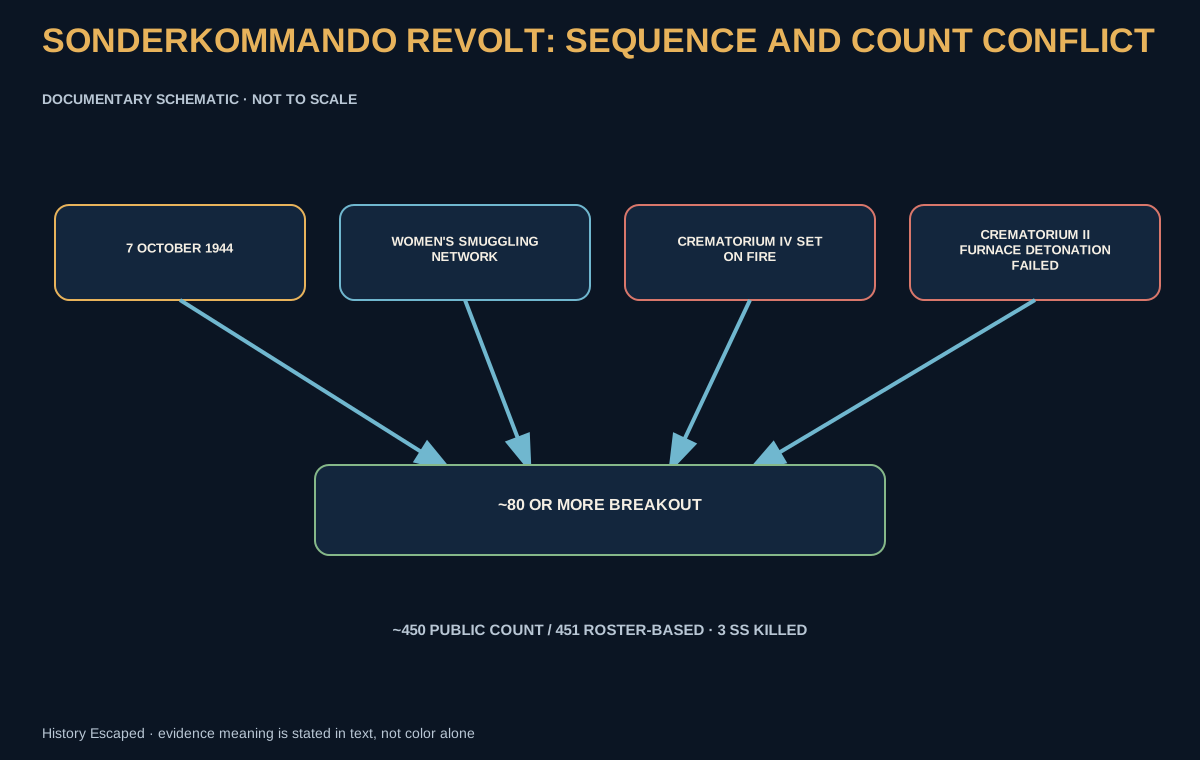
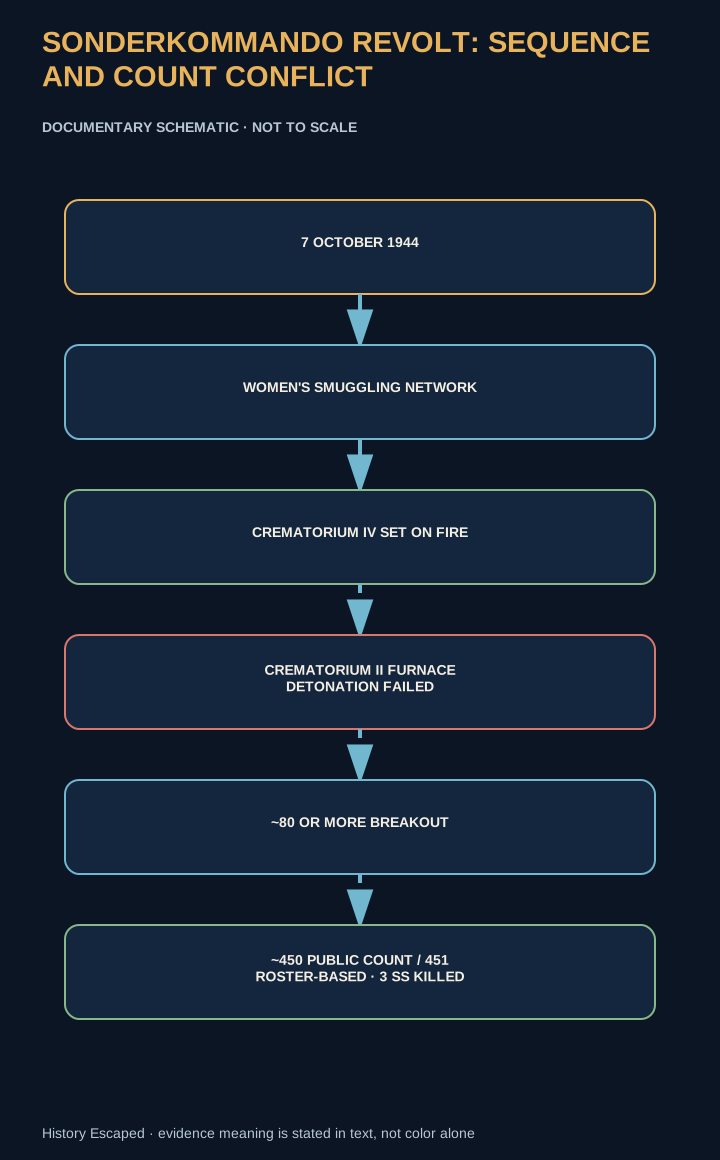
Simplified evidence-led editorial reconstruction based on the cited record; not to scale. Uncertainty is stated directly in the visual and adjacent text.

