
By the night of 1–2 October 1943, German police had orders to arrest the Jews of Denmark. When officers reached many of the addresses on their lists, the people they expected to find were already gone.
The warning had spread days earlier. Families had moved into private homes, hospitals, churches, farms, summer houses, and other temporary refuges. Along the Danish coast, fishermen and rapidly assembled rescue groups began carrying people across the water to Sweden. Within a few weeks, roughly 7,200 Jews and about 700 non-Jewish relatives had reached safety.
The rescue became one of the most successful collective escapes from Nazi persecution. Its history is strongest when the achievement is not simplified. The operation was decentralized, improvised, sometimes expensive, and occasionally catastrophic. Jewish fugitives helped organize their own survival. Danish civilians and resistance activists provided concealment and transport. Sweden made a decisive policy choice to admit the refugees. German occupation officials pursued the deportation while parts of the same occupation system leaked the warning or failed to enforce the sea route aggressively.
Understanding how those pieces fit together explains why the Danish rescue succeeded when so many other Jewish communities under German domination were destroyed.
At a Glance
- Principal escape period: Late September through October 1943
- Place: German-occupied Denmark to neutral Sweden
- Targeted group: Jews living in Denmark, including Danish citizens and refugees
- Estimated Jews reaching Sweden: about 7,200
- Non-Jewish relatives also evacuated: about 700
- Principal method: concealment followed by decentralized boat crossings from multiple Danish coastal points
- Warning: German deportation plans leaked before the main roundup
- Deported: about 470; current major institutions differ slightly on the exact total
- Deaths among deportees: about 50
- Outcome: the large majority of the Jewish population in Denmark survived the Holocaust
Denmark under German occupation
Germany invaded Denmark on 9 April 1940. The occupation that followed differed in important ways from German rule elsewhere in Europe.
The Danish government, parliament, courts, police, and much of the civil administration continued to operate. The government pursued cooperation with the occupation authorities in the hope of preserving Danish institutions and reducing German interference. That arrangement was morally and politically contentious, but it had a direct consequence for Denmark's Jewish population: Danish authorities resisted the introduction of anti-Jewish legislation.
Jews in Denmark were not separated from civic life through the escalating system of legal exclusion imposed in many other occupied countries. They were not ordered to wear a yellow star. Their property was not subjected to a state-run "Aryanization" program on the scale seen elsewhere. Danish institutions continued to insist that Jewish citizens were citizens.
That relative protection depended on a political arrangement that could change.
By 1943, the occupation had become increasingly unstable. Sabotage, strikes, unrest, and public resistance grew. German demands hardened. On 29 August, the Danish government resigned rather than accept a new set of German conditions.
The collapse of the cooperation government removed one of the barriers that had restrained anti-Jewish measures.
The decision to act against Denmark's Jews
Werner Best, the German Reich plenipotentiary in Denmark, played a central and deeply ambiguous role.
After the August crisis, Best proposed that the moment had come for action against Denmark's Jewish population. Berlin approved the plan in September. German police prepared a nationwide roundup for the beginning of October.
The operation was supposed to exploit the Jewish High Holy Day period, when families could more easily be found at home. German authorities expected to arrest thousands in a concentrated action.
Then the plan leaked.
That leak has sometimes turned the rescue story into a simple tale about one German diplomat saving the Jews. The evidence is more complicated.
Georg Ferdinand Duckwitz was a German maritime attaché and diplomat working in Copenhagen. He learned that the roundup was imminent and on 28 September passed the warning to Danish political contacts, including Social Democrat Hans Hedtoft. The information moved from political circles into the Jewish community.
Werner Best himself had provided the information to Duckwitz. Historians have debated why. Best had initiated the deportation proposal, yet he also had reasons to fear that mass arrests would destabilize Denmark and damage the occupation system he was trying to manage.
The warning was indispensable. Its existence does not erase German responsibility for planning and executing the roundup.
A warning becomes a network
A secret only helps if it reaches people in time.
On 29 September, Jewish communal leaders began spreading the news. Rabbi Marcus Melchior warned worshippers that German arrests were coming and urged people to leave their homes. Political contacts, doctors, employers, friends, neighbors, business associates, resistance members, and strangers carried the same warning through Copenhagen and other communities.
Some recipients initially found the report difficult to believe. Denmark had experienced three years of occupation without the anti-Jewish measures that had become routine elsewhere. The idea that a national deportation operation was only days away represented a sudden break with what many people had come to expect.
The evidence shows how quickly that disbelief was overcome.
Families packed what they could carry. Some divided, sending children to one hiding place and adults to another. Others moved immediately toward the coast. Many left without knowing exactly which boat would carry them, how much the crossing would cost, or how long they would remain hidden.
Diaries preserved by the Danish Jewish Museum give this stage a perspective missing from older rescue narratives. Jews did not simply wait for non-Jewish rescuers to arrive. They telephoned contacts, moved relatives, negotiated transportation, interpreted rumors, and made decisions under severe uncertainty.
The rescue began with warning, but it depended on thousands of individual responses to that warning.
The roundup finds empty homes
German police launched the main arrest action on the night of 1–2 October.
It failed to achieve what had been planned. Many intended victims were no longer at the addresses German authorities possessed. The warning had deprived the roundup of surprise.
The failure was not complete. Jews were arrested in homes, streets, hiding places, ports, hospitals, and later searches. German police continued pursuing fugitives after the main night of arrests.
The first deportation transport nevertheless revealed the scale of the failure. When the ship Wartheland left Copenhagen on 2 October, it carried only a fraction of the Jewish population German authorities had hoped to seize, alongside Danish Communist prisoners.
Most of the people the Germans wanted were now underground.
That created a different logistical problem. Thousands of people could not remain hidden indefinitely.
Sweden lay across the water.
A country becomes a hiding network
The days between warning and departure required an enormous amount of temporary shelter.
Private homes became hiding places. Hospitals admitted or concealed fugitives. Churches, parsonages, farms, summer houses, institutions, workshops, warehouses, and other buildings were used as staging points. In some communities, local networks supplied food while boat departures were arranged.
This was not a single nationwide organization issuing assignments from a central office. Some networks were linked to emerging resistance groups. Others formed around physicians, clergy, political activists, Jewish community contacts, fishermen, or simply people who knew someone who needed help.
That decentralization could be inefficient. People were moved more than once. Rumors of German searches forced last-minute changes. Boat schedules disappeared. Families waited without knowing whether a promised vessel would arrive.
It also made the rescue harder to destroy with one arrest. There was no single command center whose capture could end the operation.
The resulting pattern was closer to a temporary social infrastructure: thousands of ordinary relationships rapidly repurposed for concealment and movement.
Why Sweden was reachable
The geography of eastern Denmark made Sweden unusually close.
At several points along the Øresund and surrounding waters, the Swedish coast could be seen across a short stretch of sea. Some crossings were only about five to ten kilometers. From Copenhagen, Sweden was still close enough to make small-boat evacuation realistic.
But proximity alone did not create sanctuary.
Sweden had maintained a restrictive refugee policy toward many Jewish refugees during much of the 1930s and early war years. By 1943, that policy was changing. The Danish crisis accelerated the change.
Swedish authorities announced that refugees from Denmark would be admitted.
For people deciding whether to leave hiding places and risk a night crossing, that commitment mattered enormously. Reaching Swedish waters would not merely mean escaping Germany's immediate jurisdiction; it meant entering a state that had publicly agreed to receive them.
Danish physicist Niels Bohr, who was himself forced to flee because of his Jewish ancestry, helped press Swedish authorities to make their acceptance policy public. Swedish radio broadcast the message.
The opposite shore was now both geographically close and politically open.
No single escape route

The phrase "the boat lift to Sweden" can suggest one organized maritime corridor. There were many.
Refugees left from coastal communities on Zealand, especially in the north, and from other islands including Lolland, Falster, and Møn. Some departures used ordinary fishing harbors. Others shifted to beaches and less obvious points when German attention made harbors dangerous.
Vessels varied just as widely. Fishing boats were important because their owners knew the waters and had legitimate reasons to be at sea. Other refugees crossed in small coastal craft, rowboats, and whatever vessels could be arranged.
Some boats carried large groups. Others carried only a handful of people hidden beneath nets or equipment. Some boatmen made repeated journeys. The National Museum records fishermen Børge Laursen and Jacob Andersen making about ten crossings aboard the Marie, often with only two or three fugitives concealed under herring nets.
A historical map of the rescue therefore should not draw a single heroic arrow from Copenhagen to Malmö. The escape was a web of departures.
Money and the fishermen
The role of Danish fishermen became one of the defining images of the rescue. Many deserve that place in the history.
They supplied vessels, local knowledge, and the practical ability to cross dangerous water at night. Some accepted enormous personal inconvenience and real risk. Some carried refugees without charge.
Others demanded money.
The prices varied greatly. Sofie Lene Bak's research documents fares ranging from hundreds to thousands of kroner per person, with some desperate families facing much larger demands. The National Museum notes that an average crossing could cost the equivalent of several months of wages for an unskilled worker.
That fact was awkward for a postwar national story built around unanimous altruism, but acknowledging it does not diminish the rescue as a whole.
Money paid for fuel, lost fishing time, vessels, organizers, and risk. It could also become profit. Humanitarian motives and commercial motives existed side by side.
Rescue committees responded by collecting funds and trying to standardize or subsidize fares. Businesses, organizations, private donors, and Jewish families contributed. People without enough money were not necessarily abandoned, but the need to finance thousands of crossings was a real part of the operation.
The rescue was morally extraordinary without being economically pure.
What the Germans controlled—and what they did not
The sea crossing is often imagined as a continuous race against German patrol boats. The evidence gives a more complicated picture.
German police could arrest people at coastal points, investigate suspicious activity, search buildings, use informers, and disrupt embarkations. German gunfire affected at least some local departures. The Gestapo remained a serious threat on land.
Yet the Germans did not establish comprehensive police control of the sea during the critical weeks. Sofie Lene Bak's research concludes that German police had no systematic sea surveillance over the Øresund during the rescue and that Wehrmacht policy limited military interference. Of the roughly 600–700 illegal transports she identifies, none was seized by German police at sea.
This distinction changes the reconstruction.
The most dangerous parts of many escapes were not necessarily the middle of the Øresund. They were the period of hiding, movement to the coast, waiting at embarkation points, dealing with informers, and reaching a boat before German police arrived.
Once a vessel was underway, the probability of interception could be much lower than popular retellings suggest.
The sea still killed people. Small craft were vulnerable to weather, currents, darkness, and accident. Some fugitives tried desperate methods. The absence of routine German interception did not make the crossing harmless.
It makes the danger historically specific.
Gilleleje
No place better captures both the success and the vulnerability of the rescue than Gilleleje.
The North Zealand fishing town became a major embarkation center. Local residents, fishermen, clergy, and improvised committees organized food, concealment, money, and departures. National Museum estimates suggest that roughly one-fifth of the Jews in Denmark passed through the Gilleleje area during the operation.
That success attracted attention.
On 5 October, German forces disrupted a departure, and organizers shifted some operations away from the harbor. The danger was no longer theoretical.
The next night, a large group of Jewish fugitives was betrayed while hiding in the church area. German forces surrounded the site and arrested scores of people.
The exact resulting figures vary according to what is being counted. National Museum material describes roughly eighty arrests and says most of those people were deported. Scholarly accounting attributes about fifty deportations specifically to the informer-driven Gilleleje betrayal.
The difference should remain visible rather than be forced into a single number. Gilleleje became one of the largest gateways to Sweden and one of the rescue's worst local failures.
Both belong in the same history.
Sweden receives the fugitives
Arrival in Sweden did not end every difficulty, but it ended the immediate threat of German deportation.
Swedish authorities, relief organizations, Jewish organizations, Danish exile networks, and private citizens helped receive refugees. Housing, food, schools, medical care, employment, and longer-term support had to be arranged for a community that expected the exile to last until Denmark was free again.
The Danish-Swedish Refugee Service and other groups coordinated parts of this work. Children continued their education. Adults sought work or participated in exile institutions. Danish Jews maintained community structures while living in Sweden.
The refugee population changed over time. This is one reason the numbers must be handled carefully.
A National Museum count gives 7,906 people in the Danish refugee community in Sweden by May 1945. That figure included 686 non-Jewish spouses, children including babies born in Sweden, stateless refugees, and other categories.
It is not evidence that exactly 7,906 Jews crossed the Øresund in October 1943. The standard crossing figure remains about 7,200 Jews, plus approximately 700 non-Jewish relatives.
Those who did not escape
The success of the rescue can make the people who were captured disappear from the narrative. They should not.
Current major institutional sources place the deportation total at roughly 470. The United States Holocaust Memorial Museum gives 470 Jews deported from Denmark to Theresienstadt. Current Danish Jewish Museum research gives 472.
Older sources give slightly larger figures, including 481 and 485.
There is a similar small difference in recorded deaths. USHMM currently gives 51 deaths among the deportees. Current Danish Jewish Museum material gives 53.
These discrepancies do not alter the historical scale. They do matter when presenting the history as if every number were settled.
The responsible summary is that about 470 people were deported and about fifty died. Almost all of the deportees survived.
Why the Theresienstadt group survived at such a high rate
The fate of those deported from Denmark also differed from that of many Jewish prisoners sent to Theresienstadt from elsewhere.
Danish political and administrative institutions continued pressing German authorities for information and access. Danish organizations sent food and relief parcels. The prisoners remained the subject of unusual external attention.
German authorities eventually permitted an International Committee of the Red Cross and Danish delegation to visit Theresienstadt in June 1944. The camp was grotesquely staged for that inspection, with prisoners and facilities manipulated to conceal the reality of persecution.
The Danish Jews were not deported onward to Auschwitz in the way many other Theresienstadt prisoners were.
Their survival should not be read as evidence that Theresienstadt was benign. It was a site of imprisonment, deprivation, disease, death, and transit into the killing system. The Danish deportees survived in unusually high numbers because their circumstances were unusual, not because the camp itself was safe.
In April 1945, most surviving Danish prisoners were evacuated from Theresienstadt in the Swedish Red Cross "White Buses" operation. The rescue story therefore has two different movements toward Sweden: the mass escape of 1943 and the later evacuation of surviving deportees in 1945.
They should not be conflated.
Who saved the Danish Jews?

There is no single answer. Georg Ferdinand Duckwitz transmitted the warning that allowed the community to act before the roundup.
Danish politicians and Jewish leaders spread the warning. Jewish families and individuals made rapid decisions, left their homes, found contacts, raised money, moved toward the coast, and endured concealment.
Danish civilians opened homes and institutions. Doctors and hospitals helped hide people.
Fishermen and boat owners supplied the essential means of crossing. Resistance activists organized routes, money, transportation, and communications.
Swedish authorities decided to admit the refugees. Swedish and Danish organizations received and supported them after arrival.
Even German administrative behavior affected the outcome: Best's warning leak, weak maritime enforcement, and limits on Wehrmacht intervention reduced the effectiveness of the deportation operation. A serious explanation does not have to choose one of these factors and discard the others.
The rescue worked because they converged.
The yellow-star story
The most famous story about Denmark's Jews is also one of the least reliable. According to the legend, the Germans ordered Danish Jews to wear a yellow Star of David, and King Christian X either wore one himself or threatened that all Danes would wear one in solidarity.
It did not happen.
Danish Jews were never subjected to a yellow-star order in Denmark. The king therefore never had the occasion to wear the star as a response.
The story became powerful because it expressed something true about Danish resistance to separating Jews from the rest of the citizenry. But symbolic truth is not the same as historical fact.
The documented rescue is more impressive than the legend. It required thousands of actual decisions, places to hide, money to raise, boats to find, families to move, and people willing to help.
It does not need an invented royal gesture.
A rescue larger than the resistance
Another postwar simplification placed the organized Danish resistance at the center of nearly every crossing.
Resistance groups were important, especially as the operation developed. They helped collect money, coordinate transportation, establish routes, and connect local actors.
But the October rescue was broader than the formal resistance.
Many helpers had no organizational membership. They responded because a neighbor, patient, colleague, business partner, student, or stranger needed help. Some considered what they were doing humanitarian aid rather than political resistance.
That distinction matters because it changes the scale of participation.
It also restores Jewish agency. A narrative in which a resistance movement "rescued passive Jews" is less accurate than one in which Jews and non-Jews rapidly built temporary networks together.
The word rescue remains appropriate. It should not erase escape.
Why Denmark was different
The rescue is sometimes explained as proof of a unique Danish national character. National culture and civic norms mattered, but historians have identified several more concrete conditions.
Denmark had a relatively small Jewish population. Most Jews lived in or near Copenhagen, within reach of a narrow sea passage to neutral territory.
The cooperation government had protected civic equality until August 1943. The deportation plan leaked in advance.
A large share of the non-Jewish population regarded anti-Jewish measures as illegitimate. Sweden was nearby and had agreed to accept the refugees.
German occupation structures in Denmark remained comparatively restrained and fragmented, and the maritime border was not sealed effectively. Jewish communal networks were intact.
Local people possessed boats and knowledge of the coast. None of those conditions alone would have saved thousands.
Together, they made mass escape possible.
Counting a rescue without distorting it
The rescue is frequently summarized with a percentage: 95 percent, 98 percent, or "almost all" Danish Jews survived.
The broad conclusion is correct. Denmark preserved a far greater share of its Jewish population than almost any other German-occupied country.
The precise percentage depends on who is counted.
Does "Danish Jews" include only Danish citizens? German and Austrian Jewish refugees living in Denmark? Stateless Jews? Children in agricultural training programs? People classified as Jewish under Nazi racial definitions but outside the organized Jewish community? Non-Jewish spouses?
Different historical institutions have answered these questions differently. That is why the most transparent summary uses actual categories:
- about 7,200 Jews reached Sweden;
- about 700 non-Jewish relatives went with them;
- about 470 Jews were deported;
- about 50 of the deportees died.
These numbers describe the historical achievement without pretending that archival accounting has produced one universally agreed total.
What the photographs show
The surviving photographs are especially powerful because some document the escape itself.
One 1943 image preserved by the National Museum shows Jewish refugees aboard a small boat traveling from Falster toward Ystad in Sweden. It was reportedly taken by one of the refugees. Another shows Danish Jews arriving in Sweden in a rowing boat.
These are not staged film images and do not need dramatic reconstruction. They show something the numbers can obscure: families and individuals physically crossing a narrow stretch of water in ordinary vessels.
The famous rescue boat Gerda III, preserved today, provides another material connection to the operation. Boats like it carried multiple groups from Denmark during October.
The best visual treatment therefore begins with the archival record and uses a custom map only to explain how many separate coastal routes fit into the larger rescue.
The limits of a heroic story
The rescue deserves admiration without being turned into legend.
Some fugitives paid heavily for passage. Some helpers profited. German officials behaved inconsistently. Swedish refugee policy had not always been generous. Informers betrayed hiding places. Some boats failed. Hundreds were captured. Roughly fifty deportees died.
Those facts do not cancel the rescue. They show what a real rescue looks like when carried out by thousands of people under pressure: uneven, decentralized, morally mixed at its margins, and still capable of saving nearly an entire community.
By late October, the German plan to empty Denmark of Jews had failed in its main objective. Thousands of the people marked for arrest were living across the water in Sweden.
They had survived because a warning moved faster than the roundup, because people opened doors before German police reached them, because boats were found, because Sweden admitted them, and because enough individual decisions aligned in the same direction. That is the documented history.
It is stronger than the myth. ---
Documentary reconstruction
A decentralized network carried refugees across multiple routes
A case-local visual focused on the historical question that the surviving evidence can answer.
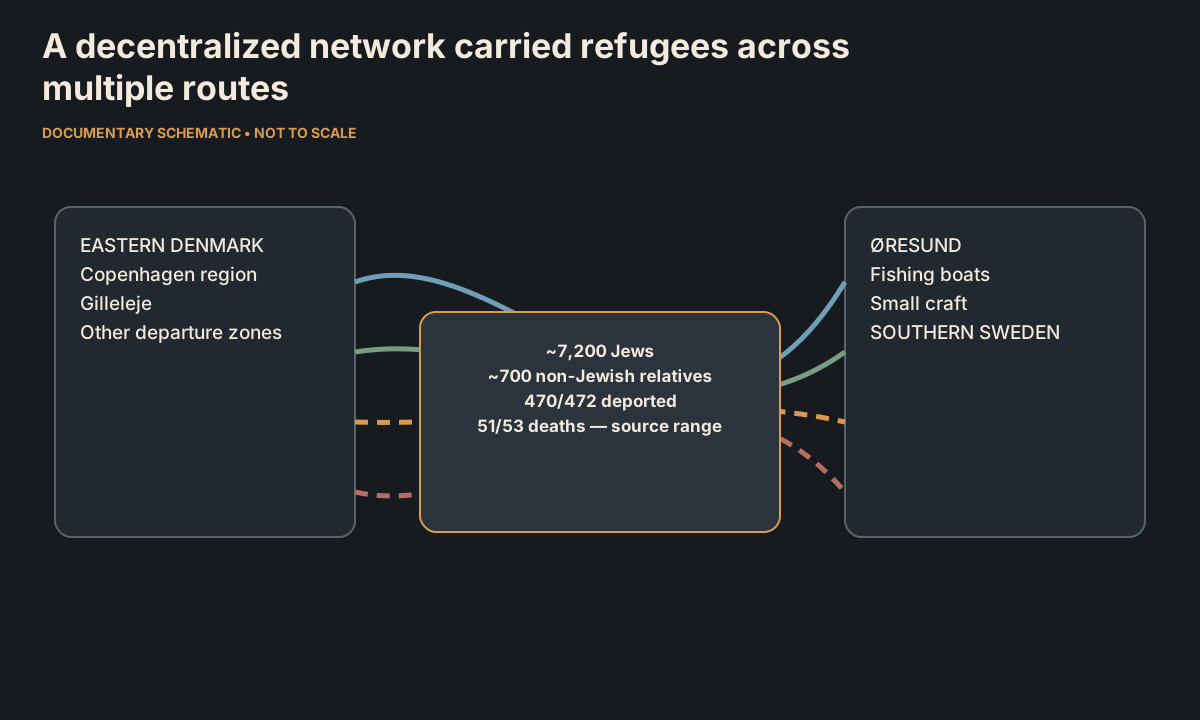
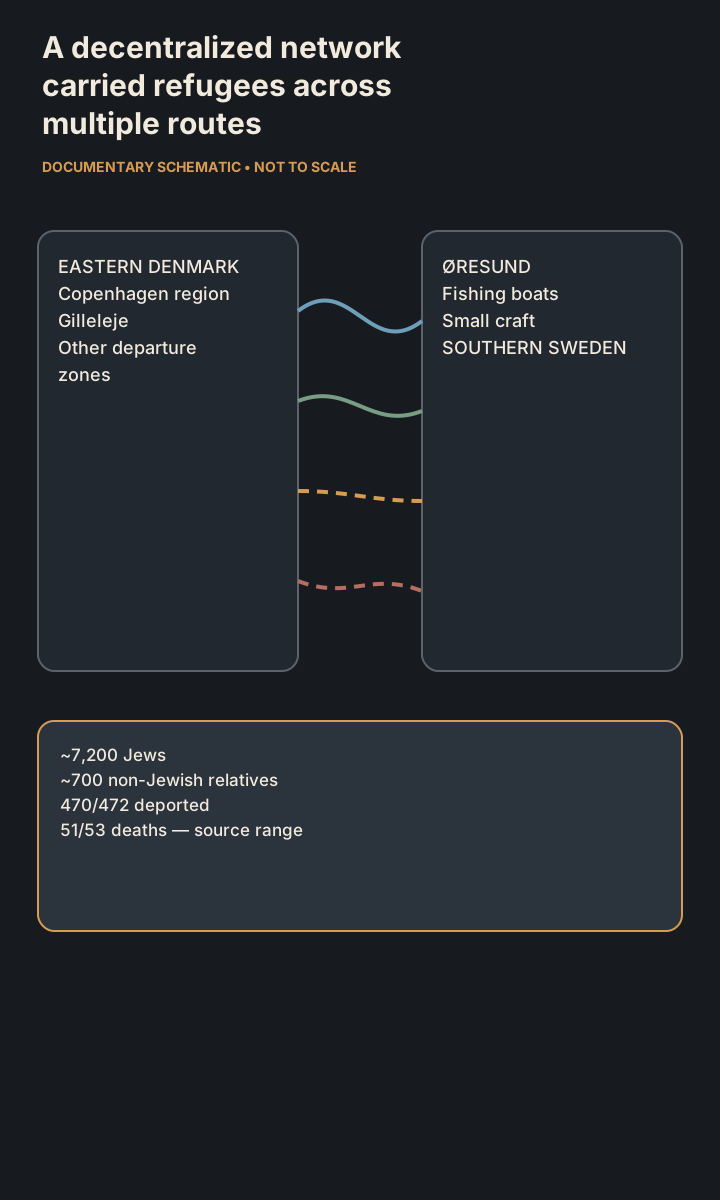
Simplified documentary reconstruction; not to scale. Evidence qualifications are written directly into the visual and explained in the adjacent text.
Evidence discipline
What the record supports
Status labels distinguish secure conclusions from uncertainty and rejected claims. Color is never the only signal.
MYTH
Exactly 7,906 Danish Jews escaped to Sweden in October 1943.
The figure 7,906 is a May 1945 refugee-community count that included 686 non-Jewish spouses, children including some born in Sweden, and other categories. The standard escape figure is about 7,200 Jews plus roughly 700 non-Jewish relatives.
Sources: SRC-003DISPUTED
Exactly 470 Jews were deported from Denmark.
Current USHMM material gives 470, while current Danish Jewish Museum research gives 472. Older Danish materials use additional figures including 481 and 485. The difference is small but should remain explicit.
Sources: SRC-001, SRC-003, SRC-005, SRC-006DISPUTED
Exactly 51 Danish Jewish deportees died in Theresienstadt.
USHMM currently records 51 deaths, while current Danish Jewish Museum research gives 53. A public summary of about fifty deaths is more transparent than forcing one total.
Sources: SRC-001, SRC-005MYTH
The organized Danish resistance alone rescued the Jews of Denmark.
Resistance groups played important roles, but the operation also depended on Jewish self-organization, unaffiliated civilians, professionals, fishermen, political networks, Swedish policy, and the behavior of German occupation authorities.
Sources: SRC-003, SRC-004, SRC-006, SRC-009, SRC-010MYTH
All fishermen carried Jewish refugees without payment.
Some crossings were free, while other boat owners charged substantial fares. Rescue committees raised money and subsidized people who could not pay.
Sources: SRC-003, SRC-004MYTH
Every civilian helper faced a likely death sentence if caught.
Helping remained dangerous and could bring arrest, but scholarship shows that German sanctions against many civilian helpers were generally more limited than later national memory suggested.
Sources: SRC-004MYTH
German police systematically patrolled the Øresund and captured many refugee boats at sea.
German enforcement was dangerous on land and around some embarkation points, but scholarship finds no comprehensive German police sea surveillance during the crucial rescue period and no refugee transport seized by German police at sea among an estimated 600–700 voyages.
Sources: SRC-004MYTH
King Christian X wore a yellow Star of David in solidarity with Danish Jews.
Danish Jews were never ordered to wear the yellow star in Denmark, and the famous story of the king wearing one is not historical.
Sources: SRC-008MYTH
Georg Ferdinand Duckwitz single-handedly saved Denmark's Jews.
Duckwitz's warning was crucial, but the rescue required rapid Jewish action, Danish civilian and political networks, boat crews, organized assistance, Swedish acceptance, and favorable geographic and enforcement conditions.
Sources: SRC-003, SRC-004, SRC-006, SRC-007, SRC-009UNKNOWN
Werner Best deliberately designed the entire deportation operation to fail.
Best helped initiate the deportation action and also allowed information to reach Duckwitz. Historians debate his motives and the degree to which he sought to limit the operation. The evidence does not support reducing his role to either straightforward rescuer or wholly consistent enforcer.
Sources: SRC-003, SRC-004, SRC-006, SRC-011MYTH
Danish Jews were passive recipients of rescue.
Contemporary diaries and later scholarship document Jewish families making decisions, locating hiding places, arranging transport, raising money, and navigating the escape networks themselves.
Sources: SRC-004, SRC-010