
At a Paris airport, one of the Soviet Union’s most exciting young dancers learned that his company was going to London without him. Minutes later, his career—and his country—had changed.
The airport was supposed to be a departure point
On the morning of June 16, 1961, the dancers of Leningrad’s Kirov Ballet reached Le Bourget Airport outside Paris expecting to continue a landmark European tour in London. Rudolf Nureyev, 23 years old and already one of the company’s most talked-about performers, expected to go with them.
He did not.
At the airport, Nureyev learned that he had been separated from the London-bound company and was instead to return to Moscow. Accounts differ over the explanation attached to the order. Later narratives say he was told that he was required for an important performance in the Soviet Union. A public explanation from the Kirov side after the defection invoked illness in his family. What matters most is less ambiguous: Nureyev was no longer being allowed to continue to London, and the ticket being arranged for him took him east.
For a dancer who had spent the Paris leg of the tour pushing hard against Soviet rules, that change was ominous.
The result was one of the Cold War’s most famous cultural defections—but the reality was more complicated than the familiar phrase “leap to freedom” suggests. Nureyev did not simply jump a barrier and disappear into Paris. His escape depended on friends, French police, the law of asylum, and his own decision to state clearly that he wanted to remain.
A star under supervision
Nureyev had joined the Kirov Ballet after graduating from the Leningrad Choreographic School in 1958. His rise was rapid. He was technically formidable, intensely ambitious, and unwilling to behave as a compliant cultural ambassador.
That mattered because a Soviet ballet tour was not simply an artistic engagement. During the Cold War, companies such as the Kirov and Bolshoi were showcases for Soviet cultural achievement. Touring dancers crossed the Iron Curtain under rules and supervision designed partly to prevent precisely what Nureyev would eventually do.
The 1961 Kirov tour brought the company to Paris before London. In France, Nureyev attracted acclaim onstage and attention off it. He spent time with French dancers and friends, explored Paris, and did not consistently return to the hotel or follow the collective routines expected of the troupe. Later accounts describe close security attention around him; archival and institutional sources agree that his contacts with Westerners had caused concern.
He also had reason to value what Paris offered him professionally. Western dancers, choreographers, museums and performances were not abstractions anymore. They were immediately accessible. Nureyev later insisted that his central concern was artistic freedom rather than a carefully developed political program. That distinction matters. Western coverage quickly made him a Cold War symbol, but his own explanation emphasized the fear that Soviet punishment could constrict or even cripple his career as a dancer.
By June 16, those fears had acquired a concrete form: Moscow instead of London.

The order to go back
Contemporary French reporting established the essential setting within a day of the event. The Kirov company was scheduled to leave Le Bourget for London on a British European Airways flight. Nureyev was at the airport with the troupe, but he was not going to be allowed to continue with them.
The precise words spoken to him are harder to establish than the outcome.
The Rudolf Nureyev Foundation’s account says he was given a Moscow ticket and told that he was required for a gala. Contemporary reporting recorded a different public Soviet explanation: that he had to return because his mother was ill. Clara Saint, a French friend who was at the airport, later said that the decisive fact for Nureyev was seeing that his ticket was for Moscow rather than London.
Those versions should not be collapsed into one neat script. A propaganda-sensitive event generated explanations almost immediately, and later biographies added detail. The evidence supports a straightforward sequence: Soviet authorities intended to remove Nureyev from the Western tour and return him to the USSR; Nureyev believed that once back, he might not be permitted to travel abroad again and could face professional punishment.
He needed a way to make his decision effective before Soviet officials controlled the next stage of his journey.
Friends and French police
Clara Saint became an important intermediary.
The most useful historical reconstruction comes not from a film or a celebrity biography but from historian Stéphanie Gonçalves’s study of ballet diplomacy during the Cold War, based on French, British, American and Russian archival research. Her account uses French police and diplomatic records concerning the incident.
Those records show that Saint alerted airport authorities that Soviet officials were trying to send Nureyev back to Moscow. French officers entered the airport hall. What followed was not a quiet administrative conversation. Soviet representatives objected, and French officials recorded an aggressive confrontation serious enough that additional police support was used while Nureyev was taken toward the airport police station.
The exact choreography of the first contact varies across accounts. Some later retellings focus on a tiny physical gap between Nureyev and waiting officers; others describe the police approaching him after Saint raised the alarm. The essential legal point is much firmer than the spatial detail: French authorities required Nureyev’s own decision. Friends could alert the police, but they could not defect for him.
Nureyev personally asked for—or, in the archival formulation, maintained—his request to remain under French protection. That was the decisive move.
The moment of defection
Later retellings often compress the event into a cinematic instant: Nureyev spots French policemen, springs away from Soviet guards, and lands in freedom. There was a moment of physical decision, but “leap to freedom” is best understood as a metaphor, not a reliable floor plan.
A contemporary report in Le Monde said Nureyev sought the protection of the airport police after a heated discussion involving Soviet representatives. The French archival account adds that Soviet officials and diplomats resisted the police intervention and that Nureyev maintained his asylum request even after contact with the Soviet consul general.
That second point is important. Defection was not complete merely because Nureyev crossed a few meters of airport floor. French authorities had to establish that he was acting voluntarily. During the subsequent confrontation, he affirmed that he was in full possession of his faculties and wanted to remain. He refused further dealings with the Soviet officials who were pressing the issue.
The French police then took him into their administrative system rather than handing him back.
The escape mechanism was therefore social and legal, not mechanical. There was no tunnel, forged uniform or hidden vehicle. Nureyev’s opening came from being physically present in France, surrounded by a host state whose police could intervene, and having friends who understood quickly enough that authorities needed to be alerted.
The final act still had to be his.
From the airport to legal protection
The events did not end in the departure lounge.
French police informed the relevant authorities and transferred Nureyev into the process for seeking asylum and legal residence. Contemporary reporting two days later recorded that he had been taken to the foreigners service at the Paris police prefecture and granted temporary permission to remain for three months while the refugee-protection process continued.
This distinction is useful because popular retellings often make asylum sound instantaneous. At Le Bourget, Nureyev secured protection from being forced onto a Soviet-bound journey. His legal status in France then had to be regularized through French institutions.
The Soviet side did not accept the event quietly. Kirov representatives initially gave explanations that obscured what had happened, and archival police material records angry objections from Soviet officials. Nureyev’s action was not merely a personnel problem for a ballet company. A prestigious young performer had used a state-sponsored cultural tour to leave the Soviet Union in full view of the Western press.
The symbolism was irresistible.
A Cold War story that became larger than the decision itself
Nureyev’s defection was quickly interpreted as a political victory for the West and a humiliation for the Soviet Union. That framing was understandable but incomplete.
His own later explanation centered on dancing. He feared being restricted, demoted, or prevented from seeing the wider artistic world. His choice was political in consequence because leaving the Soviet Union without permission directly challenged Soviet authority. It did not require him to be a conventional ideological dissident.
That nuance helps explain why the story remained so powerful. Nureyev’s “freedom” was not only the freedom to live in another country. It was also the freedom to choose teachers, partners, repertory, employers and travel.
The professional consequences came almost immediately. He joined the Grand Ballet du Marquis de Cuevas in France and soon became one of the most famous dancers in the world. His later partnership with Margot Fonteyn at the Royal Ballet became central to twentieth-century ballet history. In 1983 he became director of the Paris Opera Ballet.
The Soviet state, meanwhile, treated his departure as betrayal. He was later convicted in absentia and sentenced to imprisonment. For decades he could not simply return home. Only in 1987, during the Gorbachev era, was he permitted a brief visit to see his gravely ill mother. By then he had become an Austrian citizen, a status granted in 1982.
What the famous version gets wrong
The enduring image of Nureyev’s defection is a sudden leap across an airport boundary. It is memorable because it fits his profession: a dancer escaping through a jump.
The evidence supports a more interesting story.
The decision was sudden, but it occurred inside a network of rules. Soviet officials could order him toward Moscow. French friends could alert authorities. French police could protect him only if he chose that protection. Soviet diplomats could pressure him afterward. The French state still had to process his status.
Even the exact pretext for his return is less certain than popular narratives suggest. “Kremlin gala” belongs to Nureyev-centered later accounts; “sick mother” appeared in the Kirov’s contemporary public explanation. Neither should distract from the documented fact that he was being removed from the London leg of the tour.
Nor is there good reason to turn every remembered meter of the airport into mapped certainty. Later memoir and biography preserve vivid details, but the archival record is strongest on decisions and institutional actions, not on a precise diagram of where each person stood.
Why it worked
Nureyev’s defection succeeded because several conditions aligned at once.
He was already outside the Soviet Union. He had built relationships with people in Paris who could act quickly. French police had jurisdiction at the airport. Most importantly, he reached a point where his preference could be stated directly to authorities who were not under Soviet control.
The Soviet system supervising the tour could restrict his movements and change his ticket, but at Le Bourget it could not lawfully make the French state ignore his request.
This was the vulnerability in the control system: international cultural diplomacy required Soviet artists to be physically present in foreign countries. The same tours designed to demonstrate Soviet prestige also created rare moments when an individual performer could step outside Soviet institutional authority.
On June 16, 1961, Rudolf Nureyev used one of those moments.
His escape covered almost no geographic distance. In historical consequence, it carried him across the Cold War divide.
Escape reconstruction
How the escape unfolded
An evidence-aware sequence of the principal stages.
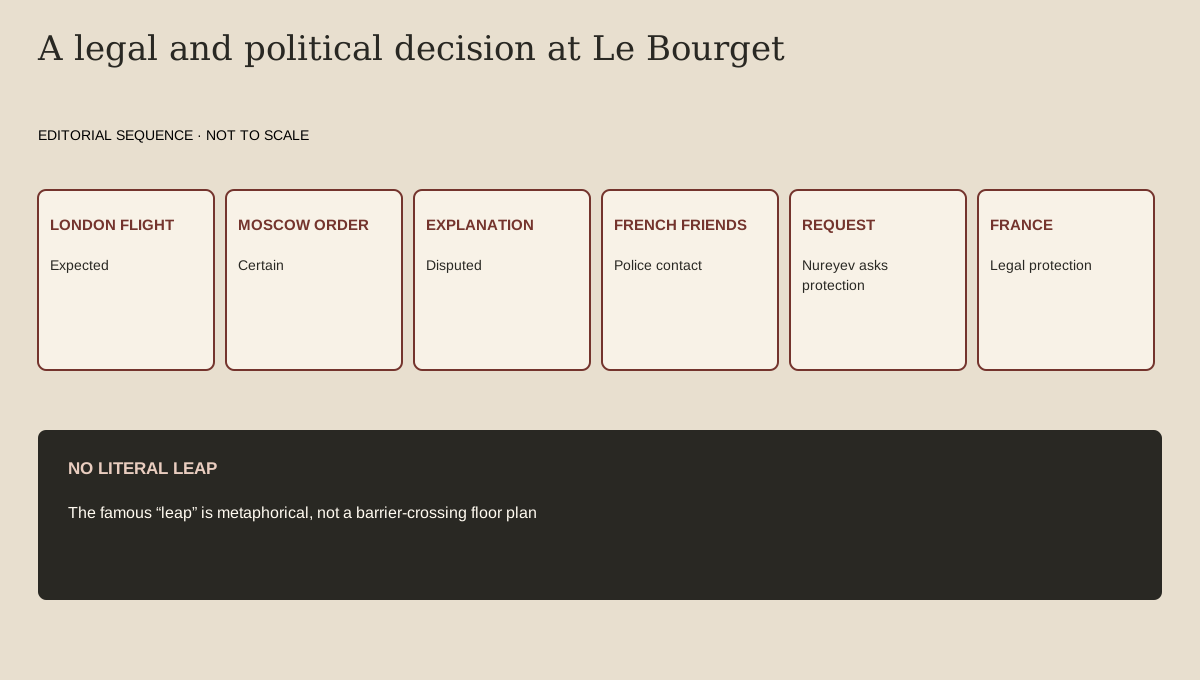
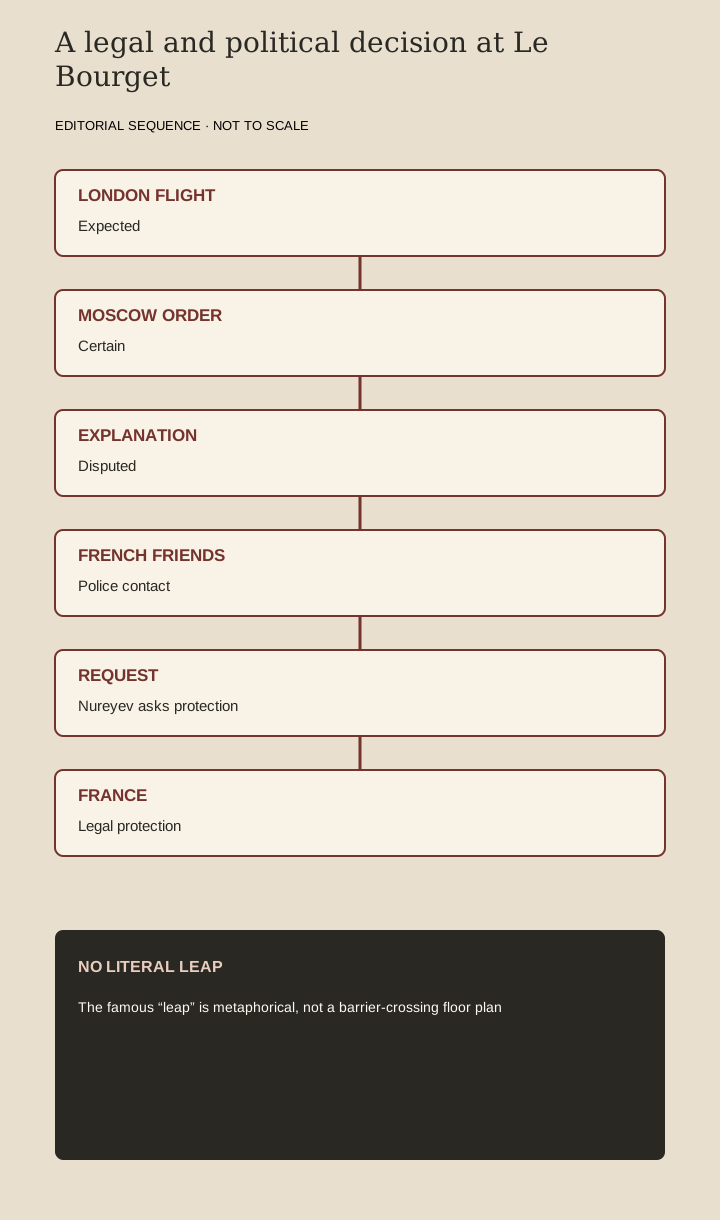
Simplified editorial reconstruction; not to scale. See adjacent text for evidence qualifications and unresolved details.
Problem → response
Escape was a sequence of problems
Each response solved a practical obstacle while often creating the next one.
- 01→
Obstacle
Soviet control of the tour
Nureyev’s travel remained subject to Soviet company and state authority, which could redirect him away from the London leg.
Response
He used his physical presence in France to seek the protection of French authorities rather than submit to the Moscow-bound journey.
- 02→
Obstacle
Asylum had to be his own decision
Friends could alert the French police, but the decisive request had to come from Nureyev himself.
Response
He personally asked to remain and continued to affirm that decision during contact with French and Soviet officials.
- 03→
Obstacle
Immediate Soviet diplomatic pressure
Soviet representatives objected strongly after French police became involved.
Response
French police maintained control of the situation and transferred Nureyev into the French administrative process.
The final accounting
Outcome
Defection
Nureyev avoided the Soviet-directed return to Moscow and remained under French protection.
French status
He received an initial three-month authorization to remain while pursuing formal refugee protection.
Long-term freedom of movement
Nureyev later became an Austrian citizen on January 25, 1982.
Evidence discipline
What the record supports
Status labels distinguish secure conclusions from uncertainty and rejected claims. Color is never the only signal.
DOCUMENTED
Rudolf Nureyev defected at Le Bourget Airport on June 16, 1961.
The date and location are supported by contemporary French reporting, archival scholarship, institutional biographies and Nureyev-related records. A Paris Opera biography currently displays May 16, 1961; that date conflicts with the broader record and is treated as an error.
Sources: SRC-001, SRC-002, SRC-003, SRC-005, SRC-013DOCUMENTED
Nureyev was being redirected to Moscow rather than allowed to continue to London.
Contemporary and later sources agree on the Moscow redirection. They differ over the explanation attached to it.
Sources: SRC-002, SRC-003, SRC-004, SRC-005WELL-SUPPORTED
He was told he had to return specifically for a Kremlin or Moscow gala.
The gala explanation appears in Nureyev-centered later accounts and the Nureyev Foundation. Contemporary Kirov public statements instead invoked his mother’s illness, so the gala explanation is not the only recorded version.
Sources: SRC-002, SRC-004, SRC-010DISPUTED
Nureyev’s mother was genuinely ill and that was the real reason for his forced return.
The illness explanation appeared in immediate Kirov public statements, while French and later accounts connect the Moscow redirection to concern over Nureyev’s conduct and Western contacts. The illness claim is therefore not established as the motive.
Sources: SRC-004, SRC-005WELL-SUPPORTED
Clara Saint played a material role in connecting the crisis to French police.
Archival scholarship, contemporary reporting and later accounts agree that Saint was present and helped alert or engage French authorities, although exact micro-sequences differ.
Sources: SRC-001, SRC-004, SRC-010MYTH
The defection was literally a single dramatic leap across an airport barrier.
The famous 'leap to freedom' phrase compresses a more complex process involving friends, police, Soviet protests and Nureyev’s own asylum request. Later accounts contain vivid movement details, but the archival record does not justify a precise barrier-jump reconstruction.
Sources: SRC-001, SRC-003, SRC-006DISPUTED
Nureyev defected primarily because of a fully formed anti-Soviet political ideology.
The act had major political consequences, but Nureyev’s own later explanation emphasized artistic mobility and fear that returning would restrict his ability to dance. Motive should not be simplified into Western Cold War propaganda.
Sources: SRC-006, SRC-010Selected chronology
Selected chronology
Nureyev joins the Kirov Ballet
After graduating from the Leningrad Choreographic School, Nureyev entered the Kirov Ballet and quickly emerged as a leading young male dancer.
Kirov tours Paris
The Kirov Ballet’s Western European tour brought Nureyev to Paris, where his performances won acclaim and his unauthorized social contacts with Westerners drew Soviet concern.
Return to Moscow ordered
At Le Bourget, Nureyev learned that he would not continue with the troupe to London and was instead to return to Moscow.
Nureyev seeks French protection
With French friends and police involved, Nureyev personally maintained his request to remain in France despite Soviet objections.
Temporary residence process begins
French authorities moved Nureyev into the Paris administrative process; he received a provisional three-month permission to remain while pursuing refugee protection.
Brief return to the Soviet Union
After twenty-six years away, Nureyev received a short visa to visit his gravely ill mother in Ufa.