
On July 2, 2008, fifteen people held by the Revolutionary Armed Forces of Colombia (FARC-EP) were told they were being moved. They had no reason to assume the transfer meant freedom. Some had already spent close to a decade in captivity, and former Colombian presidential candidate Íngrid Betancourt later recalled that the prisoners initially suspected another staged FARC event rather than a rescue.
The people who arrived in white-and-red helicopters appeared to belong to an international humanitarian mission, accompanied by supposed journalists. The FARC commanders responsible for the captives had been led to believe that the group was being transferred to meet senior commander Alfonso Cano. The appearance was a deception created by Colombian military intelligence. Once the hostages and two FARC custodians were aboard and the aircraft was safely away from the landing area, the balance of control reversed. The two custodians were subdued, the captives were told that the people around them were Colombian soldiers, and all fifteen hostages emerged alive. The rescue was completed without a shot being fired.
Operation Jaque became one of the most celebrated intelligence operations in modern Colombian history. It was also more complicated than the first official account suggested. The rescue had been designed and executed by Colombians, but it grew out of years of U.S.-Colombian intelligence and military cooperation and received limited American technical and contingency support. More seriously, later evidence confirmed that an officer wore the protected Red Cross emblem and that the fictitious humanitarian organization used in the deception had borrowed identifying information from a real nongovernmental organization. Those facts do not erase the rescue. They are part of its history.
At a Glance
- Date: July 2, 2008.
- Location: The Tomachipán area of Guaviare, Colombia; the surviving record does not securely establish exact landing-site coordinates.
- Rescued: 15 hostages — Íngrid Betancourt, three U.S. contractors, seven members of the Colombian Army, and four members of the Colombian National Police.
- FARC custodians captured: Gerardo Antonio Aguilar Ramírez, known as “César,” and Alexander Farfán Suárez, known as “Gafas” or “Enrique Gafas.”
- Method: A Colombian military-intelligence deception made the captors believe that a fictitious humanitarian organization would transfer the hostages to senior FARC leadership.
- Immediate result: All 15 hostages were freed; no shots were fired during the rescue.
- Central controversy: The operation used humanitarian and media identities, including unauthorized use of the Red Cross emblem. Later video evidence contradicted the government’s first explanation of when that emblem had been put on.
- Foreign assistance: Colombian forces designed and executed the rescue, but American training, intelligence cooperation, technical support, surveillance and contingency planning formed part of the wider effort.
Fifteen hostages with different histories
The rescued group had not entered captivity together. Seven Colombian Army personnel and four police officers had been seized in attacks and operations between 1998 and 1999. By 2008, several had been held for roughly a decade. The Army personnel were Juan Carlos Bermeo, Raimundo Malagón, José Ricardo Marulanda Valencia, Erasmo Romero Rodríguez, William Humberto Pérez Medina, José Miguel Arteaga and Amaón Flórez Pantoja. The police personnel were Julio César Buitrago Cuesta, Armando Castellanos Gaona, Vianey Javier Rodríguez Porras and John Jairo Durán Tuay.
Íngrid Betancourt had been abducted on February 23, 2002 while campaigning for the Colombian presidency. Her Colombian and French citizenship made her case internationally prominent, and repeated efforts to obtain her release became entangled with negotiations, proposed humanitarian exchanges and the wider politics of Colombia’s armed conflict.
The three Americans — Marc Gonsalves, Thomas Howes and Keith Stansell — worked on an aerial counternarcotics surveillance program. Their aircraft crashed in southern Colombia on February 13, 2003. Pilot Thomas Janis and Colombian Army sergeant Luis Alcides Cruz were killed after the crash; Gonsalves, Howes and Stansell were taken captive and remained in FARC hands for more than five years.
These prisoners were valuable to the FARC as political and bargaining assets, but describing them only as “exchangeable” hostages can obscure the conditions imposed on individual captives. Colombia’s post-conflict Special Jurisdiction for Peace has since investigated FARC kidnapping on a much broader scale, including other crimes committed during captivity. Operation Jaque concerned one especially visible group within that larger history.
The challenge of finding people who kept moving
A rescue could not begin with a helicopter. Colombian and American agencies first had to determine where captives who were repeatedly moved through jungle territory were being held and whether a rescue could be attempted without provoking their guards to kill them.
One important break came before Jaque itself. In 2007, police subintendent Jhon Frank Pinchao escaped after years in FARC captivity. His information helped Colombian authorities narrow the general area in which high-value hostages had been moved. Intelligence efforts continued through 2007 and into 2008, alongside long-running American support and joint efforts aimed particularly at locating the three U.S. contractors.
By early 2008, the broader context had also changed. FARC commander Raúl Reyes was killed in a Colombian strike in Ecuador in March; another Secretariat member, Iván Ríos, was killed the same month; and longtime leader Manuel Marulanda had died. Alfonso Cano became the organization’s top commander. At the same time, Colombian intelligence was gaining access to communications involving the FARC First Front, the formation commanded by César that was holding the group later rescued in Jaque.
The hostages themselves were not all together. Colombia’s Defense Ministry stated immediately after the rescue that they had been divided among three groups. The deception depended on persuading their custodians to consolidate them for what appeared to be a legitimate transfer ordered from higher in the FARC chain of command.
A deception modeled on something the FARC had already seen
The concept drew credibility from real humanitarian releases earlier in 2008. Venezuelan President Hugo Chávez had helped arrange transfers in which helicopters, medical personnel and television crews appeared in the process. To a FARC unit accustomed to those images, another international-looking mission did not have to appear unprecedented.
Colombian intelligence built a fictitious organization called Misión Humanitaria Internacional and constructed the appearance of a humanitarian transfer. Personnel rehearsed assigned roles. The helicopters were made to resemble aircraft associated with humanitarian operations. Supposed journalists were included. Most important, the FARC custodians were led to believe that the order came from their own leadership and that the captives were to be moved to Alfonso Cano.
The official Colombian communiqué described the basic mechanism on the afternoon of July 2. Military intelligence had penetrated the First Front and, the government said, elements of the FARC command structure. The three hostage groups were brought together, and César was persuaded that he and another FARC member should accompany the captives on the flight.
Later military histories provide much more detail about how communications were manipulated and how the team prepared. Those accounts are useful for understanding the scale of planning, but the central historical fact does not require turning the case into a manual: the rescuers did not assault a defended camp. They convinced the people guarding the hostages to participate in the movement that removed the hostages from FARC control.
Colombia led the operation, but Colombia was not operating in isolation
The first public presentation strongly emphasized national authorship. Colombia’s Defense Ministry called Jaque a military-intelligence operation planned and executed by its own personnel. The Pentagon likewise said immediately afterward that it had been planned, led and executed by Colombia.
That remains the correct starting point. The deception plan, its command decisions and the personnel who entered the landing area belonged to the Colombian military. Later U.S. Army Special Operations Command history, based heavily on participant interviews, described the deception itself as overwhelmingly Colombian and separate from the larger U.S.-Colombian hostage-search mission.
But “Colombian operation” does not mean “no foreign contribution of any kind.” The United States had spent years training and assisting Colombian forces under Plan Colombia and related programs. American and Colombian teams had conducted searches and reconnaissance connected to the hostages. U.S. technical intelligence contributed to the environment in which Jaque was executed, and American forces were positioned for contingency support if the operation failed.
This distinction matters because two simplified narratives appeared after the rescue. One treated Jaque as an entirely isolated national feat untouched by years of U.S. partnership; another implied that the Americans had secretly designed the rescue. The evidence supports neither extreme. Colombian intelligence conceived and ran the deception. U.S. assistance was real but supporting rather than controlling.
July 2
By the morning of July 2, the hostages had been ordered toward a transfer point in the Guaviare jungle. Betancourt’s account from the day after the rescue captures the uncertainty from the prisoners’ side. They knew they were being moved and saw aircraft that suggested an outside mission, but they did not know whether they were being released, transferred, displayed for propaganda or placed under different FARC custody.
One of the white-and-red Mi-17 helicopters landed. The rescue party maintained the identities it had rehearsed while the hostages and FARC personnel were gathered for boarding. The hostages were restrained for the supposed transfer, reinforcing the appearance that nothing fundamental had changed.
César and Gafas boarded with them. That decision was essential to the deception’s outcome: the two men with immediate authority over the captives had voluntarily entered an aircraft controlled by the Colombian state. After takeoff, Colombian personnel subdued them. The hostages were then told that the people around them were soldiers and that they were free.
The public announcement followed quickly. Fifteen people had been recovered alive: Betancourt, the three Americans and eleven Colombian soldiers and police officers. The aircraft carried them first toward San José del Guaviare and onward into government-controlled facilities. The three Americans were subsequently flown to the United States for medical evaluation and reintegration.
No firearm was discharged in freeing the fifteen. That achievement is central to why Jaque drew immediate international attention. Hostage rescue in the Colombian conflict had a history of lethal outcomes, and a conventional assault could have placed the captives at direct risk. Jaque removed them through control of information rather than firepower.
The humanitarian disguise created a second history of the operation
The rescue’s success did not settle whether every element of the deception was acceptable. Within two weeks, President Álvaro Uribe acknowledged that a member of the security forces had worn a vest carrying the Red Cross emblem. The International Committee of the Red Cross responded publicly that the emblem is specifically protected under international humanitarian law and that its abuse is prohibited because the organization depends on the confidence of all parties to reach people affected by war.
The ICRC also made another point explicit: it had not participated in Operation Jaque and did not know beforehand that the operation would occur. Any impression that the rescue was an authorized ICRC mission was false.
The government initially presented the emblem use as the unauthorized decision of an officer who had become nervous. That explanation became harder to sustain when a longer recording of the operation emerged in August. El Tiempo reported that the footage showed an officer wearing the Red Cross-marked vest before the helicopters took off, not merely putting it on at the landing site in a last-minute reaction. The fact of emblem use is therefore documented; the first official explanation of its timing and spontaneity is disputed by the later visual record.
Other borrowed identities raised similar concerns. Personnel posed as journalists and displayed media branding. The fictitious Misión Humanitaria Internacional also used registration information associated with Global Humanitaria, a real Barcelona-based nongovernmental organization. Global Humanitaria publicly denied any connection to Jaque and demanded respect for its neutrality after learning that identifying data from its records had been copied into the false organization’s presentation.
These controversies are not peripheral merely because the operation succeeded. Humanitarian organizations and journalists operate in conflict zones partly because armed actors accept that they are not disguised combatants. Imitating those identities can create risks that extend beyond a single mission. The ICRC’s objection was therefore about the future credibility and protective function of humanitarian neutrality, not about denying that fifteen people had been rescued.
Was there a secret ransom?
A separate controversy appeared within days. Swiss radio reported an allegation from an unnamed source that roughly $20 million had been paid to César in connection with the hostages’ release. The Colombian government denied the claim, and Defense Minister Juan Manuel Santos called it false. The allegation was repeated internationally but was not accompanied by publicly demonstrated evidence establishing such a payment.
The later emergence of extensive video from the operation strongly corroborated that a sophisticated deception actually took place. It did not logically prove that no separate payment or inducement could have existed, but it weakened any suggestion that the visible rescue mechanism had been invented after the fact to conceal a simple purchased release.
The evidence supports a narrower conclusion than either side’s rhetoric. A ransom allegation existed and was contested. Available evidence does not establish that $20 million, or another ransom, was paid to César. The claim remains disputed rather than a proven hidden mechanism.
What happened to César and Gafas
The two FARC custodians did not leave the helicopter as free men. Gerardo Antonio Aguilar Ramírez, “César,” had commanded the First Front for years and had responsibility for hostages in its custody. He was arrested during Jaque and was later extradited to the United States on narcotics-conspiracy charges. A U.S. federal court ultimately sentenced him to 29 years in prison. Colombia’s Special Jurisdiction for Peace has continued to identify him in its investigation of FARC kidnapping and notes that he remains outside Colombia.
Alexander Farfán Suárez, “Gafas,” was also captured during the operation. Colombian courts later convicted him in cases connected to his FARC activity, and his subsequent history entered Colombia’s transitional-justice process. Those later proceedings are separate from the immediate rescue, but they confirm that the two men presented in the first government communiqué as having been “neutralized” aboard the aircraft were taken alive into legal custody.
A rescue that became political capital
Operation Jaque arrived at a moment when the Colombian government was already pressing the FARC militarily and politically. Freeing Betancourt and the three Americans gave the operation enormous international visibility. For President Uribe’s government and Defense Minister Santos, the rescue demonstrated an intelligence capacity that contrasted sharply with earlier images of state weakness in remote areas.
It was a serious blow to FARC prestige and internal security. A First Front commander had accepted false orders, assembled high-value captives and placed them aboard an enemy-controlled helicopter. The state had removed fifteen hostages without a battle and captured two of their custodians in the same movement.
Still, Jaque did not end the Colombian armed conflict, end kidnapping immediately or by itself produce the later peace settlement. Fighting continued for years. The final agreement between the Colombian government and the FARC was signed in 2016, after a separate political process. Treating July 2, 2008 as the single event that defeated the organization turns a consequential rescue into a retrospective origin story it cannot bear.
Its more defensible significance is specific. Jaque freed fifteen people who had collectively spent decades in captivity. It showed how intelligence penetration and deception could solve a hostage problem that a direct assault might have made lethal. It demonstrated the maturation of Colombian intelligence and aviation capabilities developed during a long period of war and international partnership.
It also left an ethical and evidentiary warning attached to that success. A state can achieve a legitimate objective while individual methods remain open to serious criticism. The unauthorized use of a protected humanitarian emblem was not erased by the safe outcome, and the later video record required correction of the first public explanation. Operation Jaque is strongest as history when both truths remain visible: fifteen captives were freed without gunfire, and the deception crossed boundaries whose importance extends far beyond one helicopter flight.
Evidence discipline
What the record supports
Status labels distinguish secure conclusions from uncertainty and rejected claims. Color is never the only signal.
DOCUMENTED
Operation Jaque rescued fifteen hostages on July 2, 2008 without gunfire.
Contemporary Colombian, U.S. and ICRC sources agree on the date and fifteen-person outcome; Colombian official accounts and later reconstructions agree that no shot was fired in the rescue.
Sources: SRC-001, SRC-003, SRC-004, SRC-009DOCUMENTED
The rescue deception was designed and executed by Colombian military intelligence.
The contemporary Colombian communiqué states this directly, the Pentagon said the mission was planned, led and executed by Colombia, and later participant-based military histories preserve Colombian authorship of the deception.
Sources: SRC-001, SRC-004, SRC-009DISPUTED
Operation Jaque had no meaningful U.S. assistance or connection.
Colombian authorship is secure, but U.S. official and military sources document years of joint hostage-search work, training and intelligence cooperation, limited technical support and contingency forces connected to the wider effort.
Sources: SRC-004, SRC-007, SRC-009MYTH
The ICRC participated in or authorized the fictitious humanitarian mission.
The ICRC stated that it did not participate and did not know that Operation Jaque would take place.
Sources: SRC-003DOCUMENTED
A Colombian security-force officer wore the Red Cross emblem during Operation Jaque.
President Uribe acknowledged the use, the ICRC formally responded, and later released video visibly placed the emblem in the operation before takeoff.
Sources: SRC-002, SRC-010DISPUTED
The Red Cross-marked vest was put on only as an improvised, nervous decision at the landing site.
That was the initial official explanation, but the longer video reported in August showed the officer wearing the vest before the helicopters took off.
Sources: SRC-002, SRC-010MYTH
Misión Humanitaria Internacional was an independent real NGO participating in the rescue.
It was a fictitious cover. The real organization Global Humanitaria denied involvement and said its registration data and descriptive material had been copied into the false organization’s presentation.
Sources: SRC-001, SRC-011DISPUTED
Colombia secretly paid César about $20 million to surrender the hostages.
A Swiss-radio report based on an unnamed source alleged a payment; Colombian authorities denied it. The source base reviewed here establishes a real, rehearsed deception operation but does not establish the alleged ransom.
Sources: SRC-016MYTH
Operation Jaque ended the Colombian armed conflict or by itself defeated FARC.
The rescue was a major operational and political blow, but the conflict continued for years and the government-FARC peace agreement was reached separately in 2016.
Sources: SRC-007, SRC-012Documentary reconstruction
Believed transfer and custody reversal
A case-local editorial visual clarifies the evidence structure without adding false precision or reusable operational detail.
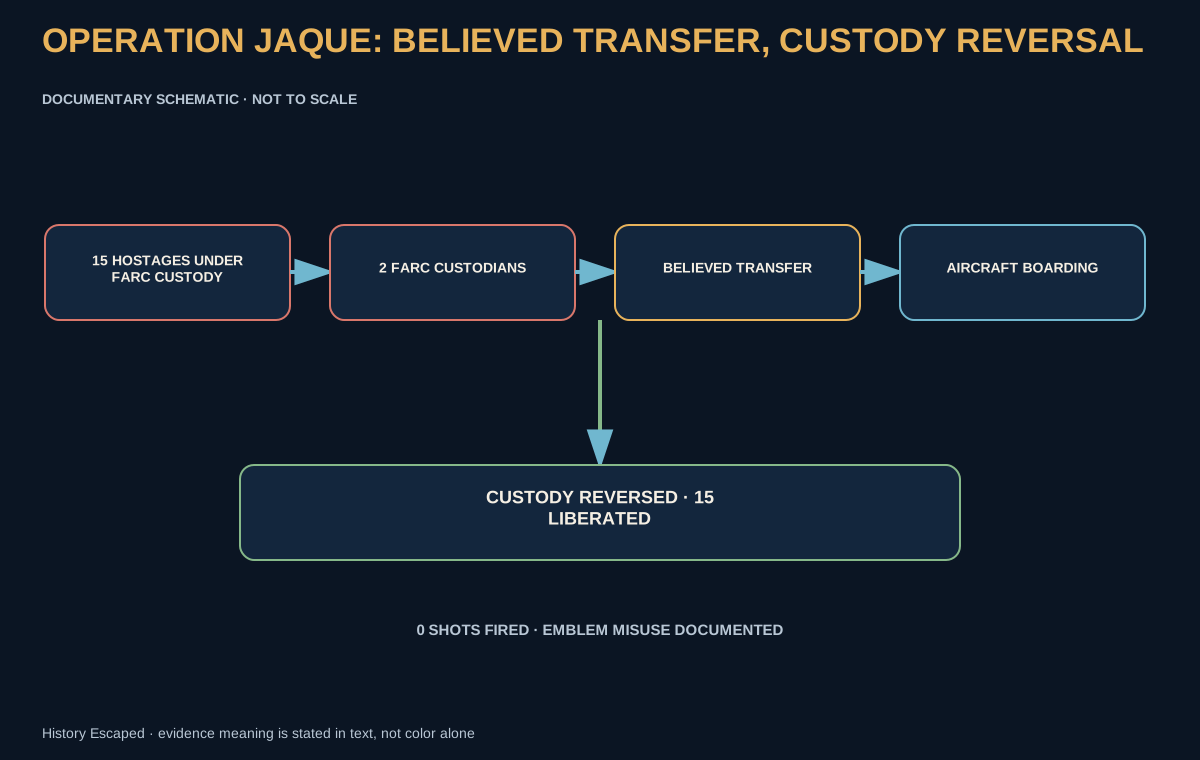
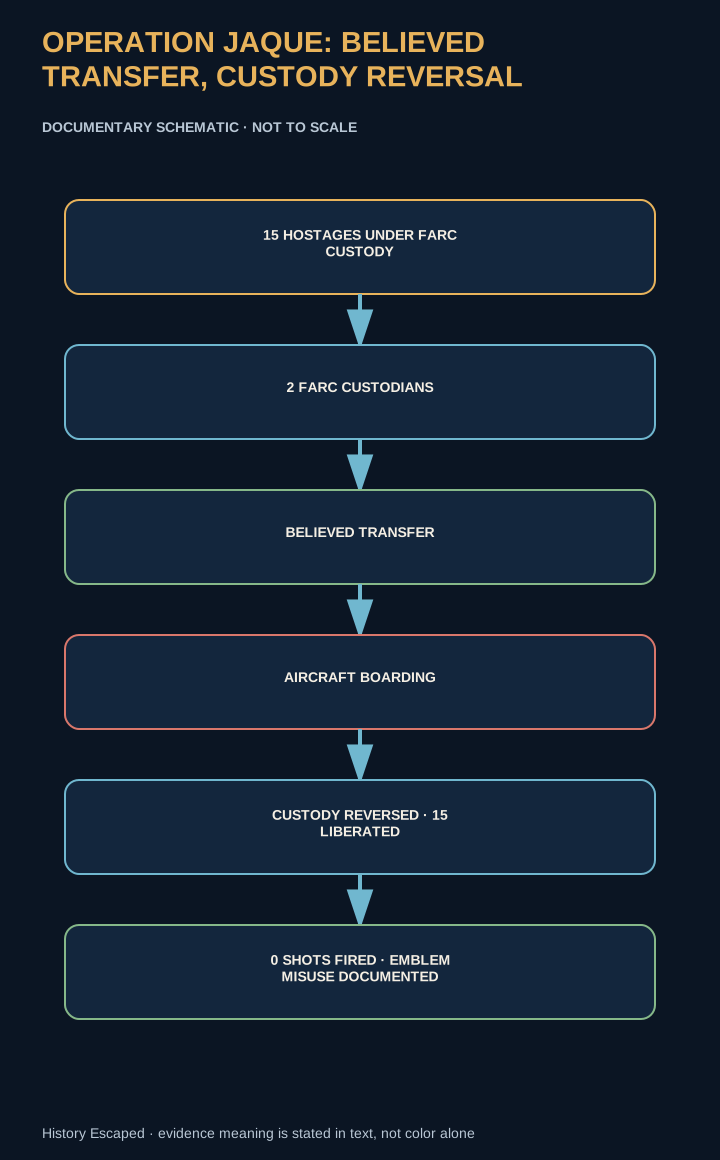
Simplified evidence-led editorial reconstruction based on the cited record; not to scale. Uncertainty is stated directly in the visual and adjacent text.

