
Jhon Frank Pinchao escaped from FARC captivity on the night of 28 April 2007 after more than eight years as a hostage. His escape did not immediately produce safety. For the next seventeen days he moved through the forests and river systems of southeastern Colombia before reaching a Colombian police unit near Pacoa in Vaupés.
The broad outline is secure because it was documented almost immediately after his return and later described by Pinchao himself. The details are less tidy. Early reporting briefly confused his escape with a military rescue. Later interviews differ over how long he had been planning, exactly who helped him prepare, and how many days he was lost before reaching a river and receiving local assistance.
The strongest reconstruction therefore separates the event into three parts: the captivity that began after the FARC attack on Mitú in 1998, the deliberate break from a guarded camp on 28 April 2007, and the much longer struggle to remain free until he encountered government forces on 15 May.
At a Glance
- Escapee: Jhon Frank Pinchao Blanco
- Captor: FARC-EP
- Original capture: during the FARC assault on Mitú, Vaupés, beginning 1 November 1998
- Escape date: 28 April 2007
- Time in captivity before escape: about eight years and six months
- Escape conditions: night, heavy rain, darkness, and a weakened restraint
- Immediate direction: away from the camp toward nearby waterways
- Time outside FARC custody before reaching government forces: 17 days
- Recovery: 15 May 2007 near Pacoa, Vaupés
- Force encountered: Colombian National Police anti-narcotics/Jungla personnel
- Important evidence caution: later retellings vary on the exact chain-breaking sequence, the role of other hostages in preparations, and the number of days spent lost before he found navigable water
Mitú, 1998
Pinchao’s captivity began in one of the most significant FARC offensives of the late 1990s. On 1 November 1998, a large FARC force attacked Mitú, the capital of Vaupés. Colombia’s Truth Commission later described the assault as the first time the guerrilla succeeded in taking a departmental capital. The attack devastated parts of the town and police station and resulted in the abduction of sixty-one police officers.
Pinchao was among those taken into the jungle. Over the following years, many of the Mitú captives were released, but a smaller group remained in FARC custody as so-called “canjeables,” hostages whom the guerrilla hoped to exchange for imprisoned members. The Colombian Truth Commission has emphasized that this hostage-taking was not simply a feature of military detention. It was part of a coercive political strategy in which the continued liberty and safety of captives were tied to demands made against the state.
Pinchao remained in that system for more than eight years.
Captivity in motion
FARC captivity did not mean one fixed prison. Pinchao later described repeated movements through jungle camps, sometimes by foot, sometimes by boat, and occasionally by vehicle.
Captives were separated and recombined. Some lived behind barbed-wire enclosures. Chains were used at night and, as punishment, sometimes for much longer periods.
His 2007 public testimony was among the first direct accounts from someone who had recently shared captivity with several nationally known hostages. He reported having been held with Íngrid Betancourt, former senator Luis Eladio Pérez, three American contractors, military personnel and other police officers.
Those reports had enormous public impact because families had little reliable information about many captives. The same testimony also shaped the public image of the escape. Pinchao appeared in Bogotá holding the kind of chain and padlock used in captivity. Photographs of that press conference became some of the most widely circulated images of his return.
Planning without knowing the opportunity
Pinchao consistently said the escape was not a purely spontaneous decision. In his first interviews he said he had contemplated or prepared for escape for roughly two years. Later accounts describe broader discussions among captives about routes, rivers and what to do if any one person obtained a chance to flee.
That does not mean there was one fixed collective plan that everyone executed together. A 2019 retrospective says the hostages had discussed leaving alone or in company and had agreed that anyone who got a real opening should not turn back. Later reporting also says Íngrid Betancourt and Luis Eladio Pérez had contributed to planning or preparation. The exact nature of that help is not described consistently enough to turn them into co-executors of Pinchao’s final breakout.
One point is much firmer: Pinchao had been working on his restraint before the night of the escape. Contemporary reporting says he had weakened or loosened part of the chain over time while trying not to reveal the damage during inspections.
The public version should stop there. Exact manipulation of restraints is not necessary to understand the history and should not be converted into a procedural guide.
28 April 2007
The escape itself began on the night of Saturday, 28 April. Pinchao’s own later account places him at a camp near the Apaporis River. Heavy rain reduced visibility and masked movement. He said that when a guard moved away on a routine round, he slipped free of the restraint and began moving out of the camp.
In his 2008 account, Pinchao describes crawling while watching for the guard’s light, then getting farther into the forest and reaching water. Other later versions compress this to a sudden run into the jungle.
Those are differences of presentation rather than a contradiction over the core event. What is secure is that he left alone.
He had food hidden or saved in advance, including farinha or cassava flour and other small rations. He also carried a water container that later accounts say could help with flotation because he was not a confident swimmer.
The storm that made movement difficult also helped conceal the escape.
The first hours outside captivity
Getting out of sight of the camp did not mean Pinchao knew where he was going. He was deep in the forest in a region where rivers function as the most reliable corridors.
His goal was to put distance between himself and the FARC guards, then use waterways and the sun to regain orientation.
Later first-person accounts describe him reaching a river and allowing the current to carry him for part of the first night before leaving the water before daylight. The following days were far less controlled.
Pinchao repeatedly said he became lost. Early reporting said five days; later interviews and retrospectives say approximately a week. The difference cannot be reconciled precisely and is not important enough to manufacture a single number.
The more secure point is that a planned escape became an improvised survival journey.
Seventeen days in the forest
Pinchao spent seventeen days outside FARC custody before reaching the police. He moved mainly during daylight after the first night and rested when darkness made travel too dangerous.
He followed waterways when he could. He later described covering himself with vegetation for protection from insects and weather and developing infected cuts on his hands and body.
Food became a serious problem. The supplies he had carried from the camp did not last indefinitely. Contemporary reporting says he supplemented them with whatever food he could find and attempted to use pieces of his former restraint while trying to catch fish.
Some of the most detailed survival anecdotes come from Pinchao’s own testimony. They are valuable firsthand evidence but should not be transformed into a precise day-by-day route. No independent observer accompanied him through the forest.
That evidentiary limit matters because later media retellings have sometimes made the journey more cinematic than the first accounts support.
The Indigenous helper
One of the most important early stories concerns an Indigenous man Pinchao met near a river. In reporting published immediately after his return, Pinchao said he encountered an older Indigenous man with a canoe, identified himself, and asked for help finding government forces.
The man concealed him in the boat and travelled with him for a period before making contact with uniformed personnel.
Later first-person summaries sometimes compress or omit this episode and move directly from the jungle journey to the police encounter. That does not make the Indigenous assistance false. The story comes from reporting based on Pinchao’s own early account. What remains uncertain is the exact duration of that assistance and the precise route of the canoe.
The helper’s name is not securely established in the surviving accounts. He therefore remains anonymous rather than being assigned a later unverified identity.
15 May: contact near Pacoa
Pinchao reached safety on 15 May 2007 near Pacoa in Vaupés. He did not initially know the date or exactly where he was.
A Colombian National Police Jungla unit operating in the region was alerted to the possibility that a hostage had escaped because security forces had intercepted FARC communications referring to the flight. Early reports say the police were wary of a trap and verified Pinchao’s identity before bringing him in.
He was in poor physical condition—dehydrated, undernourished and covered with wounds—but alive. From the area he was moved first into government hands in Vaupés and then toward Bogotá for medical treatment and debriefing. The escape phase had lasted seventeen days.
Why early reports were confused
When news first broke, authorities did not yet have Pinchao’s full account. Some initial reports on 16 May said he may have been freed during a military operation. Others called the event a rescue before officials had established what had happened.
Within hours, that version was overtaken by Pinchao’s own testimony: he had escaped the camp on 28 April and had been on his own for more than two weeks before encountering government personnel. This distinction matters because “rescue” and “escape” are different historical events.
The government forces who encountered Pinchao ended the survival phase of his flight. They did not break him out of FARC custody.
The 27-versus-28 April problem
A few later articles give 27 April as the escape date, but the stronger evidence supports 28 April 2007.
Contemporary Colombian reporting repeatedly used 28 April within days of his return. Pinchao’s own 2008 narrative explicitly says “today, 28 April” when describing the night of his departure. His later interviews also generally return to that date.
The 27 April date should therefore be treated as a later secondary error rather than a genuine chronological dispute.
What he left behind
Pinchao’s return was important for more than the escape itself. He had recently been held with people whose condition was a matter of national and international concern.
His testimony provided fresh information about Íngrid Betancourt, Luis Eladio Pérez, the three American contractors and other hostages.
The Colombian Truth Commission later identified Pinchao’s 2007 escape as one of the events that began to break a political deadlock around the hostages considered exchangeable by the FARC. Pinchao himself did not present the escape as proof that everyone else could simply do the same thing. In his first major Colombian interview, he said a negotiated humanitarian exchange remained the safest option for the people still in captivity.
That position is important because later coverage often turned him into a symbol of individual escape as the solution to hostage-taking. His own message was more cautious.
Memory and later reconstruction
Pinchao published Mi fuga hacia la libertad in 2008 and continued giving interviews about his captivity. Those later accounts add details that were understandably absent from the first press conference: planning conversations, failed opportunities, the behavior of guards, improvised navigation and the psychological calculation behind leaving.
They also create the normal problems of retrospective testimony. Specific durations change slightly. The person to whom Pinchao was chained in particular episodes is not always described consistently across later retellings. Some accounts emphasize the help of fellow hostages, while others stress that he physically escaped alone.
The most reliable way to use these sources is not to choose whichever version is most dramatic. It is to separate what the 2007 record establishes from what Pinchao added later.
What the evidence supports
Jhon Frank Pinchao was taken by the FARC during the 1998 attack on Mitú and remained a hostage for about eight and a half years. On the night of 28 April 2007, he exploited heavy rain, darkness and a momentary opening in guard supervision to leave a FARC camp in the Vaupés-Apaporis region.
He escaped alone and then spent seventeen days moving through the forest and river system. He became lost, exhausted his prepared food, suffered injuries and eventually received local Indigenous assistance before reaching Colombian police personnel near Pacoa on 15 May.
The details of exactly how the chain had been weakened, exactly who helped plan the escape, exactly how many days he remained lost, and exactly how long he travelled by canoe vary among later accounts. Those uncertainties do not weaken the central history.
Pinchao escaped after more than eight years of captivity, survived for more than two weeks before reaching government forces, and returned with firsthand information about people who remained hostages of the FARC. His case belongs as much to the history of prolonged hostage-taking in Colombia as it does to the history of escape.
Evidence discipline
What the record supports
Status labels distinguish secure conclusions from uncertainty and rejected claims. Color is never the only signal.
MYTH
Pinchao escaped on 27 April 2007.
A few later secondary articles use 27 April, but contemporary 2007 reporting and Pinchao’s own 2008 first-person narrative consistently identify 28 April.
Sources: SRC-003, SRC-005, SRC-012MYTH
Pinchao was freed from FARC custody by a military rescue operation.
Some initial reports repeated an unconfirmed rescue explanation. Pinchao’s own testimony established that he escaped the camp on 28 April and encountered government forces only after seventeen days.
Sources: SRC-003, SRC-011UNKNOWN
Pinchao’s seventeen-day route can be reconstructed precisely.
His accounts establish broad use of forest and river corridors, but exact day-by-day geography is not independently documented and later retellings vary.
Sources: SRC-004, SRC-005, SRC-006DISPUTED
The number of days Pinchao was completely lost is securely known.
Early reporting gives about five days, while later accounts say roughly seven days. The article keeps the duration qualitative.
Sources: SRC-004, SRC-005MYTH
Íngrid Betancourt and Luis Eladio Pérez physically escaped with Pinchao.
Later reporting credits them with helping prepare or discuss escape plans, but Pinchao left the camp alone and both remained captive.
Sources: SRC-009, SRC-013LATER CLAIM
An Indigenous man helped Pinchao during the final survival phase.
This appears in immediate reporting based on Pinchao’s own account, but later summaries sometimes omit the episode and the helper’s identity is not securely documented.
Sources: SRC-004MYTH
Pinchao’s testimony proved that escape was the safest option for all remaining FARC hostages.
Pinchao explicitly said after his return that a negotiated humanitarian exchange remained the safest option for his former fellow captives.
Sources: SRC-007Evidence diagram
Breakout, survival, and contact after seventeen days
The documented dates separate the breakout from the seventeen-day survival phase and final government contact.
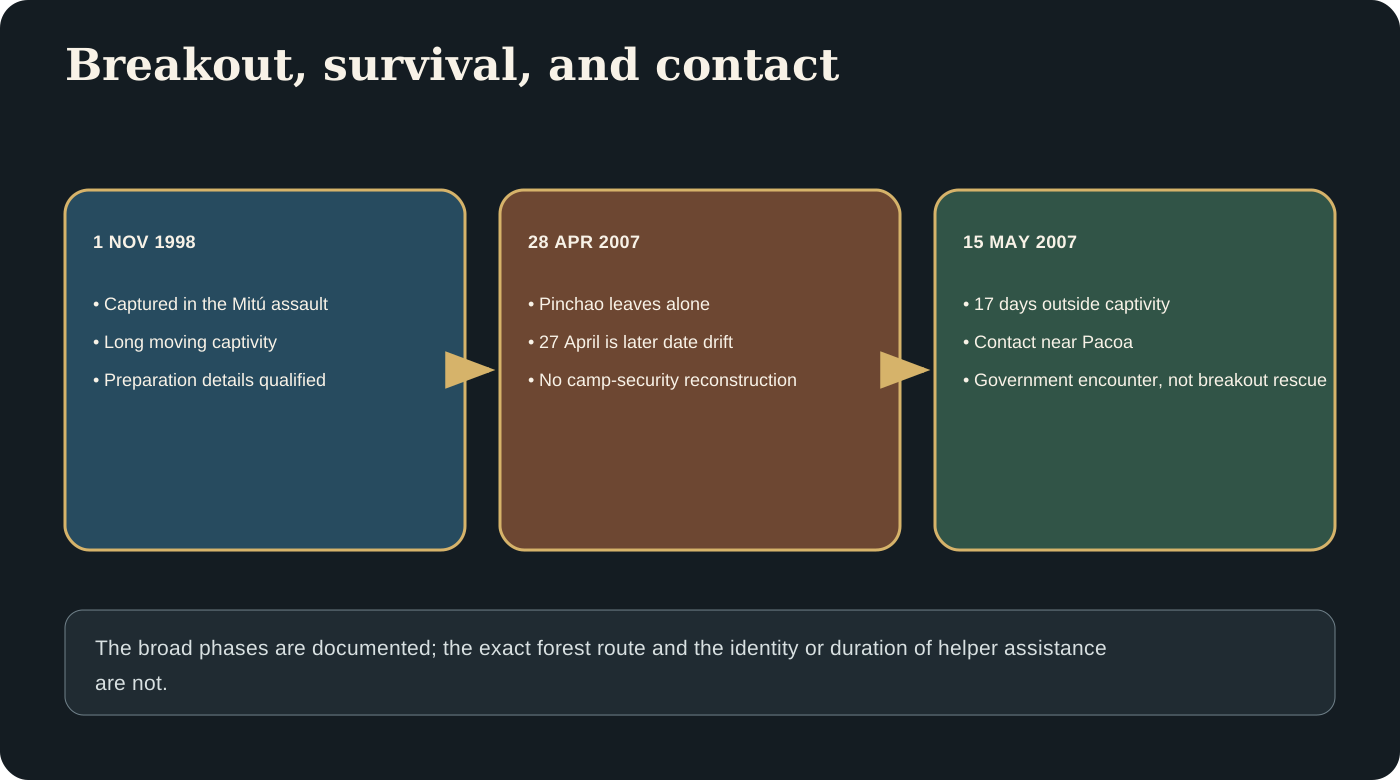
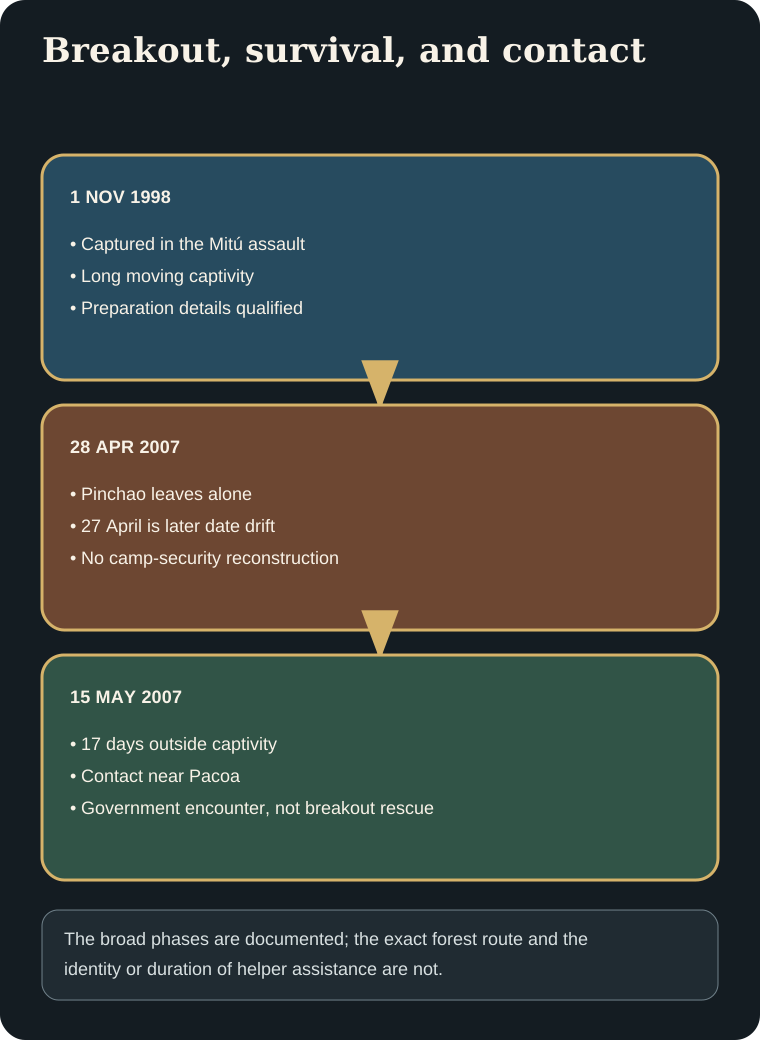
The documented dates separate the breakout from the seventeen-day survival phase and final government contact.