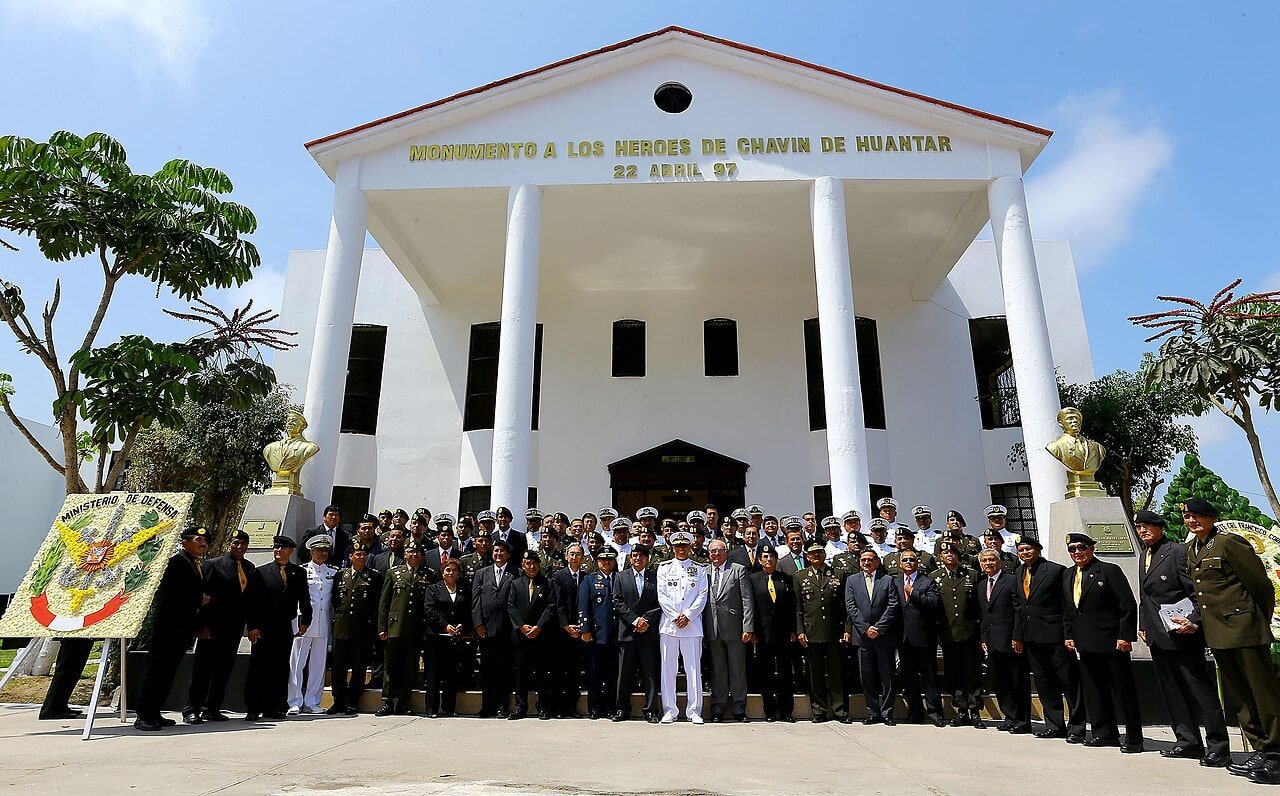
For nearly four months, the Japanese ambassador’s residence in Lima was both a diplomatic compound and a prison. On the night of 17 December 1996, fourteen members of the Movimiento Revolucionario Túpac Amaru (MRTA) broke into a reception being held for the birthday of Japan’s Emperor Akihito and seized hundreds of guests. Most were gradually released. Seventy-two remained when Peruvian forces launched Operation Chavín de Huántar on 22 April 1997.
The rescue is remembered for its extraordinary immediate outcome. Seventy-one of the seventy-two remaining hostages came out alive. Two commandos, Juan Valer Sandoval and Raúl Jiménez Chávez, were killed. Supreme Court magistrate Carlos Giusti Acuña was the only hostage to die. All fourteen MRTA members in the residence also died.
Those numbers made Chavín de Huántar a national symbol of military competence and a model frequently cited in discussions of hostage rescue. They did not settle every historical question. Years later, testimony from former hostage Hidetaka Ogura and forensic evidence raised the possibility that some MRTA members had survived the fighting and were killed after being taken into state custody. Peru’s Truth and Reconciliation Commission treated the allegations seriously. The Inter-American Court of Human Rights ultimately found Peru internationally responsible for violating the right to life of one MRTA member, Eduardo Nicolás Cruz Sánchez, while finding insufficient evidence to reach the same conclusion regarding Herma Luz Meléndez Cueva and Víctor Salomón Peceros Pedraza.
The operation can therefore be both a highly successful hostage rescue and the setting of a proven extrajudicial killing. The two findings are not mutually exclusive. The historical task is to preserve both.
At a Glance
- Hostage crisis began: 17 December 1996
- Site: residence of Japanese ambassador Morihisa Aoki, San Isidro, Lima
- MRTA force: 14 members led by Néstor Cerpa Cartolini
- Guests initially seized: approximately 600 in the Inter-American Court record; some Peruvian accounts give higher totals
- Hostages remaining by the final stage: 72
- Rescue launched: 22 April 1997 at approximately 3:23 p.m.
- Hostages who survived: 71
- Hostage fatality: Supreme Court magistrate Carlos Ernesto Giusti Acuña
- Commando fatalities: Juan Alfonso Valer Sandoval and Raúl Gustavo Jiménez Chávez
- MRTA fatalities: 14
- Assault force: approximately 142 members of the Patrulla Tenaz in the Inter-American Court record; later official commemorations count 195 broader participants, including 142 elite Army and Navy personnel
- Major later legal finding: Peru violated Eduardo Nicolás Cruz Sánchez’s right to life after evidence showed he had been apprehended alive before his death
The Seizure of the Residence
The reception at Ambassador Morihisa Aoki’s residence brought together senior figures from Peruvian public life and the diplomatic community. The Inter-American Court later described approximately six hundred attendees, including Supreme Court magistrates, legislators, ministers, senior military and police officers, diplomats, politicians and business leaders.
The fourteen MRTA members entered through a neighboring property and breached the wall into the residence. Their objective was political leverage: the organization sought the release of imprisoned MRTA members. The seizure took place during the final years of Peru’s internal armed conflict, at a point when the MRTA had already been badly weakened by arrests, defections and the collapse of much of its operational structure.
The first hours produced an enormous hostage population that could not realistically be maintained. Releases began quickly and continued in stages. Foreign diplomats, women, elderly captives and others were among those freed as negotiations developed. Eventually the number stabilized at seventy-two.
That final group included senior Peruvian officials, judges, diplomats, military officers and Ambassador Aoki himself. Their captivity continued for 126 days by the usual Peruvian local-date count. Japan’s diplomatic record describes 127 days because its chronology uses Japanese time for the opening and ending dates. Both figures describe the same crisis through different time-zone conventions.
Negotiation and Preparation Happened at the Same Time
President Alberto Fujimori’s government pursued negotiation while also preparing a military alternative. Domingo Palermo became the government’s principal negotiator, and the International Committee of the Red Cross provided humanitarian intermediation. A commission of guarantors sought a peaceful settlement.
The principal obstacle was the MRTA demand that imprisoned members of the organization be released. Fujimori’s government would not accept that condition. As the standoff continued, neither negotiation nor military preparation could safely be treated as the only path.
The parallel rescue plan became known as Nipón 96 and, ultimately, Chavín de Huántar. General Augusto Jaime Patiño supervised the higher-level military planning, while then-Colonel José Williams Zapata commanded the intervention force known as the Patrulla Tenaz. The operation integrated Army and Navy personnel, intelligence support and a series of specialized teams.
One of the most important planning advantages was information from inside the residence. Hostages covertly helped authorities understand where captives and MRTA members were located at different times. The rescuers also trained repeatedly on a purpose-built replica of the residence.
Tunnels were constructed from neighboring properties to create concealed approaches. The operation later took the name Chavín de Huántar in reference to the subterranean galleries of the ancient Andean ceremonial center. The historical significance of the tunnels is clear, but a useful account does not require publishing a reusable diagram of exact entry geometry.
How Many Commandos Were There?
Published accounts give 140, 142, 143 and, in more recent official commemorations, 195 participants. These figures look contradictory until their denominators are separated.
The 2015 Inter-American Court judgment, drawing on the operational plan, after-action material and testimony, describes the Patrulla Tenaz as consisting of approximately 142 commandos, officers and noncommissioned officers from the armed forces. Other Peruvian accounts round or count the patrol as 143.
Recent Defense Ministry and armed-forces commemorations frequently use 195. A 2025 Peruvian Navy account provides the clearest reconciliation: it refers to 195 participants in the broader military effort while specifically identifying 142 elite Army and Navy members among them. The larger figure encompasses additional command, support or intelligence personnel rather than replacing the assault-force count.
For the physical intervention inside and immediately around the residence, approximately 142 is therefore the most useful figure. For the broader recognized military participation in the operation, Peru now often uses 195.
The distinction matters because inflated precision can change the apparent scale of the assault. A historical article should not treat 142 and 195 as competing measurements of the same thing.
The Decision to Assault
By April, the standoff had lasted more than four months. The government had continued negotiating, while the rescue force remained prepared to act when conditions offered the best chance of protecting the hostages.
The Inter-American Court later examined the operation in unusually close detail because of the human-rights case that followed. Its judgment recognized the rescue objective as legitimate. Neither the Inter-American Commission nor the representatives challenging the alleged executions disputed the state’s right to use force to rescue hostages whose lives and physical safety remained at risk.
On 22 April, intelligence indicated that most MRTA members were gathered away from the main concentration of hostages. Fujimori authorized the operation. At approximately 3:23 p.m., explosions began the assault.
The initial blasts opened access routes and disrupted members of the hostage-taking group. Assault teams entered through several prepared approaches and moved to secure the areas in which the hostages were being held. The operation was built around speed because delay would give the hostage-takers time to organize, reach captives or use explosives.
The details are often presented as a near-mechanical choreography. Contemporary and later records, however, differ on exactly how long the combat and full clearing of the residence took. Some accounts describe roughly seventeen minutes for the decisive rescue phase; others place the entire operation between approximately thirty-five and forty-five minutes. Those figures likely count different endpoints—initial dominance, hostage evacuation, or complete securing of the site.
The outcome is more secure than the stopwatch.
Seventy-One Hostages Survived
Most of the hostages were on the upper floor when the assault began. They had been warned through covert communications that a rescue could occur and had instructions intended to reduce their exposure once the first explosions were heard.
The rescuers reached the captives while fighting continued elsewhere in the building. Seventy-one hostages survived and were removed from the residence. Several were wounded, including senior officials.
Carlos Giusti Acuña did not survive. Contemporary accounts and later operational records agree that he suffered a serious gunshot injury around the thigh or groin, with catastrophic bleeding, and was found in cardiorespiratory arrest before or during evacuation. Early reporting sometimes summarized the immediate cause as a heart attack, but that formulation can obscure the underlying wound and blood loss.
Giusti was the sole hostage fatality. The two military deaths were Lieutenant Colonel Juan Alfonso Valer Sandoval and Lieutenant Raúl Gustavo Jiménez Chávez. Both became central figures in Peru’s official commemoration of the operation.
Every member of the MRTA unit also died.
That last fact produced the question that would follow Chavín de Huántar for decades: did all fourteen die while actively fighting?
The Official Account and the First Serious Challenge
The military after-action account maintained that the fourteen MRTA members were killed during the confrontation. For several years, that remained the dominant public version.
The situation changed after former hostage Hidetaka Ogura, who had been first secretary at the Japanese embassy, publicly said that he had seen MRTA members alive and under state control after the assault. His statements raised the possibility that some deaths occurred after individuals were no longer participating in combat.
Three names eventually became central to the legal dispute: Eduardo Nicolás Cruz Sánchez, known as “Tito”; Herma Luz Meléndez Cueva; and Víctor Salomón Peceros Pedraza.
The distinction between active combat and custody was legally decisive. Members of the MRTA were participants in the armed conflict and were not civilians while actively taking part in hostilities. The Inter-American Court emphasized, however, that a person who surrendered, was captured or otherwise became hors de combat acquired protections under Common Article 3 of the Geneva Conventions and applicable human-rights law.
The issue was therefore not whether the Peruvian state had been entitled to conduct a rescue. The Court explicitly held that resort to force for the purpose of liberating the hostages was legitimate. The question was whether lethal force continued against particular people after they no longer represented an active threat.
What Peru’s Truth Commission Said
Peru’s Truth and Reconciliation Commission later took a deliberately dual position. It condemned the MRTA hostage-taking, recognized the state’s right to rescue the captives and praised the efficiency and heroism of the commandos. At the same time, it condemned the extrajudicial executions it believed had occurred against surrendered individuals.
That conclusion was politically explosive because Chavín de Huántar had become one of the most celebrated events of the Fujimori period. Criticism of post-assault conduct was sometimes portrayed as an attack on the rescue itself or on all of the commandos.
The distinction in the Truth Commission’s formulation is historically useful. A successful rescue does not provide legal authority to kill a person who has already surrendered or been captured. Conversely, evidence of a post-capture killing does not mean the hostage rescue as a whole was illegitimate.
The same separation later appeared in the Inter-American Court’s analysis.
The Domestic Cases
Peruvian courts spent years examining allegations surrounding the deaths. The litigation became procedurally complicated, including disputes over civilian and military jurisdiction.
In 2012, a Lima criminal chamber acquitted Vladimiro Montesinos, former armed-forces chief Nicolás Hermoza Ríos and intelligence officer Roberto Huamán Azcurra of responsibility as indirect perpetrators of the alleged killings. The court found that prosecutors had not established the proposed command structure ordering executions.
The judgment nevertheless treated the death of Eduardo Cruz Sánchez differently. The domestic record concluded that he had been apprehended by intelligence personnel and later appeared dead with a single fatal gunshot wound, while the evidence did not establish that the killing had been ordered by the defendants then on trial. The court directed that the circumstances of his death continue to be investigated.
Peru’s Supreme Court upheld the acquittal portions in 2013. The Supreme Court itself stressed that the appeal concerned those acquittals and did not dispose of every factual question about Cruz Sánchez’s death.
This is another place where later summaries can become misleading. “The commandos were acquitted” is not the same proposition as “no captured MRTA member was killed unlawfully.” The domestic judgments rejected the specific criminal responsibility alleged against the defendants before them, while the circumstances of Cruz Sánchez’s death remained a separate issue.
The Inter-American Court’s 2015 Judgment
The Inter-American Court of Human Rights issued its judgment in Cruz Sánchez et al. v. Peru on 17 April 2015.
The Court began from several facts important to a balanced interpretation. Peru was in a non-international armed conflict. The MRTA members had actively participated in hostilities. The hostage rescue pursued a legitimate aim, and lethal force against an active armed threat could be lawful in that context.
The Court also found that the operational planning itself contemplated the possibility of capturing MRTA members. It noted consistent testimony that commandos had not been given a general order to kill every hostage-taker and that the written plan called for avoiding excesses and respecting human rights.
The Court then examined the three disputed deaths separately.
For Eduardo Nicolás Cruz Sánchez, the Court found Peru internationally responsible for violating the right to life. The evidentiary record showed that Cruz Sánchez had been apprehended alive and then died after passing into state custody. The state did not provide a satisfactory lawful explanation for that sequence.
For Herma Luz Meléndez Cueva and Víctor Salomón Peceros Pedraza, the Court found that the evidence was insufficient to establish Peru’s international responsibility for violating their right to life. That did not amount to a finding that every allegation concerning their deaths was false; it meant the proof did not meet the Court’s threshold for attributing those deaths to unlawful state action.
The Court also found violations connected to deficiencies and delays in the investigation of the deaths.
The judgment therefore does not support either extreme version commonly attached to Chavín de Huántar. It did not declare the rescue operation criminal, and it did not exonerate every act that happened after or around the fighting.
Success Without Myth
Measured by the most immediate objective, Chavín de Huántar was remarkably successful. A heavily armed hostage crisis involving seventy-two remaining captives ended with seventy-one of them alive. The operation prevented the MRTA from converting its seizure of prominent hostages into the mass prisoner exchange it had demanded.
That result came at a real cost: one hostage and two commandos died, other people were wounded, and all fourteen hostage-takers were killed. The later evidence concerning Cruz Sánchez adds a further cost that cannot be folded into ordinary combat casualties.
The legal record also makes clear why “all fourteen were executed” is as inaccurate as “all fourteen unquestionably died in combat.” The Inter-American Court made a specific finding concerning one man. It did not find sufficient evidence to impose the same conclusion for Meléndez Cueva and Peceros Pedraza, and it did not condemn the rescue as such.
A trustworthy reconstruction must also resist the national-mythmaking language that accumulated around the operation. Describing its military effectiveness does not require adopting official claims that it was the greatest hostage rescue ever conducted. Those are commemorative judgments, not measurable historical facts.
Likewise, recognizing the MRTA’s armed hostage-taking as an unlawful and coercive act does not remove the state’s obligations toward a captured adversary.
What Chavín de Huántar Actually Established
The basic sequence is secure. Fourteen MRTA members seized hundreds of people on 17 December 1996. Releases reduced the captive group to seventy-two. Negotiation and rescue planning proceeded in parallel. On 22 April 1997, Peruvian forces assaulted the residence. Seventy-one hostages survived; Carlos Giusti, Juan Valer and Raúl Jiménez died; all fourteen MRTA members were dead by the end of the operation.
The disputed history begins after that simple tally.
Evidence later established that Eduardo Cruz Sánchez had been taken alive and subsequently killed while under state control. The Inter-American Court held Peru responsible for that violation of the right to life. The same court did not find enough evidence to reach that conclusion for Meléndez Cueva or Peceros Pedraza.
Those findings do not cancel the rescue. They define it more accurately.
Chavín de Huántar remains a case in which planning, intelligence and rapid intervention saved almost every remaining hostage. It is also a case in which the obligation to distinguish combat from custody mattered after the shooting stopped. Any account that preserves only one of those truths leaves out the most important lesson of the other.
Evidence discipline
What the record supports
Status labels distinguish secure conclusions from uncertainty and rejected claims. Color is never the only signal.
MYTH
Operation Chavín de Huántar rescued all 72 hostages alive.
Seventy-two hostages remained when the operation began, but 71 survived. Carlos Giusti Acuña was the sole hostage fatality.
Sources: SRC-001, SRC-005, SRC-006DISPUTED
The rescue force consisted of exactly 195 assault commandos.
The Inter-American Court describes Patrulla Tenaz as approximately 142 commandos, while recent Peruvian commemorations use 195 for a broader participant denominator and separately identify 142 elite Army and Navy members.
Sources: SRC-001, SRC-007MYTH
Every MRTA member was proven to have died during active combat.
The original military account said all fourteen died in combat, but later evidence established that Eduardo Cruz Sánchez had been apprehended alive before his death.
Sources: SRC-001, SRC-002, SRC-008MYTH
The Inter-American Court ruled that the hostage rescue itself was unlawful.
The Court expressly recognized the legitimacy of using force to rescue the hostages. Its judgment concerned whether particular deaths after persons were hors de combat violated the American Convention.
Sources: SRC-001, SRC-002DOCUMENTED
Peru was internationally responsible for unlawfully killing Eduardo Nicolás Cruz Sánchez.
The Inter-American Court found a violation of his right to life after evidence showed that he had been apprehended alive and subsequently died in state custody.
Sources: SRC-002, SRC-003MYTH
The Inter-American Court found Peru responsible for unlawfully killing Herma Luz Meléndez Cueva and Víctor Salomón Peceros Pedraza.
The Court held that the evidence was insufficient to establish Peru's international responsibility for violating their right to life.
Sources: SRC-003MYTH
The Peruvian domestic acquittals proved that Eduardo Cruz Sánchez was never extrajudicially killed.
The domestic proceedings rejected the specific command-responsibility case against the defendants before them but separately recognized unresolved evidence concerning Cruz Sánchez's death and directed further investigation.
Sources: SRC-008MYTH
The crisis lasted either 126 or 127 days because sources disagree about the event dates.
The dates are not meaningfully disputed. Peruvian sources count 17 December to 22 April as 126 days, while Japan's diplomatic chronology states dates in Japan time and therefore describes a 127-day crisis.
Sources: SRC-004, SRC-005Evidence diagram
Hostage flow, rescue, and later legal finding
The visual separates the final hostage count, the rescue outcome, and the later human-rights judgment without tactical tunnel detail.
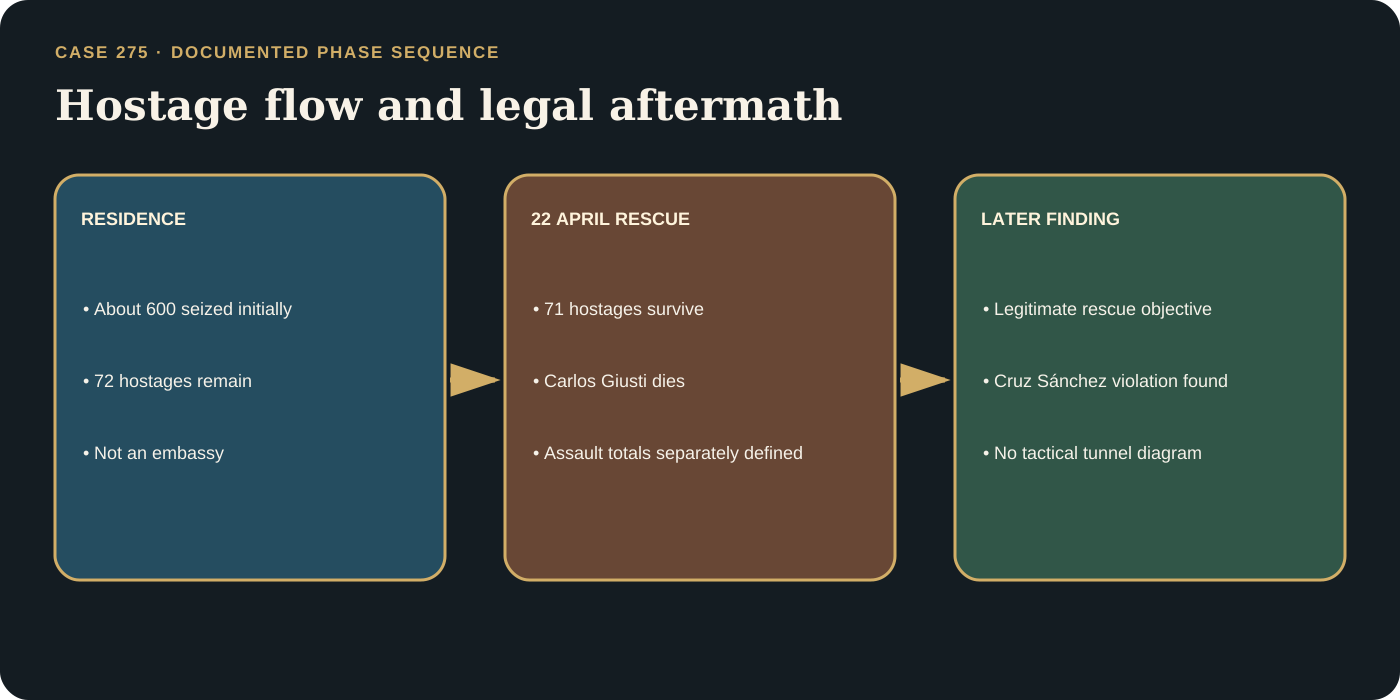
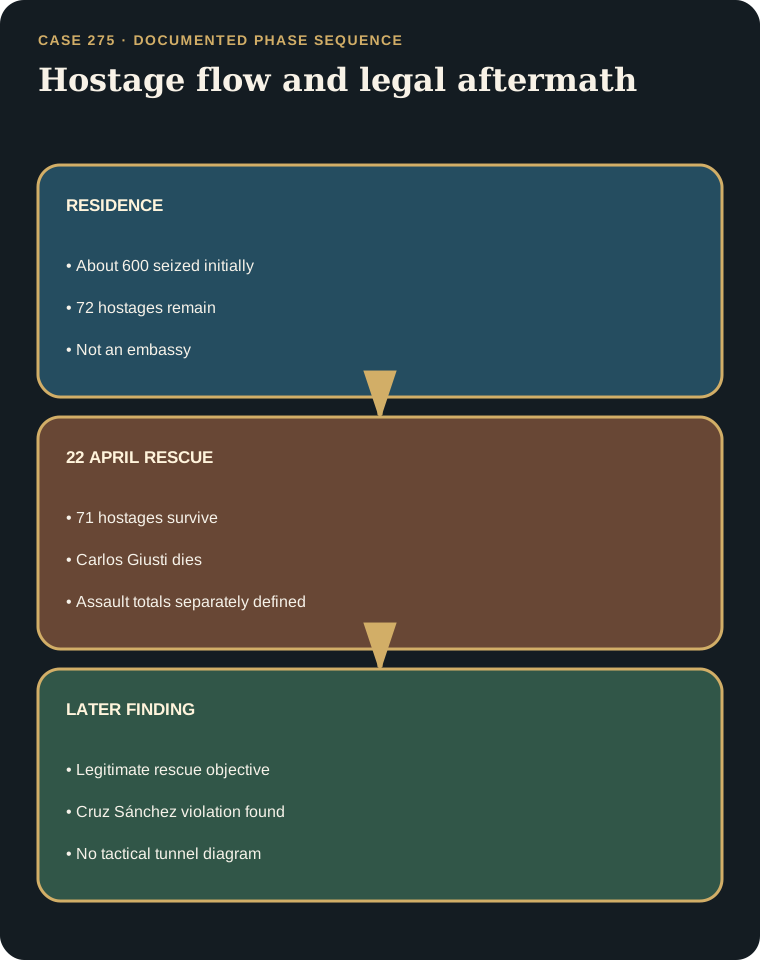
The visual separates the final hostage count, the rescue outcome, and the later human-rights judgment without tactical tunnel detail.