
Napoleon III’s Escape from Ham: How Louis-Napoléon Walked Out of Prison in 1846
On the morning of 25 May 1846, one of France’s most famous political prisoners left the Fort of Ham by the route that should have been hardest to use. He walked through the gate.
Louis-Napoléon Bonaparte—the future Emperor Napoleon III—had been confined at Ham since 1840, when a failed attempt to seize power at Boulogne ended with his capture and a sentence of life imprisonment. The fortress was guarded, his movements were watched, and the commandant was expected to verify that the prisoner remained inside. Yet repairs to Louis-Napoléon’s quarters introduced something security systems often struggle to distinguish from danger: routine.
Workmen were entering and leaving. Louis-Napoléon decided to become one of them.
His disguise was simple. His valet, Charles Thélin, obtained workman’s clothing and wooden shoes. Louis-Napoléon shaved his moustache. He carried a plank on his shoulder, using it not merely as a prop but as a movable screen between his face and the men who might recognize him. While Thélin and Dr Henri Conneau helped distract the people most likely to expose the substitution, the prisoner moved downstairs, crossed the fortress interior, passed the guards, and continued through the gate.
By the time the authorities understood what had happened, Louis-Napoléon was no longer inside Ham. He moved toward Saint-Quentin, continued through Valenciennes, crossed into Belgium, and reached London on 27 May.
Six years earlier, his attempt to take power had ended in imprisonment. Two years after the escape, revolution would open another path back into French politics. By December 1848 he would be president of the Republic. In December 1852 he would become Napoleon III.
The escape from Ham did not make that later career inevitable. But without the escape, the future emperor would still have been serving a life sentence.
The Prisoner Who Had Tried to Become a Ruler
Louis-Napoléon’s route to Ham began with political failure.
He was a nephew of Napoleon Bonaparte and believed that the Bonaparte name still possessed political power in France. In October 1836 he tried to rally troops at Strasbourg. The attempt collapsed quickly, and he was sent abroad. Four years later he tried again.
On 6 August 1840, Louis-Napoléon landed at Boulogne-sur-Mer with supporters and attempted to persuade the local garrison to join him. The plan failed. He was arrested, taken to Paris, and tried before the Chamber of Peers. On 6 October he was sentenced to imprisonment for life in a fortress.
Ham became his prison.
The confinement was secure but not equivalent to an underground dungeon. Louis-Napoléon occupied rooms within the fortress, could read and write, receive books and visitors under restrictions, and continued producing political, economic, and military works. During these years he wrote De l’extinction du paupérisme, the work most often associated with the social ideas he developed at Ham. He later joked about having completed his education at the “University of Ham.”
The relative comfort did not change the essential fact: there was no release date. By 1846 he had spent more than five years inside.
A Reason to Leave
Louis-Napoléon later said that his elderly father helped force the decision.
In a letter describing the escape, published in newspapers soon afterward, he wrote that the desire to see his father again had pushed him toward what he regarded as an unusually dangerous undertaking. He also stated that he had become convinced that the French government would not release him on terms he could accept.
That distinction matters.
The escape was not simply an impulsive dash produced by an unguarded door. Louis-Napoléon had already explored the possibility of leaving through negotiation. When that failed, he prepared to leave without permission.
His father, Louis Bonaparte, the former King of Holland, was then elderly and ill. Louis-Napoléon would escape France, but he would not succeed in reaching him before his death in July.
The Weakness Was Not the Wall
Ham was a fortress. Its defensive architecture included walls, towers, guarded approaches and an interior courtyard. A direct attempt to climb out would have required Louis-Napoléon to defeat the structure designed to contain him.
Instead, he exploited the people moving through it.
Repairs were being carried out in the part of the fortress where he lived. Workmen had a legitimate reason to enter and leave. Their presence created a category of person the guards expected to see.
Louis-Napoléon did not need to become invisible. He needed to become uninteresting.
The disguise worked because it matched the environment. A stranger in elegant civilian clothing would have demanded attention. A laborer carrying building material did not necessarily do so.
The entire escape plan rested on that difference.
Thélin Builds the Disguise
Charles Thélin was more than a servant standing nearby.
Louis-Napoléon’s own account identifies Thélin as the man who procured the clothing needed for the escape: a workman’s smock and wooden shoes. Thélin also prepared transport outside the fortress and helped control what happened inside just before the attempt.
Louis-Napoléon shaved his moustache and dressed for the role.
The later legend says that he borrowed a mason’s clothes and escaped under the identity “Badinguet.” That version is too neat. The strongest institutional treatment in the available record says the surviving evidence does not establish whether the clothes were a prepared disguise or were borrowed at the last moment from a worker named Pinguet. The famous name “Badinguet” belongs more securely to the later political mythology surrounding Napoleon III than to the operational facts of the morning itself.
What is secure is simpler: Thélin obtained workman’s clothes, and Louis-Napoléon put them on. Then he picked up the object that made the disguise much safer. A plank.
Material evidence
Tools of Escape
The objects used in an escape reveal how a plan worked under constraint.
- 01Created the core visual identity of the disguise.
Workman's smock
Clothing obtained by Charles Thélin to make Louis-Napoléon resemble one of the laborers moving through the prison during repairs.
- 02Helped make the workman persona visually coherent.
Wooden shoes (sabots)
Work footwear obtained as part of the disguise.
- 03The most important identity-concealment object in the escape.
Plank
A board carried on Louis-Napoléon's shoulder and used to obstruct views of his face while remaining plausible as a workman's load.
- 04Converted the successful gate passage into rapid movement toward Saint-Quentin and the frontier route.
Pre-arranged carriage
Transport arranged by Thélin for the journey away from Ham after Louis-Napoléon cleared the fortress.
- 05Contingency documentation for crossing or travelling beyond the French frontier.
Belgian passport
Louis-Napoléon reported carrying a Belgian passport during the flight, although he said it was never requested.
The Plank Was More Than a Prop
A disguise can change clothing without changing a face.
Louis-Napoléon still had to pass people who knew what the prisoner looked like. The plank solved that problem in a way that fit the role he was playing.
He carried it on his shoulder and shifted it between his face and the people he passed.
To anyone expecting a workman, the object made sense. To Louis-Napoléon, it was also portable cover.
That is what makes the Ham escape so effective as a case study in deception. The best part of the disguise was not decorative. It had a specific operational job.
It reduced the time during which guards could study his face without giving them a reason to wonder why he was hiding it. A laborer carrying a board could naturally have part of his face obscured. A prisoner covering his face with his hands could not.
Clearing the Staircase
The plan still had a dangerous weakness: the real workmen.
A guard might fail to recognize Louis-Napoléon. A laborer who had spent days working on the same job was more likely to notice that the supposed colleague carrying a plank did not belong there.
Thélin addressed that problem directly.
According to Louis-Napoléon’s published account, Thélin took the workers something to drink so that the escapee would be less likely to meet them on the way out. He also arranged to draw away one of the keepers while Dr Conneau occupied another.
The escape therefore depended on several small diversions occurring at roughly the same time. None removed the guards from the fortress. They merely reduced the number of people who were looking in the right direction at the right moment.
The First Near Failure Came Almost Immediately
Louis-Napoléon did not move through an empty building.
He later wrote that almost as soon as he left his room he encountered a worker who mistook him for one of the laborers. At the bottom of the stairs he found himself facing a keeper.
The plank went in front of his face. He reached the courtyard.
From there, the challenge became exposure. He had to cross the interior of the fortress and pass the commandant’s residence before reaching a guarded exit. Histoire par l’image, drawing on the surviving architecture and the later route plan made by military engineer Nicolas Flajollot, emphasizes how audacious this was: Louis-Napoléon did not slip through an obscure breach in the wall. He crossed the fortress interior to the guard post.
His costume did the rest.
Walking Past the Guards
Louis-Napoléon’s own account describes the passage as a series of moments in which recognition might have ended the attempt.
An officer was occupied reading a letter. Soldiers at the guardhouse noticed the supposed worker. A drummer looked at him repeatedly. Louis-Napoléon kept using the plank to shield his face.
Then came the most important action in the entire escape. The gate opened. He passed through it.
Nothing had been broken. No guard had been overpowered. No wall had been climbed.
The prisoner had crossed the security system by presenting himself as someone the security system was designed to admit.
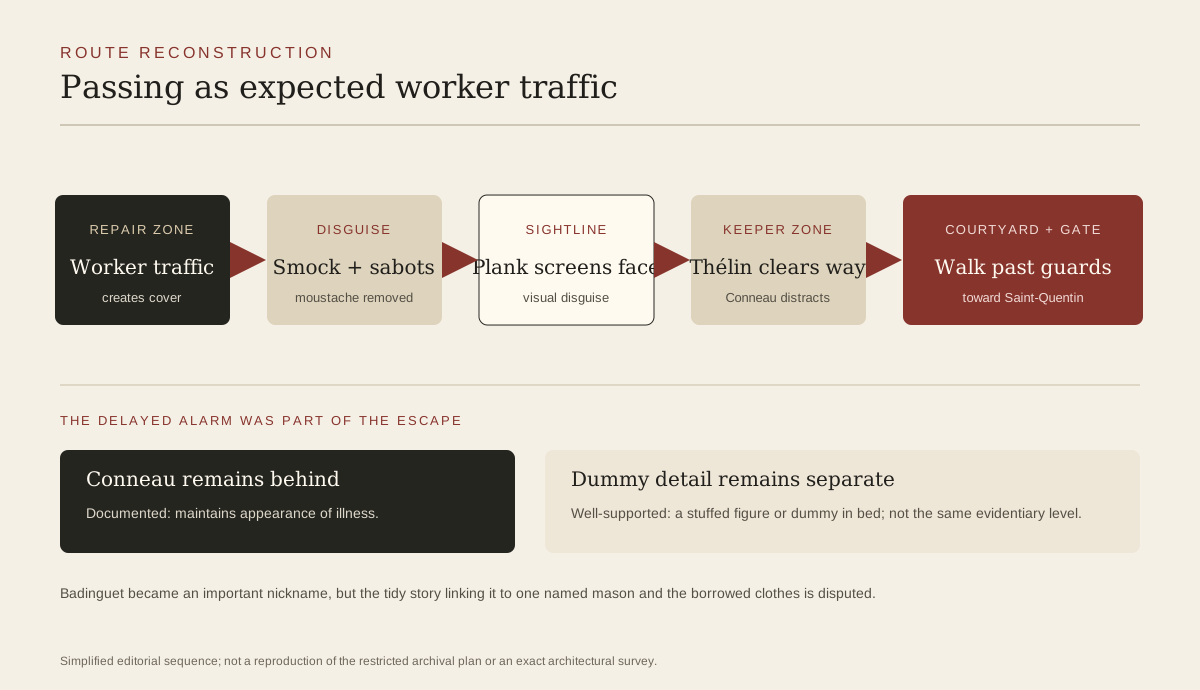
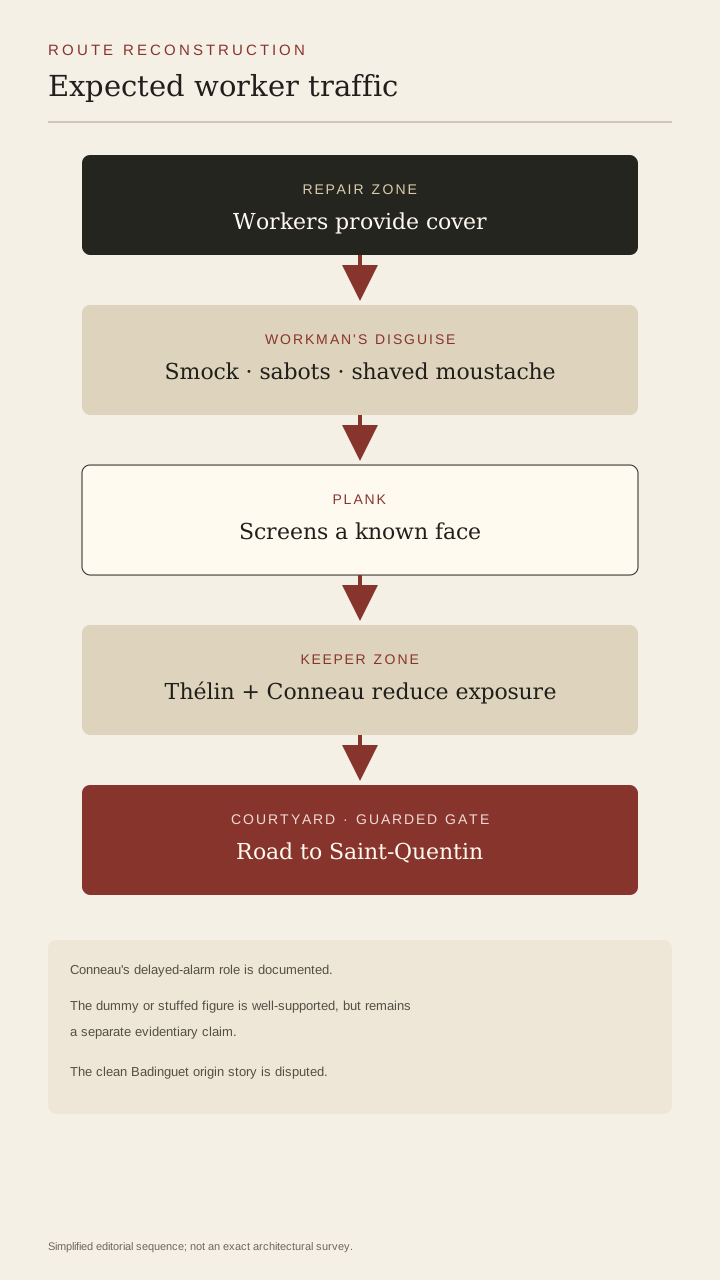
Route reconstruction
Walking out as a workman
Repairs created expected worker traffic. Clothing, sightline control and coordinated distractions allowed Louis-Napoléon to pass through guarded space.
- 01
Repair traffic
Workers moving through the fort made another workman less exceptional.
- 02
Disguise
Thélin obtained workman's clothing; Louis-Napoléon removed his moustache.
- 03
Plank
The plank screened a recognizable face while making the disguise legible.
- 04
Distractions
Thélin reduced exposure to workers and keepers while Conneau occupied another keeper.
- 05
Gate and delay
Louis-Napoléon crossed the courtyard and guarded gate; Conneau delayed discovery afterward.
Simplified editorial sequence; not an exact architectural survey.
Conneau’s Job Began After Louis-Napoléon Was Gone
Getting through the gate did not make Louis-Napoléon safe.
If the alarm went out immediately, mounted police, troops and local officials could begin searching the roads before he had travelled far from Ham. The escape therefore required a second deception inside the fortress.
Dr Henri Conneau stayed behind.
Louis-Napoléon’s own letter says Conneau made the authorities believe the prisoner was ill in order to give him time to reach the frontier. A same-year narrative by Frédéric Briffault adds a memorable detail: Conneau prepared a stuffed figure in the bed so that the room could appear occupied while he resisted attempts to disturb the supposedly sick prisoner.
Whether every later version of the dummy story preserves the exact sequence correctly is less important than the documented purpose of Conneau’s actions. He was buying time. The escape route outside Ham only worked if the fortress continued behaving as though its most important prisoner was still inside.
Problem → response
Escape was a sequence of problems
Each response solved a practical obstacle while often creating the next one.
- 01→
Obstacle
Known face
Guards and staff knew the appearance of the fortress's most important political prisoner.
Response
Louis-Napoléon shaved his moustache, dressed as a worker and used a plank to block direct views of his face.
- 02→
Obstacle
Real workmen could expose the disguise
Workers involved in the repairs were more likely than guards to notice an unfamiliar supposed colleague.
Response
Thélin took the workers drink and tried to keep them away from Louis-Napoléon's route.
- 03→
Obstacle
Keepers controlled the prisoner's immediate area
Louis-Napoléon had to pass personnel responsible for monitoring him before reaching the courtyard.
Response
Thélin engaged one keeper while Conneau occupied another.
- 04→
Obstacle
Guarded courtyard and gate
The escape required crossing the interior of the fortress and passing soldiers at the exit rather than slipping through an unguarded breach.
Response
Louis-Napoléon maintained the workman role and used the plank to limit facial recognition until the gate was opened.
From Ham to Saint-Quentin
Once outside, Louis-Napoléon moved quickly toward the road to Saint-Quentin.
Thélin had arranged a carriage in advance and later caught up with him. Louis-Napoléon’s own account says that he passed through Saint-Quentin on foot after removing the workman’s smock. Thélin then obtained a post-chaise under the pretext of travelling toward Cambrai.
The disguise that had been useful inside the fortress had now become a liability. There was no reason for a fugitive to remain dressed as a laborer once he had left the environment that made the costume plausible.
They continued to Valenciennes, where Louis-Napoléon took the railway. He carried a Belgian passport but later said that he was never asked to show it.
The border mattered more than any single gate at Ham. France was the country that had imprisoned him. Belgium offered the route out.
Institutional French histories state that Louis-Napoléon was in Belgium before the escape was fully discovered and that he reached England the following day. Fondation Napoléon dates his arrival in London to 27 May 1846, where he registered at the Brunswick Hotel as the Count of Arenenberg.
The life prisoner was free.
The Escape Did Not End the Problem With His Father
Freedom did not accomplish the personal objective Louis-Napoléon had emphasized in his account. He wanted to see his father.
From London he attempted to obtain the ability to travel to him, but Louis Bonaparte died at Livorno on 25 July 1846. The escape had freed Louis-Napoléon from Ham; it had not brought him to his father in time.
That outcome is useful because it strips away some of the retrospective triumph surrounding the story.
Later, it was easy to tell the escape as one more sign that Louis-Napoléon was destined for power. At the time, its immediate emotional purpose had failed.
Politically, however, his position had changed completely. He could write, organize, travel and wait outside a French prison. France would soon change around him.
Two Years Later, the Political Landscape Collapsed
In February 1848, revolution overthrew King Louis-Philippe and ended the July Monarchy. The political prisoner who had escaped Ham was suddenly a potential participant in a new republic.
Louis-Napoléon returned to French politics, won election to the National Assembly and then stood for president under the new constitution. On 10 December 1848 he won the presidency by an overwhelming vote.
Four years later, after the 1851 coup d’état and the creation of a new constitutional order, the empire was restored. On 2 December 1852, Louis-Napoléon became Napoleon III, Emperor of the French.
The title by which history remembers him came more than six years after Ham.
That distinction matters when reconstructing the escape. The man carrying the plank was not an emperor making a theatrical getaway. He was a defeated claimant who had already failed twice to seize power and had been sentenced to spend the rest of his life inside a fortress.
The outcome was not known in advance.

Was He Really “Badinguet”?
The nickname is one of the most persistent pieces of the Ham story. Napoleon III’s opponents later called him Badinguet, and popular retellings often explain that this was the name of the mason whose clothes he wore during the escape. The evidence is less tidy.
Histoire par l’image notes that it is uncertain whether Louis-Napoléon wore clothing prepared specifically for the escape or clothing borrowed from a worker named Pinguet. It then explains that caricaturists later transformed that name into “Badinguet,” a mocking label attached to the emperor as a reminder of the conspirator who had once fled prison in workman’s clothes.
Other modern sources still repeat the older version in which Badinguet was the worker himself. There is no need to force those traditions into agreement. The safest conclusion is that the nickname is historically real, but the neat story explaining exactly whose name and clothes Louis-Napoléon adopted is disputed. That is precisely the kind of distinction a reconstruction should preserve.
Evidence discipline
What the record supports
Status labels distinguish secure conclusions from uncertainty and rejected claims. Color is never the only signal.
DOCUMENTED
Louis-Napoléon escaped by disguising himself as a workman and carrying a plank to hide his face.
The mechanism appears in Louis-Napoléon's own published account and is confirmed by French institutional histories.
Sources: SRC-001, SRC-002, SRC-004DISPUTED
A mason named Badinguet lent Louis-Napoléon his clothes and identity.
Later tradition often gives this story, but Histoire par l’image says it is uncertain whether the clothing was a prepared disguise or clothing borrowed from a worker named Pinguet and explains that caricaturists later transformed the name into 'Badinguet'.
Sources: SRC-002, SRC-012DOCUMENTED
Dr Conneau stayed behind and pretended Louis-Napoléon was ill to delay discovery.
Louis-Napoléon's own published account explicitly credits Conneau with remaining inside and creating the impression that he was ill.
Sources: SRC-001WELL-SUPPORTED
Conneau used a dummy in Louis-Napoléon's bed.
Briffault's 1846 account describes a stuffed figure used to reinforce the illness deception, but this specific detail is not stated in Louis-Napoléon's own escape letter.
Sources: SRC-006DOCUMENTED
Louis-Napoléon escaped primarily because he wanted to see his elderly father.
His published letter states that the desire to see his father again motivated the attempt. The source establishes what Louis-Napoléon said about his motive, not an independently measurable hierarchy of all political and personal motives.
Sources: SRC-001What the Escape Actually Required
Remove the later imperial legend and the mechanism becomes clearer. Louis-Napoléon needed five things to work:
- A believable reason for an unfamiliar worker to be inside the fortress. Repairs supplied it.
- Clothing that matched that role. Thélin supplied it.
- A way to reduce facial recognition. The plank supplied it.
- Distractions at the most dangerous internal checkpoints. Thélin and Conneau supplied them.
- A delay before the alarm. Conneau supplied that as well.
The escape succeeded because the pieces supported one another.
The clothing without the repairs might have looked suspicious. The repairs without the clothing would have been useless. The disguise without the plank left his face exposed. Passing the gate without delaying discovery would have started the pursuit too early.
The story is often remembered as a clever costume escape. It was more accurately a sequence of controlled assumptions. Everyone who saw Louis-Napoléon had to decide, for only a few seconds, that the man in front of them was probably someone else. That was enough.
Selected chronology
Imprisonment, escape and political return
Boulogne attempt fails
Louis-Napoléon's second major attempt to seize power ends in arrest.
Life sentence
The Chamber of Peers condemns Louis-Napoléon to imprisonment for life in a fortress.
Return to Ham
After the trial, Louis-Napoléon is returned to the Fort of Ham to serve his sentence.
Writing at Ham
During his imprisonment Louis-Napoléon publishes De l’extinction du paupérisme, part of the political and social writing associated with his 'University of Ham' years.
Escape from Ham
Disguised as a workman and carrying a plank to obscure his face, Louis-Napoléon passes through the guarded fortress and escapes.
Arrival in London
Louis-Napoléon arrives in London and takes rooms at the Brunswick Hotel under the name Count of Arenenberg.
Death of Louis Bonaparte
Louis-Napoléon's father dies at Livorno before the escaped prisoner can reach him.
Elected president
Louis-Napoléon wins the presidential election of the Second Republic.
Napoleon III
Louis-Napoléon is proclaimed Emperor of the French as Napoleon III.