
On the afternoon of 1 July 1796, Mungo Park learned that men sent by Ali of Ludamar had arrived at Queira to take him back into closer custody. Park did not ride away that afternoon. He waited through the night, prepared his clothes around midnight and left at daybreak after his interpreter Johnson reported that the men were asleep.
That sequence makes the familiar date of 1 July difficult to sustain as the actual moment of escape. Park's own narrative points instead to the following morning—apparently 2 July 1796. What followed was not a clean dash to safety but several days of pursuit, robbery, thirst, concealment and deliberate misdirection before Park reached territory where he no longer expected Ali's people to return him.
At a Glance
- Initial seizure: 7 March 1796
- Arrived at Ali's camp at Benowm: 12 March
- Final escape: Daybreak, apparently 2 July 1796
- Starting point of final flight: Queira, in the historical kingdom of Ludamar
- Immediate method: Mounted flight after Ali's men fell asleep
- Navigation: Concealed pocket compass
- Immediate complication: Armed interception and robbery shortly after departure
- Short-term safety: Wawra, 5 July
- Reached Ségou on the Niger: 21 July
- Outcome: Successful escape from Ali's authority followed by continued overland travel
- Presentation note: Park's term "Moors" is a period label, not neutral modern ethnography
An expedition built around a European geographical question
Park had entered West Africa on a journey sponsored by the African Association, a British organization created during the Enlightenment-era expansion of European scientific travel. One of its central questions concerned the Niger: European geographers disagreed about the river's direction, connections and ultimate outlet.
The expedition therefore mixed curiosity with larger commercial and political interests. Modern historian Charlie Withers describes the late-eighteenth-century "Niger problem" as a European problem whose solution promised geographical knowledge and commercial opportunity while some sponsors also linked exploration to hopes of suppressing the slave trade.
None of that made the Niger unknown in West Africa. Communities, rulers, merchants and scholars lived beside it and moved through the commercial networks connected to it. Park himself repeatedly gathered geographical information from African informants before he ever saw the river.
The distinction matters. Park's later fame rested on what he published for European readers, not on being the first person to know that the Niger existed.
Entering Ludamar
By March 1796 Park was travelling east through a politically fragmented region in which access depended on rulers, guides, traders and local negotiations. On 7 March, near Samee, men sent by Ali arrived and ordered that Park accompany them. He did not describe the encounter as a voluntary visit. Concluding that resistance was impractical, he went with them.
The escorted party moved through several settlements over the next few days. On 12 March Park reached Benowm, where Ali was then encamped. This is the beginning of the captivity normally associated with the phrase "Moorish captivity."
What "Moorish captivity" means here
Park used the word "Moor" repeatedly for the Muslim ruling population of Ludamar. It was a European category with a long and imprecise history, and Park's own use of it was shaped by fear, religious difference and racial prejudice.
His narrative contains sweeping statements about physical appearance, character and supposed collective cruelty. Those passages tell us something important about Park's mental world and eighteenth-century European racial thinking, but they should not be treated as objective descriptions of an entire population.
A modern reconstruction can describe his captivity without inheriting his generalizations. Park was held under Ali's authority in Ludamar, and the people who watched, questioned, mocked, fed, robbed or assisted him were individuals acting in different circumstances.
The same narrative that expresses hostility toward broad groups also records acts of assistance by people within those groups. That inconsistency is a reason to read Park critically rather than flatten his text into either heroic testimony or worthless prejudice.
Benowm
At Benowm, Park's freedom of movement was sharply restricted and his possessions attracted attention. He was treated as an unusual and suspicious foreigner, and he feared that Ali regarded him as a possible spy.
Much of his equipment was taken or became impossible to use openly. One small compass survived because Park concealed it in the sand and later kept it hidden.
That compass would become one of the few pieces of expedition equipment that still mattered after the final escape. Park's physical confinement was real, but later summaries often oversimplify it. He was not locked in one building at Benowm for four uninterrupted months. He remained under Ali's authority for months while the ruler's camp and political circumstances changed.
Demba's freedom was also at stake
Park did not enter this captivity alone. One of his attendants was Demba, an African man who had been enslaved by Dr. Thomas Laidley, the British trader with whom Park had stayed before setting out inland. Laidley attached Demba to Park's expedition under a promise: if Park later reported that Demba had served faithfully, Demba would receive freedom.
Park's own narrative says Demba's service had earned that promised freedom. On 28 May, Ali took him.
Park wrote that Demba was sent back into slavery. He later tried to bargain for Demba's release, offering a written promise equivalent to the value of two enslaved people, but Ali refused while Park remained in his power.
Demba's fate complicates any account that treats Park simply as a freedom-seeking victim. Park was genuinely captive and afraid of permanent loss of liberty, but he was also moving through systems in which Demba had been assigned to him as enslaved labor and his promised freedom depended on decisions made by other men. A sensitive account has to hold both facts at once.
Selected chronology
Selected chronology
Seized under Ali's authority
Men sent by Ali intercepted Park near Samee and ordered him to accompany them.
Arrives at Benowm
Park reached Ali's camp and entered the strictest phase of his captivity.
Leaves Benowm with Ali's party
Park accompanied the movement toward Jarra; Fatima returned some clothing and his horse and saddle.
Demba seized
Ali took Park's attendant Demba, whom Park said had earned promised freedom, and sent him back into slavery.
Jarra
Park's constrained movement continued amid growing regional instability.
Queira
Park reached Queira and waited for travellers heading toward Bambarra.
Ali's men arrive
Johnson learned that the newly arrived men intended to take Park back.
Final flight begins
Park left Queira on horseback after Johnson confirmed that the escort was asleep.
Intercepted and robbed
Armed men overtook Park but took his property instead of returning him to Ali, allowing the flight to continue.
Still moving east-southeast
Park obtained food from a Foulah shepherd, paid with brass buttons and continued to hide from travellers.
Wawra reached
Park believed he was now beyond the immediate threat of return to Ali.
Ségou and the Niger
Park reached Ségou and personally observed the Niger flowing eastward, confirming information African informants had already given him.
Leaving Benowm did not mean becoming free
On 26 May, Park was allowed to accompany Ali's movement away from Benowm toward Jarra. Ali's wife Fatima returned some of Park's clothing along with his horse and saddle.
That change made his circumstances less physically restrictive, but he remained under Ali's power. Demba's seizure two days later demonstrated how little control Park had over the situation.
By early June Park was at Jarra. Regional conflict then began to destabilize the area. Populations moved, rulers shifted position and people fled the threat of war. The disorder weakened the practical ability to watch Park continuously, but it did not eliminate the danger that Ali could order him seized again.
Queira
On 28 June Park reached Queira with people fleeing the regional fighting. He remained there for two days, hoping to join travellers going toward Bambarra.
Then Ali's authority reappeared. On the afternoon of 1 July, Ali's chief slave and four other men arrived. Johnson, Park's interpreter, listened to their conversations and learned that they had been sent to take Park back.
For Park, the choice was no longer between waiting and travelling comfortably onward. He believed that returning to Ali could mean renewed detention and the loss of the limited opportunity created by the surrounding political disorder. He decided to leave before the escort could wake.
The date problem
Park's chronology is unusually specific but not perfectly labelled. He explicitly dates the arrival of Ali's men to the afternoon of 1 July. He says that around midnight he prepared his clothing for flight. Then, "about daybreak," Johnson told him that the men were asleep and the moment had come.
If those statements are read in ordinary sequence, daybreak falls on 2 July. Park's next dated entry is 4 July after a substantial period of post-escape travel, which fits the same reading.
This is why the strongest case date is not simply the often-repeated 1 July. The primary source supports daybreak, apparently 2 July 1796.
Johnson gives the signal
Johnson's role was small in duration but decisive. He had warned Park about the purpose of Ali's visitors. During the night he monitored the men and then, at daybreak, told Park that they were sleeping.
Park gathered a small bundle, mounted his horse and said goodbye. Johnson did not go with him. The escape from Queira became a solo flight almost immediately.
The assistance should be described precisely: Johnson provided warning and timing. Park's account does not support a larger organized escape network.
Caught almost at once
The first mile nearly ended the attempt. Park encountered a cattle camp. People shouted after him and shepherds pursued him, throwing stones. He continued on horseback, but three armed men caught him.
They told him he had to return to Ali. For a moment, Park believed the escape was over.
Then the encounter changed. The men took his cloak and other property and rode away rather than escorting him back.
Park concluded that they had used his vulnerability to rob him rather than acting as Ali's authorized captors. The distinction was fortunate for him. He had been stopped, but he had not been returned to custody. He turned east again.
A compass in his pocket
Park now had very little material protection. Money, trade goods and most expedition equipment were gone. His horse remained, as did the small compass he had preserved through captivity.
He used it to set an east-southeast course toward Bambarra. This was not a march along a mapped imperial road. Park was moving through political territories he only partly understood and deliberately avoiding some settlements because he feared identification or return to Ali.
His compass could provide direction. It could not provide water, food or safety.
Problem → response
Escape was a sequence of problems
Each response solved a practical obstacle while often creating the next one.
- 01→
Obstacle
Ali's continuing authority
Even after Park left Benowm, Ali retained the ability to order him seized and returned.
Response
Park waited for regional disorder and the sleeping escort at Queira to create an opening for flight.
- 02→
Obstacle
Immediate armed interception
Three armed men overtook Park soon after he left and claimed he must return to Ali.
Response
The men chose to rob him rather than escort him back, and Park resumed his eastward escape.
- 03→
Obstacle
Loss of equipment and money
Months of captivity and robbery left Park with very few resources.
Response
He relied on his horse, concealed compass, brass buttons and whatever food or water he could obtain locally.
- 04→
Obstacle
Severe dehydration
Avoiding settlements and crossing dry country left Park close to collapse from thirst.
Response
He collected rain in his clothes during a storm and later used frogs as a sign of nearby standing water.
- 05→
Obstacle
Risk of recognition in settlements
Villages could provide food but could also contain people willing to send Park back to Ali.
Response
At Shrilla, Park used a false northward departure, doubled into the woods and resumed his actual eastward course.
- 06→
Obstacle
Incomplete geographical knowledge
Park did not possess a modern route map and had to navigate political and physical geography he only partly understood.
Response
He used a compass, asked for local geographical information, joined travellers where useful and adjusted his route according to perceived political danger.
Thirst
The first days after Queira pushed Park close to physical collapse. He moved through dry country and became intensely thirsty. At one point he lay down in the sand believing death might be near.
The weather changed. A thunderstorm brought rain. Park spread clothing to collect water and drank by wringing or sucking moisture from the fabric. After dark he used flashes of lightning to see the compass.
The episode is one of the most memorable in the narrative because the solution was not an ingenious tool he had carried from Britain. It was rain, improvised collection and endurance.

Following frogs to water
Later Park approached a place where he believed he might find water but feared encountering people who would return him to Ali. He kept away.
Near daybreak he heard frogs. Following the sound led him toward muddy pools where he could drink and water the horse.
The sequence shows the changing nature of the escape. Once Park was outside direct custody, the greatest threat alternated between people and environment. Avoiding inhabited places protected him from seizure while simultaneously making food and water harder to obtain.
Documentary reconstruction
Captivity, flight and the return to the Gambia
A case-local visual focused on the spatial, mechanical or evidentiary relationship established by the surviving record.
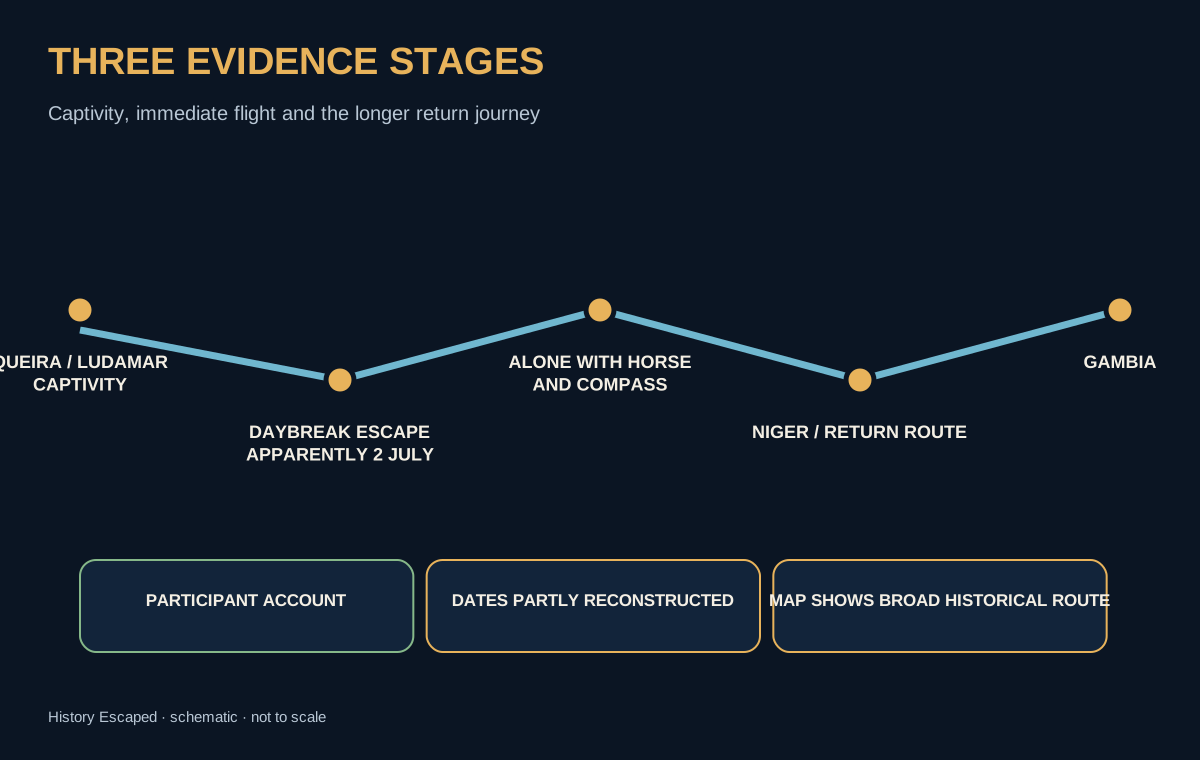
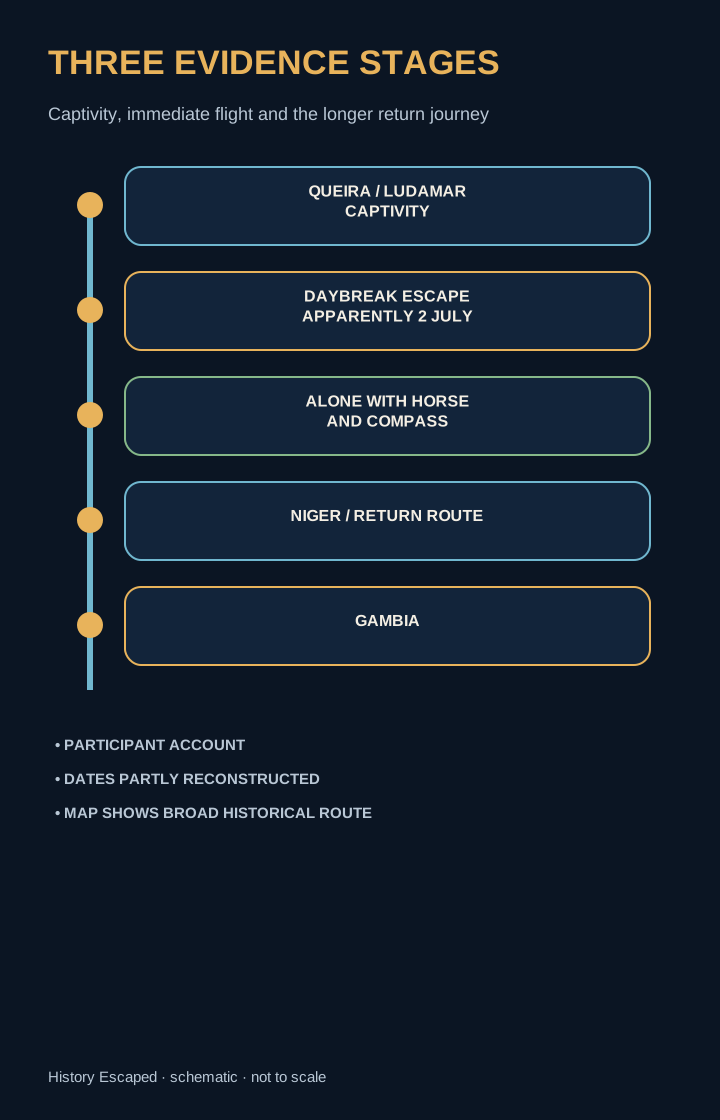
Simplified editorial reconstruction based on the cited historical record; not to scale. Uncertainty is stated directly in the visual and adjacent text.
Shrilla
Eventually Park entered Shrilla, a Foulah village that he understood to fall under Ali's authority. An older woman gave him food and provided corn for his horse. The assistance mattered because Park's resources were almost exhausted.
Then he overheard men discussing whether he should be sent back. He responded with deception rather than confrontation.
Park publicly took a road leading north, away from the direction he actually wanted. Once out of view, he moved into the woods, circled back and resumed his eastward course. This is one of the clearest deliberate evasion maneuvers in the narrative.
Assistance did not come from one side
The people Park encountered after his escape cannot be sorted neatly into captors and rescuers by ethnicity, religion or political affiliation. Some people connected to Ali threatened his liberty.
Others robbed him for their own purposes. An older woman in a village under Ali's authority fed him.
A Foulah shepherd later welcomed him and sold him corn. Further east, hosts and travellers provided food, information and temporary security.
That pattern undercuts Park's own broad hostile generalizations. His survival depended repeatedly on individuals drawn from the same wider societies he sometimes described collectively in deeply prejudicial terms.
4 July
Park's dated entry for 4 July places him still moving east-southeast. He encountered a Foulah shepherd who gave him food and accepted brass buttons in exchange for corn. Park also hid from travellers on the road because he remained afraid of being recognized or seized.
By this point the escape had lasted roughly two days if the departure is placed at daybreak on 2 July. That chronology is another reason the primary sequence fits 2 July better than 1 July.
Wawra
On 5 July, Park reached Wawra. He understood the settlement to belong politically to Kaarta but at that moment to be tributary to Mansong, ruler of Bambarra. More important to the escape, Park believed he had now reached a place where the people associated with Ali were unlikely to seize and return him.
Wawra is therefore a useful endpoint for the narrow captivity case. It was not the end of Park's expedition. It was the point at which the immediate escape from Ali's authority had effectively succeeded.
The final accounting
Outcome
Park escapes Ali's authority
The daybreak flight from Queira ultimately carried Park beyond the immediate danger of return to Ali by 5 July.
Demba loses promised freedom
Demba was seized by Ali on 28 May and sent back into slavery despite Park's statement that his faithful service had earned freedom.
Niger reached after escape
Park reached Ségou on 21 July and published his observation of the river's eastward flow for European readers.
Across Bambarra
Park continued east. His route passed through communities whose political relationships and spellings he recorded imperfectly through an eighteenth-century European ear. Modern maps can identify some places with confidence and others only approximately.
He received assistance, paid for food where he could and sometimes joined larger groups for protection. The journey remained dangerous, but the nature of the danger had changed. Park was no longer primarily evading men sent by Ali. His original expedition toward the Niger had resumed.
Ségou, 21 July
On the morning of 21 July 1796, Park reached Ségou and saw the Niger. The moment became the most famous scene in his book. For European geography, the observation that the river there flowed eastward was enormously important.
But even Park's own text prevents the modern reader from turning the scene into a simple "discovery." Before reaching Ségou, he had repeatedly asked African informants about the river. He had already been told that it flowed east.
His observation confirmed what local and regional knowledge had been telling him. What Park added was a published European travel account that carried that information into British geographical debate.
He did not discover the Niger
The wording matters because "discovery" can make existing African knowledge disappear. The Niger was part of West African settlement, trade, political authority and intellectual geography long before Park arrived. His patrons were trying to solve uncertainty inside European maps.
Park's historical importance lies in the way he observed, recorded and published information that changed European geographical understanding. That is significant without claiming that a Scottish visitor made the river exist in history.
Evidence discipline
What the record supports
Status labels distinguish secure conclusions from uncertainty and rejected claims. Color is never the only signal.
DISPUTED
Park's final escape took place on 1 July 1796.
Park dates the arrival of Ali's escort to the afternoon of 1 July, says he prepared around midnight and departed at daybreak. The primary sequence therefore points to the morning of 2 July, though many summaries compress the episode to 1 July.
Sources: SRC-001, SRC-002WELL-SUPPORTED
Daybreak on 2 July 1796 is the best-supported exact escape date.
It follows the ordinary chronological reading of Park's dated 1 July afternoon arrival, midnight preparation and daybreak departure, and is compatible with his next dated entries.
Sources: SRC-001, SRC-002MYTH
Park was physically imprisoned at Benowm continuously for four months.
He remained under Ali's authority for months, but left Benowm with Ali's moving party on 26 May and later stayed at Jarra and Queira.
Sources: SRC-001, SRC-003LATER CLAIM
Women of Ludamar organized Park's final breakout.
Women did materially assist Park at other stages—Fatima returned clothing and his horse, and a woman at Shrilla fed him—but the final Queira timing came from Johnson's warning and confirmation that Ali's men were asleep.
Sources: SRC-001MYTH
Park was recaptured immediately after leaving Queira.
Armed men intercepted him and said he must return to Ali, but they robbed him and left rather than taking him back into custody.
Sources: SRC-001DOCUMENTED
Park's concealed compass materially aided his overland escape.
Park states that he preserved a small compass during captivity and used it to steer east-southeast after the final flight.
Sources: SRC-001MYTH
Mungo Park discovered the Niger River.
The Niger was long known to West African communities and intellectual/commercial networks. Park himself obtained information from African informants before reaching it. His 1796 importance lay in observing and publishing its eastward flow for European geography.
Sources: SRC-001, SRC-003, SRC-007, SRC-008MYTH
Park's hostile generalizations about the people he called Moors can be used as neutral ethnographic description.
Modern literary and postcolonial scholarship analyzes Park's narrative as a culturally situated travel text shaped by race, embodiment and European assumptions; the hostile collective judgments are evidence of his perspective, not objective group descriptions.
Sources: SRC-005, SRC-006MYTH
Demba's freedom was unrelated to Park's captivity story.
Demba travelled as Park's attendant under a conditional freedom promise, was seized by Ali during the same captivity and was returned to slavery. His loss of liberty is structurally part of the episode.
Sources: SRC-001What Park's narrative can prove
Park's Travels in the Interior Districts of Africa appeared in 1799, three years after the events described here. He presented it as a journal drawn from notes made during the journey and preserved with great difficulty. It remains the controlling source for the captivity and escape because no comparable day-by-day record from Ali's camp survives in the source base used here.
That makes the narrative powerful and limited at the same time. It is strong for Park's movements, his perceptions, possessions and the sequence he remembered or recorded.
It is weak as an independent account of what other people intended. When Park says three men robbed him instead of returning him, we know his interpretation of their actions. When he generalizes about whole populations, we are reading the conclusions of one frightened eighteenth-century traveller, not a social survey.
Women did help him—but not in the way some summaries suggest
Later summaries sometimes imply that women in Ludamar directly organized Park's final escape. Park's own sequence is more specific.
Ali's wife Fatima earlier returned clothing and his horse when Park left Benowm. At Shrilla, after the escape, an older woman gave him food.
Those were meaningful acts of assistance. The final daybreak opportunity at Queira, however, came from Johnson's warning that Ali's men intended to take Park back and his confirmation that they were asleep. The history is stronger when those separate forms of assistance remain separate.
Why the escape worked
Political disorder created the opportunity. Park's movement from Benowm to Jarra and then Queira had already weakened the tight confinement of March. Regional warfare displaced communities and complicated Ali's ability to supervise him directly.
Johnson supplied timely information. The sleeping escort created the immediate opening.
The horse created distance. The compass supplied direction after Park left familiar routes.
Misdirection at Shrilla prevented a likely attempt to send him back. Rain, muddy pools and local food kept the flight physically possible. No single device explains the escape.
Freedom was not equally distributed
Park's successful flight can be reconstructed in detail because he survived, returned to Britain and published. Demba's story ends differently in the narrative.
He had been promised freedom for serving Park faithfully. Park believed he had earned it. Ali seized him anyway and sent him back into slavery.
That contrast belongs inside the escape story rather than in a footnote. Park was trying desperately to prevent his own captivity from becoming permanent while travelling with a man whose freedom had been conditional on the decisions of British and African powerholders alike.
The two stories do not cancel each other. Together they show why this case requires a sensitive rather than celebratory treatment.
An escape, then an expedition again
By 5 July Park had effectively escaped the immediate reach of Ali. By 21 July he had reached Ségou.
Those are different endpoints. Wawra completes the captivity-escape story.
Ségou completes the immediate return to the expedition's original purpose. Keeping that distinction prevents the Niger from swallowing the escape narrative and prevents the escape from being rewritten as a heroic prelude to European "discovery." The historically stronger story is more complicated: a captive traveller fled at daybreak, survived because of a compass, weather, deception and local help, and resumed a mission whose fame would later be shaped by the colonial geography of Europe as much as by the West African world through which he had travelled.