Mary Draper Ingles’s escape from Shawnee captivity in 1755 is one of the most famous survival stories associated with colonial Virginia. It is also a story whose details became more certain in popular memory than they are in the surviving evidence.
Mary left no known written account of her own. The first reports of her return appeared in colonial newspapers early in 1756, based on information carried from the New River settlements. The fullest narrative was written decades later by her son John Ingles, who had not yet been born in 1755 but said he had heard his parents repeat the story throughout his childhood. A second family tradition, written down by Letitia Preston Floyd in 1843, preserved different details. Nineteenth-century historians and later novelists gradually combined the traditions.
What remains secure is remarkable enough. Mary was taken captive in the July 1755 attack at Draper’s Meadow with her two young sons and other settlers. She was carried through the river country of the Ohio Valley, separated from her children, and put to work. In the autumn she and another captive woman left a hunting and salt-making camp near Big Bone Lick and attempted to follow the river system back toward Virginia. About forty to forty-two days later, Mary was back among New River settlers.
At a Glance
Captured: Draper’s Meadow, Virginia, 30 July 1755.
Captors: A Shawnee war party during the French and Indian War.
Children: Mary’s sons Thomas and George were taken with her and later separated from her.
Escape: October 1755, from the Big Bone Lick area, with an older German-speaking captive whose name is not securely known.
Return route: Broadly Ohio River → Kanawha River → New River.
Duration: Contemporary and family sources support roughly forty to forty-two days.
Distance: Several hundred miles; later estimates vary too widely for a single precise total.
Source warning: Most detailed scenes come from family narratives written decades after the event, not from Mary herself.
Draper’s Meadow, 30 July 1755
Draper’s Meadow lay near the site of present-day Blacksburg, Virginia. Euro-American families had established farms there as settlement pushed farther into the New River country.
That movement did not occur across vacant land. Shawnee and other Indigenous peoples used the Ohio and trans-Appalachian river systems as hunting grounds, travel corridors, diplomatic spaces, and places of settlement. By the early 1750s, Shawnee leaders were already resisting colonial claims to the Ohio Country and the idea that distant negotiators could dispose of Shawnee lands without Shawnee consent.
War intensified the conflict. Britain and France were fighting for power in North America, and Shawnee factions increasingly entered the struggle against British colonial settlement.
On 30 July 1755, a Shawnee war party attacked Draper’s Meadow. The raid killed several settlers, including Colonel James Patton, and carried away Mary Ingles, her two young sons, her sister-in-law Bettie Draper, and another settler.
Later accounts sometimes date the attack to 8 July. The stronger documentary chronology supports 30 July: contemporary reporting placed Patton’s death at the end of the month, and later source criticism has shown that the earlier date belongs to a different family tradition.
The raid was violent. Explaining its political setting does not erase that violence, just as describing the killings without the struggle over land and imperial war would erase the world in which the raid occurred.
Captivity Was Not One Status
Mary and the other captives were moved west through the river valleys.
John Ingles’s family narrative places the route down the New River, through the Kanawha system, and toward the Ohio before reaching a Shawnee community near the mouth of the Scioto. The exact daily route cannot be recovered, but that broad geography is consistent with later institutional histories.
Once there, the captives did not all experience the same fate.
Mary’s sons were separated from her and taken into Shawnee households. Captive adoption was an important part of Shawnee wartime practice. Some outsiders were incorporated into families and communities rather than held as prisoners in a European institutional sense. Other captives occupied harder and more coercive positions.
Mary worked. Her son’s account says she sewed shirts associated with French traders and received goods for some of that work. An early newspaper account says that she and another woman were assigned labor for a hunting party, including preparing food and working animal skins. Modern scholarship places Mary at Big Bone Lick helping produce salt while hunters used the surrounding country.
Those conditions were coercive even if they did not map neatly onto a prison cell or a single legal category.
For Mary, the decisive fact was separation from her children. John Ingles’s account says she initially resisted opportunities to leave because she still hoped the family might somehow remain together or be released together. By the time she was at Big Bone Lick, the sons were no longer with her.
Big Bone Lick
Big Bone Lick, in present-day Kentucky, was not an obscure point in an empty wilderness.
Salt licks attracted animals and people for thousands of years. Indigenous nations knew and used such places as hunting and resource centers long before Euro-American colonization. Historian Annabel LaBrecque has shown how inland salt sources structured travel, settlement, power, and economic life across the North American interior.
The Mary Ingles tradition fits into that larger history. Her captors did not simply carry her randomly westward. The movement toward a salt lick belonged to an established geography of hunting and resource use.
At Big Bone Lick, Mary encountered or worked alongside another female captive remembered in the Ingles family account as the “old Dutch woman.” In colonial usage, “Dutch” frequently meant German-speaking rather than a person from the Netherlands.
Her identity remains unresolved.
The National Park Service notes that she has sometimes been called Mrs. Stump. Other scholarship calls her Mrs. Bingamin or Bingaman. A documentary study of the early Bingaman families in the New River area concluded that the known family records do not support identifying Mary’s companion as a Bingaman woman.
The safest historical description is therefore the least satisfying one: she was an older German-speaking captive whose name has not been securely preserved.
Two Women Leave
The two women decided to go.
John Ingles’s account says they used permission to leave camp for gathering food as the opportunity to continue away. Later retellings give a precise departure around 19 October, but the stronger institutional evidence supports only October 1755.
Their most reliable guide was geography.
They knew that the great rivers along which the captives had traveled connected back toward Virginia. The broad return sequence is therefore usually reconstructed from the Ohio to the Kanawha and then into the New River system.
That does not mean the modern route can be drawn as a measured hiking trail. River bends have changed, later roads influence modern assumptions about travel, and the family narrative was written long after the journey. A schematic river sequence is historically defensible; a day-by-day GPS line is not.
Early newspaper reporting puts the journey at roughly forty days. John Ingles remembered his parents’ version as forty-two and a half days. That agreement is more useful than the disputed mileage.
Modern institutional estimates often describe a journey of roughly five or six hundred miles. Older family and popular histories have proposed much larger totals. The variation reflects the difference between straight-line distance, river following, reconstructed detours, and later attempts to turn memory into a precise itinerary.
Hunger and Separation
The women’s condition deteriorated as they moved east.
Here the story enters territory that is both dramatic and unusually difficult to narrate responsibly. Starvation dominates the later family accounts, but an early 1756 newspaper report also preserves the allegation that Mary’s companion eventually attacked her and was thought to intend to eat her.
That makes the basic conflict much earlier than the nineteenth-century legend.
What should not be imported without qualification is the expanded version. Letitia Preston Floyd’s 1843 family narrative says the women drew lots to determine which would be eaten. That scene is not established by the earlier evidence and belongs to a later layer of the story.
John Ingles’s version describes increasing hostility and a final break between the women. Mary then continued alone.
The other woman did not simply disappear from history. The Ingles family tradition says Mary later asked that people search for her companion, and that the woman was found alive and brought toward safety.
The episode therefore should not be reduced to a simple villain role for an unnamed starving woman. Both captives were trying to survive after prolonged coercion and deprivation, and both ultimately returned.
The Last Part of the New River
Mary’s final approach to the New River settlements is best understood through the same combination of geography and family recollection.
John Ingles says she found a canoe and crossed part of the river system before continuing toward places she recognized. Modern institutional summaries repeat the canoe episode, although exact crossings differ among route reconstructions.
Eventually she reached the vicinity of Adam Harman’s improvement or hunting cabin along the New River. Harman and his family belonged to the same thin network of Euro-American settlement from which Mary had been taken.
The exact calendar day is less certain than later commemorations sometimes suggest. Sources support a return in late November or around the beginning of December 1755.
By then news of the journey spread rapidly.
Colonial newspapers reported that two women had returned after Shawnee captivity and that their journey had taken around forty days. That contemporary notice is crucial because it confirms the central event before the story had passed through generations of family memory.
The Baby Story
One of the most famous details of Mary Ingles’s captivity is also one of the least secure.
The Preston family tradition recorded by Letitia Floyd says Mary was pregnant when captured, later gave birth to a daughter, and left the infant behind when she escaped. Versions of that episode became common in later retellings.
John Ingles does not mention such a child in his detailed account based on his parents’ stories.
Historian Ellen Apperson Brown has also pointed out a chronological problem. Floyd’s stated sequence places childbirth three months after capture and escape another three months after that, which would put Mary’s return in 1756. Contemporary evidence places her back in Virginia by late 1755.
Silence does not prove there was no pregnancy, and it is possible that painful family experience went unrecorded. But the abandoned-infant story cannot responsibly be narrated as established fact.
It is a later claim. The distinction matters because some of the most emotionally powerful elements of the modern Mary Ingles story are exactly the elements most dependent on nineteenth-century family tradition.
Her Sons
Mary returned without Thomas and George.
Later histories generally conclude that George died during captivity. Thomas remained for years in Shawnee society and eventually returned to his Virginia family as a teenager.
His experience complicates the language of captivity.
A child taken by force could also be raised within a Shawnee family, learn the language, and become culturally integrated. Later British and colonial demands for the “return” of captives sometimes broke families that had existed for years. Historian Ian K. Steele has shown that some former captives resisted return or went back to Indigenous families after colonial authorities tried to restore them to white relatives.
Thomas’s eventual return therefore belongs to a larger history of coercion, adoption, kinship, and cultural change. It does not transform the original seizure from Draper’s Meadow into a voluntary event. It does show why “prisoner” alone is too narrow a description of what wartime captive-taking could become.
What Mary’s Story Can Actually Prove
The hardest part of reconstructing Mary Draper Ingles’s escape is not deciding whether it happened. Contemporary reporting establishes that women returned from Shawnee captivity after a long journey, and the Ingles family preserved a detailed account that fits the broad geography.
The problem is deciding how much precision the evidence can carry.
The attack belongs on 30 July 1755, not the often-repeated 8 July. The escape belongs in October, but not securely on a single day. The return journey took about forty to forty-two days, but no exact mileage should be treated as settled. Mary escaped with another woman, but that woman’s name is unknown. A late-journey violent conflict appears in contemporary reporting, but the drawing-lots story is later. The abandoned-baby episode is later still and conflicts with the chronology.
Even the term wilderness needs qualification. Mary crossed country that was unfamiliar to her as a settler far from home, but it was not unknown land. The rivers and salt licks belonged to Indigenous geographies long before the Draper family arrived in the New River Valley.
The strongest version of the story is therefore not the most detailed one.
Mary was seized in a wartime raid, separated from her children, and compelled to work. In October 1755 she and another captive woman left the Big Bone Lick area and followed connected river systems east. Hunger eventually separated them. Mary continued through the New River country and reached the settler network from which she had been taken. Her companion survived too.
That is a documented historical core surrounded by layers of memory. Preserving the difference between the two makes the escape more credible, not less remarkable.
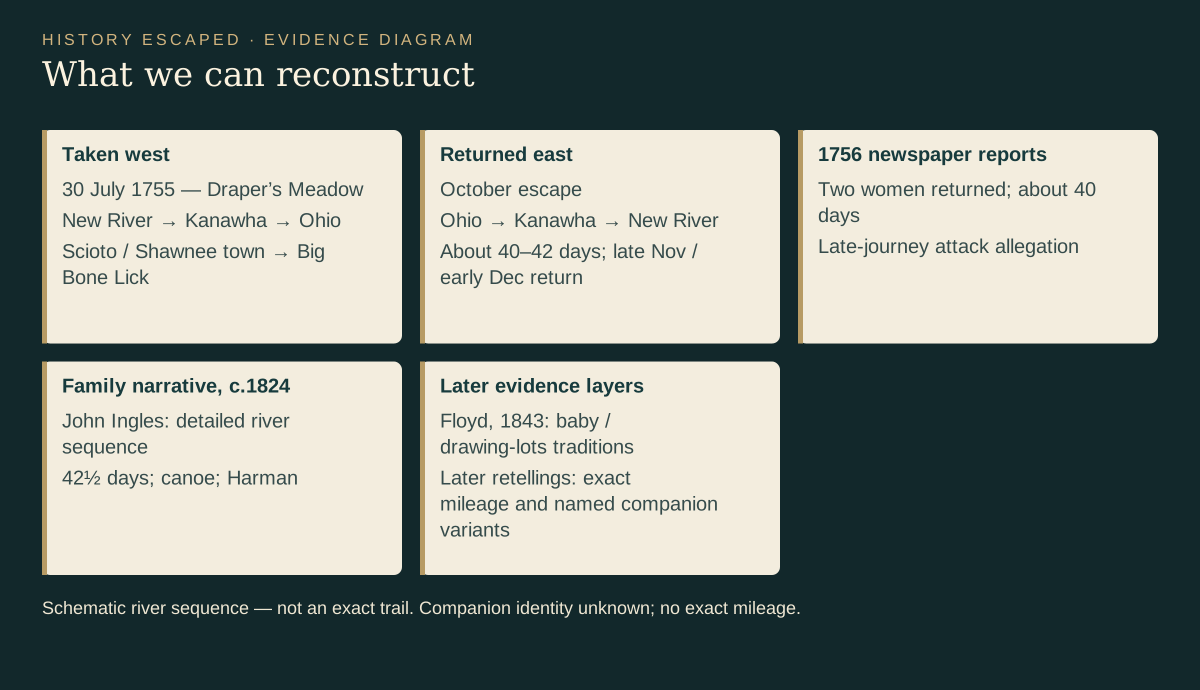
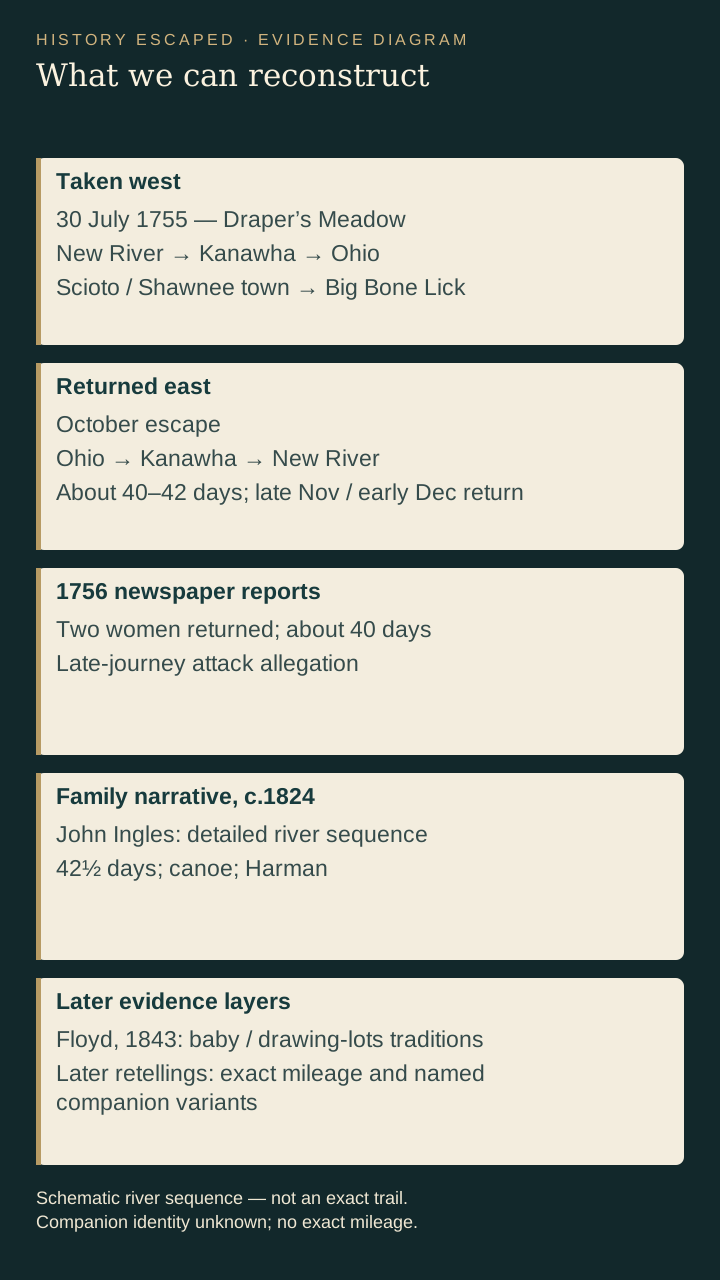
Evidence diagram
What we can reconstruct
Schematic river sequence — not an exact trail. Companion identity unknown; no exact mileage.
- 01
Leave the Big Bone Lick party
In October 1755, Mary and an older German-speaking captive used an opportunity away from close supervision to leave the hunting and salt-making party. WELL-SUPPORTED. Sources: SRC-001, SRC-002, SRC-006, SRC-008.
- 02
Follow the Ohio eastward
The women used the river system as their principal geographic guide rather than attempting a direct cross-country route. WELL-SUPPORTED. Sources: SRC-001, SRC-002, SRC-006.
- 03
Turn into the Kanawha and New River system
The broad family and institutional reconstruction follows the Ohio to the Kanawha and then the New River toward the settlements from which Mary had been taken. WELL-SUPPORTED. Sources: SRC-002, SRC-006, SRC-007.
- 04
Separate after severe hunger
Early newspaper reporting and the Ingles family tradition both preserve a violent late-journey conflict after which Mary continued alone. WELL-SUPPORTED. Sources: SRC-001, SRC-002.
- 05
Cross the river and reach known settlement
The family tradition says Mary used a found canoe during the final approach and eventually reached the vicinity of Adam Harman’s New River improvement. WELL-SUPPORTED. Sources: SRC-002, SRC-006, SRC-007.
- 06
Recover the companion
According to the Ingles tradition, Mary asked settlers to search for the older woman after reaching safety; the companion also survived. WELL-SUPPORTED. Sources: SRC-001, SRC-002.
Schematic river sequence — not an exact trail. Companion identity unknown; no exact mileage.
Problem → response
Escape was a sequence of problems
Each response solved a practical obstacle while often creating the next one.
- 01→
Obstacle
Separation from her children
Mary’s sons had been removed from her and taken into Shawnee households before her escape.
Response
Mary eventually chose to leave captivity without them after the possibility of remaining together had disappeared.
- 02→
Obstacle
Uncertain geography
Mary was far from the New River settlements and lacked a precise mapped route home.
Response
The escape relied on connected river systems as geographic guides.
- 03→
Obstacle
Food scarcity and physical exhaustion
Early and later sources agree that the women faced severe hunger during a journey lasting about forty days.
Response
They foraged while continuing along the river corridors; eventually the two separated and Mary continued alone.
- 04→
Obstacle
Uncertain final crossing
The New River still separated Mary from familiar settlement areas near the end of the journey.
Response
The family tradition says she found and used a canoe before reaching the vicinity of Adam Harman’s settlement.
The final accounting
Outcome
Women who escaped together
Mary and an unidentified older German-speaking captive left the Big Bone Lick area together.
Women who ultimately survived the return
Mary reached the New River settlements first; family tradition says her companion was subsequently located alive.
Mary’s captured sons who returned with her
Mary escaped after her sons had been separated from her. Thomas returned years later; George did not.
Selected chronology
Selected chronology
Draper’s Meadow attacked
A Shawnee war party killed several settlers and carried Mary, her sons, Bettie Draper, and another settler away as captives.
Captives move toward the Ohio
The detailed family tradition places the party’s route along the New River and Kanawha toward the Ohio and a Shawnee town near the Scioto.
Mary separated from her sons
Thomas and George were taken into Shawnee households while Mary remained in a different captive/laboring status.
Mary reaches Big Bone Lick and escapes
Mary and another female captive left a hunting/salt-making party in the Big Bone Lick area.
The women follow the river system east
Their broad route followed the Ohio, Kanawha, and New River systems; exact daily locations are not secure.
Mary reaches the New River settlements
After separating from her companion, Mary returned to the settler network in the New River Valley; some later sources place the final arrival around 1 December.
Ingles Ferry established
William and Mary Ingles later settled along the New River near present-day Radford, where the family developed a ferry operation.
Evidence discipline
What the record supports
Status labels distinguish secure conclusions from uncertainty and rejected claims. Color is never the only signal.
MYTH
The Draper’s Meadow attack occurred on 8 July 1755.
The 8 July date comes from later family tradition. Documentary and modern source-critical work supports 30 July 1755.
Sources: SRC-004, SRC-005, SRC-007UNKNOWN
Mary’s escape companion was definitely Mrs. Bingaman or Mrs. Stump.
John Ingles knew her only as the 'old Dutch woman.' Later sources propose Stump or Bingaman/Bingamin, but the Bingaman family evidence does not support a secure identification.
Sources: SRC-002, SRC-006, SRC-010UNKNOWN
Mary began the escape on exactly 19 October 1755.
Modern public histories sometimes give this date, but the stronger source set securely establishes only an October escape.
Sources: SRC-001, SRC-002, SRC-006DISPUTED
The return journey was exactly 800 miles.
Mileage estimates range from roughly 500–600 miles in modern institutional summaries to 700–900 or around 800 in older family and public-history traditions. Route uncertainty prevents a single exact number.
Sources: SRC-002, SRC-006, SRC-007WELL-SUPPORTED
The journey lasted about forty to forty-two days.
Early newspaper reporting gives about forty days and the John Ingles family narrative gives forty-two and a half.
Sources: SRC-001, SRC-002WELL-SUPPORTED
The companion tried to kill Mary after prolonged starvation.
An early 1756 newspaper report already contained this allegation, and the Ingles family narrative preserves a related version. Exact motive and sequence remain reported testimony rather than direct first-person documentation.
Sources: SRC-001, SRC-002LATER CLAIM
Mary and her companion drew lots to decide who would be eaten.
The dramatic drawing-lots episode appears in the later Preston/Floyd tradition and is not established by the earlier newspaper evidence or John Ingles’s account.
Sources: SRC-003, SRC-004LATER CLAIM
Mary gave birth during captivity and abandoned the infant when escaping.
The story appears in the Preston/Floyd tradition and later retellings but is absent from John Ingles’s detailed account. Floyd’s stated timing also conflicts with contemporary evidence that Mary returned in late 1755.
Sources: SRC-003, SRC-004MYTH
Shawnee captivity was simply incarceration equivalent to a colonial jail.
Shawnee captive-taking could include adoption and incorporation into families as well as coercive labor and other statuses. Mary’s own family experienced more than one captive status.
Sources: SRC-009