
Between 1576 and 1579, Miguel de Cervantes became involved in four major attempts to escape captivity in Algiers. The plans were not four versions of the same breakout: one tried the overland road toward Oran, one depended on a hidden coastal group and a rescue vessel, one tried to bring trusted guides from Oran, and one prepared a frigate for a large maritime escape. All failed.
At a Glance
- Period: 1576–1579
- Place: Ottoman Algiers and routes toward Oran
- Escapee: Miguel de Cervantes, usually with other Christian captives
- Captivity type: Captivity for ransom / enslavement after corsair capture
- Main methods: Overland flight, coastal concealment, outside rescue contacts, maritime extraction
- Outcome: Four major attempts failed; Cervantes was ransomed on 19 September 1580
Captured on the way home
Cervantes’s captivity began on 26 September 1575. He and his brother Rodrigo were sailing toward Spain aboard the Sol when corsairs operating from Algiers captured the vessel and carried prisoners to the city. Letters of recommendation found with Cervantes led his captors to regard him as a man from whom a substantial ransom might be obtained.
Algiers was then an Ottoman-ruled Mediterranean port where warfare, commerce, privateering, ransom and enslavement overlapped. Christian captives could be held for labor, exchange or ransom, and their conditions depended heavily on owner, status and expected value. Cervantes’s later testimony describes chains and close confinement after failed escape activity, but his five-year captivity cannot be reduced to one fixed prison setting.
The main evidence for the escape sequence is unusually strong. In October 1580, shortly after his ransom, Cervantes requested what is now called the Información de Argel: a notarized inquiry in which fellow captives testified about his conduct and sufferings. Because Cervantes wanted the record for possible use before royal authorities, it is both near-contemporary evidence and an interested document designed to protect his reputation.
Selected chronology
Selected chronology
Cervantes is captured
Corsairs seize the Sol and carry Cervantes and Rodrigo to Algiers.
First escape attempt
The overland attempt toward Oran fails when the guide abandons the group.
Cave plan exposed
The hidden captives are seized after the maritime pickup fails and the cave is revealed.
Oran messenger plan fails
The messenger carrying Cervantes’s letters is intercepted and the rescue plan collapses.
Mass frigate plan exposed
The large maritime conspiracy is disclosed before embarkation.
Cervantes is ransomed
Juan Gil completes the ransom and secures Cervantes’s freedom.
Información de Argel is taken
Cervantes requests sworn testimony about his captivity and conduct.
First attempt, 1576: the road toward Oran
The first plan was an overland flight. Cervantes found a local guide who was supposed to lead him and other Christian captives toward Oran, the Spanish-held city far to the west.
The 1580 testimony says the group traveled for several days before the guide abandoned them. Without someone who knew the route, water sources and terrain, continuing became impractical. They returned to Algiers, where Cervantes was held more closely and with heavier restraints.
The Biblioteca Nacional de España places this first attempt in early 1576. The precise day is not preserved in the testimony, so the important point is the mechanism: the plan failed because the fugitives lost the person on whom their route depended.
Second attempt, 1577: the cave and the missing pickup
The second attempt was more elaborate and created the episode now associated with the “Cervantes cave.” By 1577 Cervantes’s family had sent money toward ransom, but not enough to meet the price demanded for Miguel. His brother Rodrigo was ransomed instead.
According to the Información, Miguel instructed Rodrigo to organize a vessel from Valencia, Mallorca or Ibiza that could return to the Algerian coast. Fourteen captives were hidden in a cave outside Algiers. Some remained there for five or six months, supported by a clandestine provisioning network; Cervantes himself entered only shortly before the expected pickup.
A rescue vessel did reach the coast, but the landing was not completed. The testimony says the sailors lost their nerve and withdrew. The fugitives remained concealed, still hoping another opportunity would come.
On 30 September 1577 the hiding place was exposed. The Información identifies a collaborator known as El Dorador as the informer. Armed men seized Cervantes and companions, and witnesses said Cervantes tried to take responsibility rather than identify those who had helped.
That last detail became central to the heroic image of Cervantes. Several witnesses do support it, but the proceeding was created at Cervantes’s own request and framed around his honorable conduct. It establishes that contemporaries made the claim; it is not a neutral transcript of the governor’s interrogation.
The modern Gruta de Cervantes in Algiers is connected to this second attempt, but its commemorative identification is much later. The BNE records nineteenth-century investigation and formal marking of the site. The cave is therefore valuable historical landscape and memory, not proof that every modern feature reproduces the 1577 setting.
Problem → response
Escape was a sequence of problems
Each response solved a practical obstacle while often creating the next one.
- 01→
Obstacle
Dependence on overland guides
Reaching Oran required local route knowledge.
Response
After the 1576 guide deserted, Cervantes later tried to summon trusted help from Oran itself.
- 02→
Obstacle
Dependence on a maritime pickup
The 1577 group could hide near the coast but could not leave without a vessel.
Response
Rodrigo organized a ship, but the landing failed and the hidden group remained vulnerable.
- 03→
Obstacle
Exposure risk in a large conspiracy
The 1579 plan involved many captives and civilian/maritime collaborators.
Response
Preparations were kept secret, but the plan was disclosed before departure.
- 04→
Obstacle
High ransom value
Letters of recommendation encouraged captors to expect a substantial ransom for Cervantes.
Response
Repeated attempts failed; ransom negotiated by Juan Gil ultimately ended the captivity.
Third attempt, 1578: bring help from Oran
After the cave failure, Cervantes was held under tighter control by Hasan Pasha. His next plan tried to solve the guide problem before the prisoners moved.
Cervantes sent a Muslim messenger toward Oran carrying letters to Martín de Córdoba and other contacts. The letters asked for reliable agents or guides who could come to Algiers and lead Cervantes and several companions out.
The messenger was captured near Oran and returned to Algiers. The surviving testimony says he was executed after the letters exposed the plan. Hasan Pasha ordered Cervantes to receive 2,000 blows.
The same witnesses state that the punishment was not carried out because intermediaries intervened. That distinction matters: “2,000 blows” was a sentence attributed to Hasan Pasha, not a punishment that the evidence says Cervantes actually endured.
The BNE chronology places the episode in 1578. The plan shows Cervantes adapting after his first failure: instead of trusting an unknown guide already in Algiers, he tried to bring trusted assistance from Spanish-held Oran.

Documentary reconstruction
Four attempts, four failure points
A case-local visual focused on the spatial, mechanical or evidentiary relationship established by the surviving record.
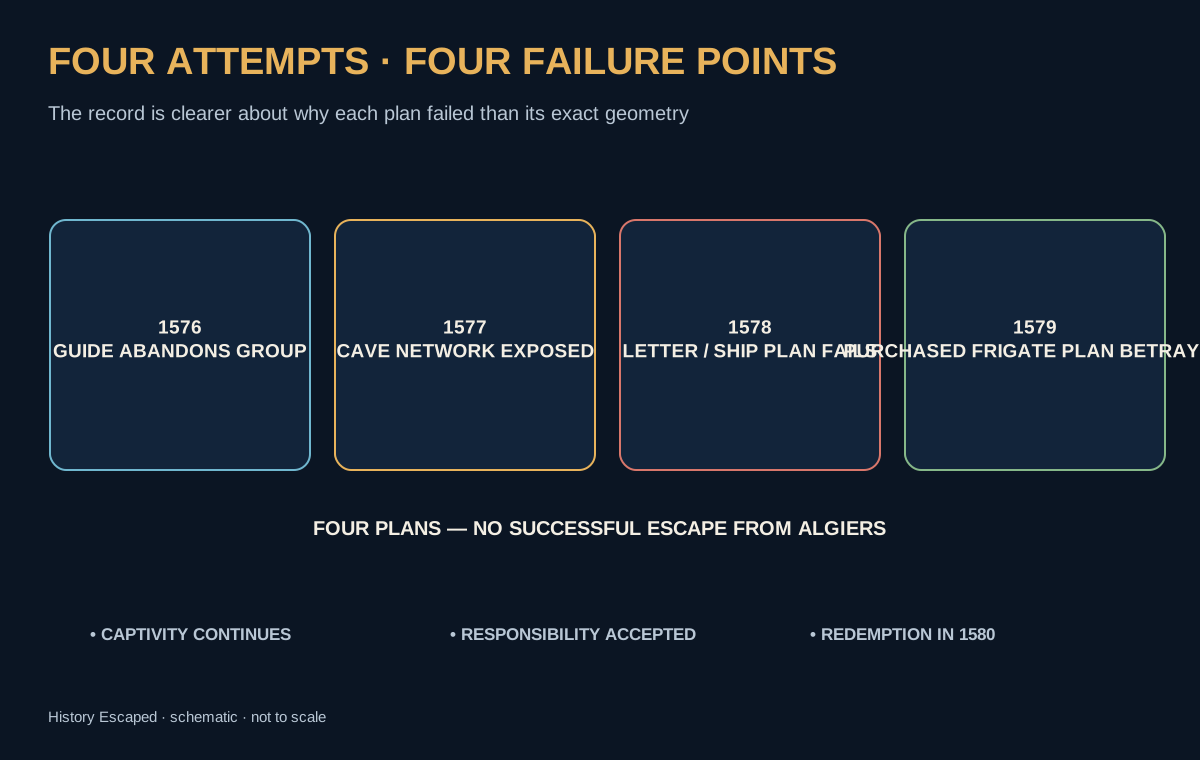
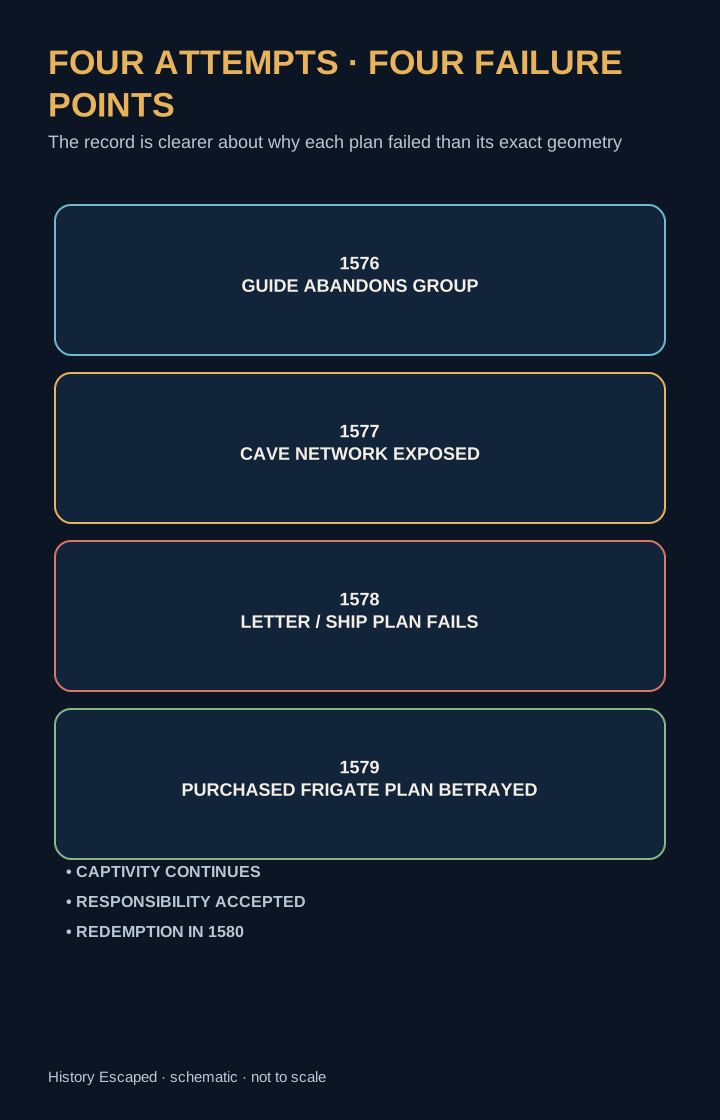
Simplified editorial reconstruction based on the cited historical record; not to scale. Uncertainty is stated directly in the visual and adjacent text.
Fourth attempt, 1579: a mass maritime escape
The final plan was the largest. The Información says Cervantes worked with a Spanish-born renegade known before conversion as Licenciado Girón and afterward as Abd al-Rahman. A Valencian merchant, Onofre Exarque, financed the purchase and preparation of a twelve-bench frigate.
Cervantes then quietly alerted a large group of captives. His interrogatory speaks of about sixty people, while witnesses describe more than sixty prospective participants. The intended passengers included soldiers, clergy and other captives regarded by the witnesses as prominent members of the Christian captive community.
This was not the cave plan repeated two years later. The primary record clearly separates the 1577 cave-and-rescue-vessel operation from the 1579 purchased-frigate conspiracy. Some modern summaries blur the two, but the 1580 testimony is explicit enough to keep them apart.
The 1579 plan was exposed before departure. The Información says a Florentine renegade informed Hasan Pasha and that Juan Blanco de Paz, a Spanish cleric held captive in Algiers, confirmed the plot and identified Cervantes as its organizer.
The allegation against Blanco requires caution. Cervantes’s inquiry includes a long, openly hostile series of questions about him, and Cervantes was trying to protect his own reputation before returning to Spain. Multiple witnesses do repeat the claim that Blanco revealed the conspiracy, making the disclosure well supported; the broader attacks on Blanco’s character are much less useful as neutral history.
The final accounting
Outcome
1576 attempt fails
The group returns after its guide abandons the route to Oran.
1577 cave rescue fails
The ship does not complete the pickup and the group is later exposed.
1578 Oran-contact plan fails
The messenger is captured and Cervantes remains captive.
1579 mass escape fails
The frigate conspiracy is discovered before embarkation.
Freedom by ransom
Juan Gil secures Cervantes’s release on 19 September 1580.
Giving himself up
When the fourth plan collapsed, witnesses said Cervantes feared that other captives and civilian helpers would be interrogated and exposed. The Información says he voluntarily presented himself to Hasan Pasha and tried to contain responsibility.
He was imprisoned in chains for months. By this point repeated escape activity had made him a conspicuous security problem as well as a valuable ransom captive.
Why Hasan did not execute him has attracted later speculation. The documentary record already supplies less dramatic constraints: Cervantes was valuable for ransom, intermediaries had previously succeeded in reducing punishment, and the evidence about his conduct comes largely from people seeking to present him as honorable and courageous. Claims that his survival proves a secret intimate relationship with Hasan remain speculation, not established history.
Four attempts, four different failure points
Calling these “four escape attempts” is useful as long as it does not imply four identical breakouts. In 1576 Cervantes and companions had physically started an overland flight. In 1577 captives reached a hidden coastal position but the vessel failed to complete the pickup and the cave was later betrayed.
The 1578 plan failed earlier in the chain: the messenger seeking rescue help was intercepted before Cervantes could leave. The 1579 mass plan failed earlier still, when a large conspiracy was exposed before embarkation.
The common problem was therefore not a single wall or gate. Cervantes repeatedly tried to connect prisoners inside Algiers with a viable route to Spanish territory, and each attempt broke at a different link: guide, pickup, communication or secrecy.
Evidence discipline
What the record supports
Status labels distinguish secure conclusions from uncertainty and rejected claims. Color is never the only signal.
DOCUMENTED
Cervantes made four major escape attempts during his Algiers captivity.
The 1580 inquiry distinguishes four schemes, and institutional chronologies broadly agree.
Sources: SRC-001, SRC-003, SRC-006DOCUMENTED
The famous cave episode belonged to the 1577 second attempt.
The primary inquiry places fourteen captives in the cave while Rodrigo arranged a rescue vessel in 1577.
Sources: SRC-001, SRC-007MYTH
The cave concealment was part of the 1579 fourth attempt.
Some modern summaries conflate the two; the primary record separates the 1577 cave plan from the 1579 purchased-frigate scheme.
Sources: SRC-001, SRC-003, SRC-007MYTH
Cervantes actually received 2,000 blows in 1578.
Witnesses say the punishment was ordered but not carried out because intermediaries intervened.
Sources: SRC-001WELL-SUPPORTED
Juan Blanco de Paz betrayed the 1579 plan.
Several witnesses identify him as confirming the plot, but the Información was initiated by Cervantes and is openly hostile to Blanco; the betrayal claim is stronger than its broader attacks on his character.
Sources: SRC-001, SRC-002UNKNOWN
Cervantes’s survival proves a secret intimate relationship with Hasan Pasha.
The secure documentary record does not establish such a relationship; ransom value and intervention by third parties are documented factors.
Sources: SRC-001, SRC-006UNKNOWN
The modern Cervantes cave is an exactly verified, unchanged 1577 site.
It is a longstanding commemorative site, but BNE records formal nineteenth-century identification and commemoration.
Sources: SRC-007, SRC-011How much can the 1580 testimony prove?
The Información de Argel deserves considerable weight. Spain’s PARES archival portal confirms the surviving dossier, and the testimony was taken in Algiers before Trinitarian redeemer Juan Gil and notary Pedro de Rivera only weeks after Cervantes’s ransom.
It also had a purpose. Cervantes explicitly asked for testimony about his captivity, conduct and services that he could later present if necessary. Modern scholarship notes that such records could protect a returned captive’s honor and reputation.
That does not make the escape stories invented. It means repeated events corroborated by several named witnesses are stronger than praise of Cervantes’s character or accusations against personal enemies.
Antonio de Sosa’s near-contemporary account of Algiers provides another stream of evidence, particularly for the cave episode and the world of captivity. The BNE also notes that Sosa’s work had a polemical purpose: it sought to move readers on behalf of Christian captives and encourage action in the Mediterranean.
The documentary Cervantes is impressive without hagiography. He repeatedly organized or joined escape projects, took serious risks and, according to several fellow captives, tried to protect collaborators when plans failed.
Freedom came by ransom
None of the four attempts freed Cervantes. His family continued trying to assemble the price demanded for him while religious redemption orders worked to release captives.
In 1580 the Trinitarian redeemers Juan Gil and Antón de la Bella arrived in Algiers. The surviving redemption record highlighted by the BNE documents the last effort to secure Cervantes while Hasan Pasha was preparing to leave for Constantinople.
On 19 September 1580 Juan Gil obtained Cervantes’s release for 500 gold escudos. Cervantes stayed in Algiers long enough to commission the Información de Argel and then sailed back toward Spain in October.
The ending prevents a falsely triumphant escape narrative. Cervantes never perfected one of his four plans; his captivity ended through ransom. The attempts remain historically important because they show repeated adaptation across land, coast, courier networks and maritime planning—and because unusually rich testimony allows the failures themselves to be reconstructed.