
At a Glance
- Date: c. 5th century
- Starting point: Somewhere in Ireland; exact place unknown
- Escapee: Patrick, later known as Saint Patrick
- Captivity type: Enslavement after overseas raiding
- Duration of enslavement: Six years, according to Patrick
- Main method: Flight overland to an unknown port, followed by sea passage
- Outcome: Escaped enslavement and eventually returned to his family in Britain
Saint Patrick's escape is famous partly because so much has been added to it. Modern retellings can give him a mountain in Ireland, a named master, a road across the island, a port, a ship type, a landing point, and a direct journey home. Patrick himself gives far less—and that is precisely why his account is so valuable.
In the Confessio, written late in his life, Patrick says that he had been taken from Britain at about sixteen, carried to Ireland with other captives, and enslaved for six years. He tended livestock. Then, after what he understood as divine messages that he would return home and that a ship was waiting, he fled the person who held him and began a long journey toward the coast.
The broad escape is first-person evidence from the man who experienced it. Its map is not.
Taken from Britain and enslaved in Ireland
Patrick begins the Confessio by identifying his father, Calpornius, as a deacon and his grandfather as a priest. He places his family home near a settlement he calls Bannavem Taburniae, whose location has never been identified with confidence. He says he was taken prisoner from there at about sixteen and carried into captivity in Ireland with many others.
His other surviving work, the Letter to the Soldiers of Coroticus, is not an escape narrative, but it helps establish how Patrick remembered his own status. There he describes himself as free-born and refers again to the people who had once taken him captive. He was writing in fury over a later raid in which newly baptized Christians were killed or carried into slavery, an experience that clearly resonated with his own past.
In Ireland, Patrick says, he tended sheep or livestock every day. He also portrays these six years as the period in which his religious life changed profoundly. Prayer occupies much of his recollection. For a historical reconstruction, however, the important physical fact is simpler: he was not a traveler who chose to remain in Ireland. In his own account, he belonged to another person and could not lawfully leave.
The location is the first major uncertainty. Later Patrician tradition and modern local traditions have connected his captivity with Slemish in County Antrim, while other arguments place the relevant landscape in western Ireland. Patrick himself does not identify the site. The famous "wood of Foclut" appears later in a vision about his return to Ireland as a missionary; using it to plot the precise location of his earlier enslavement requires an inference the text does not explicitly make.
Selected chronology
Selected chronology
Patrick is taken from Britain
Patrick says raiders carried him and many others into captivity in Ireland.
Enslavement in Ireland
Patrick says he tended livestock and remained under an unnamed enslaver for six years.
Flight from the enslaver
Patrick leaves and begins a long overland journey toward a ship he describes as roughly two hundred miles away.
Patrick boards an unnamed ship
After an initial refusal by the captain, Patrick is called back and accepted aboard.
Unknown landfall
The ship reaches land after three days; Patrick does not identify the destination.
Long onward journey
Patrick describes traveling through sparsely inhabited country, suffering hunger, and eventually reaching people.
Return to Britain
Patrick says he was again with his parents in Britain, who urged him not to leave them again.
Six years, then flight
Patrick says that after six years he heard, in sleep, that he would soon return to his native country. Not long afterward, another message told him that his ship was ready.
The next detail has generated centuries of route-making. Patrick says the ship was roughly two hundred miles away. He had never been to the place and knew no one there. He nevertheless left the man who had held him and set out.
That "two hundred miles" is useful evidence, but it does not fix the start or end points. We do not know whether Patrick was estimating loosely, using a distance convention, or remembering the journey with literal accuracy decades later. Without knowing where his enslaver lived or where the ship lay, a modern map cannot convert the figure into a single defensible line across Ireland.
What can be said is that the escape required a substantial overland flight. Patrick's status made discovery dangerous: an enslaved person who had left without permission could be recaptured. His text does not describe a network of helpers, forged documents, disguises, weapons, or a prepared route. He presents the journey as an act of trust in God and says he reached the ship without fear.
An unknown port
Patrick arrived as the ship was preparing to leave. Here the narrative becomes unusually concrete. He approached the crew and asked to sail with them, but the captain initially rejected him.
Patrick withdrew toward the place where he was lodging. Before he had gone far, men from the ship called him back. The crew then accepted him, though the text includes a puzzling social ritual in which they asked him to demonstrate friendship or submission in a way he refused for religious reasons. The Royal Irish Academy's notes point to analogues for such gestures of protection in several societies, but the precise meaning in Patrick's situation remains difficult to recover.
The port is never named. That absence rules out one of the most tempting kinds of historical reconstruction: choosing whichever Irish harbor best fits a preferred theory of Patrick's captivity.
The same problem applies to the vessel. Patrick calls it a ship, but he does not give enough technical detail to establish its construction, cargo, rig, or commercial purpose. Later writers have imagined trading craft, raiding vessels, or hide-covered boats. Those possibilities belong to contextual history, not to the secure mechanics of this escape.
Three days at sea
Patrick says the ship sailed for three days and then reached land. He does not say where.
That missing place matters because the next part of the account is difficult. After disembarking, Patrick and the crew traveled for twenty-eight days through a desertum—a sparsely inhabited or wilderness-like region—until severe hunger overtook them. They could not find people or reliable food.
For historians, this is one of the most debated passages in the Confessio. A direct Ireland-to-Britain voyage seems natural if Patrick's goal was to return home, but a long journey through near-empty country after landing is hard to fit neatly onto much of late Roman Britain. Some scholars have therefore looked toward northwestern Gaul.
Raymond Keogh argued that Armorica, in the period of political breakdown around the early fifth century, offers a plausible setting for the wilderness journey. He connected Patrick's description with depopulation, disrupted administration, woodland, and food shortages. E. A. Thompson, by contrast, considered the twenty-eight-day march extremely difficult to reconcile with real geography as Patrick described it.
Neither debate gives a modern reconstruction permission to choose a coast. The correct map label is unknown landfall.
Twenty-eight days through a "wilderness"
Patrick's account emphasizes hunger more than geography. He says the party traveled for twenty-eight days and eventually ran out of food. At a moment of crisis, the captain challenged Patrick to call upon his God. Patrick prayed, and the group soon encountered animals that provided food. He also mentions wild honey.
The episode is written as religious testimony, not expedition reporting. Patrick's purpose was to show divine protection, and the narrative is thick with biblical language. That does not make the journey fictitious, but it changes the way details should be handled. A historian can record the duration Patrick gives and the conditions he describes without pretending that the text supplies a surveyable route.
Patrick later refers to another captivity lasting sixty nights, an episode he places "many years" afterward but does not explain fully. He also says that only after a few years was he again with his parents in Britain. This makes another popular simplification unsafe: the three-day voyage was not necessarily a direct ferry home followed immediately by reunion.
His escape from slavery had succeeded when he got away from his enslaver and left Ireland. His return to his family was part of a longer, less clearly reconstructed sequence.

Documentary reconstruction
A documented escape with an uncertain route
A case-local visual focused on the spatial, mechanical or evidentiary relationship established by the surviving record.
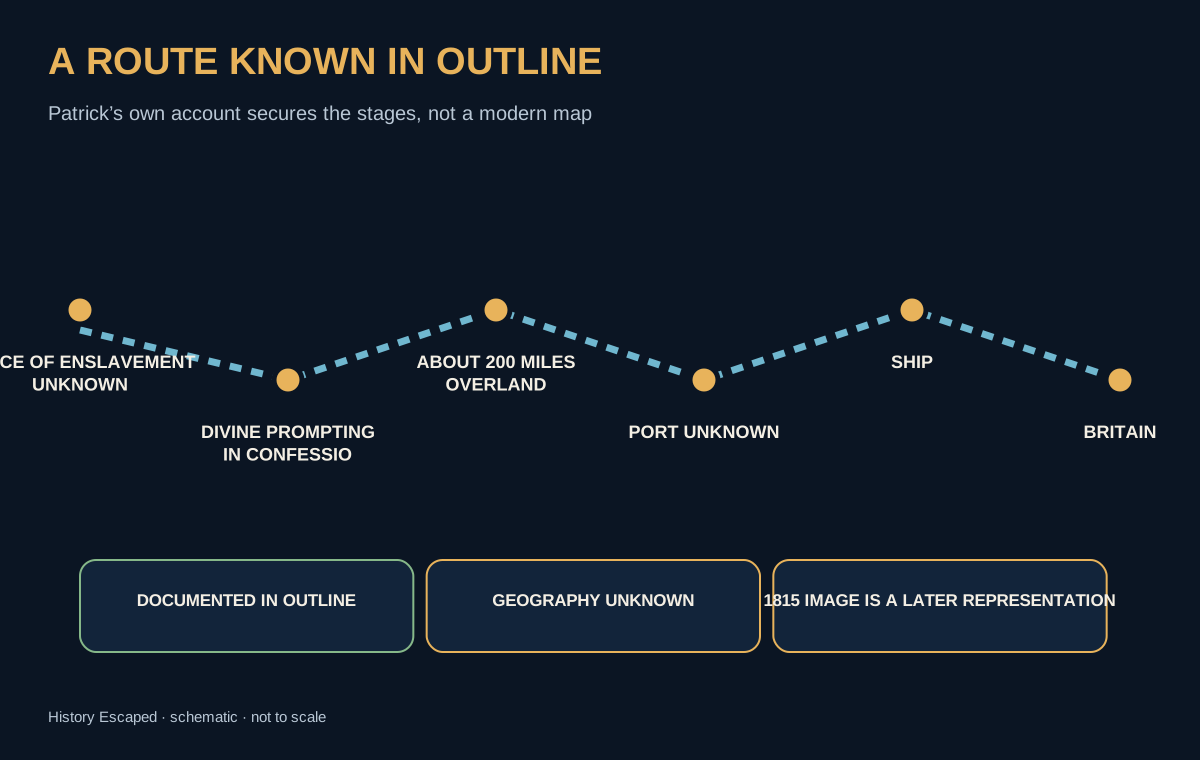
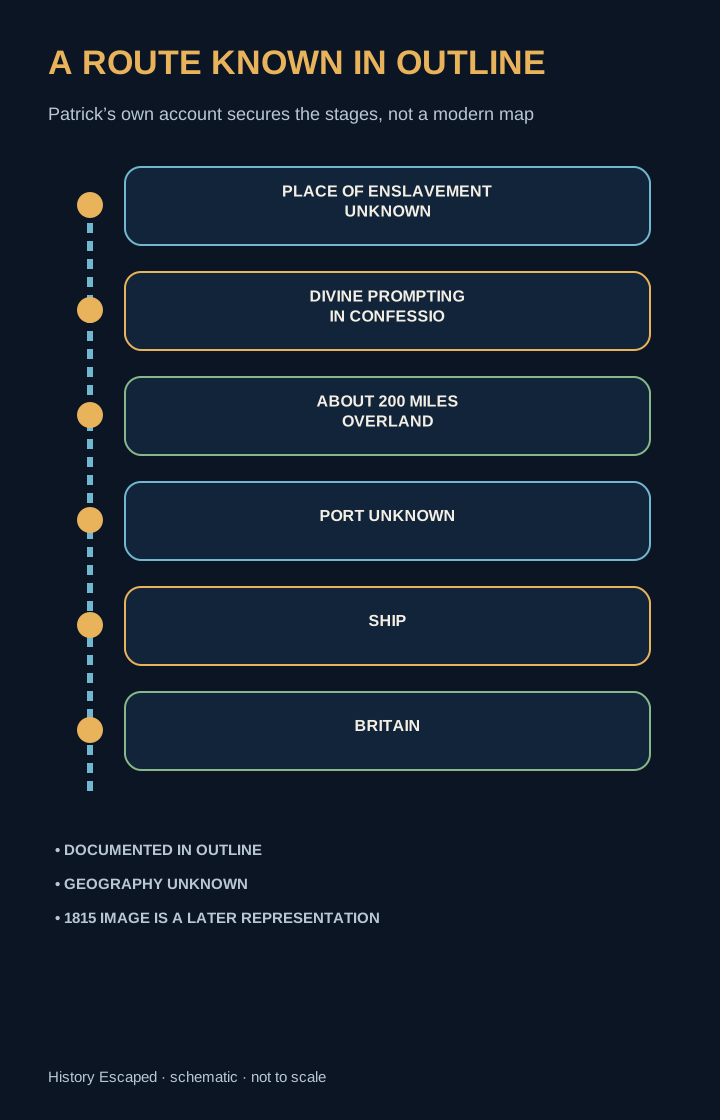
Simplified editorial reconstruction based on the cited historical record; not to scale. Uncertainty is stated directly in the visual and adjacent text.
How certain is the slavery story?
Because Patrick wrote retrospectively and for a religious and defensive purpose, scholars have long tested his autobiography against the late Roman world around him. The most radical modern challenge comes from historian Roy Flechner, who has proposed that Patrick may have left Britain voluntarily to avoid civic obligations associated with his family's social status, rather than being kidnapped into slavery exactly as the Confessio says.
That hypothesis is worth acknowledging because it directly challenges the foundation of the escape story. It remains, however, a revisionist interpretation rather than the normal scholarly baseline. Patrick states the captivity repeatedly, and the Epistola separately recalls that he had been free-born and had once been taken captive by people from Ireland. Royal Irish Academy scholarship continues to treat his six years of slavery as a real formative experience.
For this case, the strongest formulation is therefore straightforward: Patrick's enslavement and escape are known primarily from Patrick himself, whose two surviving writings strongly and repeatedly present the captivity as real. The documents are retrospective and theological, so their route details must be handled critically; that is different from treating the entire captivity as legend.
The final accounting
Outcome
Escape from enslavement
Patrick successfully left the control of the person who had held him for six years.
Departure from Ireland
He secured maritime passage and left the island after reaching an unnamed port.
Eventual return to Britain
After further journeys and tribulations, Patrick says he was reunited with his family in Britain.
The source is extraordinary—and limited
Patrick may be the only person from the fifth century whose surviving writing gives us a first-person account of having endured slavery and later escaped it. That alone makes the Confessio exceptional. Yet its survival should not be confused with completeness.
The earliest major manuscript witness is the Book of Armagh, copied around the early ninth century, centuries after Patrick wrote. Other medieval manuscripts preserve additional portions of the text, allowing modern editors to reconstruct it comparatively. The Royal Irish Academy's HyperStack and University College Cork's CELT project make that manuscript tradition unusually transparent.
What the manuscripts preserve is not a travel log. Patrick never tells readers, "I was enslaved at this modern place, took this road, boarded at this harbor, and landed at this coast." Later lives of Patrick, written centuries afterward, supplied names, landscapes, miracles, and narrative continuity that became part of the saint's public story. Those texts are important evidence for Patrick's later cult, but they cannot automatically fill holes in his own account.
Evidence discipline
What the record supports
Status labels distinguish secure conclusions from uncertainty and rejected claims. Color is never the only signal.
LATER CLAIM
Patrick was enslaved at Slemish in County Antrim.
Slemish is deeply embedded in later tradition, but Patrick's own Confessio does not name the location of his six-year enslavement.
Sources: SRC-001, SRC-003, SRC-006MYTH
Patrick's roughly two-hundred-mile flight identifies a precise route across Ireland.
The distance comes from Patrick, but neither endpoint is securely known. It cannot support a single exact modern route.
Sources: SRC-001, SRC-005DISPUTED
The ship carried Patrick directly home to Britain.
Patrick says the voyage lasted three days and was followed by a twenty-eight-day journey through sparsely inhabited country. Britain and northwestern Gaul have both been proposed as the landfall; the text does not identify it.
Sources: SRC-001, SRC-005DISPUTED
Patrick's twenty-eight-day wilderness journey can be mapped confidently in Gaul.
Armorica is one scholarly reconstruction and has been defended from environmental and political context, but the landfall and route remain unproven.
Sources: SRC-005DISPUTED
Patrick's entire enslavement story is certainly fictional.
A modern revisionist interpretation questions the literal captivity narrative, but Patrick's two surviving writings repeatedly present his capture and former free-born status as real, and mainstream institutional scholarship continues to treat the slavery experience historically.
Sources: SRC-001, SRC-002, SRC-003, SRC-007MYTH
Later medieval lives can fill the missing geography in Patrick's own escape account as fact.
Later hagiographies are important evidence for the growth of Patrick's cult, but they were written centuries after him and cannot automatically supply secure escape geography missing from his own writings.
Sources: SRC-004, SRC-006Why the escape worked
Patrick gives us almost no tactical preparation. There is no evidence of a tunnel, a disguise, a forged pass, an organized rescue party, or a violent confrontation. The decisive factor may have been the structure of enslavement itself.
He was used for pastoral labor, which likely required movement beyond a tightly controlled household. His own writing places him in woods and on mountains while tending animals and praying. Such work could create physical distance from an enslaver even while legal and social control remained absolute.
Once he chose to flee, geography became both obstacle and opportunity. The ship lay far away, but a port also offered the possibility of moving beyond the reach of the person who claimed him. The crew's eventual decision to take him aboard converted an overland flight into an international escape.
Patrick's story therefore belongs to a very old pattern in the history of self-emancipation: distance from the enslaver created the first opening, but durable freedom required transportation beyond the territory in which recapture was easiest.
What can be reconstructed
A responsible visual of Patrick's escape should be almost deliberately incomplete.
It can show:
- a family home somewhere in Britain, exact location unknown;
- forced transport to Ireland;
- six years of enslavement somewhere in Ireland;
- a long overland flight Patrick remembered as roughly two hundred miles;
- an unknown Irish port;
- a three-day sea voyage;
- an unknown landfall;
- a twenty-eight-day journey through sparsely inhabited country;
- eventual reunion with family in Britain.
It should not draw a hard line from Slemish to Wicklow, from Mayo to Wexford, or from any named Irish location to a specific French or British harbor. Those maps may be interesting hypotheses, but they are not the escape Patrick actually documented.
After freedom
Patrick eventually returned to Britain and to his family. Later, after religious training and a series of experiences he understood as a divine call, he returned to Ireland as a Christian missionary and bishop.
That later career produced the legends that eventually overwhelmed the young captive in popular memory. Snakes, shamrocks, royal conversions, and miracle stories became more famous than the sparse autobiography Patrick actually left behind.
The escape deserves to be separated from those legends. A teenager taken across the sea into enslavement spent six years under another person's control, fled across a landscape he did not know, persuaded a reluctant ship's crew to take him, survived a difficult onward journey, and ultimately regained his freedom.
The documentary record cannot tell us exactly where his footsteps fell. It can tell us that Patrick himself never forgot what it meant to have been free-born, taken captive, and then released from slavery.