
Moses Roper's final escape began in Florida in July 1834, but he did not describe freedom as something he reached in a single night. He fled an enslaver near Marianna, crossed rivers and hundreds of miles of hostile territory, found work aboard a schooner to New York, and then spent more than a year moving through northern states while still vulnerable to recapture.
Only in November 1835 did he leave the United States for Britain. Looking back, Roper wrote that the whole process had taken him nearly sixteen months. That longer chronology matters because it reflects his own understanding of the difference between getting away from an enslaver and becoming secure from the American slave system.
At a Glance
- Final flight began: July 1834
- Starting point: Marianna, Florida Territory
- Overland objective: Savannah, Georgia
- Maritime escape: Schooner Fox to New York, August 1834
- Status in New York: Still vulnerable to recapture
- Departure from United States: 11 November 1835
- Arrival in Liverpool: 29 November 1835
- Primary source: Roper's own Narrative of the Adventures and Escape of Moses Roper
- Outcome: Successful self-emancipation followed by a major abolitionist writing and speaking career
Escape was already a pattern
The 1834 flight was not Roper's first attempt. His narrative is structured around repeated resistance: running away, being captured, being punished, and trying again.
As a teenager in South Carolina, Roper was held by John Gooch and members of Gooch's family. After fleeing into the woods to avoid another punishment, he was caught and jailed at Lancaster. He later wrote that he made several additional attempts and was repeatedly whipped after being recaptured.
Another flight carried him across the Catawba River in a small canoe. He remained in the wilderness until hunger forced him to approach a house for food, where he was captured again.
Punishment did not end the attempts. Roper escaped again, removed a heavy chain and travelled through North Carolina. In 1831, he set out on one of his most consequential early flights, travelling toward the free states while also trying to find the mother from whom he had been separated as a child.
The escape that reached his mother
Roper eventually found his family in Caswell County, North Carolina. His mother did not recognize him at first; roughly ten years had passed since they had last seen each other.
He wanted to continue toward the free states, but his family persuaded him to remain nearby for a short time. During the day he hid in the woods and at night returned to the house.
After about a week, armed men surrounded the place at night and seized him. Roper was jailed for thirty-one days before being taken back south.
That episode captures the central pattern of his earlier resistance. Roper could break physical control and travel considerable distances, but remaining inside the slave states left him exposed to a system of advertisements, jails, armed pursuers and legal penalties for anyone who sheltered him.
A life of forced movement
Over the following years Roper was sold, exchanged and transported through several parts of the South. The constant movement was imposed on him, but it also gave him knowledge that later helped him escape.
He learned roads and rivers. He saw how enslaved and free people travelled. He worked on vessels connected with the Apalachicola River and gained experience as a steward.
By 1834, the knowledge accumulated through forced travel could be turned against the system that had moved him from one enslaver to another.
Sold again in 1834
Roper was then held by Robert Beveridge, who lived in Apalachicola in West Florida. When Beveridge became bankrupt in 1834, his property was sold.
Roper fell into the hands of a planter he identifies as Mr. Register. He already knew Register's reputation and had previously said he would not willingly live with him.
Roper dates the purchase to July 1834. On the journey from Apalachicola toward Register's home, the party stopped at Marianna late at night.
Register had been drinking heavily. Roper brought him his dried clothes and deliberately spoke loudly enough to test whether he was asleep. Once satisfied that the man was unlikely to wake, Roper took his own few belongings and left for the woods.
This was the beginning of the final successful flight.
The Chipola River
The first major barrier was the river Roper called the "Chapoli," now the Chipola.
He reached it after running many miles. The water was deep, and Roper believed alligators made an attempt to swim too dangerous.
For a day, a night and part of the following day, he searched for another way across. Around noon he found an old canoe and improvised a paddle from a piece of wood.
Reaching the opposite bank did not end the danger. People were already looking for him, so he hid until night before moving again.
East toward Georgia
Roper travelled east through woods, using the rising sun to keep his direction. He eventually reached the Chattahoochee River, the boundary between Florida and Georgia.
He again waited for darkness before obtaining a ferry boat. The current carried him downstream before he reached the Georgia side.
From there the route continued through a landscape in which almost any encounter could expose him. Roper begged food from an older enslaved man, slept outdoors, crossed Spring Creek and reached the Flint River near the Bainbridge area.
A man working on a boat recognized him.
Roper responded immediately with a false explanation, claiming that his enslaver had travelled ahead by coach and that he was walking to meet him. He asked the man for directions and then deliberately went the opposite way.
The deception kept him out of the nearby jail.
False destinations
Roper repeatedly used misinformation as protection. When he needed directions, he sometimes asked how to reach Augusta even though Savannah was his actual destination.
He later entered a road he called the Coffee Road. He preferred it because there were relatively few houses, reducing the number of people who could question or identify him.
The route was not direct. Roper crossed or waded multiple rivers and flooded areas, sometimes swimming where he could not remain on foot.
That explains why distance estimates differ. Roper later said he had travelled about five hundred miles by the time he reached Savannah, while the edition itself noted that the direct distance was much shorter and that evasive detours accounted for much of the difference. Modern DocSouth summarizes the journey as more than 350 miles.
Either figure describes the same essential reality: the route was shaped by avoiding capture rather than by finding the shortest road.
Creating papers
Near the Altamaha River, Roper confronted another problem. Savannah was a major slaveholding port where a Black traveller without papers could attract immediate suspicion.
He needed documentation.
Roper first persuaded a rural family that he had lost a passport. The father could not write, but his son could. Drawing on passes he had heard free people of color read, Roper dictated what he needed the boy to put on paper.
The document did not look convincing enough. Roper later damaged it in water and showed the ruined paper to cattle drovers with whom he had been travelling.
The drovers vouched that they had seen the pass before it was spoiled. A cotton planter then wrote Roper a new pass and recommendation describing him as a free man of Indian and white ancestry.
Roper had turned other people's assumptions about race into protection.
Eleven miles from Savannah
After obtaining the new papers, Roper wrote that he had eleven miles left to reach Savannah.
Entering the city required a different kind of confidence. He could not remain hidden in woods while looking for passage north.
Roper walked through the main street and went directly to the docks. There he asked for a steward's berth on a vessel bound for New York.
His earlier river work mattered immediately. Within minutes he had a position aboard the schooner Fox.
The Fox

The Fox did not sail at once.
Roper says the schooner remained in the river for four days. During that delay he had to go into Savannah several times, each trip risking recognition or arrest.
Fearing the Fox would not leave before his pursuers found him, he deserted it and boarded a brig bound for Providence. The brig was towed roughly thirty miles from Savannah before its captain concluded that Roper was probably an enslaved fugitive.
Carrying an enslaved person from Savannah to a free state could expose the captain to a substantial fine. Roper was therefore sent back on the towing steamboat.
The decision placed him again in the city from which he was trying to escape.
Back to the Savannah docks
Roper expected the return to end badly. He had deserted the Fox, and its captain could have had him imprisoned.
Instead, the first person he met at the docks was that captain, who was looking for another steward. The captain asked Roper to return to the schooner.
Roper accepted.
His narrative is careful about the captain's role: the man did not know that Roper was enslaved. The voyage should therefore not be recast as a documented abolitionist rescue.
About two days later, the Fox finally sailed for New York.
Roper dates this phase explicitly to August 1834.
Six days north
The passage lasted six days. Roper had never been at sea before and became severely seasick, leaving other sailors to perform some of his work.
The danger did not disappear aboard a northern vessel. During quarantine near Staten Island, members of the crew assaulted Roper and used racist abuse against him.
After two days of quarantine, the vessel entered New York.
Roper's reaction is one of the most important lines in his narrative. He arrived believing he was free, then learned that he could still be taken.
His final flight from an enslaver had succeeded.
His security had not.
Moving through the North
Roper continued up the Hudson to Poughkeepsie, where he found work but became seriously ill. He then went to Albany.
From Albany, he worked aboard a canal boat travelling west. After several hundred miles he decided the route was taking him too close to slaveholding territory and turned back.
He then went north through the canal system into Vermont. In Sudbury, he told people that he had escaped slavery and found work among people he considered more sympathetic.
Even there, safety was unstable. When he feared that an employer might communicate with his former enslaver and seek a reward, he left.
Ludlow, New Hampshire and Boston
Roper moved to Ludlow, Vermont, where a supporter helped him attend school for several weeks. When he learned that advertisements were circulating for him, he left again.
He spent time in a more secluded place near Ludlow, then went to New Hampshire and later Boston. The northern states contained abolitionists and free Black communities, but they were still part of a country whose laws and interstate practices could return fugitives to slavery.
In Boston, Roper worked in a shop before deciding that too many strangers passed through for him to remain safely concealed. He shaved his head, bought a wig and went to Brookline, where people around him often read him as white.
The ambiguity helped him, but it did not remove the underlying danger.
A search reaches Boston
After Roper returned to Boston, two Black men warned him that someone had been asking for a person matching his description and had offered money for information.
The men refused to betray him.
Roper went into hiding, then spent several weeks in the Green Mountains. From there he returned to New York and remained concealed while looking for a ship out of the country.
The decision to leave the United States was not simply a desire to travel. It was the final response to the problem he had encountered since arriving in New York in 1834: movement into a free state had not erased his legal vulnerability.
The Napoleon
Roper eventually learned that a ship called the Napoleon was sailing for England.
He departed New York on 11 November 1835, carrying letters of introduction to contacts in Britain. He later calculated that nearly sixteen months had passed since he first fled in July 1834.
The Napoleon reached Liverpool on 29 November 1835.
For the chronology of the case, that date marks a second finish line. The final successful escape from the enslaver began in 1834; the extended flight to a jurisdiction outside the American slave system ended in Britain in 1835.
How many times did Roper try?
Modern summaries often describe the 1834 flight as Roper's twentieth escape attempt after nineteen previous failures.
The number is memorable, but Roper's narrative does not provide a clean numbered list that makes "nineteen" a primary-source total. He instead writes of "several attempts," gives detailed accounts of multiple major flights, and organizes chapters around the fact that he kept running despite repeated recapture.
That is enough to establish the essential point. Roper did not suddenly decide to escape in 1834; self-emancipation was a sustained project that survived years of punishment, sale and forced movement.
The precise modern count should remain secondary to that documented pattern.
Writing the cycle down
Roper reached Britain as a young man with a story shaped by repetition: sale, violence, escape, capture, punishment and escape again.
In 1837 he published A Narrative of the Adventures and Escape of Moses Roper, from American Slavery. The book was repeatedly reprinted and became notable not only for its first-person testimony but also for its illustrations of slavery and punishment.
Roper then travelled widely in Britain and Ireland as an abolitionist lecturer. Modern research places him among the earliest self-emancipated African American speakers to build a major public career in the British Isles.
The repeated failed escapes were not a prelude that disappeared once he became free. They became evidence in his attack on the institution that had repeatedly tried to force him back into bondage.
Why the final escape worked
The 1834 flight succeeded partly because Roper's earlier failures had taught him what simply running away could not solve.
Distance alone was insufficient. He needed rivers crossed, roads chosen for isolation, false destinations, documentation, employment that explained his movement, and finally transport beyond the slave states.
He also used skills acquired under coercion. River and vessel work gave him experience that allowed him to present himself as a steward in Savannah. Forced travel had taught him geography. Hearing free Black people read their papers taught him the form of documents he later dictated.
The final success was therefore not a single trick. It was an accumulation of knowledge built during years in which every earlier attempt had been defeated.
Two meanings of freedom
The 1834 and 1835 dates should not compete with each other.
July 1834 marks the beginning of the final successful break from slavery. August 1834 marks the maritime escape from Savannah to New York. November 1835 marks Roper's departure from the United States and arrival in Britain.
Roper's own narrative connects them. He understood the escape as a process that continued after he crossed into the free states because the possibility of recapture continued with him.
That is the central chronology of Moses Roper's final escape: he got away in 1834, and he kept moving until getting away could no longer be reversed.
Documentary reconstruction
Escape in 1834; durable safety in Britain in 1835
A case-local visual focused on the historical question that the surviving evidence can answer.
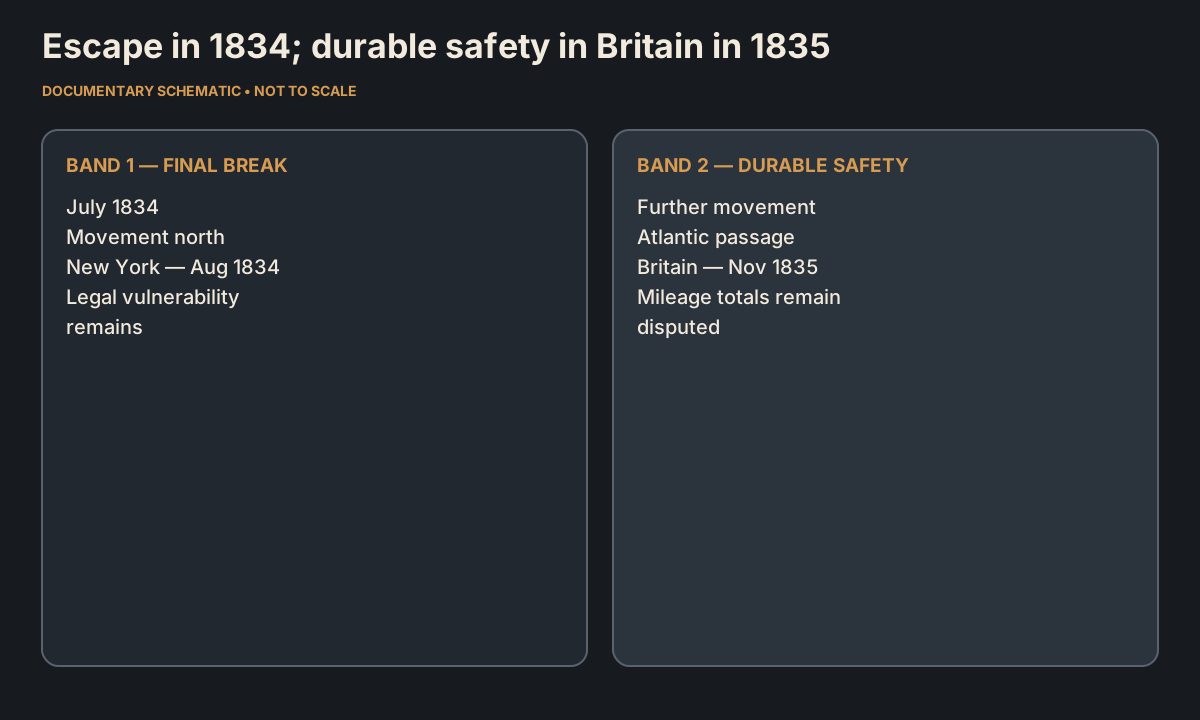
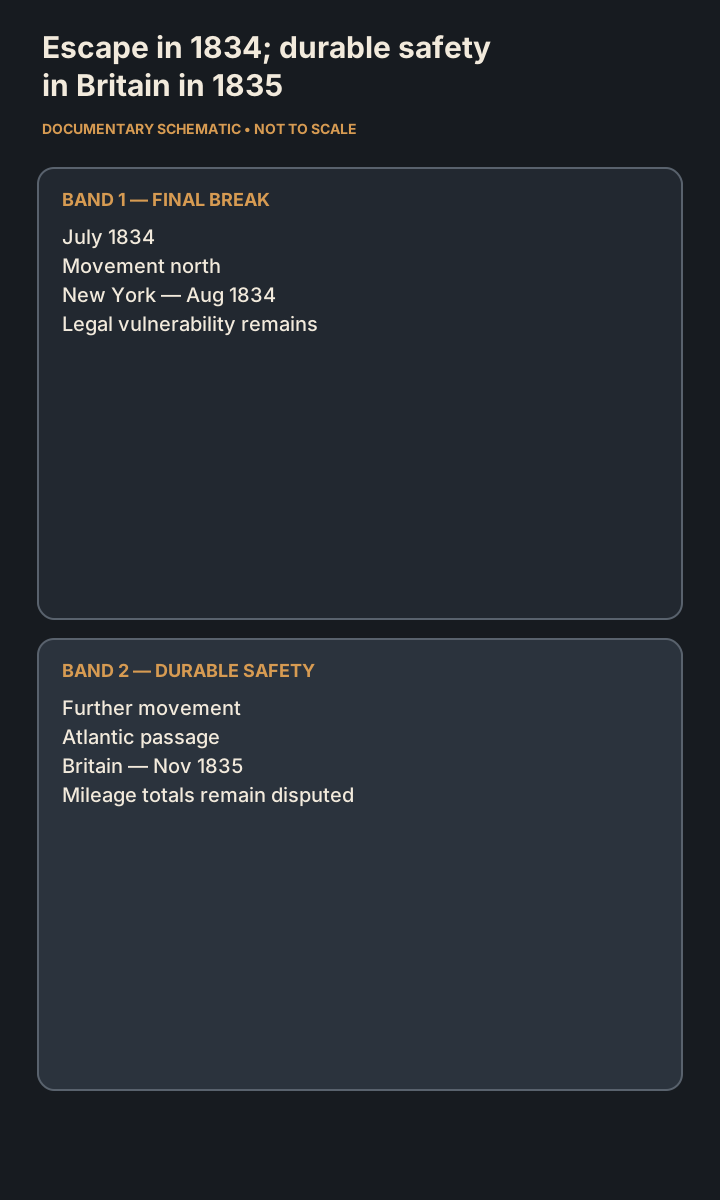
Simplified documentary reconstruction; not to scale. Evidence qualifications are written directly into the visual and explained in the adjacent text.
Evidence discipline
What the record supports
Status labels distinguish secure conclusions from uncertainty and rejected claims. Color is never the only signal.
DOCUMENTED
Roper's final successful flight from slavery began in July 1834.
Roper explicitly says that he first started from slavery in July 1834; his final-escape chapter begins with Register's July 1834 purchase and the Marianna flight.
Sources: SRC-001MYTH
The final successful flight occurred in 1835 rather than 1834.
1835 marks Roper's departure from the United States and arrival in Britain. The break from the enslaver and journey to New York occurred in 1834.
Sources: SRC-001, SRC-002, SRC-003LATER CLAIM
Roper made exactly nineteen failed escape attempts before a twentieth succeeded.
Modern public-history sources use this count, but Roper's own narrative documents repeated attempts without supplying a clean numbered total of nineteen prior failures.
Sources: SRC-001, SRC-004, SRC-005WELL-SUPPORTED
Roper's earlier failed attempts materially contributed to the knowledge used in the final escape.
His narrative repeatedly connects previous travel, vessel work, knowledge of roads and rivers, and familiarity with free people's passes to choices made during the 1834 flight.
Sources: SRC-001, SRC-002DISPUTED
Roper travelled one exact, securely measured distance from Marianna to Savannah.
Roper estimated about five hundred miles including detours, while modern DocSouth summarizes the route as more than 350 miles. The evasive path was intentionally indirect.
Sources: SRC-001, SRC-002MYTH
The captain of the Fox knowingly helped Roper escape slavery.
Roper explicitly says the captain did not know he was enslaved. The captain employed and rehired him as a steward but should not be recast as a documented abolitionist accomplice.
Sources: SRC-001MYTH
Reaching New York in August 1834 made Roper fully secure from recapture.
Roper says he arrived believing himself free and then learned he could still be taken. He continued moving until leaving for Britain in 1835.
Sources: SRC-001, SRC-003DOCUMENTED
Roper's first-person narrative is the principal evidence for the detailed escape route.
Modern institutional accounts rely heavily on Roper's published narrative, whose final-escape chapter provides the detailed Florida-to-Savannah and northern itinerary.
Sources: SRC-001, SRC-002, SRC-003