
The best-known image from Bonnie Prince Charlie’s escape after Culloden is not the beginning or the end of the story. It is a boat crossing in late June 1746, more than two months after the Jacobite defeat, with Charles Edward Stuart disguised as an Irish maid in Flora MacDonald’s travelling party. By then Charles had already crossed rough seas, abandoned an attempt to leave through Stornoway and spent weeks being moved among hiding places in the Outer Hebrides.
After leaving Flora on Skye, he still had nearly three months of evasion ahead of him before French ships carried him from Scotland. The full escape lasted about five months and depended on a succession of guides, boatmen, householders and outlawed Jacobites. Flora’s intervention was crucial, but the mechanism that kept Charles free was a relay network able to replace one exhausted or failed route with another.
At a Glance
- Battle: Culloden, 16 April 1746
- Fugitive: Charles Edward Stuart, commonly called Bonnie Prince Charlie
- Political cause: Jacobite attempt to restore the Stuart dynasty
- Time in hiding after Culloden: about five months
- Main regions: western Highlands, Outer Hebrides, Skye, Raasay and mainland Highland refuges
- Government reward: £30,000 in contemporary and near-contemporary accounts
- Key early pilot: Donald MacLeod of Galtrigill
- Key Hebridean guide: Neil MacEachen
- Failed maritime route: Stornoway, early May
- Principal South Uist refuge: Corrodale area
- Flora MacDonald enters the plan: late June
- Alias/disguise: “Betty Burke,” an Irish maid
- Skye crossing: 27–28 June phase
- Later mainland helpers: the Seven Men of Glenmoriston, Lochiel, Ewen MacPherson of Cluny and others
- French ships reached: 19 September
- Final sailing from Loch nan Uamh: 20 September 1746
- Outcome: successful escape to France
Culloden ended the campaign, not the pursuit
The Jacobite army met the government force commanded by the Duke of Cumberland at Culloden on 16 April 1746. The battle was over quickly and destroyed Charles’s ability to continue the rising as a conventional field campaign. He left the battlefield and moved west while surviving Jacobite forces dispersed.
The political struggle that produced Culloden was more complicated than the familiar shorthand of Scotland against England. Jacobitism sought a Stuart restoration and drew support across regional and national lines, while many Scots served or supported the government. Religion, constitutional arguments, dynastic loyalty, clan politics and the wider war between Britain and France all shaped the rising.
For Charles, those larger questions suddenly became secondary to survival. Remaining beside a large body of defeated troops would make him easier to locate, and trying to rebuild an army immediately would expose both him and those still willing to follow him. The post-Culloden escape began with dispersal rather than another rally.

The government hunt unfolded inside a wider repression
The pursuit of Charles was one part of a much broader government campaign after Culloden. Troops searched communities associated with Jacobite support, arrested suspects, seized weapons and property, and carried out punitive measures that modern National Trust for Scotland interpretation describes as severe and deliberate. The burden therefore fell on Highland households and communities as well as on prominent fugitives.
A reward of £30,000 for Charles’s capture appears repeatedly in contemporary and near-contemporary accounts. Later Jacobite memory made the fact that he was not betrayed a moral proof of Highland loyalty, but the real network was more varied. Some helpers were committed Jacobites, some belonged to politically divided families, and others appear to have acted from sympathy, kinship or local obligation rather than a single shared ideology.
That danger helps explain the structure of the escape. Charles could not rely on one household for weeks or on one guide for hundreds of miles. Every prolonged stay increased the chance that a search, interrogation or neighbor’s suspicion would expose the people protecting him.
The west coast offered routes the government could not easily seal
Charles moved toward Lochaber and the western coast, where rugged country and sea lochs offered more options than the principal roads. National Museums Scotland preserves objects associated with the hurried retreat from Culloden, part of a material tradition showing how completely the ceremonial world of the campaign had collapsed. A fugitive who had entered Edinburgh in triumph months earlier now benefited from having less to carry and fewer people around him.
The west also opened the possibility of a maritime escape. France had supported the Jacobite cause, and the sea ultimately offered the only secure way to remove its most prominent figure from Britain. In late April, however, no French rescue ship was waiting conveniently offshore.
The first solution was therefore much smaller: an open boat and men who knew the western waters.
An open-boat crossing began the island phase
On 26 April, Charles left the Loch nan Uamh and Borrodale area with a small party. The voyage included experienced boatmen such as Donald MacLeod of Galtrigill, whose local maritime knowledge became indispensable. Rough weather turned the crossing into an ordeal before the party reached the Hebrides.
The modern Bonnie Prince Charlie Trail in the Outer Hebrides is useful because its chronology is explicitly based on early source traditions, including Robert Forbes’s Lyon in Mourning, Walter Blaikie’s itinerary and the narrative attributed to Neil MacEachen. It places Charles on Benbecula by 27 April. That marked the beginning of a prolonged island phase rather than a quick transit toward France.
Small boats gave the fugitives freedom from roads, but they introduced other risks. Storms, tides and patrols could trap a party in exposed water or on an island with few exits. Every crossing therefore depended on local knowledge as much as on secrecy.
The Outer Hebrides were not automatically Jacobite sanctuary
The islands contained Jacobite sympathizers, government supporters and people who wanted no part in the struggle. Local militia could know the same channels, ferries and settlements as Charles’s guides, which meant that moving farther from the mainland did not necessarily make him harder to find.
The network responded by using short stages. A boatman might know the next safe landing; a local guide might know which household could be trusted; another person might know where militia had landed. The fugitive’s route was rebuilt continuously from information gathered on the spot.
Neil MacEachen became one of the central figures in this phase. His later narrative supplies much of the detailed itinerary for the Uists and shows how often plans changed. Unlike Flora MacDonald, whose celebrated role occupied a short period, MacEachen accompanied Charles through a substantial portion of the island escape.
Stornoway offered the first real chance to leave Britain
Early in May, Charles moved north toward Lewis and Stornoway. The attraction was straightforward: a port might supply a vessel capable of carrying him out of Britain. If successful, the entire escape could have ended within weeks of Culloden.
A port was also a dangerous place to ask for secret passage. Sailors, merchants, officials and local residents had reasons to notice unusual requests, and Charles’s presence became too difficult to conceal. The Stornoway plan collapsed before a safe departure could be arranged.
The failure is important because it shows that the later route was not preplanned. Charles did not leave Culloden with a fixed itinerary through Flora MacDonald and Skye. When Stornoway failed, the network turned him back toward less conspicuous settlements and rougher country.
Rarnish and Corrodale replaced the failed port
By 11 May the itinerary places Charles at Rarnish on Benbecula. A few days later Neil MacEachen guided him toward Glen Corrodale on South Uist, which became one of the principal refuges of the island phase. Its value lay in isolation rather than comfort.
Corrodale could hide the prince from normal traffic, but it could not supply permanent safety. Food and intelligence still had to reach him, and the government could shift troops and militia into the surrounding districts. In early June the party moved again, including a period on the small island of Wiay.
By mid-June the search was becoming increasingly local. Government-aligned militia knew the islands and could close fords and landing places. Charles needed a way to leave the Uists that looked legitimate enough to survive questioning.
Flora MacDonald entered a plan already under pressure
Flora MacDonald was twenty-four when she became involved. National Museums Scotland emphasizes that her background does not fit the later image of a lifelong Jacobite heroine waiting to rescue the prince. She was a Presbyterian from a politically mixed family environment, and her stepfather had links to pro-government militia forces.
That very connection helped make her useful. Flora had a plausible reason to travel, and she could seek permission for a journey with servants and a boat crew. Her contribution was therefore not simply personal courage; it was access to an administrative cover that the fugitive network urgently needed.
Flora later represented her assistance as an act of charity toward a person in distress. That statement does not eliminate the possibility of Jacobite sympathy, but it cautions against projecting the heroine of later songs backward onto the young woman making a risky decision in June 1746.
Her July statement is one of the strongest sources for the crossing
The British state papers preserve Flora MacDonald’s statement after her arrest on 12 July 1746. Because it was recorded only weeks after the event, it provides unusually close evidence for her phase of the escape, even though it was given under government questioning.
The statement describes the travel arrangement, the false identity and the places connected to the crossing. It is narrower than later romantic retellings, which is one reason it is so valuable. Flora did not claim to have guided Charles from Culloden or to have organized the final escape to France.
Her role was a transfer. She helped move a fugitive trapped by tightening searches in the Uists into a new network on Skye.
The permit made “Betty Burke” plausible
Charles was dressed as an Irish maid named Betty Burke. The women’s clothing is the part later art and popular history remembered, but the disguise worked because it fit Flora’s permission to travel with attendants. A costume by itself would not answer why the supposed maid was moving between islands with a particular boat crew and destination.
The administrative cover made the social story coherent. Flora could explain the journey; Betty Burke could be presented as part of her household. Boatmen and other helpers supplied the physical movement that the papers could not provide.
The exact dating of the departure is usually given as 27 or 28 June depending on which stage of the overnight movement a source emphasizes. The broader chronology is secure: by the end of June, Charles had left the Uists with Flora’s party and was moving toward Skye.
The famous Skye crossing was not a two-person voyage
Later culture reduced the scene to Charles and Flora alone in a small boat. Contemporary and modern institutional discussions make clear that a boat crew was involved and that the men handling the vessel could see that the supposed maid was unusual, even if they were not necessarily told every part of the political plan.
The disguise was therefore never a perfect invisibility device. Like many successful false identities, it worked because the surrounding group behaved as if the identity were normal. Recognition and suspicion were manageable as long as they did not turn into disclosure.
The crossing became one of the most famous journeys in Scottish history, but its fame distorts the scale of the wider escape. Charles had already been a fugitive for more than two months, and Skye still did not provide the ship to France.
Skye required another relay of helpers
Once on Skye, the network changed again. Lady Margaret MacDonald helped arrange the fugitive’s movement despite the publicly government-aligned position of her husband, Sir Alexander MacDonald of Sleat. Alexander MacDonald of Kingsburgh sheltered Charles, and Donald Roy MacDonald helped manage the next handoff toward Portree.
The politically mixed character of these households is revealing. The escape did not pass through a clean map of Jacobite territory. Public allegiance, private sympathy, kinship and local obligation could point in different directions, allowing people to help without sharing the same political commitment.
The Betty Burke disguise was abandoned during this stage. Once its specific function had been served, it risked drawing attention because Charles did not make a convincing female servant over prolonged contact. The network replaced the identity rather than insisting on it.
Portree ended Flora’s part, not Charles’s escape
Charles reached the Portree area and separated from Flora. From there he moved toward Raasay and then back toward the mainland with different guides. Flora’s celebrated intervention had lasted only a small portion of the five-month flight.
Her consequences were nevertheless serious. She was arrested on 12 July and detained for her role. National Museums Scotland records that she spent roughly a year in custody before returning to Skye.
Her fame grew rapidly after the event. Portraits, stories and later relic culture transformed her into the defining helper of the escape, even though many people had assisted Charles before she met him and many more did so after she was arrested.
The mainland phase was less picturesque and harder to trace
Returning to the mainland brought Charles into districts where government troops were conducting extensive searches and punitive operations. He moved through Morar, Glenmoriston and other western Highland areas, often in very small groups. Remote country provided concealment but also intensified dependence on local supplies and intelligence.
The source record becomes less tidy here. Early testimony and later tradition associate Charles with numerous caves, huts and mountain refuges. Some places are well supported, while others acquired “Prince Charlie” associations long after 1746.
A responsible map therefore needs to show regions and secure major movements rather than draw a precise line through every cave promoted by local memory. The uncertainty is not a defect in the history; it reflects a fugitive journey reconstructed from testimony in a landscape where written records were never meant to be created.
The Seven Men of Glenmoriston show another kind of refuge
One enduring mainland episode concerns the outlawed Jacobites remembered as the Seven Men of Glenmoriston. Charles spent time under their protection during the summer, depending on people who were themselves living outside normal government control.
The story is often told as a test of loyalty because the men could theoretically have claimed the enormous reward. The broader lesson is more practical. A fugitive was safest with people whose own circumstances made cooperation with government search parties unlikely and whose knowledge of rough country gave them options unavailable to conventional travellers.
Their protection did not prove that every Highland community supported Charles. It showed that this particular local network valued protection of the prince more than the reward or the risks of discovery.
Every helper solved a different problem
The escape makes more sense as a relay than as a single rescue. Donald MacLeod supplied maritime expertise, while Neil MacEachen supplied knowledge of the Uists. Flora MacDonald supplied a permitted travelling identity at a moment when island searches were narrowing.
On Skye, Lady Margaret, Kingsburgh and Donald Roy provided shelter and movement. In Glenmoriston, outlawed Jacobites supplied concealment in rough country. Later, Donald Cameron of Lochiel and Ewen MacPherson of Cluny reconnected Charles with senior Jacobite networks and with information about French rescue efforts.
No individual needed to know the whole route from Culloden to France. That compartmentalization reduced the damage if one helper was arrested and allowed the escape to adapt to conditions that no planner could have predicted in April.
Recognition did not automatically produce betrayal
The £30,000 reward makes it tempting to imagine that success required Charles to remain unrecognized. In reality, many of the people around him knew exactly who he was, and others suspected his identity. The problem was not avoiding every pair of eyes; it was preventing recognition from becoming actionable information for the government.
That distinction helps explain why the Betty Burke episode should not dominate the story. The disguise mattered for one difficult crossing, but the longer escape depended more often on deliberate silence, trusted introductions and local social relationships. Charles’s fame made him difficult to hide, yet it also made some supporters willing to take extraordinary risks.
The government could search roads and settlements more easily than it could dissolve every personal tie in the Highlands and islands. The helper network survived in the gaps between formal authority and local relationships.
By August, the problem was endurance
The first weeks after Culloden were about leaving the battlefield, reaching the west and finding any possible way out. The island phase became a contest against tightening searches and failed maritime options. By August, after Skye and the return to the mainland, the task had changed again.
Charles had to remain alive and uncaptured until foreign rescue could reach him. There was little value in constantly exposing himself to ports and vessels if no trustworthy ship was available. Mountain hiding networks offered depth while messengers and senior Jacobite contacts searched for news from France.
The late-stage association with Ewen MacPherson of Cluny produced another famous refuge tradition, “Cluny’s Cage,” in the Ben Alder country. Cluny’s role in sheltering Charles is well established, but the precise location claimed by later tradition should be treated more cautiously than the association itself.
Lochiel and Cluny reconnected the fugitive to the surviving Jacobite leadership
Donald Cameron of Lochiel had been one of the most important Jacobite leaders in the rising. Rejoining figures of that rank changed the structure of Charles’s flight because the network could now connect Highland concealment with Continental rescue efforts.
This was not a revival of the army defeated at Culloden. The later network was concerned with survival, escape and the movement of senior fugitives rather than a renewed field campaign. The political project had failed in Scotland even though many of its leaders remained at large.
By September, French vessels were approaching the west coast. The long period of evasion finally had a possible endpoint.
Charles reached the rescue ships on 19 September
The final movement brought Charles back toward Loch nan Uamh, the same western maritime world that had shaped both his arrival in 1745 and his escape in 1746. He reached or boarded the French rescue vessels on 19 September with other Jacobite fugitives, including senior allies.
Some modern summaries use 19 September as the date Charles “left Scotland.” That wording compresses embarkation and sailing into the same event. Other strong sources, including National Museums Scotland and academic synthesis by Allan Macinnes, place the actual departure of the ships on the following day.
Distinguishing the two dates removes an unnecessary contradiction. The rescue was reached on the nineteenth; the voyage from Scotland began on the twentieth.
The ships sailed on 20 September 1746
On 20 September, the French vessels left Loch nan Uamh for the Continent. Charles had spent roughly five months moving through battlefield roads, western glens, open water, Hebridean islands, militia-controlled districts, Skye households, outlaw shelters and mountain refuges.
He had used a famous disguise for only a brief portion of that time. Most of the escape consisted of movement between people who could keep him hidden for a night, a week or one difficult crossing before another person took over. The final ship succeeded because the network had kept him free long enough for it to arrive.
The personal escape was complete, but the Jacobite campaign was not restored. Charles reached France alive while the political and military consequences of Culloden continued to fall on supporters left behind.
Why Flora became the whole story
Flora MacDonald’s episode had everything later romantic culture needed: a young woman, a fugitive prince, an unusual disguise, an island crossing and a farewell. Those elements could be painted or sung more easily than five months of changing guides, uncertain huts and failed routes.
By the nineteenth century, Jacobitism no longer posed a serious political threat to the British state. The rising could be sentimentalized, and Charles increasingly appeared as the handsome doomed prince rather than the leader of a violent dynastic rebellion. Flora became the loyal heroine who saved him.
That memory is historically important in its own right, but it compresses the escape. The trip to Skye was a transfer between networks, not the final departure to France.
The Skye Boat Song belongs to the afterlife
The Skye Boat Song is often treated as though it descended directly from 1746. National Museums Scotland notes that the familiar song was published in the nineteenth century, long after Charles and Flora had died.
Its popularity changed what later generations remembered. The crossing to Skye became the emotional climax of the flight even though Charles still faced months of danger afterward. A route that had included the failed Stornoway plan, Corrodale, Raasay, Glenmoriston and Cluny’s network collapsed into one lyrical voyage.
The song is therefore evidence, but not eyewitness evidence. It tells us how Victorian Britain and Scotland remembered the escape.
Caves and relics created a landscape of memory
Many places across the Highlands and islands later acquired associations with the fugitive prince. Some can be connected to early testimony; others rest primarily on local tradition. The same process affected material culture, with snuffboxes, garments, weapons and household objects acquiring stories that linked them to Charles or Flora.
National Museums Scotland treats that relic culture as part of the later romantic construction of Jacobitism. Provenance matters for determining whether an object truly belonged to a participant, but even a weakly proven relic can reveal how intensely later generations wanted physical contact with the story.
The Prince’s Cairn at Loch nan Uamh offers a clearer example of commemorative memory. Erected in 1956, it marks the traditional departure site but is itself a twentieth-century monument, not surviving fabric from 1746.
The escape succeeded because it could keep changing
Charles did not survive because one perfect plan carried him from Culloden to a waiting ship. Several plans exhausted themselves or failed. The Stornoway route became unusable, island refuges became dangerous, the Betty Burke identity was discarded after Skye, and reaching Skye did not produce an immediate foreign vessel.
Each failure was absorbed by a different local network. The western movement got him away from the battlefield; the Hebrides reduced dependence on roads; the Uist hiding places bought time; Flora’s permitted journey solved one island exit; Skye produced another handoff; mainland outlaw networks provided depth; Lochiel and Cluny restored access to senior Jacobite communications; French ships finally converted evasion into escape.
The disguise became the icon because it is easy to remember. The relay network is the better explanation for why Bonnie Prince Charlie remained free for five months.
Documentary reconstruction
A five-month relay across western Scotland and the Hebrides
A case-local visual focused on the historical question that the surviving evidence can answer.
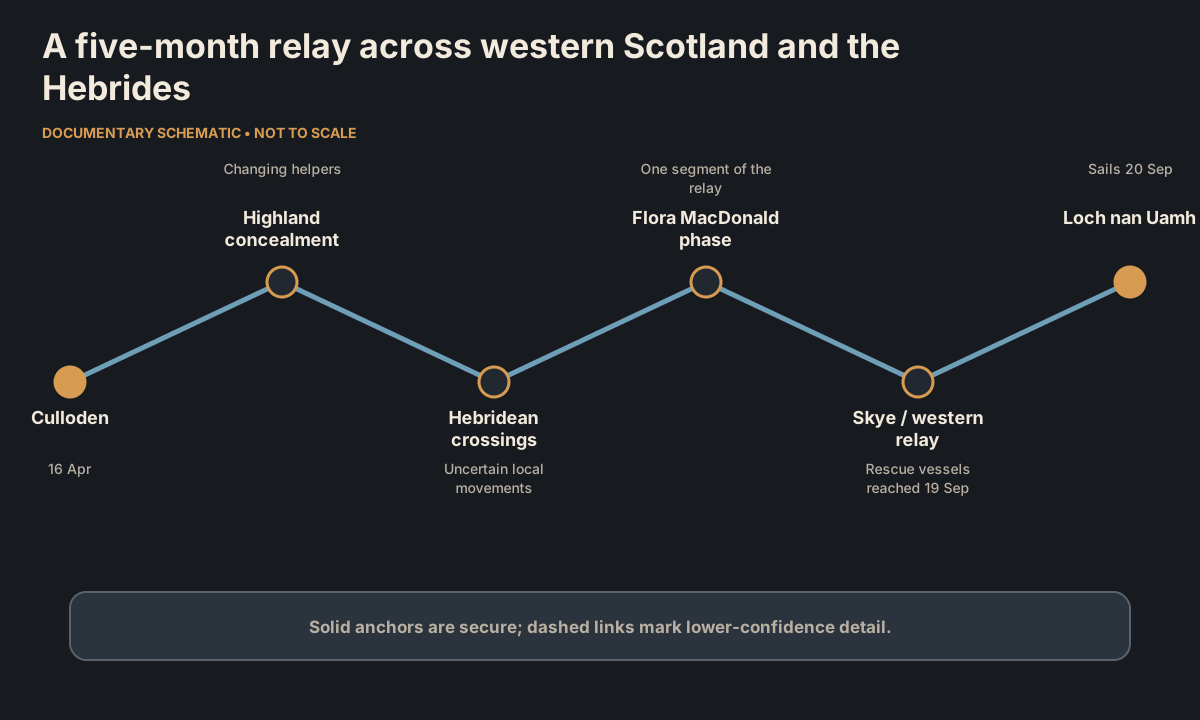
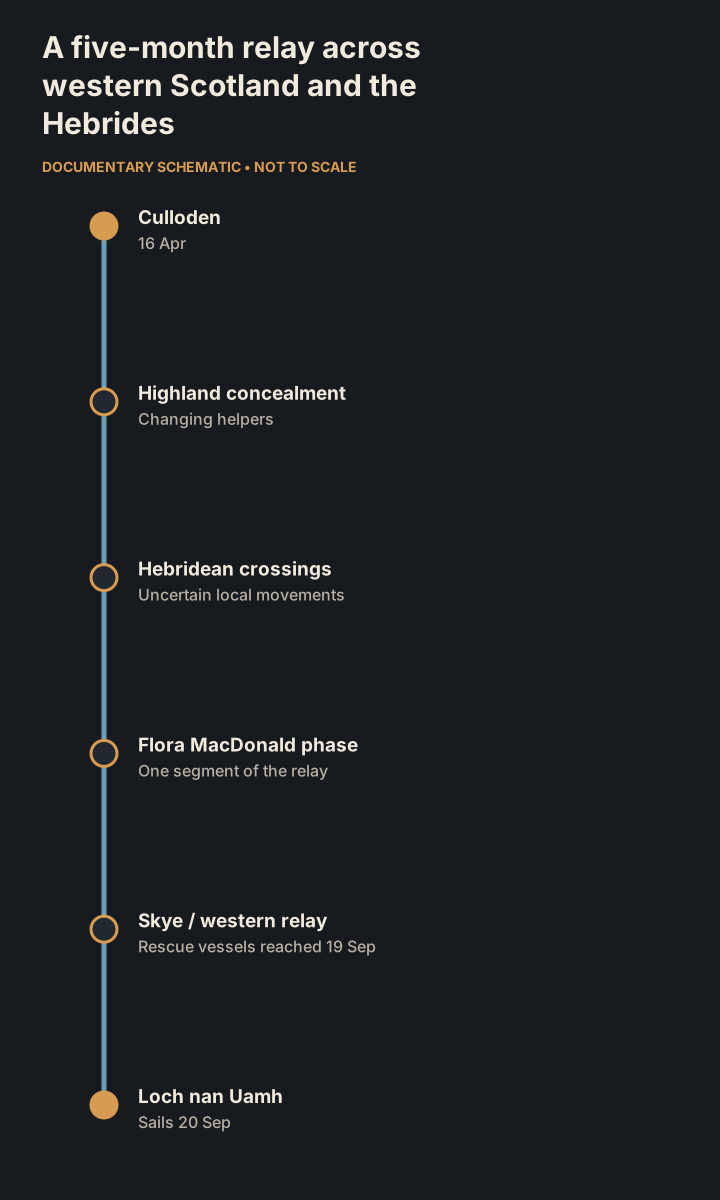
Simplified documentary reconstruction; not to scale. Evidence qualifications are written directly into the visual and explained in the adjacent text.
Evidence discipline
What the record supports
Status labels distinguish secure conclusions from uncertainty and rejected claims. Color is never the only signal.
MYTH
Flora MacDonald carried Bonnie Prince Charlie all the way from Culloden to France.
Flora helped during a short but crucial late-June phase, chiefly the move from the Uists to Skye. Charles had already been a fugitive for more than two months and continued evading capture for nearly three months after they separated.
Sources: SRC-001, SRC-003, SRC-004MYTH
Charles escaped Scotland immediately after Culloden.
He remained in Scotland for about five months, moving through the western Highlands, Outer Hebrides, Skye, Raasay and mainland refuges before the September departure.
Sources: SRC-003, SRC-004, SRC-013MYTH
The Skye Boat Song is a contemporary eyewitness song from 1746.
The familiar English-language song was published in the nineteenth century and belongs to the later romantic memory of the escape.
Sources: SRC-001, SRC-015DISPUTED
Flora MacDonald was unquestionably a committed Jacobite political activist before meeting Charles.
Modern institutional accounts stress Flora's politically mixed or pro-government family context and her later claim that charity motivated her aid. Her precise political commitment at the moment of the escape is less certain than later romantic tradition implies.
Sources: SRC-001, SRC-003MYTH
The Betty Burke disguise by itself got Charles through the search.
The disguise worked because it was embedded in Flora's travel permission, a legitimate-looking party, boatmen and a chain of helpers. Clothing alone would have been a weak cover.
Sources: SRC-002, SRC-003MYTH
Charles was never recognized during the five-month flight.
Numerous helpers knew exactly who he was, and others suspected or learned his identity. The escape depended less on perfect anonymity than on people choosing not to betray him.
Sources: SRC-003, SRC-004, SRC-010MYTH
Every 'Prince Charlie's Cave' identified today is a securely documented 1746 refuge.
Some hiding places are supported by early narratives, while many caves and shelters acquired associations with Charles through later local tradition.
Sources: SRC-010, SRC-011DISPUTED
Charles unambiguously sailed from Scotland on 19 September 1746.
Some summaries use 19 September because Charles reached or boarded the French rescue vessels then. National Museums Scotland, academic synthesis and the Loch nan Uamh memorial tradition place the ships' sailing on 20 September.
Sources: SRC-001, SRC-013, SRC-014MYTH
Culloden was a straightforward Scotland-versus-England conflict.
The rising divided Scottish families and clans, included English and Irish dimensions, involved Scots on the government side, and was intertwined with dynastic, constitutional, religious and European war politics.
Sources: SRC-005, SRC-006MYTH
The later romantic story preserves the escape exactly as contemporaries experienced it.
Nineteenth-century songs, paintings, relic culture and tourism concentrated the story around Charles and Flora, compressing a much longer relay of helpers and sometimes turning uncertain local traditions into fixed landmarks.
Sources: SRC-001, SRC-008, SRC-015