
In the winter of 1142, King Stephen appeared to have his rival trapped. After nearly three months inside besieged Oxford Castle, Empress Matilda escaped into a landscape of snow and ice and reached the safety of Wallingford. The escape is famous. Its exact mechanics are not.
A claimant almost trapped
By the end of 1142, Empress Matilda had already lived through one of the most unstable political careers in medieval Europe.
She was the daughter of King Henry I of England and the widow of the Holy Roman Emperor Henry V. After the death of Henry I’s legitimate son William Adelin in the White Ship disaster of 1120, the king designated Matilda as his heir and required leading nobles to recognize her claim. But when Henry died in 1135, his nephew Stephen of Blois moved quickly, crossed to England, and was crowned king.
The succession dispute developed into a civil war.
Matilda landed in England in 1139 with her half-brother and principal military supporter, Robert, Earl of Gloucester. Her position reached its high point in 1141 when Stephen was captured at the Battle of Lincoln. Matilda was recognized as Lady of the English and prepared for a coronation, but she never secured the crown. Her support fractured, London rejected her government, and the war turned again. Robert of Gloucester was later captured, forcing an exchange that returned both Robert and Stephen to their respective sides.
The conflict continued into 1142.
Oxford mattered because it was an important fortified center near Wallingford, one of the strongest bases held for Matilda. In the summer of 1142 Robert crossed to Normandy to seek additional support. Matilda remained in England. Stephen seized the opportunity.
On 26 September, according to the chronology preserved by William of Malmesbury and accepted by later historians, Stephen’s forces broke into Oxford. Matilda and her household withdrew into the castle.
The king had taken the town. Now he had to take his rival.
Three months behind the walls
Oxford Castle was a formidable place by twelfth-century standards. The Norman complex had grown from an eleventh-century motte-and-bailey fortress, and parts of the medieval site still survive today, including St George’s Tower. Contemporary descriptions emphasize the strength of the castle and the difficulty of attacking Oxford through its waterways and defenses.
Stephen settled into a close siege.
The Gesta Stephani, a contemporary narrative generally sympathetic to Stephen, describes the king pressing the castle with determination while food and the means of sustaining life dwindled inside. William of Malmesbury likewise places Matilda under blockade while her brother attempted to gather forces for her relief.
That approaching relief may have helped create the opening she needed.
William says that some of the besiegers became anxious about Robert of Gloucester’s approach. Some slipped away, and others watched less carefully than before. William did not pretend to know every detail. In fact, his account is unusually valuable because he pauses to admit uncertainty about the exact manner of Matilda’s escape.
What was certain was that remaining in the castle was becoming dangerous. If Oxford surrendered with Matilda still inside, Stephen might capture the person around whom the rival claim to the English throne was organized.
Sometime shortly before Christmas, she left.
Escape sequence
Two medieval accounts, one successful flight
The broad winter escape is secure. The precise way out of the castle is not.
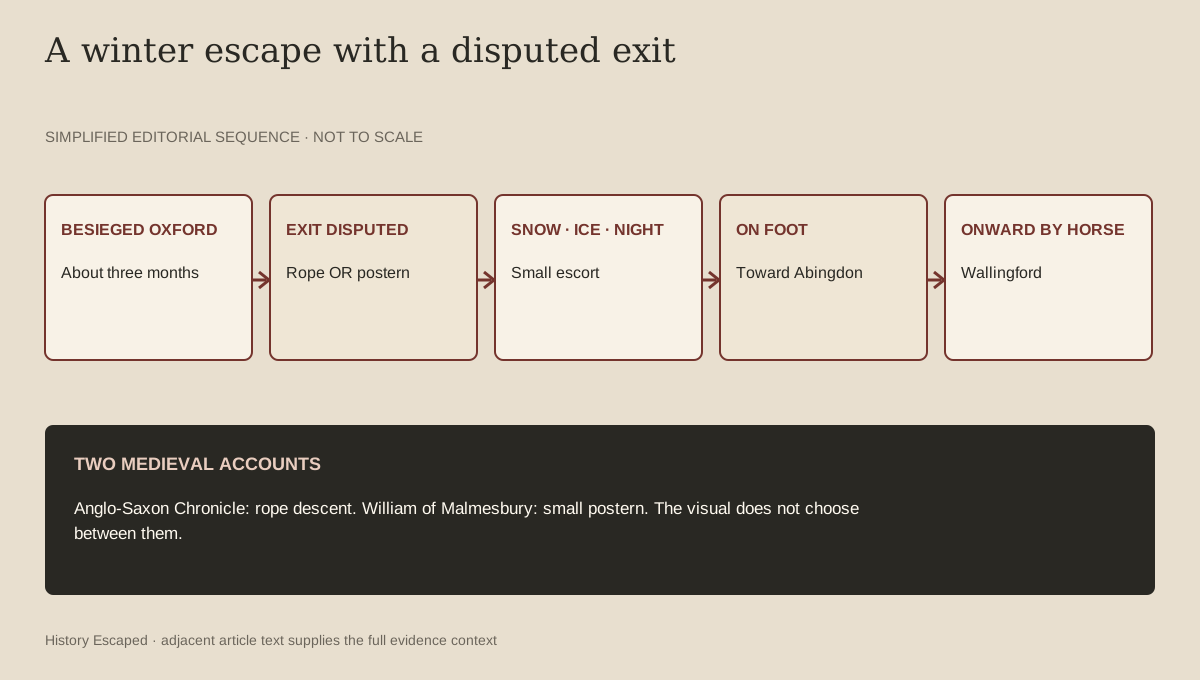
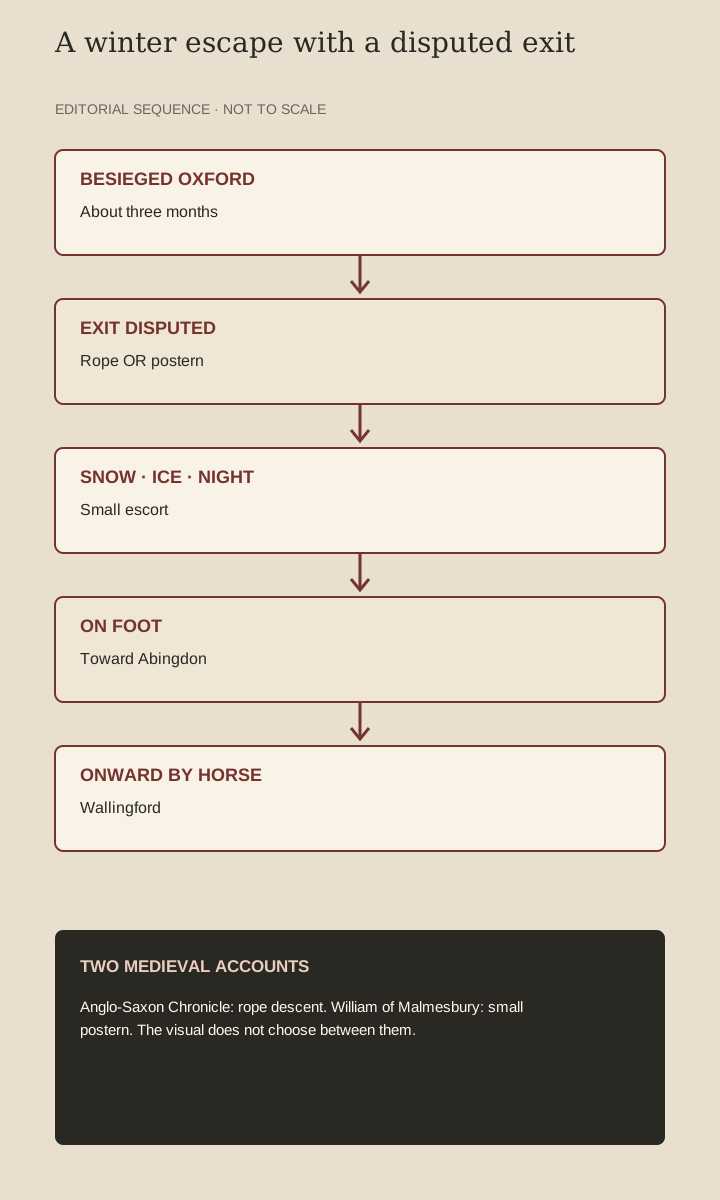
Simplified editorial sequence based on medieval accounts; not to scale. Rope descent and postern exit remain competing traditions.

The night escape
The core of the story is secure.
Matilda escaped at night with only a few companions. The ground was covered with snow. Water around Oxford had frozen. She passed beyond the besieging force and continued away from the city.
The details become more difficult the closer we look.
The Anglo-Saxon Chronicle gives one of the most dramatic versions. It says Matilda was let down from the tower at night by ropes before fleeing on foot.
William of Malmesbury gives a different account. He says Matilda escaped with four soldiers through a small postern and crossed the river. From there, she went on foot to Abingdon and continued to Wallingford on horseback. William calls the escape extraordinary, but he also states that he would have described it more fully if he had been able to learn the truth from people who were actually present.
The Gesta Stephani gives another variation. It says she left with three knights and traveled about six miles on foot through snow and ice. The author emphasizes both the physical effort of the journey and the frozen conditions.
Henry of Huntingdon adds the feature that has dominated later retellings: white clothing. In his account, Matilda’s clothing blended with the snow and helped conceal the fugitives from Stephen’s men. William of Newburgh, writing later in the twelfth century, also describes white garments, darkness, snow, and a frozen Thames.
These versions overlap enough to reconstruct the escape without pretending that the chronicles provide a camera-like record.
Matilda left Oxford Castle at night. She had a tiny escort. Winter weather made routes possible that would have been harder or impossible in ordinary conditions. She crossed water or ice, moved beyond Stephen’s cordon, and traveled on foot toward Abingdon. Horses then carried her on to Wallingford.
How she crossed the castle wall itself remains disputed.
Evidence discipline
What the record supports
Status labels distinguish secure conclusions from uncertainty and rejected claims. Color is never the only signal.
DOCUMENTED
Matilda escaped from besieged Oxford shortly before Christmas 1142.
Multiple twelfth-century chronicles independently record the escape and its successful conclusion.
Sources: SRC-001, SRC-002, SRC-003, SRC-004, SRC-005DISPUTED
Matilda was lowered from a tower by ropes.
The Anglo-Saxon Chronicle gives a rope descent, while William of Malmesbury says Matilda left through a small postern. The evidence does not justify choosing one as certain.
Sources: SRC-002, SRC-003WELL-SUPPORTED
Matilda wore white clothing to blend into the snow.
Henry of Huntingdon explicitly connects white clothing with concealment in the snow, and William of Newburgh later repeats the tradition. The detail is not present in every early account.
Sources: SRC-004, SRC-005WELL-SUPPORTED
Matilda crossed frozen water during the escape.
The Gesta Stephani describes heavy snow and a thick crust of ice on the water, while Henry of Huntingdon and William of Newburgh describe a frozen Thames.
Sources: SRC-001, SRC-004, SRC-005DISPUTED
Exactly three companions escaped with Matilda.
The Gesta Stephani gives three knights, while William of Malmesbury gives four soldiers. The precise escort size cannot be fixed confidently.
Sources: SRC-001, SRC-002MYTH
Matilda escaped Oxford on ice skates.
The principal medieval accounts describe travel on foot through snow and ice, followed by horseback travel. They do not describe skating.
Sources: SRC-001, SRC-002, SRC-003, SRC-004, SRC-005UNKNOWN
The exact path from the castle wall across medieval Oxford can be mapped precisely.
The chronicles do not provide sufficient route geometry, and the castle and surrounding waterways have changed substantially. A precise modern route would overstate the evidence.
Sources: SRC-002, SRC-008
Ropes, postern, or both?
Later illustrations often show Matilda descending dramatically from a tower on a rope. Modern popular accounts sometimes add knotted sheets. Others have her stepping neatly through a hidden gate.
The medieval evidence does not allow that certainty.
The rope story comes from the Anglo-Saxon Chronicle. William of Malmesbury’s postern account is incompatible with a straightforward claim that a rope descent was definitely the route. It is possible that one source preserved a detail the other did not, but there is no responsible way to force them into a single sequence.
The surviving St George’s Tower makes the rope version visually tempting. It is one of the oldest surviving structures at Oxford Castle, and Matilda certainly endured the siege within the medieval castle complex. But survival of the tower is not proof that she was lowered from that exact structure.
The exit mechanism therefore remains disputed.
What can be said with much greater confidence is that the escape succeeded because the siege environment changed. Darkness limited visibility. Snow helped disguise movement. Frozen water offered crossings outside the most obvious guarded routes. The approaching threat from Matilda’s allies may have reduced the besiegers’ concentration. And once she was clear of Oxford, she did not have to remain on foot all the way to Wallingford.
The escape was not one miraculous trick. It was a chain of opportunities.
The white-cloak story
The image of Matilda dressed in white against the snow is not merely a modern invention.
Henry of Huntingdon, writing in the twelfth century, explicitly connects white clothing with concealment in the snowy landscape. William of Newburgh repeats the image later in the century. The detail therefore deserves more credit than some of the more elaborate versions attached to the story.
Even so, the early sources do not form one perfectly consistent account. William of Malmesbury does not use the white-cloak detail in his surviving description, and the Gesta Stephani is more concerned with the snow, ice, distance, and danger of the journey.
The safest conclusion is that white clothing is well-supported, not universally documented.
The same distinction matters for the frozen river. Multiple medieval accounts place the escape in severe winter conditions and describe frozen water or a frozen Thames. But medieval Oxford’s river channels, mill streams, defenses, and later alterations make it unwise to draw a modern route line and claim that Matilda stepped across one precisely identified piece of ice.
Six miles through winter
The physical demands of the escape were considerable even without later embellishment.
The Gesta Stephani describes roughly six miles of travel on foot through snow and ice. William of Malmesbury places the first destination at Abingdon before Matilda continued to Wallingford on horseback.
The exact mileage in modern terms should not be treated as survey data. Medieval chroniclers were not providing GPS measurements, and the route is uncertain. But the sequence is credible and consistent: a difficult night movement away from Oxford, a stop or transition near Abingdon, and then a faster mounted journey to Wallingford.
Wallingford was the crucial destination. The castle there was held for Matilda’s cause and was one of the strongest Angevin positions in the region. Reaching it transformed the situation immediately. Stephen had nearly secured the one prisoner who might have given him enormous political leverage. Instead, he took a castle from which his rival had already vanished.
Oxford’s remaining garrison surrendered after her departure and was allowed to leave. Stephen had won the fortress. He had missed Matilda.
Selected chronology
Selected chronology
Stephen is crowned king
After Henry I’s death, Stephen of Blois secured the English crown despite earlier oaths recognizing Matilda as Henry’s heir.
Matilda enters the English civil war
Matilda landed in England with Robert of Gloucester and began the sustained military phase of her campaign against Stephen.
Stephen is captured at Lincoln
Stephen’s capture temporarily shifted the balance toward Matilda, who was later recognized as Lady of the English but was not crowned.
Stephen takes Oxford and begins the castle siege
Stephen’s forces entered Oxford while Matilda withdrew into the castle, beginning a close siege that lasted into December.
Matilda escapes Oxford
Matilda left the besieged castle at night with a small escort, crossed through snow and ice, and made for friendly territory.
Oxford Castle surrenders
With Matilda safely away, the remaining garrison surrendered the castle to Stephen and was permitted to depart.
Settlement recognizes Henry as Stephen’s successor
A negotiated peace ended the dynastic struggle by recognizing Matilda’s son Henry as Stephen’s heir.
Stephen dies; Henry II succeeds
Stephen’s death brought Matilda’s son Henry to the English throne as Henry II.
What the escape changed — and what it did not
It is easy to make the episode carry too much historical weight.
Matilda’s escape did not suddenly turn the war in her favor. She never became crowned queen of England. Her military position remained difficult, and she eventually returned to Normandy. The civil war continued through shifting sieges, local contests, dynastic calculations, and the growing role of her son Henry.
But the escape mattered because capture would have changed the political balance.
Stephen had once been Matilda’s prisoner. He understood the value of holding a rival claimant. At Oxford, he had spent months trying to force her into his hands. Her disappearance denied him that result.
Matilda remained free, her party remained politically alive, and her son’s claim remained available for the next phase of the struggle.
By the early 1150s, Henry had become Stephen’s principal dynastic opponent. In 1153 a negotiated settlement recognized Henry as Stephen’s successor. Stephen died in 1154, and Matilda’s son became King Henry II.
That outcome should not be reduced to one snowy night in Oxford. But without the escape, the road to it might have been very different.
What the famous retellings get wrong
“She definitely climbed down St George’s Tower on a rope.”
Disputed. The Anglo-Saxon Chronicle supports a rope descent, but William of Malmesbury says she used a small postern. The precise exit cannot be established.
“She escaped on ice skates.”
Myth. The principal medieval narratives describe walking, snow, ice, river crossing, and later horseback travel. They do not describe Matilda skating out of Oxford.
“She used knotted bedsheets.”
Myth or later embellishment. A rope descent appears in one medieval source. The transformation of those ropes into bedsheets belongs to later storytelling, not the secure twelfth-century record.
“The white cloak was invented by Victorian writers.”
No. White clothing appears in medieval accounts, especially Henry of Huntingdon and later William of Newburgh. It is a well-supported part of the tradition, although not present in every early narrative.
“The escape ended the Anarchy.”
No. It kept Matilda out of Stephen’s hands. The succession struggle continued for more than a decade and ended through a later settlement centered on her son Henry.
Problem → response
Escape was a sequence of problems
Each response solved a practical obstacle while often creating the next one.
- 01→
Obstacle
A close military siege
Stephen’s army held Oxford and surrounded the castle, making an ordinary departure impossible.
Response
Matilda left at night with only a very small party and took advantage of a moment when, according to William of Malmesbury, the besiegers’ vigilance had weakened.
- 02→
Obstacle
Waterways around Oxford
Oxford’s rivers and channels helped defend the town and constrained movement from the castle.
Response
Severe winter conditions froze water and created crossings described by medieval chroniclers as part of the escape.
- 03→
Obstacle
Visibility in enemy-held ground
Matilda had to pass beyond forces positioned around the castle without being recognized and stopped.
Response
Darkness, snow, and, in Henry of Huntingdon’s account, white clothing reduced the chance of detection.
- 04→
Obstacle
Distance to a secure stronghold
Escape from the castle did not itself guarantee safety; Matilda still had to reach territory controlled by her supporters.
Response
She traveled first on foot toward Abingdon and then continued by horse to Wallingford.
Why it worked
Matilda’s Oxford escape succeeded because several conditions aligned at once.
The siege had gone on long enough for the garrison’s position to become desperate, but also long enough for Stephen’s army to face the possibility of an approaching relief force. Winter created concealment and froze waterways. Night reduced observation. A very small party could move more quietly than a large breakout. Friendly territory and a strong destination lay within reach.
Most important, Matilda did not need to defeat the army around Oxford. She only had to pass through it once.
The chroniclers remembered that achievement because the stakes were so high. A besieged claimant, almost within the king’s grasp, escaped into the snow and reached the fortress that Stephen had failed to isolate her from politically.
The later legend made the scene cleaner than the evidence. The real story is better: not a single perfect trick, but a successful escape preserved through several medieval witnesses who agree on the danger and the outcome while disagreeing on exactly how it was done.