
Peng Ming-min did not climb a prison wall in January 1970. He walked out of a watched house, disappeared from the view of the security agents assigned to follow him, assumed another identity, and boarded a commercial flight from Taipei. By the time Taiwan's security apparatus understood that he was no longer on the island, he had reached Sweden.
That distinction matters because the familiar phrase "house arrest" simplifies an unusual form of political confinement. Peng had been pardoned from an eight-year sedition sentence in November 1965. He later wrote that he was technically free to move around Taiwan, and he did travel within the island. Yet his home was watched, agents followed him whenever he went out, communications were monitored, his university career had effectively ended, and repeated efforts to take academic posts abroad were blocked. It was not a new court-imposed sentence. It was a security regime that made formal release very different from ordinary freedom.
At a Glance
- Household break: 2 January 1970
- Departure from Taiwan: 3 January 1970
- Arrival in Stockholm: 4 January 1970
- Starting point: Peng's home in Taipei
- Exit point: Taipei Songshan Airport
- Travel document: A Japanese passport belonging to Kenichi Abe, altered with Peng's photograph
- Key helpers: Milo and Judith Thornberry, Takayuki Munakata, Kenichi Abe, Swedish Amnesty International contacts, and additional helpers Peng initially left unnamed
- Immediate outcome: Successful departure from Taiwan and entry into Sweden
- Longer outcome: Swedish political asylum, followed later in 1970 by admission to the United States
- Central source problem: Peng's 1972 memoir intentionally concealed names and intermediate locations to protect helpers; later participant testimony filled in many of those gaps
From pardon to surveillance
Peng's confinement followed one of the best-known political prosecutions of Taiwan's martial-law period. In 1964, Peng, a National Taiwan University legal scholar, and his former students Hsieh Tsung-min and Wei Ting-chao drafted the "Declaration of Formosan Self-Salvation." The text criticized the Kuomintang government's claim that it would reconquer mainland China, called for democratic political reform, and proposed a political future in which Taiwan was distinct from the People's Republic of China.
The declaration was discovered before its intended distribution. Peng, Hsieh, and Wei were arrested on 20 September 1964. A military court sentenced Peng and Wei to eight years and Hsieh to ten. Peng's case drew international academic and human-rights attention, including support from Amnesty International.
On 3 November 1965, Chiang Kai-shek granted Peng a special pardon. The prison gate opened, but Peng's political problem did not end. Taiwan's National Human Rights Museum records that he remained under close surveillance after his release. The Peng Ming-min Foundation describes round-the-clock monitoring from neighboring property and security agents assigned to his movements.
Peng's own memoir is more precise about the paradox. He wrote that he was "technically free" to travel within Taiwan without permission, but that surveillance followed him by jeep, taxi, train, and on foot. He was not restored to his National Taiwan University position. Government-linked employment was repeatedly offered as a way of drawing him back into acceptable political life, and he repeatedly refused.
This is why "house arrest" should be read as descriptive shorthand rather than as the name of a clearly documented judicial order. Peng could leave the house; what he could not do was resume ordinary professional and political life, escape observation, or secure permission to leave Taiwan for academic work abroad. By 1968 he had invitations from universities outside Taiwan but remained unable to depart.
Deciding to leave
Peng later said the decision to escape grew from the sense that surveillance was tightening and that another arrest—or worse—remained possible. That fear is part of his retrospective testimony and the testimony of foreign friends, not a surviving written order for his assassination. The historically secure point is that by early 1969 he was actively planning to leave Taiwan without government authorization.
Sweden became the preferred destination because it offered a realistic asylum route and did not place him immediately inside the diplomatic relationship between Taipei and Washington. Peng had been in correspondence with Karin Gawell and other members of Amnesty International's Swedish section since his imprisonment. In his memoir he says he asked whether Sweden would receive him if he arrived without valid travel documents, and that an affirmative answer reached him in February 1969.
The plan then became international. Takayuki Munakata, a Japanese supporter of the Taiwan independence movement, worked on the identity-document problem. His friend Kenichi Abe agreed to make his Japanese passport available. Milo and Judith Thornberry, American Methodist missionaries living in Taiwan, helped build a local support network and provided a place where Peng could disappear from the pattern his watchers expected.
Later accounts sometimes compress this into a single "Amnesty rescue" or an operation of the overseas independence movement. Neither description captures the whole structure. Amnesty contacts were important to the Swedish asylum end of the operation; Munakata and Abe were central to the passport plan; the Thornberrys and other people in Taiwan helped with concealment and departure. Peng's 1972 memoir deliberately omitted many names because those people could still be endangered.
Training the surveillance system to expect nothing
One of the most consequential elements was not a disguise but a change in routine. Peng wrote that during 1969 he deliberately spent longer and longer periods inside his house. When he did go out, the agents followed. At other times he remained unseen for weeks.
By the end of the year, the watchers had become accustomed to his apparent inactivity. Peng also experimented with his appearance, including facial hair, glasses, and a wig. Because he had lost his left arm after an American air raid in Japan during the Second World War, concealing that distinctive feature presented an additional problem.
The exact identity he was meant to project is described inconsistently in later sources. The Peng Ming-min Foundation and Taiwan's National Human Rights Memory Bank describe photographs of him made up as a boxer. Other recollections describe him as a Japanese musician with an injured arm, sometimes mentioning a musical-instrument case. Peng's own contemporary-near memoir includes an eyewitness reference to his "boxing glove" but avoids publishing the full cover identity.
The safest historical conclusion is that Peng adopted a conspicuous disguise designed in part to account for his missing arm, but later labels such as "boxer" and "musician" are not entirely consistent. The disguise photographs are real; the precise fictional biography attached to them should not be overstated.
January 2: disappearing before the flight
Published chronologies differ over whether Peng "escaped" on January 2 or January 3. The difference becomes understandable once the stages are separated.
Peng's later detailed account says that he left his home on the morning of 2 January 1970. He went to the home of the American missionaries who were helping him and remained away from his family for the final day before departure. He had already conditioned the surveillance agents to accept periods when he did not appear publicly, and he told his household that he would be traveling inside Taiwan.
The intended international departure, however, was the evening flight on 3 January. Taiwan's National Human Rights Museum exhibition material gives January 3 as the date he used the altered passport to leave the country, and the Thornberry account also places the successful flight on that Saturday night.
This makes January 2 the break from the watched household and January 3 the decisive border crossing. A later Legislative Yuan recollection gives January 2 and identifies Taichung's Ching Chuan Kang base as the exit point, but that version conflicts with the better-supported Songshan Airport reconstruction and with participant accounts.
The passport and the airport
Abe entered Taiwan using his own Japanese passport. Participant testimony given publicly in 2008 describes a clandestine handoff in Taipei. Munakata had spent months studying how a replacement photograph might be made to match the embossed passport seal, while Peng had sent photographs showing possible disguises.
The resulting passport carried Peng's disguised photograph while retaining Abe's identity. This is a documented part of the 1970 operation, but it should remain historical description rather than a modern document-forgery tutorial. The technology and inspection systems were those of a different era, and there is no editorial reason to reproduce a procedural method for defeating current passport controls.
Peng then went to Songshan Airport. Later participant accounts say additional friends watched from a distance so that, if he disappeared into custody, witnesses would know what had happened. He passed immigration and boarded the scheduled flight.
The details of every airport interaction are mostly retrospective. Peng later recalled being called back by an official for an omitted stamp and waiting through a mechanical delay before departure. Those episodes fit the known sequence but are not independently documented in surviving official records used here.
What is independently significant is that the security services did not immediately recognize that Peng had gone. Taiwan's National Human Rights Memory Bank preserves the extraordinary aftermath: on 23 January, officials were still analyzing whether he might have escaped by sea and were strengthening anti-smuggling measures. They had missed a departure through the capital's international airport.
Hong Kong, Bangkok, and Sweden
Peng's 1972 memoir anonymized the stopovers. He wrote of a sequence of relay points and friends who helped him continue toward Sweden without naming places that might identify collaborators.
Later disclosures filled in the route more clearly. At a 2008 reunion, Peng and the Japanese participants described a journey from Taipei to Hong Kong, onward through Bangkok, then through additional European transit points before Stockholm. The National Human Rights Museum's exhibition handbook likewise summarizes the route as Songshan Airport to Hong Kong, Bangkok, and Sweden.
Peng reached Stockholm on 4 January 1970. Swedish Amnesty contacts met him, and immigration authorities then faced an unusual problem: the man asking protection had arrived through an assumed identity and now had to prove that he was really Peng Ming-min. His academic network helped establish his identity. Sweden formally granted political asylum after review.
The success remained secret for nearly three weeks. Peng and his helpers wanted people involved in Taiwan to have time to leave or distance themselves before his whereabouts became public. When the news finally broke, his family and political associates were interrogated, and the security apparatus launched a broad investigation.
The intelligence failure
The official response revealed how completely the surveillance system had failed. Peng later claimed that agents had continued filing fabricated reports and expense claims describing his supposed movements in Taiwan after he had already reached Sweden. The National Human Rights Memory Bank independently confirms the larger institutional confusion: the Taiwan Garrison Command created the "124 Project" after the escape and initially focused heavily on the possibility of maritime smuggling.
That failure produced a durable rumor—that only the CIA could have moved Peng through such a heavily monitored system. Contemporary and later evidence shows why the idea seemed plausible. In January 1970 even U.S. officials were uncertain about Peng's precise location, though they believed he was probably in Sweden. Taiwan's government strongly objected when Washington later considered allowing him into the United States.
But evidence for a CIA-run extraction has not emerged. Peng denied receiving help from any government other than Sweden in granting asylum. Decades later, the previously concealed civilian participants described their roles in detail. In a 1972 meeting with Zhou Enlai, Richard Nixon and Henry Kissinger also denied U.S. involvement when Zhou raised the accusation. An official denial is not proof by itself, but combined with the reconstructed helper network it leaves the CIA theory unsupported.
From fugitive to exile
The physical escape ended in Stockholm, but the political consequences continued. The U.S. government expected that Peng might become a prominent leader of the Taiwan independence movement and debated how to handle a visa application. A January 28 National Security Council memorandum records both the expectation that he was in Sweden and concern over the diplomatic consequences of admitting him.
In September 1970 the United States finally issued Peng a nonimmigrant visa for a research position at the University of Michigan despite strong objections from the Republic of China government. Chiang Ching-kuo later described that decision to the U.S. ambassador as an exceptionally damaging event in bilateral relations.
Peng remained outside Taiwan for more than two decades. He returned in 1992 after Taiwan's democratization had transformed the legal and political environment, and in 1996 he became the Democratic Progressive Party's presidential candidate in Taiwan's first direct presidential election.
The 1970 escape acquired symbolic importance because it exposed a contradiction at the heart of Peng's post-prison life. He had been formally pardoned yet remained under a system designed to observe, restrict, and politically isolate him. His success did not come from defeating a locked room. It came from making a surveillance state believe, for just long enough, that the man it was watching was still where it expected him to be.
Evidence discipline
What the record supports
Status labels distinguish secure conclusions from uncertainty and rejected claims. Color is never the only signal.
DISPUTED
Peng was under a formal new court-imposed house-arrest sentence from 1965 to 1970.
Official and institutional sources commonly use 'house arrest' or its equivalent, but Peng's own account says he was technically free to move within Taiwan after the pardon. The secure fact is pervasive extrajudicial surveillance and travel restriction, not a clearly documented new judicial sentence.
Sources: SRC-001, SRC-002, SRC-004WELL-SUPPORTED
Peng's escape date was 2 January 1970.
January 2 is the date he left the watched household and entered concealment with helpers; his international departure occurred on January 3.
Sources: SRC-004, SRC-010WELL-SUPPORTED
Peng left Taiwan on 3 January 1970 through Taipei Songshan Airport.
The National Human Rights Museum, later participant accounts, and Peng's detailed chronology support a January 3 Songshan departure. A later Legislative Yuan recollection giving January 2 from Ching Chuan Kang conflicts with this stronger source set.
Sources: SRC-002, SRC-005, SRC-006, SRC-010DISPUTED
Peng was disguised specifically as a boxer.
Taiwan institutional captions describe the escape disguise as a boxer, while Thornberry-related and other later accounts describe a Japanese musician with an injured arm. Peng's memoir confirms disguise experimentation and includes an eyewitness reference to a boxing glove but does not cleanly resolve the fictional identity.
Sources: SRC-004, SRC-006, SRC-009DISPUTED
The CIA engineered Peng's escape.
The theory circulated after the security failure and was raised by Zhou Enlai in 1972. Peng denied U.S. government help, Nixon and Kissinger denied involvement, and later civilian participants described a detailed non-governmental helper network. No affirmative evidence of a CIA extraction is established in the available record.
Sources: SRC-004, SRC-005, SRC-007, SRC-011MYTH
Taiwan security officials immediately knew Peng had departed by air.
The National Human Rights Memory Bank records that on January 23 the security apparatus was still analyzing possible methods and considered sea smuggling sufficiently plausible to intensify maritime anti-escape measures.
Sources: SRC-003Documentary reconstruction
Surveillance, departure and asylum stages
A case-local editorial visual clarifies the evidence structure without adding false precision or reusable operational detail.
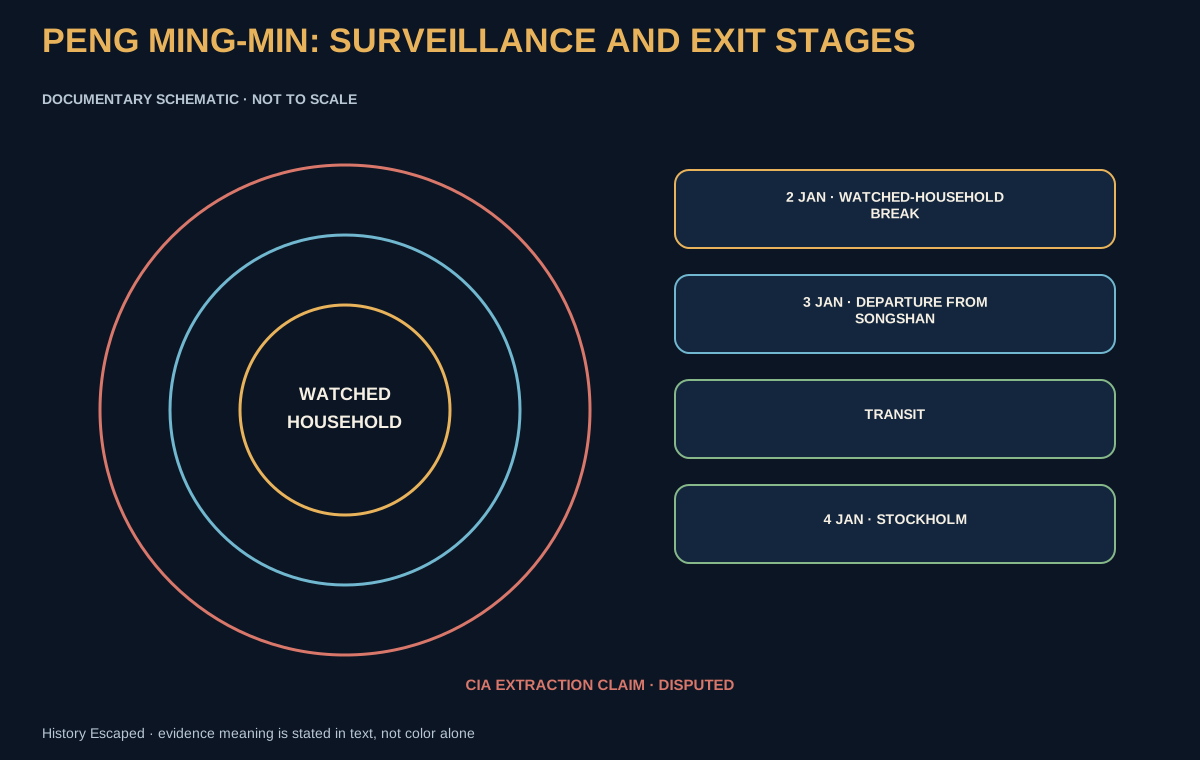
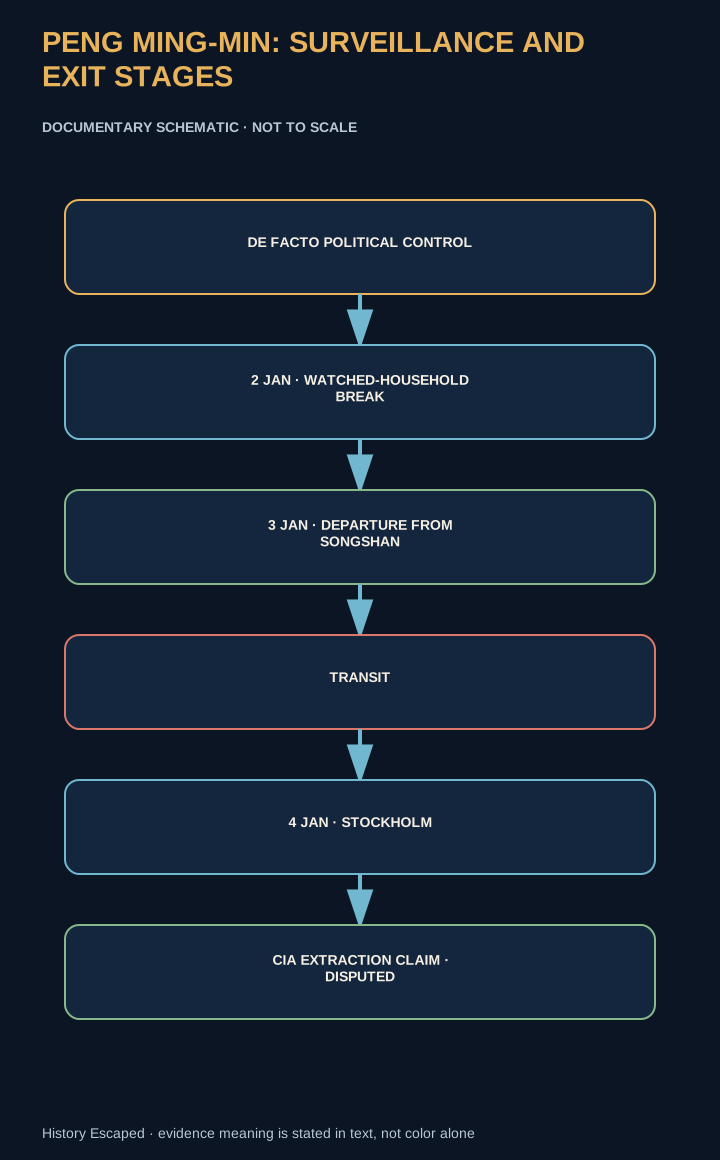
Simplified evidence-led editorial reconstruction based on the cited record; not to scale. Uncertainty is stated directly in the visual and adjacent text.