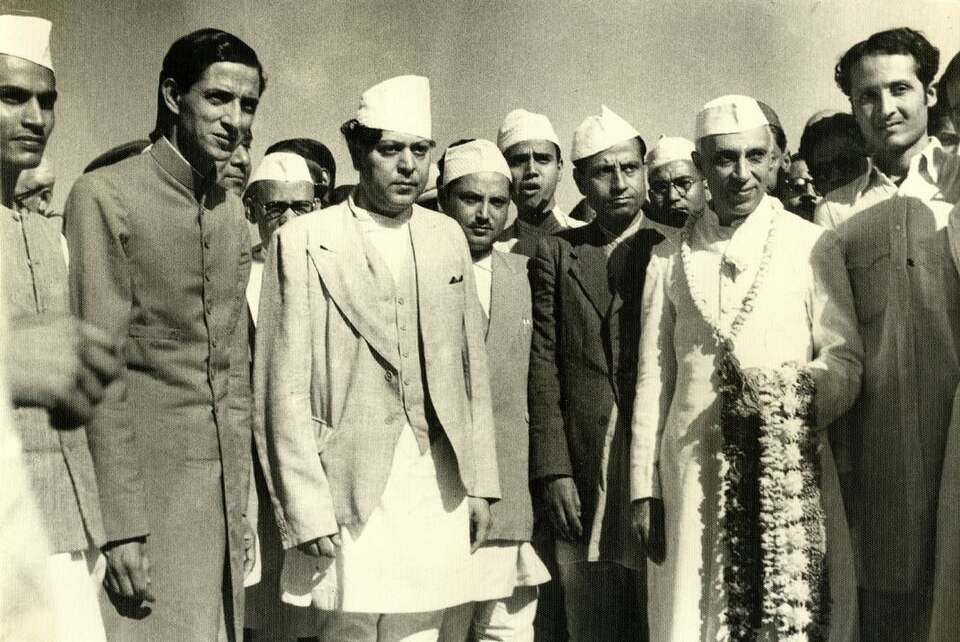
King Tribhuvan’s break with Nepal’s Rana regime began not at an airport, but at the gate of the Indian Embassy in Kathmandu.
On the morning of 6 November 1950, Tribhuvan left Narayanhiti Palace with most of the royal family in a motor convoy that was publicly presented as a hunting outing. As the cars approached the Indian Embassy at Shital Niwas, the royal party turned into the compound instead of continuing toward the hunt. Once inside, Tribhuvan placed himself and his family under Indian protection and refused demands from the Rana government to return.
That movement across a diplomatic gate changed Nepal’s political crisis. For more than a century, hereditary Rana prime ministers had exercised effective political power while Shah kings remained monarchs with heavily constrained authority. Tribhuvan’s decision removed the reigning king from direct Rana control and gave the anti-Rana movement a living monarch around whom opposition could rally.
The episode is often described simply as Tribhuvan “fleeing to India.” That skips the most important stage. He first escaped Rana control inside Kathmandu, remained in the Indian Embassy while the government tried to reverse the situation, and only afterward left Nepal by Indian military aircraft.
At a Glance
- Escapee: King Tribhuvan Bir Bikram Shah
- Political authority escaped from: the hereditary Rana premiership under Mohan Shamsher
- Initial escape date: 6 November 1950
- Initial destination: Indian Embassy at Shital Niwas, Kathmandu
- Cover: a royal hunting outing
- Royal party: Tribhuvan, his two queens, three sons, and other family members
- Royal family member left behind: Prince Gyanendra, Tribhuvan’s young grandson
- Rana response: attempted persuasion, declaration that Tribhuvan had forfeited the throne, and installation of Gyanendra as king
- Flight to India: strongest primary Indian chronology gives 11 November 1950
- Destination after Nepal: New Delhi
- Return: 15 February 1951
- Political result: restoration of Tribhuvan and an interim Rana–Nepali Congress government, followed by the 18 February democratic proclamation
A king without full political power
Tribhuvan had been king since childhood, but the royal title did not mean that he governed Nepal freely. The Rana system dated from 1846 and made the prime ministership hereditary within the Rana family. By the twentieth century, the Shah monarch remained symbolically important while executive power was concentrated in the Rana oligarchy.
That arrangement created a peculiar form of royal captivity. Tribhuvan was not an ordinary prisoner. He lived in a palace, appeared ceremonially as king, and possessed dynastic legitimacy. Yet the Rana government controlled the effective machinery of state and could sharply restrict his political freedom.
By the 1940s, opposition movements seeking political reform had grown stronger. Tribhuvan increasingly sympathized with anti-Rana forces and with the idea of responsible government. India’s independence in 1947 altered the regional balance as well. The Ranas could no longer rely on the same relationship with British India, while Nepali political activists operated across the open border and built organizations in Indian cities. The most important of those forces became the Nepali Congress.
The decision to leave Narayanhiti
By late 1950, tension between Tribhuvan and Prime Minister Mohan Shamsher had become severe. Modern scholarship describes Tribhuvan as increasingly aligned with political groups challenging the Rana system. The Nepali Congress was preparing armed resistance, and the king’s political position inside Kathmandu had become precarious.
The plan used on 6 November was simple precisely because it exploited royal routine. Tribhuvan and most of his family left Narayanhiti Palace in cars, supposedly for a hunting expedition. The Indian Embassy lay along the route.
When the convoy reached the embassy, the royal cars entered the compound. Later accounts add cinematic details about which prince drove which car, how surprised Rana escorts were, and exactly when embassy gates were closed. Those details are plausible within the broader story, but they do not all carry the same evidentiary weight.
The secure core is stronger than the embellishments: the outing was a cover, the royal party entered the Indian Embassy deliberately, and Tribhuvan sought sanctuary from Rana control.
Who entered the embassy?
Jawaharlal Nehru’s correspondence from 7 November provides one of the closest surviving official descriptions. It says that early on 6 November, Tribhuvan, his two queens, three sons, and other members of the family took shelter in the Indian Embassy.
That wording is more useful than later compressed claims that “the entire royal family” escaped. One important person did not.
Prince Gyanendra, the young second son of Crown Prince Mahendra, remained at the palace. Later historians have suggested that leaving Gyanendra behind may have been deliberate—to reduce suspicion surrounding the supposed hunting trip, or to preserve a member of the dynasty if the escape plan failed. Later Nepali political recollections also say the decision was intentional.
The motive cannot be locked with the same confidence as the fact itself. What is certain is that Gyanendra’s absence gave the Ranas an immediate alternative claimant to the throne.
The Ranas try to reverse the escape
Mohan Shamsher’s government reacted rapidly. Nehru’s records state that Bijaya Shamsher, the prime minister’s son, was sent to the Indian Embassy on 6 November to persuade Tribhuvan to return. The king refused.
The following day, an emergency political assembly declared that Tribhuvan and the family members who had joined him had forfeited their rights. The Ranas first tried another dynastic solution.
They demanded that Tribhuvan send back his elder grandson Birendra. Tribhuvan refused to abdicate and refused to return Birendra. The government then installed Gyanendra as king on 7 November.
He was only a small child. The move preserved a nominal Shah monarchy under Rana control, but it created an international-recognition problem immediately. India did not accept that the Ranas had legitimately replaced Tribhuvan.
Embassy refuge was already an escape
The several days spent inside the Indian Embassy should not be treated as a waiting room before the “real” escape. Tribhuvan had already changed the political situation by crossing into diplomatic sanctuary.
From inside the embassy, the Rana government could no longer exercise the same direct physical control over him that it had at Narayanhiti. Any attempt to seize him by force risked a confrontation with India.
At the same time, the refuge was not complete freedom. Tribhuvan could not simply leave Kathmandu safely on his own. The Rana government still controlled Nepalese territory and the local airport, and his departure depended on negotiations involving the Indian government.
This makes the episode better understood as a two-stage political escape. First came sanctuary inside Kathmandu. Second came extraction to India.
10 or 11 November?
Sources disagree by one day over the royal flight from Kathmandu. A number of later histories give 10 November 1950.
A near-contemporary note by Jawaharlal Nehru, dated 12 November, states that on 11 November an Indian Air Force aircraft brought Tribhuvan and his family to Delhi after the Rana government eventually allowed them to leave. A photograph in the Nehru archive also places Tribhuvan with Nehru in New Delhi on 11 November.
That near-contemporary chronology is stronger than later date drift: 11 November is better supported, while the 10 November variant remains a genuine source conflict. The distinction does not alter the escape’s structure.
The royal family spent several days protected inside the embassy before Indian military aviation completed their removal from Rana-controlled Nepal.
Gyanendra becomes king
The installation of Gyanendra produced a striking constitutional contradiction. The Ranas needed a Shah monarch because their own system had long operated through the crown’s formal authority. Yet the adult king whose legitimacy they had relied upon was now in Indian sanctuary and refused to abdicate.
Gyanendra provided a legal appearance of continuity. Internationally, it worked poorly. India continued to treat Tribhuvan as Nepal’s legitimate king, and Britain also declined to provide the recognition the Ranas needed.
The refusal mattered because the Rana state had historically depended on strong external relationships, especially with British India. Tribhuvan’s escape had therefore stripped the regime of more than a person. It had removed a central source of political legitimacy.
The revolution widens
The king’s move also changed the timing of the Nepali Congress struggle. Anti-Rana forces were already preparing armed action. Tribhuvan’s refuge gave them a dramatic political opening.
In the days around his departure, Nepali Congress forces intensified attacks along the southern border. Birgunj became an early center of revolutionary activity, and fighting spread into other parts of the country.
Tribhuvan did not personally command those forces from an escape route, nor should the revolution be reduced to a royal initiative. The anti-Rana movement included party organizers, armed volunteers, urban demonstrators, political prisoners, and dissident elites whose campaigns predated the November escape.
The king’s importance was different. His flight helped connect monarchy, organized opposition, and Indian diplomacy in a crisis the Rana government could no longer contain using the old political formula.
New Delhi changes the balance
In Delhi, Tribhuvan became more than a fugitive monarch. He became a negotiating center.
Nehru and the Indian government dealt with Tribhuvan, Rana representatives, and Nepali Congress leaders as they tried to produce a settlement that would end the confrontation without prolonged civil war. That gave India enormous influence over the transition.
It also meant that the fall of the Rana oligarchy was not simply a clean democratic victory achieved by one faction. The settlement preserved Mohan Shamsher temporarily as prime minister while creating a mixed government of Rana and Nepali Congress representatives under restored royal authority.
Modern constitutional scholarship emphasizes how important this moment became for Nepal’s later politics. Tribhuvan emerged from the crisis with powers far greater than those he had possessed under Rana domination.
The escape weakened the oligarchy—but it also strengthened the monarchy.
Return to Kathmandu
The Delhi negotiations eventually produced a compromise acceptable enough for Tribhuvan to return. The strongest chronology places his return to Kathmandu on 15 February 1951.
Nehru’s later record confirms that Tribhuvan returned with exiled Nepali Congress leaders and that a new ten-member ministry was established with Mohan Shamsher still serving as prime minister.
Three days later, on 18 February, Tribhuvan issued the proclamation associated with Nepal’s transition from Rana oligarchy toward constitutional government. The proclamation promised a political system based on a democratic constitution framed by elected representatives.
Nepal now commemorates the date as Democracy Day. The promise of immediate stable democracy was not fulfilled.
Political conflict continued, constitutional development remained unsettled, and later Shah monarchs would again accumulate enormous authority. That later history makes it especially important not to turn Tribhuvan’s 1950 escape into a simple tale of monarchy defeating dictatorship on behalf of democracy.
The result was more complicated.
Was it asylum, sanctuary, or escape?
All three terms appear in historical writing.
“Political asylum” communicates the protective role of India, but the legal status of what happened inside an embassy is not identical to ordinary territorial asylum. “Sanctuary” accurately describes the immediate diplomatic protection. “Escape” describes what the movement meant in relation to the Rana regime.
Tribhuvan had been a monarch whose physical and political independence were constrained. By deliberately entering the Indian Embassy and refusing to return, he removed himself from the direct control of the hereditary prime minister.
The later flight to Delhi transformed refuge into exile. For an escape history, the best formulation is therefore escape from Rana control to Indian Embassy sanctuary, followed by Indian evacuation to New Delhi.
What the evidence supports
On 6 November 1950, King Tribhuvan left Narayanhiti Palace with most of the royal family under cover of a hunting outing. The royal convoy entered the Indian Embassy at Shital Niwas.
Nehru’s official correspondence confirms that Tribhuvan, his two queens, three sons, and other relatives took shelter there. Prince Gyanendra remained behind.
The Rana government tried unsuccessfully to persuade Tribhuvan to return and then attempted to replace him. After Tribhuvan refused to surrender his position or send back Birendra, Gyanendra was installed as king on 7 November.
India continued to recognize Tribhuvan.
After several days in sanctuary, Tribhuvan and his family were flown to New Delhi by the Indian Air Force. Nehru’s near-contemporary record gives 11 November; some later sources use 10 November.
In India, Tribhuvan became a central participant in negotiations among the monarchy, the Ranas, the Nepali Congress, and the Indian government. He returned to Kathmandu on 15 February 1951.
The interim settlement ended the Rana monopoly on political power but did not eliminate the Ranas immediately from government. It restored Tribhuvan with enhanced royal authority and brought Nepali Congress leaders into the state.
The importance of the escape lies in that transfer of political control. A king who had functioned under a hereditary prime minister’s dominance crossed into foreign diplomatic protection, denied the regime access to his person and legitimacy, and returned months later at the center of a new political order.
Evidence diagram
Sanctuary, evacuation, restoration
The escape into sanctuary on 6 November and the later evacuation to India were separate stages.
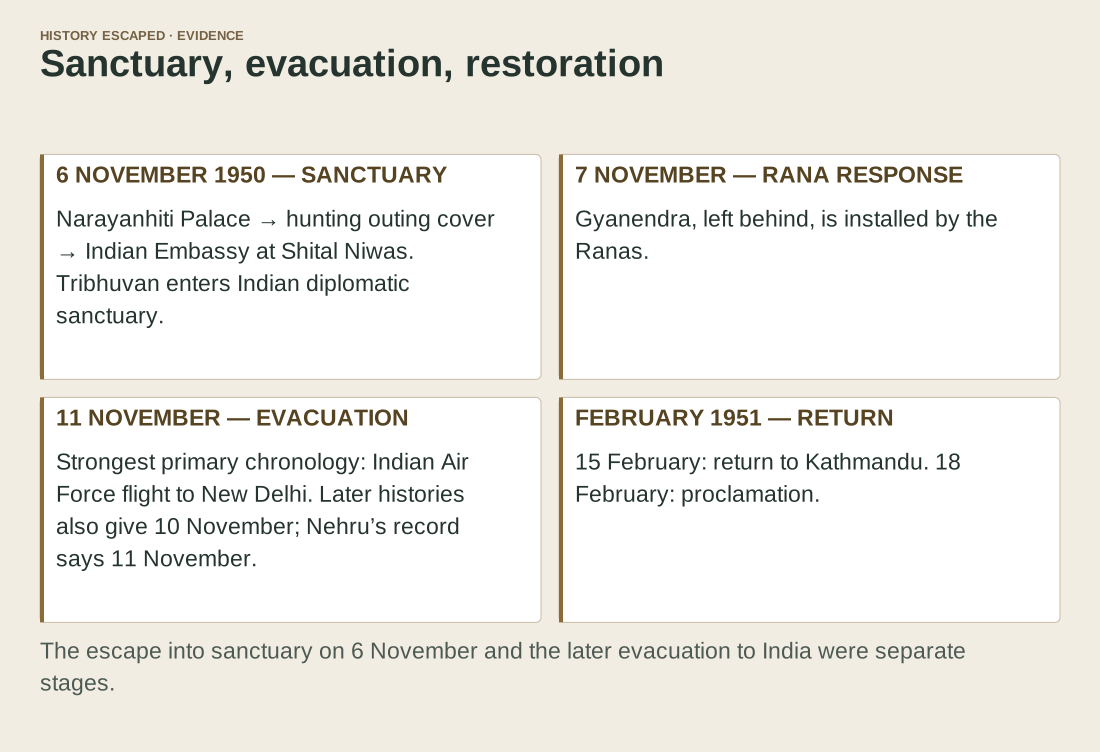
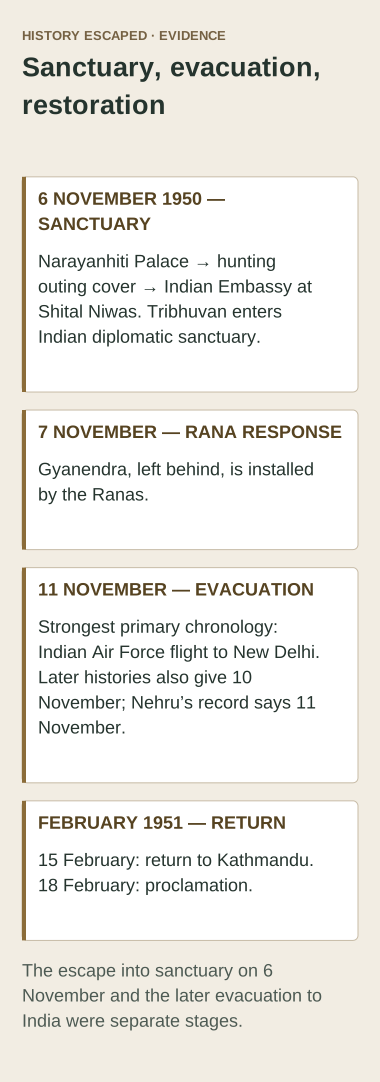
The escape into sanctuary on 6 November and the later evacuation to India were separate stages.
Selected chronology
Selected chronology
Tribhuvan enters Indian Embassy sanctuary
The king and most of the royal family leave Narayanhiti and enter Shital Niwas rather than continue the announced hunting outing.
Rana government seeks his return
Bijaya Shamsher is sent to persuade the king to leave the embassy and return to the palace.
Gyanendra installed as king
After Tribhuvan refuses to abdicate or send Birendra back, the Rana political establishment turns to the young Gyanendra.
Indian Air Force carries royal family to Delhi
Nehru’s near-contemporary note states that Tribhuvan and his family were brought to Delhi as state guests.
Revolution and Delhi negotiations
Nepali Congress armed action expands while Indian-mediated negotiations involve Tribhuvan, Rana representatives, and Congress leaders.
Tribhuvan returns to Kathmandu
The king returns with exiled political leaders after a compromise over an interim government.
Democratic proclamation
Tribhuvan issues the proclamation establishing the transitional political order and promising representative constitutional government.
Evidence discipline
What the record supports
Status labels distinguish secure conclusions from uncertainty and rejected claims. Color is never the only signal.
MYTH
Tribhuvan’s escape began only when he flew from Nepal to India.
The decisive break from Rana physical control occurred on 6 November when he entered Indian diplomatic sanctuary in Kathmandu.
Sources: SRC-001, SRC-002DISPUTED
The entire royal family entered the Indian Embassy.
Most of the family went, but Gyanendra remained behind. Nehru’s close-in-time description specifies two queens, three sons, and other family members.
Sources: SRC-001, SRC-002UNKNOWN
Gyanendra was accidentally forgotten at the palace.
Later histories suggest he may have been deliberately left to reduce suspicion or preserve the royal line, but the motive is not established by the closest primary source.
Sources: SRC-005DISPUTED
Tribhuvan flew to Delhi on 10 November 1950.
Some later histories give 10 November. Nehru’s note of 12 November states that an Indian Air Force aircraft brought the family to Delhi on 11 November, and a Nehru Archive image is dated 11 November in New Delhi.
Sources: SRC-003, SRC-007MYTH
Gyanendra’s installation immediately made him internationally accepted king.
India continued to recognize Tribhuvan; the lack of international recognition weakened the Rana attempt to replace him.
Sources: SRC-001, SRC-003MYTH
Tribhuvan’s return produced an immediate pure democracy with no Rana role.
The settlement created a mixed Rana–Nepali Congress ministry under restored royal authority, and Mohan Shamsher temporarily remained prime minister.
Sources: SRC-001, SRC-004, SRC-006MYTH
The 1950–51 revolution was solely Tribhuvan’s personal project.
The transition also depended on Nepali Congress organization and armed action, popular protest, Indian diplomacy, and wider anti-Rana political movements.
Sources: SRC-001, SRC-006