
Sun Yat-sen did not break a lock, climb from a window, or slip past a guard.
For nearly two weeks in October 1896, the future Chinese revolutionary leader was confined inside the Qing government’s legation in London. His way out depended on something less cinematic but more unusual: a chain of messages, friends, policemen, journalists, private watchers, and diplomats that gradually made a secret detention impossible to keep secret.
Even the beginning of the story is contested.
Sun later said that on the morning of 11 October he was walking through the Portland Place area when Chinese men struck up a friendly conversation, led him toward what they called their lodgings, and then half-persuaded, half-pushed him through a doorway. Only after the door closed, he wrote, did he realize he had entered the Chinese Legation.
Legation officials told a different story. They maintained that Sun had come to the building voluntarily, had previously visited, and was detained only after staff confirmed that he was the wanted revolutionary Sun Wen.
More than a century later, historians still have to preserve that disagreement.
What happened after Sun was inside is much clearer. He was not free to leave. The British government eventually demanded his release and later told Parliament that his detention had been an abuse of diplomatic privilege and was not warranted by international law.
That distinction turns the famous “kidnapping” into an unusually revealing rescue story: the entry remains disputed; the imprisonment does not.
Why the Qing Government Wanted Sun
In 1896 Sun Yat-sen was not yet the globally recognized revolutionary later associated with the fall of the Qing dynasty. He was, however, already a wanted opponent of the government.
The previous year he had been involved in plans for an uprising in Guangzhou. The effort collapsed before it could achieve its objective, participants were arrested and executed, and Sun fled. He moved through Japan, Hawaii, and the United States before reaching Britain.
Sun had a reason to come to London beyond simple exile. He knew James Cantlie, a Scottish physician who had taught him at the Hong Kong College of Medicine for Chinese. Sun later wrote that he arrived in London on 1 October 1896 and resumed contact with Cantlie and another former teacher, Patrick Manson.
The Qing authorities were also tracking him.
Modern scholarship shows that the London legation had been warned about Sun’s movements and was interested in securing him. The wider context matters. Qing diplomats operated in a world in which foreign powers had imposed extensive extraterritorial privileges in China. Historian Jenny Huangfu Day has argued that the legation’s actions should be understood partly within Qing attempts to recover judicial sovereignty over Chinese subjects abroad.
That context explains the institutional motive. It does not make the detention lawful in Britain.
The Doorway Problem
Sun’s own version appeared in Kidnapped in London, published in English in 1897.
He wrote that on Sunday morning, 11 October, a Chinese man approached him near Portland Place and asked whether he was Chinese or Japanese. After learning that Sun came from Guangdong, the stranger presented himself as a fellow provincial. Other men joined them. Conversation continued as they walked.
According to Sun, two of the men invited him inside their “lodgings.” He hesitated because he was on his way to Cantlie’s home. The invitation became persistent, and the men gave him what he described as a friendly but coercive push through the door.
The door closed behind him. Sun said only then did he recognize the building as the Chinese Legation.
The legation publicly contradicted this account. Its version held that Sun had already called at the building, had entered freely, and had returned on 11 October. Sir Halliday Macartney, the British-born counsellor who served the Qing mission, denied that Sun had been kidnapped, forced, or tricked into entering.
Recent scholarship has not eliminated the contradiction. Li Shan’s study of Sun’s English writing notes both traditions and also points to later recollections in which Sun’s own description of what he knew about the building was less straightforward than the polished 1897 kidnapping narrative.
There is no need to force certainty where the evidence does not permit it.
The safest conclusion is that the exact manner of entry is disputed. The detention that followed is not.

Locked Inside Portland Place
Sun’s description of the confinement is detailed.
He said he was taken upstairs, eventually placed in a third-floor room with a barred window, locked in, and guarded. An additional lock was fitted to the door. He remembered both Chinese and European attendants outside.
Macartney’s public statements later acknowledged that Sun was being detained upstairs, even while disputing the kidnapping allegation. Sun was now trapped by a peculiar combination of physical confinement and diplomatic privilege.
A legation was not literally foreign sovereign territory. The phrase “embassy soil” can be misleading. Sun nevertheless recalled Macartney telling him, in effect, that inside the building he was in China. Legation protection made the situation difficult for British police, but it did not erase British sovereignty over London.
That legal distinction became decisive. The British government later stated formally that the detention was not warranted under international law and represented a serious abuse of the privileges and immunities granted to foreign representatives.
Sun did not need to prove that the legation building had somehow become a piece of China. He needed outsiders to prove that he was being held there.

The First Problem: Get a Message Out
Sun later described several failed attempts to communicate.
English servants entered the room to bring coal, food, and attend to the fire. Sun said he asked them to deliver notes to Cantlie. He tried again with a message written on part of a handkerchief. He also described throwing scraps from the window.
These attempts, in his telling, either failed or were exposed to the legation. The breakthrough came through an English employee named Cole and Cole’s wife.
According to Kidnapped in London, Mrs. Cole wrote an anonymous warning to Cantlie on Saturday, 17 October. The message told him that a friend was imprisoned in the Chinese Legation and might soon be sent to China.
A separate institutional Sun Yat-sen archive preserves a short October 1896 message in Sun’s own name asking Cantlie to rescue him quickly and warning that he expected to be smuggled to China and killed. Whatever the exact route by which each surviving note moved, by the weekend Cantlie knew Sun was inside the legation. That changed everything.
Cantlie Finds a Problem No One Wants to Own
Cantlie initially faced a problem of credibility.
A foreign government secretly imprisoning a political opponent in central London sounded extraordinary. Sun’s account describes Cantlie going first to local police and then Scotland Yard, where officials listened but were reluctant to take unilateral action.
He and Patrick Manson kept pushing.
Cole provided direct information from inside the building. Manson approached the legation and asked for Sun, only to be told that no such person was there. Cantlie sought private surveillance. He alerted newspapers. The two doctors went to the Foreign Office.
The later official chronology confirms the crucial point: the Foreign Office received its first intimation of the case on Sunday, 18 October. From there the rescue moved from private agitation toward state action.
The Shipping Threat
Sun believed the greatest danger was not indefinite confinement in London but secret removal from Britain.
In his 1897 account, he said a legation official told him that arrangements were being made to place him aboard a steamer, take him toward China, and ultimately deliver him into Qing custody. Sun expected execution if that happened.
Some of the most dramatic details—being bound and gagged, the exact transfer plan, and threats made inside the room—come through Sun’s own narrative and should be treated accordingly. The underlying removal threat is stronger than those individual details.
Modern scholarship describes the legation as attempting to deport Sun back to China. Sun’s account also says that once the Foreign Office investigated shipping arrangements, officials learned that passage had indeed been sought through the Glen Line.
The British government did not need to accept every word of Sun’s later reconstruction. It needed enough trustworthy evidence to conclude that a man was being unlawfully detained on diplomatic premises and might be removed.
That evidence accumulated.
Surveillance Instead of a Raid
Popular retellings can make the rescue sound as though Scotland Yard stormed the Chinese mission. It did not.
Sun’s own account says watchers were placed outside so that any attempt to move him could be followed. He describes private detectives first and government detectives later monitoring the building.
That response fit the problem.
A police assault on a legation could have created a major international incident. Watching the exits reduced the immediate danger without physically violating the premises. At the same time, the Foreign Office worked to establish facts strong enough to justify formal intervention.
A habeas corpus route was also explored, according to Sun’s account, but it did not produce his release. The decisive pressure was diplomatic.
The Press Breaks the Secret
On 22 October the case burst into public view.
The Globe published the story, and other newspapers rapidly pursued it. The affair was no longer a quiet dispute between Cantlie, the police, the Foreign Office, and the Chinese mission.
Reporters went to the legation. Macartney acknowledged that a man was being detained while insisting that he had entered voluntarily and that the legation had not kidnapped him.
The distinction did little to remove the political problem.
Sun’s own book says that Cole pointed him toward a newspaper clipping inside the room. For the first time, Sun knew that the outside world knew where he was.
Publicity was not the legal mechanism that freed him, but it destroyed the secrecy on which a covert disappearance would have depended.
Salisbury’s Demand
The British government’s later parliamentary statement is unusually clear.
The Foreign Office learned of the case on 18 October. Officials investigated. Once trustworthy evidence was obtained, Lord Salisbury addressed a note to the Chinese minister stating that Sun’s detention was an abuse of diplomatic privilege and requesting his immediate release.
The government also later told Parliament that Sun’s detention was “certainly not warranted by International Law.” That official language matters because it settles one of the case’s central questions. The legation possessed diplomatic privileges. It did not possess a lawful power to imprison Sun indefinitely in London.
23 October: Released, Not Broken Out
Sun was released on Friday, 23 October 1896.
His own account places the handover at about 4:30 in the afternoon. He remembered being brought downstairs without first being told he was free. Cantlie appeared with a Scotland Yard inspector and a messenger from the Foreign Office.
Macartney returned Sun’s effects. The party then left through a rear or side exit into Weymouth Street.
The British parliamentary record supplies the harder institutional fact: Salisbury’s request for immediate release was complied with on 23 October. No cell door was forced. No wall was climbed. No police squad seized Sun from his captors.
The rescue succeeded because the confinement became politically, diplomatically, and publicly impossible to sustain.
What the Story Commonly Gets Wrong
The first mistake is to tell the capture as though the street kidnapping were proven beyond dispute. It is not. Sun’s account is vivid and immediate, but the legation denied it, and later scholarship has found reasons to keep the threshold question open.
The second mistake is to say that entering the legation placed Sun legally on Chinese soil. Diplomatic premises were protected, but London remained British territory. The British government’s own condemnation of the detention makes that clear.
The third is to turn Cantlie into a physical rescuer. His importance was greater than that. He built the outside chain that Sun could not build from the locked room: confirmation, allies, police attention, diplomatic escalation, surveillance, and publicity.
The fourth is to treat Kidnapped in London as if it were a neutral police file. It is a crucial primary source, written by the man at the center of the event and published the following year. It is also political autobiography. Scholarship on Sun’s later English-language image shows how the book helped recast him in Western eyes from an obscure revolutionary fugitive into a recognizable political figure.
Both facts can be true.
Why the Rescue Worked
The rescue worked because each new participant solved a different problem. Sun could not leave, so he tried to communicate.
Cole and Mrs. Cole helped move information outside.
Cantlie and Manson gave the information credibility and persistence. Private watchers and police reduced the risk of a secret removal. The Foreign Office converted suspicion into an international dispute that the Qing legation could not easily ignore. The press made continued secrecy impossible.
Salisbury supplied the formal demand.
The episode therefore belongs in the history of escapes, but with an important qualification. Sun did not escape the Chinese Legation by defeating its locks. He was rescued from a political detention when the outside world finally penetrated the information barrier around him.
That is what made the locked room untenable.
Escape reconstruction
How the escape unfolded
An evidence-aware sequence of the principal stages.
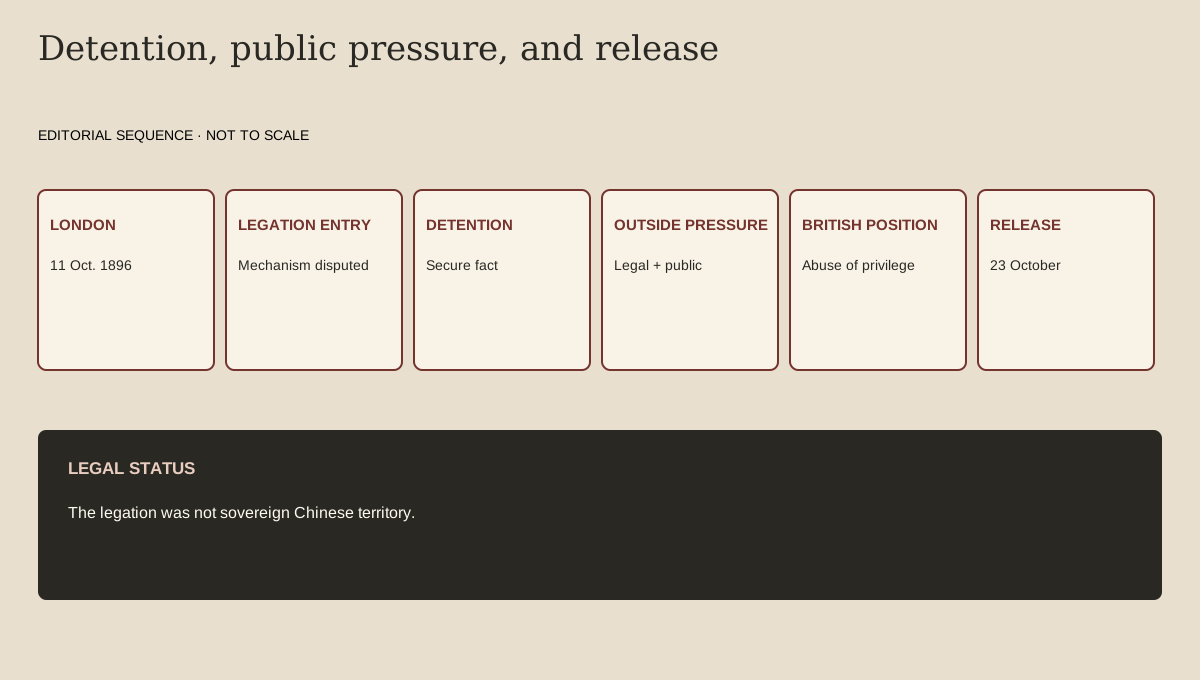
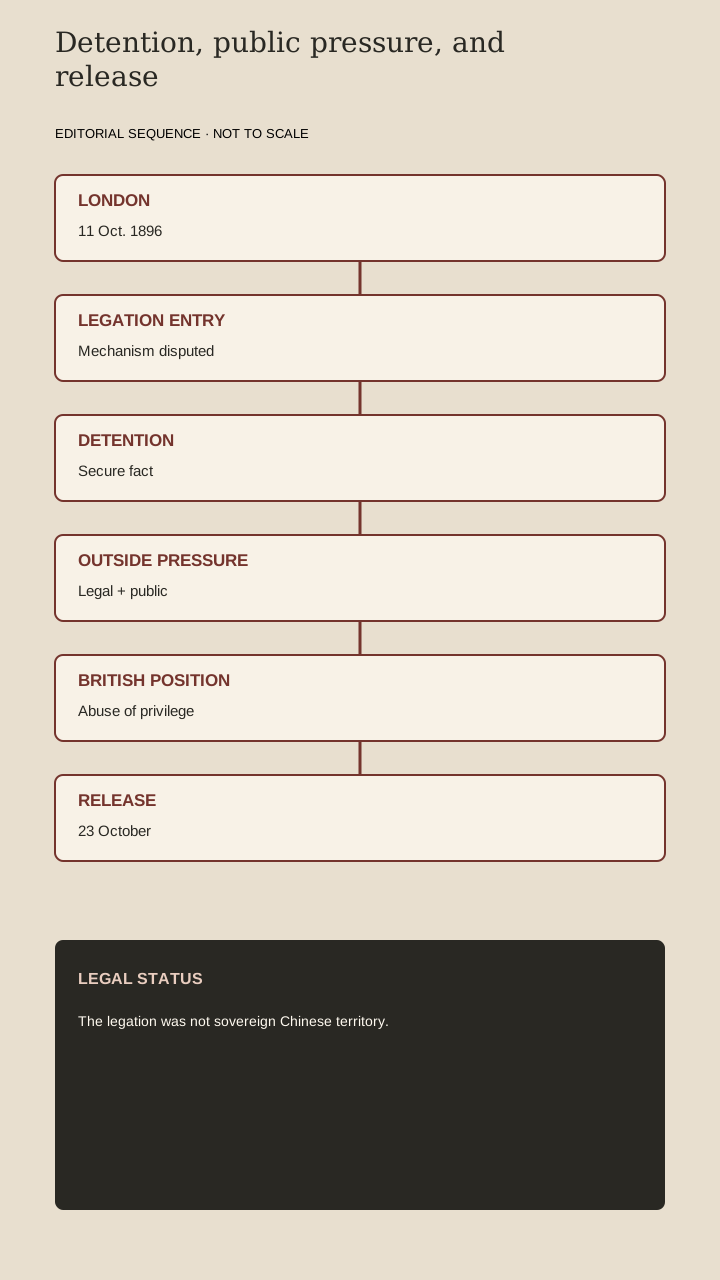
Simplified editorial reconstruction; not to scale. See adjacent text for evidence qualifications and unresolved details.
Material evidence
Tools of Escape
The objects used in an escape reveal how a plan worked under constraint.
- 01Communication
Hidden notes and cards
Sun tried several channels to send word outside; the surviving and reported messages made his otherwise concealed detention actionable.
- 02Public pressure
Press publicity
Newspaper exposure transformed a private diplomatic dispute into a public scandal and reduced the possibility of secretly removing Sun from Britain.
Problem → response
Escape was a sequence of problems
Each response solved a practical obstacle while often creating the next one.
- 01→
Obstacle
Diplomatic premises
British police could not simply treat the legation as an ordinary private house without creating a serious diplomatic dispute.
Response
Cantlie and his allies pushed the matter toward the Foreign Office, which verified the detention and used diplomatic pressure rather than a forcible raid.
- 02→
Obstacle
Secrecy
Sun’s detention was initially unknown outside the legation, and the first messages he described did not reach his friends.
Response
Cole, Mrs. Cole, Cantlie, Manson, private watchers, government investigators, and eventually the press progressively removed the secrecy.
- 03→
Obstacle
Disputed evidence of how Sun entered
The legation denied kidnapping Sun into the premises and claimed he entered voluntarily, complicating the early legal and diplomatic picture.
Response
British action ultimately rested on the continued detention itself, which the government later said was not warranted by international law.
- 04→
Obstacle
Threat of removal to China
Sun believed the legation intended to send him secretly back to Qing custody, where he expected execution.
Response
Outside surveillance, inquiry into shipping arrangements, and rapid public exposure made covert removal far harder before Salisbury demanded his release.
The final accounting
Outcome
Released in London
Sun left the Chinese Legation on 23 October 1896 after a formal British demand.
No forcible police extraction
The successful outcome was diplomatic release after outside pressure, not a storming of the legation or a physical breakout by Sun.
International notoriety
The affair brought Sun substantial press attention and contributed to the international political image he developed in the following years.
Evidence discipline
What the record supports
Status labels distinguish secure conclusions from uncertainty and rejected claims. Color is never the only signal.
DOCUMENTED
Sun Yat-sen was held against his will inside the Chinese Legation.
Whatever the manner of entry, the British government officially acknowledged the detention, demanded release, and later stated that the detention was not warranted by international law.
Sources: SRC-003DISPUTED
Sun was definitely kidnapped from the street and physically forced into the legation.
Sun’s 1897 account says Chinese men coaxed him toward the building and partly forced him across the threshold. Legation officials said he entered voluntarily, and modern scholarship identifies two competing versions of the entry.
Sources: SRC-001, SRC-004, SRC-005MYTH
Once Sun crossed the legation door he was legally “in China” and British law no longer applied.
Sun remembered Macartney using language to that effect, but the British government later said the detention was not warranted by international law and constituted an abuse of diplomatic privilege. Diplomatic premises were protected, not transformed into sovereign Qing territory.
Sources: SRC-001, SRC-003WELL-SUPPORTED
The legation intended to send Sun back to China without ordinary British extradition proceedings.
Sun’s account describes explicit threats of secret removal on a Glen Line steamer, and his narrative says the Foreign Office later verified that passage had been sought. Modern scholarship likewise describes the detention as part of an attempt to deport him back to China.
Sources: SRC-001, SRC-005MYTH
James Cantlie rescued Sun by personally breaking into the legation.
Cantlie was pivotal, but the successful mechanism was advocacy, investigation, surveillance, press exposure, and a Foreign Office demand. Sun was handed over by the legation; there was no forcible rescue raid.
Sources: SRC-001, SRC-003DISPUTED
Sir Halliday Macartney alone ordered Sun’s detention.
Modern scholarship notes disagreement over whether Minister Gong Zhaoyuan ordered the detention or Macartney acted on his own initiative. A later British parliamentary answer assigned responsibility to the Chinese minister, while recent scholarship argues Macartney may have been the principal architect because Gong was gravely ill and absent.
Sources: SRC-003, SRC-005MYTH
Sun’s 1897 book can be treated as a neutral transcript of independently verified facts.
It is indispensable primary evidence and was published soon after the event, but it is also Sun’s own political narrative, produced with English-language assistance and later central to his international image. Claims found only there require qualification.
Sources: SRC-001, SRC-004, SRC-007Selected chronology
Selected chronology
Failed Guangzhou uprising
Sun became a wanted revolutionary after involvement in the failed Guangzhou uprising and went into exile.
Sun arrives in London
Sun later wrote that he arrived in London on 1 October and renewed contact with James Cantlie.
Detained at the Chinese Legation
Sun entered the legation at 49 Portland Place and was detained. Whether he was deliberately lured and partly forced across the threshold or entered voluntarily remains disputed.
Warning reaches Cantlie
Sun’s account says an anonymous note from Mrs. Cole reached Cantlie late that night, followed by direct messages carried by Cole.
Foreign Office alerted
The British government later stated that the Foreign Office received its first intimation of the detention on Sunday, 18 October.
The case becomes public
The Globe published the detention story, generating intense press attention. Sun’s own account says he learned that day from a newspaper clipping that the affair was public.
Release
After Lord Salisbury demanded Sun’s immediate release, the legation complied. The British government later confirmed the release date and condemned the detention as an abuse of diplomatic privilege.
Kidnapped in London published
Sun published an English-language account of the affair, turning the episode into a major part of his international political image.