
At a Glance
- Rescue date: 11 March 1854
- Place: Milwaukee County Jail, Courthouse Square, Milwaukee, Wisconsin
- Person rescued: Joshua Glover
- Captivity type: Federal detention under the Fugitive Slave Act of 1850
- Main method: Mass public rescue followed by clandestine assistance
- Outcome: Glover escaped federal custody, reached Canada, and was never returned to slavery
Joshua Glover had been living in Wisconsin for nearly two years when the Fugitive Slave Act reached him. He had escaped slavery in Missouri in 1852, settled near Racine, and found work. On the night of 10 March 1854, men acting for his former enslaver seized him and carried him to Milwaukee, where federal authorities intended to use the law to send him back south.
By the following evening, Glover was no longer in the jail. A large antislavery gathering had turned from petitions and habeas corpus into direct action: members of the crowd battered through the jail entrance and brought him out. Yet the breach was only the beginning of the rescue. Glover still had to disappear into a network of helpers, evade renewed capture, and reach Canada before the federal law could be used against him again.
Freedom in Racine was legally vulnerable
Little about Glover’s early life is securely documented. By 1850 he was held in slavery by Benammi Stone Garland in Missouri. In May 1852, Glover escaped. The National Park Service estimates that he traveled roughly four hundred miles north before reaching Racine, but the exact path is unknown and should not be reconstructed as a definite Underground Railroad route.
In Racine, Glover found work connected with a local mill and began living as a free man. Wisconsin had entered the Union as a free state, but that did not protect him from federal rendition. The Fugitive Slave Act of 1850 strengthened the federal machinery available to people claiming escaped freedom seekers and imposed penalties on those who obstructed enforcement or assisted an escape.
The law made Glover’s freedom precarious even after he had successfully left Missouri. He could work, establish relationships, and live openly enough to become known in the community, while still facing the possibility that federal officers could seize him and attempt to return him to slavery.
The arrest near Racine
On 10 March 1854, Garland came to the Racine area with men assisting in Glover’s recapture. Glover was seized near the place where he was living and taken north to Milwaukee. Accounts agree that the arrest was violent and that he reached the Milwaukee jail injured, though they differ over the precise struggle and whether he resisted his captors.
That uncertainty matters because later narratives became increasingly detailed. C. C. Olin, one of the Wisconsin antislavery activists who later helped move Glover, published a long reminiscence in 1893. Within only a few pages, Olin’s account contains both a statement that force was required because Glover resisted and another assertion that eyewitnesses said he offered no resistance. The contradiction is a warning against turning a late recollection into a frame-by-frame reconstruction.
The broad sequence is firmer. Glover was placed in the Milwaukee County Jail at Courthouse Square, within the federal legal process created by the Fugitive Slave Act. News reached Racine and Milwaukee rapidly, and local opposition began to organize.
A legal challenge becomes a public confrontation
Sherman M. Booth, an antislavery newspaper editor, became the most famous public organizer associated with the rescue. He helped spread news of Glover’s detention and addressed people gathering around the courthouse and jail. Racine residents also held meetings and organized their own response, eventually sending a sizeable delegation to Milwaukee.
The first strategy was not simply to break the jail. Supporters sought legal process, including habeas corpus, and attempted to force an immediate hearing over Glover’s detention. The dispute therefore became both a protest against the Fugitive Slave Act and a contest over whether state and local legal institutions could intervene when federal officers claimed custody.
By late afternoon on 11 March, a large crowd had gathered. Later sources disagree over its maximum size, and the often-repeated figure of 5,000 should not be treated as settled. Olin remembered several hundred people at an earlier stage and more than a thousand later. What the evidence supports without controversy is that the gathering was large, organized enough to create committees and hear speeches, and reinforced by roughly one hundred people who came from Racine.
Tension rose after federal authorities refused to release Glover for the state legal proceedings sought by his supporters. Olin’s later account records Booth warning against violence shortly before the decisive moment. That does not remove Booth from responsibility for mobilizing opposition, and federal prosecutors later made his role central to their case. It does, however, complicate the familiar image of a single leader simply ordering a mob to storm the jail.
The jail door gives way
After the demand for the keys failed, members of the crowd turned to force. Olin remembered a group using a large timber as a makeshift battering ram. The exact dimensions he supplied decades later are unnecessary to understanding the event and should not be treated as secure mechanical data. What matters is that the jail entrance was broken and Glover was brought out.
The rescue was public rather than stealthy. Federal officers and their supporters were present in a city where the dispute had already drawn a crowd, committees, legal petitions, speeches, and a delegation from another community. Glover’s removal from custody therefore represented an open refusal by part of the Wisconsin public to allow the federal rendition process to continue.
The event is sometimes reduced to “Sherman Booth freed Joshua Glover.” That description gives one organizer too much control over a collective action and risks pushing Glover himself to the edge of his own story. Booth mobilized resistance and later bore much of the federal prosecution, but unidentified members of the crowd physically breached the jail, Racine activists had organized independently, and a wider network would be needed to keep Glover free afterward.
Getting out of Milwaukee was not the end
A person rescued from federal custody in Milwaukee remained vulnerable anywhere in the United States. Glover therefore had to move quickly beyond the city and then stay hidden while the search continued.
The best-known route details come from people who wrote decades later. Olin recalled that John A. Messenger took Glover west from Milwaukee toward Waukesha. From there, Olin said, Glover was moved through Rochester and back toward Racine, where supporters hoped to find passage across the Great Lakes. A 1903 note by Booth added that Glover spent time around Spring Prairie before being returned to the lakeshore and placed aboard an eastbound vessel.
These recollections are plausible and overlap with Wisconsin’s documented antislavery networks, but they are too late to justify a street-by-street or road-by-road map. The secure reconstruction is broader: Glover left Milwaukee with assistance, was concealed and moved among helpers in southeastern Wisconsin, and eventually departed by water for Canada.
That interval may have lasted several weeks. The Great Lakes shipping season affected when safe passage could be arranged, making concealment as important as speed. The rescue had changed Glover’s immediate situation, but permanent safety required crossing an international border.
Canada

Glover reached Canada in the spring of 1854. He was beyond the reach of the U.S. Fugitive Slave Act and was not returned to Garland. The exact Canadian landing point has not been established. Later research suggests possible arrival around Collingwood or Owen Sound, but neither should be presented as certain.
He eventually settled in Etobicoke, in what is now Toronto, Ontario. There he worked for decades in the community associated with Thomas Montgomery and Montgomery’s Inn. His life in Canada was not free of hardship or racism, but the central outcome of the 1854 rescue held: federal authorities never succeeded in returning him to slavery.
The documentation of this part of Glover’s story is also a reminder of an imbalance in the surviving record. Court cases and political controversy preserved extensive words from judges, lawyers, editors, and government officers. Far less of Glover’s own speech survives. A responsible reconstruction can establish what happened to him without inventing private thoughts or dialogue to compensate for that silence.
Wisconsin challenges the Fugitive Slave Act
Federal authorities responded to the rescue by prosecuting people accused of helping Glover, most notably Booth. The resulting litigation transformed a local rescue into a major dispute over federal power, state courts, and the Constitution.
Booth sought habeas corpus in Wisconsin. Justice Abram D. Smith of the Wisconsin Supreme Court ordered him released and held the Fugitive Slave Act unconstitutional. The full Wisconsin Supreme Court later sustained the state challenge, although Justice Samuel Crawford dissented. Byron Paine, Booth’s lawyer, argued that Wisconsin retained authority to protect liberty against an unconstitutional federal law.
Wisconsin resistance extended beyond the courtroom. In 1857 the state legislature enacted a measure forbidding Wisconsin officials from participating in enforcement of the Fugitive Slave Act. The state had become one of the most conspicuous centers of northern resistance to federal fugitive-slave policy.
It is easy to overstate what Wisconsin accomplished legally. The state did not repeal the federal statute, and its courts did not have the final word on federal constitutional law. Booth was also prosecuted and convicted in federal court despite his successes in the state system.
Ableman v. Booth
The conflict eventually reached the U.S. Supreme Court as Ableman v. Booth and the related federal case against Booth. In 1859, the Court unanimously rejected Wisconsin’s attempt to use state habeas corpus against federal custody.
Chief Justice Roger B. Taney’s opinion emphasized federal judicial supremacy: once a state court was informed that a prisoner was held under federal authority, it could not order the federal officer to release that person. Taney also stated that the Fugitive Slave Act was constitutionally authorized, although the Federal Judicial Center notes that this statement was not necessary to the jurisdictional holding.
The ruling reversed the legal theory on which Wisconsin’s intervention had rested. It did not erase the political significance of the resistance. For several years, Glover’s rescue and Booth’s prosecution had forced Wisconsin judges, legislators, voters, and federal officials to confront whether obedience to federal law could be reconciled with opposition to slavery and with competing understandings of personal liberty.
What the rescue did—and did not—prove
The rescue did not make Wisconsin legally independent of federal authority. Nor did it end the Fugitive Slave Act, which remained federal law until Congress repealed the fugitive-slave statutes in 1864. The U.S. Supreme Court made clear in 1859 that Wisconsin courts could not override federal custody in the manner they had attempted.
The event did demonstrate how difficult enforcement could become when a substantial part of a northern community refused cooperation. Glover’s supporters used meetings, journalism, legal petitions, local warrants, physical rescue, hiding places, transportation, and maritime escape as parts of the same resistance. The federal law existed, but enforcing it depended on officials operating in communities that could obstruct, delay, expose, and sometimes defeat rendition.
That is why the Glover case belongs both to the history of escape and to constitutional history. The immediate objective was intensely personal: prevent one man from being returned to slavery. The consequences became much larger because the federal government then tried to punish those who had made that rescue possible.
Why the Joshua Glover rescue matters
Glover’s story is sometimes overshadowed by the litigation bearing the names of Booth and U.S. Marshal Stephen Ableman. Yet the constitutional dispute existed because Glover had first escaped slavery, built a life in Wisconsin, survived recapture, and then escaped federal custody with extensive community assistance.
The most important chronological distinction is simple. 1852 was Glover’s initial self-emancipation from slavery in Missouri. March 1854 was his rescue from attempted federal rendition. The latter did not secure permanent safety until he crossed into Canada.
Seen that way, the Milwaukee jail breach is neither an isolated riot nor a complete escape story by itself. It was the visible middle of a longer struggle: freedom gained, threatened, publicly defended, hidden through a network, and finally protected beyond the jurisdiction of the law that had authorized Glover’s recapture.
Documentary reconstruction
Physical rescue and legal aftermath unfold on separate tracks
A case-local visual focused on the historical question that the surviving evidence can answer.

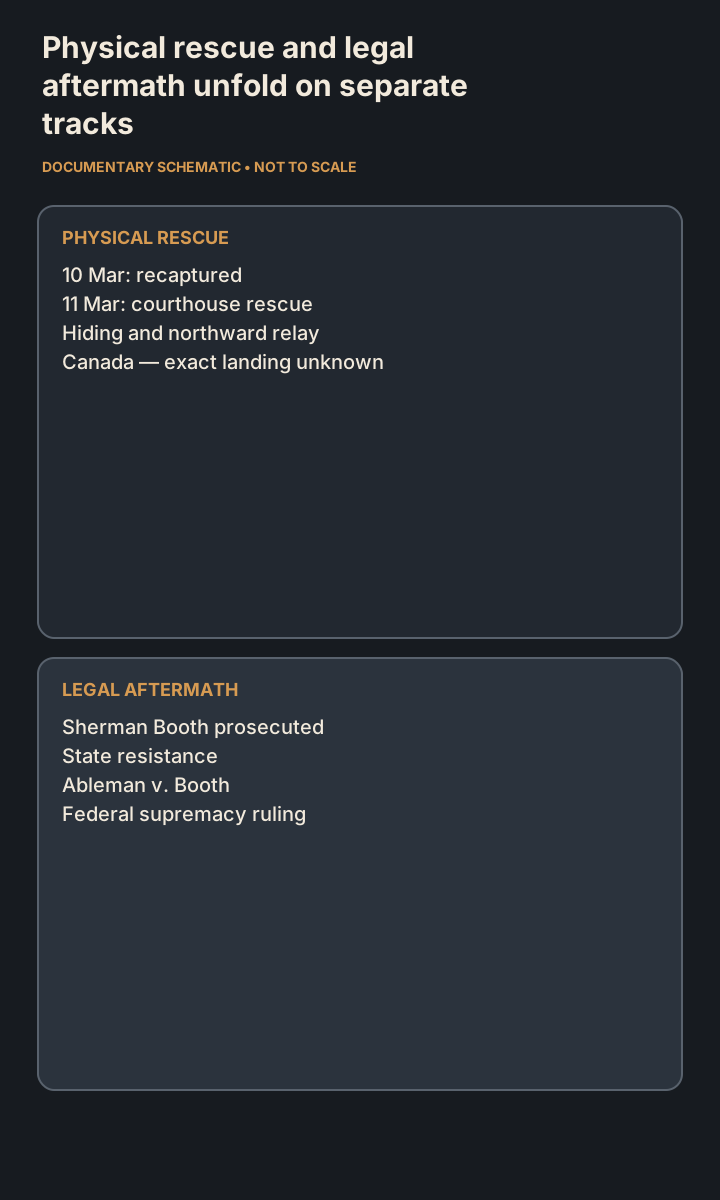
Simplified documentary reconstruction; not to scale. Evidence qualifications are written directly into the visual and explained in the adjacent text.
Evidence discipline
What the record supports
Status labels distinguish secure conclusions from uncertainty and rejected claims. Color is never the only signal.
MYTH
Joshua Glover first escaped slavery in 1854.
Glover escaped slavery in Missouri in 1852 and lived near Racine for roughly two years. The March 1854 event was his rescue from attempted federal recapture.
Sources: SRC-001DISPUTED
Exactly 5,000 people participated in the Milwaukee rescue crowd.
Later retellings often use 5,000, but participant recollections describe different crowd sizes at different stages and do not support treating one high-end figure as settled. The secure formulation is a large crowd involving hundreds of people.
Sources: SRC-007, SRC-008DISPUTED
Sherman Booth personally commanded the physical breach of the jail.
Booth clearly helped mobilize opposition and addressed the gathering, but later participant testimony also records him cautioning against violence before the breach. The jail door was broken by members of the crowd rather than by Booth acting alone.
Sources: SRC-003, SRC-008MYTH
Glover went directly from the Milwaukee jail to Canada on the night of the rescue.
Participant recollections and later institutional research describe a period of concealment and movement through southeastern Wisconsin before maritime passage to Canada became available.
Sources: SRC-008, SRC-009, SRC-010MYTH
Wisconsin permanently nullified or repealed the federal Fugitive Slave Act.
Wisconsin's courts declared the act unconstitutional in Booth's litigation and the legislature later barred state participation in enforcement, but the U.S. Supreme Court reversed the state-court intervention in 1859. Federal repeal came later through Congress.
Sources: SRC-004, SRC-005, SRC-006UNKNOWN
The exact Canadian port where Glover landed is known.
Glover's arrival in Canada and later settlement in Etobicoke are well supported, but modern heritage research treats specific landing places such as Collingwood or Owen Sound as likely possibilities rather than established facts.
Sources: SRC-010