
Charles Nalle tried to escape through a second-story window on 27 April 1860. He did not make it.
His legs were already outside the office of U.S. Commissioner Miles Beach in Troy, New York, when someone inside pulled him back. The successful rescue came later, in the street. Then Nalle was arrested again across the Hudson River and had to be rescued a second time before the day was over.
That sequence matters because the Charles Nalle Rescue was larger than the familiar image of Harriet Tubman helping a freedom seeker through a window. It was a collision between federal fugitive-slave enforcement, state legal resistance, Black abolitionist organization, mass direct action and Nalle’s own continuing effort to remain free.
At a Glance
- Date: 27 April 1860
- Place: Troy and West Troy, New York
- Freedom seeker: Charles Nalle
- Federal law: Fugitive Slave Act of 1850
- Commissioner: Miles Beach
- Nalle’s lawyer: Martin I. Townsend
- Local Black organizer: William Henry
- Major participant: Harriet Tubman
- First rescue: Street struggle in Troy
- Second rescue: After Nalle’s re-arrest in West Troy
- Legal manumission: Purchased soon afterward for $650
- Major correction: Nalle’s attempted second-story window escape failed
Nalle Had Already Escaped Once
Charles Nalle had been born into slavery in Culpeper County, Virginia, probably around 1821. By 1860 the person claiming legal ownership over him was Blucher W. Hansbrough. Later family histories describe a possible blood relationship between the two men, but that relationship is less important than the legal reality: Virginia law treated Nalle as property that Hansbrough could sell, transfer or reclaim.
Nalle had a wife, Kitty, and children from whom slavery had separated him. In October 1858, Nalle and another enslaved man, Jim Banks, escaped Virginia.
The exact date is uncertain. Federal paperwork later used dates around 13 or 15 October, while the Troy Whig reported 19 October.
The month is secure. The precise day is not.
North to Pennsylvania and New York
Nalle first reached Pennsylvania. He later made his way into upstate New York, living for a time around Sand Lake before moving into Troy.
By April 1860 he was working as a coachman for the household of prominent manufacturer Uri Gilbert. He boarded with William Henry, a Black grocer and abolitionist associated with local vigilance activity.
Nalle had reached a free state. Federal law still allowed the person claiming him to reach across state lines.
The Fugitive Slave Act Reaches Troy
The Fugitive Slave Act of 1850 strengthened federal machinery for returning people who had escaped slavery. A claimant did not need to win an ordinary state criminal trial.
Federal commissioners could examine evidence, issue warrants and authorize removal. Federal officers could be used to arrest and transport the person claimed.
In Troy, Henry J. Wale, acting as an agent for Hansbrough, went before U.S. Commissioner Miles Beach.
The paperwork began before Nalle knew he was in immediate danger. On 26 April, Beach issued a warrant.
The Betrayal Story Is Not Settled
For generations, many retellings blamed a local lawyer and newspaperman named Horatio F. Averill for exposing Nalle.
The story said Nalle, unable to write, trusted Averill with correspondence and that Averill sent his location to Virginia. Contemporary newspapers made versions of that accusation.
Averill denied it. In a signed letter published after the rescue, he said he had never written a letter for Nalle and had never met him before the day of the arrest. He acknowledged representing the claimant’s side but said intercepted correspondence had led the Virginia party to Troy.
Other local abolitionists challenged his explanation. The actual information chain remains disputed. What is certain is that Wale arrived with legal authority to pursue Nalle.
Arrested on an Errand
On the morning of 27 April 1860, Nalle left to buy bread for the Gilbert household. Deputy U.S. Marshal John L. Holmes arrested him.
He was handcuffed and taken to Commissioner Beach’s second-floor office near First and State streets. The hearing moved quickly.
Beach accepted the claimant’s evidence, identified Nalle as the person Hansbrough claimed, and issued the certificate authorizing his removal to Virginia. The federal paperwork even recorded Wale’s fear that local residents might rescue Nalle by force. That fear was already becoming reality outside.
William Henry Finds Him
When Nalle failed to return from his errand, people who knew him began looking. William Henry suspected what had happened.
Henry obtained the help of attorney Martin I. Townsend and went toward the commissioner’s office. He also spoke publicly about the arrest to people gathering outside.
The crowd grew. Black residents were prominent from the beginning.
White antislavery residents and other onlookers joined them. By afternoon, hundreds of people filled the area around the building.
Harriet Tubman Arrives
Harriet Tubman was in Troy that day. Her later biographer Sarah H. Bradford wrote that Tubman was traveling toward Boston for an antislavery meeting and had stopped in Troy to visit a relative.
Tubman learned that a man who had escaped slavery was about to be taken south. She went toward the commissioner’s office.
This part of the story requires a source distinction. The major contemporary newspaper reports describe Black men and women physically resisting the officers, including a conspicuous older Black woman. They do not generally identify Tubman by name. Bradford did.
What Bradford Could—and Could Not—Prove
Bradford’s 1869 biography says Tubman personally told her the story. Bradford was aware that some readers might find it too dramatic to believe. She therefore tried to check it against people who had been in Troy.
According to Bradford, an intermediary interviewed Martin Townsend, Nalle’s lawyer, and reported that Townsend confirmed the substance of Tubman’s account. A promised written statement from Townsend was never completed.
That is not the same as a newspaper naming Tubman on 28 April 1860. It is still strong evidence.
Tubman’s participation is well supported. The claim that she alone organized the rescue is not.
Nalle Tries the Window
As the crowd waited outside, Nalle made his own attempt. He moved toward a second-story window.
Contemporary reporting describes his legs and part of his body hanging outside while people below shouted for him to drop. The fall was dangerous.
Nalle was still heavily ironed. Before he could make it out, someone in the room pulled him back.
The window escape failed. This is one of the clearest places where modern summaries have sometimes compressed the story too far. Nalle was not freed by jumping from the window.
Townsend Changes the Legal Ground
Martin Townsend arrived too late to stop Commissioner Beach from ruling for the claimant. He turned to state law.
Townsend obtained a writ of habeas corpus from New York Supreme Court Justice George Gould. The writ required the federal officers to produce Nalle before Gould.
The legal challenge did not itself free him. It did something physically important: it required the officers to move their prisoner. They had to bring Nalle down the stairs and into the crowd.
The First Rescue
At about four in the afternoon, officers began moving Nalle from the commissioner’s building. The street erupted.
Rescuers pressed around the federal marshal, local officers and deputies. Nalle was pulled in competing directions as people tried to break the officers’ grip.
Later Bradford accounts place Tubman directly against Nalle, one arm locked around his manacled arm while the struggle moved through the streets. Whether every detail can be independently checked, Tubman was one participant among many.
Black men formed much of the inner rescue effort. Black women entered the struggle.
White allies also joined. The officers gradually lost control.
Toward the Hudson
The confrontation moved away from the commissioner’s office. Nalle’s supporters finally separated him from the officers and rushed him toward the river.
He was exhausted and still in irons. At the waterfront, supporters put him into a small boat or skiff.
The boat crossed the Hudson toward West Troy, the community now known as Watervliet. People on the Troy side cheered as he reached the opposite bank. For a moment, the first rescue seemed complete.
Arrested Again
Nalle stepped onto the Albany County side of the river still visibly manacled. That made him immediately conspicuous.
A local officer, Constable Becker, arrested him. Nalle was taken upstairs into a building near the ferry associated in local accounts with Justice Stewart.
The people watching from Troy realized what had happened. They began crossing the river. The rescue had to start again.
The Second Rescue
Hundreds of people followed Nalle into West Troy. Some crossed by ferry.
The crowd converged on the building where officers held him upstairs. This second confrontation became more dangerous than the first.
Local accounts describe rescuers forcing their way toward the room while officers drew and fired revolvers. Later reporting said multiple shots were fired, though no death is securely tied to the fight.
Bradford’s biography places Tubman in this second rescue as well. She describes Tubman and other Black women moving forward after men at the doorway had been struck down.
The crowd got Nalle out. This time there would be no river left to cross.
A Wagon West
Nalle’s supporters moved him along Broadway. Near the arsenal area, they put him into a wagon and drove west.
The exact path after that point becomes less certain. Later sources place Nalle in hiding around Niskayuna, Schenectady, Amsterdam, and in some versions farther north before his legal status was settled.
These locations should not be turned into one precise route unless a source identifies the sequence clearly. The secure outcome is that the abolitionist network kept Nalle beyond immediate federal recapture.
Rescue Was Not Yet Legal Freedom
April 27 gave Nalle physical control over his own movement again. Federal law still recognized the Virginia claim that Commissioner Beach had approved.
That left open the possibility of another arrest. Nalle’s supporters chose a strategy abolitionists often found morally repugnant but practically useful.
They raised money to purchase the legal claim. The price was $650.
The $650 Manumission
The American Anti-Slavery Society reported the result in its 1861 annual report. After the rescue, a subscription was organized.
The required money was raised. Nalle was legally emancipated.
The report says he returned to his former employment in Troy on 24 May 1860. Bradford later wrote that Nalle’s family joined him in Troy around July.
The rescue and the purchase were therefore different events. One stopped his rendition by force. The other blocked the legal mechanism from being used against him again.
Harriet Tubman’s Role Without the Legend
Tubman deserves a central place in the story. She entered a violent confrontation with federal and local officers.
Later evidence places her physically attached to Nalle during the first rescue and participating again across the river. But Troy did not wait for one famous visitor to become antislavery.
William Henry had already recognized the emergency. Townsend had already begun a legal challenge.
Black residents had already filled the street. Nalle had already tried to get himself out the window. The rescue succeeded because those actions converged.
Why the Two Rescues Matter
The first rescue showed the weakness of federal enforcement when a community refused to cooperate. The second showed how temporary that victory could be.
Nalle crossed a river and entered a different county, but the visible handcuffs on his wrists were enough to bring him back under official control. His freedom had to be won again within minutes.
That makes April 27 more than a story of a crowd overpowering officers. It was a contest over who could decide Nalle’s status: a Virginia claimant, a federal commissioner, New York courts, local officers, abolitionists—or Nalle himself.
By the end of the day, the federal certificate still existed. Charles Nalle was gone.
Evidence discipline
What the record supports
Status labels distinguish secure conclusions from uncertainty and rejected claims. Color is never the only signal.
MYTH
Nalle successfully escaped by jumping from the second-story window of Commissioner Beach’s office.
Contemporary accounts say he attempted the window but was pulled back inside. The first successful rescue occurred later in the street.
Sources: SRC-002, SRC-003MYTH
There was only one rescue on 27 April 1860.
Nalle was freed in Troy, re-arrested after crossing the Hudson, and rescued again in West Troy.
Sources: SRC-003, SRC-007MYTH
Harriet Tubman single-handedly organized the Nalle rescue.
Tubman was a major participant, but William Henry, Martin Townsend, local Black abolitionists, other Black women and men, white allies, and Nalle himself were already active in the rescue process.
Sources: SRC-005, SRC-007, SRC-011MYTH
Contemporary Troy newspapers explicitly named Harriet Tubman as a rescuer.
Major contemporary reports describe the rescuers and a conspicuous Black woman but generally do not name Tubman. Bradford’s 1869 biography supplies the clearest identification through Tubman’s testimony.
Sources: SRC-002, SRC-005DISPUTED
Horatio F. Averill definitely betrayed Nalle by writing his letters.
Newspapers accused Averill, but he publicly denied ever writing or reading Nalle’s letters and said intercepted correspondence revealed Nalle’s location. Local abolitionists disputed his denial.
Sources: SRC-004DISPUTED
The exact day of Nalle’s October 1858 escape from Virginia is securely known.
Federal rendition paperwork and contemporary newspapers give different October dates.
Sources: SRC-002, SRC-004MYTH
The state habeas corpus writ legally freed Nalle.
The writ required federal officers to produce Nalle before a state judge. The physical rescue occurred while officers were attempting that movement.
Sources: SRC-003, SRC-007MYTH
The crowd’s rescue permanently eliminated the legal claim against Nalle.
Supporters later raised $650 to obtain formal manumission and prevent another rendition attempt.
Sources: SRC-008UNKNOWN
The exact route Nalle followed after the second rescue is fully documented.
Later sources variously place him around Niskayuna, Schenectady, Amsterdam and farther north; the post-rescue hiding sequence should remain generalized.
Sources: SRC-005, SRC-007, SRC-011Documentary reconstruction
Two rescues and the evidence correction
A case-local editorial visual separates the documented sequence from uncertainty without implying exact modern geography or operational detail.
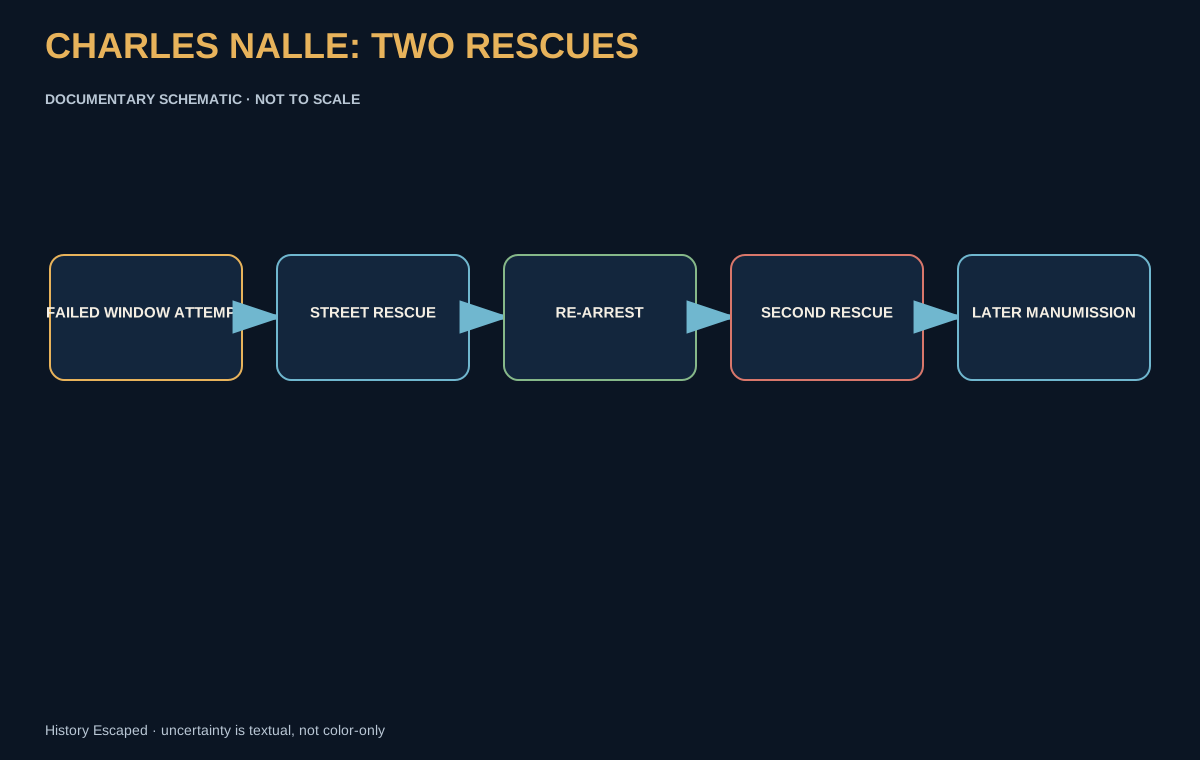
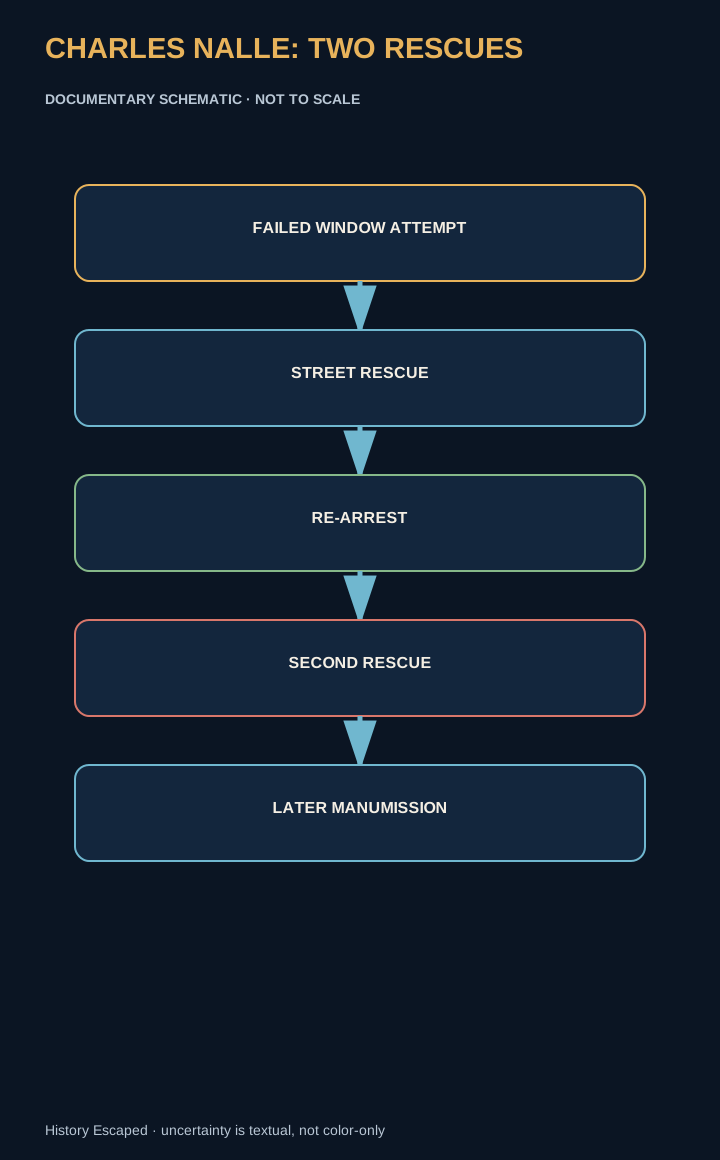
Simplified editorial reconstruction based on the cited historical record; not to scale. Uncertainty is stated directly in the visual and adjacent text.