
On 13 September 1858, John Price was taken out of Oberlin, Ohio, under a federal system designed to return people who had escaped slavery. Hours later, hundreds of residents from Oberlin and nearby Wellington were gathered around the hotel where he was being held.
Price’s captors intended to put him on a southbound train. The crowd intended to stop them.
By evening, Price was back in Oberlin. The people who had freed him would soon become defendants in one of the most politically charged Fugitive Slave Act prosecutions in the country.
At a Glance
- Date: 13 September 1858
- Place: Oberlin and Wellington, Ohio
- Person rescued: John Price
- Classification: Mass rescue from federal fugitive-slave custody
- Main setting: Wadsworth House, Wellington
- Method: Community mobilization, failed negotiation, forced extraction, concealment and Underground Railroad assistance
- Outcome: Price was returned to Oberlin and later escaped to Canada
- Federal aftermath: 37 indictments connected with the rescue
- Major correction: Thirty-seven people were indicted; thirty-seven were not convicted
Oberlin and the Fugitive Slave Act
Oberlin had spent years developing a reputation as one of the most openly antislavery communities in the United States. Black residents, white abolitionists, students, clergy and local families participated in networks that sheltered people escaping slavery and helped some continue north toward Canada.
That made the town a direct challenge to the Fugitive Slave Act of 1850.
The law strengthened federal authority to seize people alleged to have escaped slavery. It allowed claimants or their agents to pursue them into free states and imposed fines and imprisonment on people who obstructed an arrest, rescued someone from custody, or knowingly helped an alleged fugitive escape.
The law’s reach into free states was precisely what many Oberlinians rejected. Their opposition was not abstract. By 1858, the community had already been protecting freedom seekers for years.
John Price was one of them.
John Price in Oberlin
Price had escaped slavery in Kentucky and reached Oberlin around 1856. Institutional sources describe him as a young man who lived and worked in the community for roughly two years.
His exact age is less secure than the basic chronology. Some later sources call him seventeen; others eighteen. The uncertainty does not change the central fact that he had built a life in Oberlin before men acting for a Kentucky claimant came looking for him.
The claimant was John G. Bacon of Mason County, Kentucky. Anderson Jennings, acting on Bacon’s behalf, became part of the effort to recover Price.
Trying to seize Price openly in central Oberlin would have been risky. The men therefore used deception.
Lured Out With a Promise of Work
On the morning of September 13, Price was approached by Shakespeare Boynton, a local young man whose family owned land near Oberlin. According to the detailed Oberlin accounts, Boynton told Price that work was available and persuaded him to ride with him in a buggy.
Once Price was outside the town, the situation changed.
Men involved in the rendition intercepted the buggy. Local institutional histories identify Jennings, Richard Mitchell and federal officers among those who seized Price. Armed and operating under federal fugitive-slave authority, they forced him into another vehicle.
They did not take him into central Oberlin for a hearing. Instead, they drove south to Wellington, roughly eight miles away.
The move was strategic. Wellington sat on the Cleveland, Columbus and Cincinnati Railroad. From there, Price could be placed on a southbound train, taken farther from Oberlin’s abolitionist network and ultimately returned toward Kentucky.
The Alarm Reaches Oberlin

The seizure did not remain secret for long.
People travelling near the road saw enough of the movement to become suspicious. Once Price’s absence was confirmed, word spread rapidly through Oberlin.
Residents responded with extraordinary speed.
Black and white townspeople, students and abolitionists set out for Wellington in wagons, buggies, carriages and on foot. Among those later associated prominently with the rescue were Charles Langston, John Watson, John A. Copeland, Simeon Bushnell and many others.
The crowd that formed in Wellington was much larger than the group that would eventually enter the building. Estimates vary, and exact numbers should be treated cautiously. Local histories often describe 200 to 500 people around the Wadsworth House.
Whatever the exact figure, the imbalance was obvious. A small number of officers and slave catchers were holding Price inside a building surrounded by a large and increasingly determined biracial crowd.
Before the Breach: Negotiation
The final extraction was not the first response.
Members of the crowd challenged the legality and morality of Price’s detention and attempted to negotiate with the men holding him. Charles Langston emerged as one of the most important figures in that phase.
The urgency increased as the scheduled southbound train approached.
If Price were placed aboard it, the rescue would become much harder. A local confrontation in Wellington would turn into a pursuit across jurisdictions under federal authority.
Negotiations did not produce his release. The crowd then shifted from pressure to direct action.
The Wadsworth House Rescue
Price had been moved to an upper room in the Wadsworth House, a hotel and tavern near the railroad.
As the standoff intensified, rescuers forced their way into the building. Detailed Oberlin accounts name Wilson Evans, John Copeland and Jerry Fox among men involved at the guarded entrance, while Richard Winsor is credited in those accounts with helping lead Price out.
Those names are important, but the exact choreography should not be overstated. The rescue was a collective action involving a crowd outside, negotiators, people who forced entry, and others who prepared transportation.
The central sequence is secure.
A smaller group entered the hotel. Price was removed from the room where he had been held. He was brought outside and placed into a buggy.
Simeon Bushnell later became especially vulnerable to prosecution because he was identified as the driver of the vehicle that carried Price away. The southbound train did not carry John Price toward Kentucky.
The rescuers carried him back to Oberlin.
Hiding Price
Returning to Oberlin solved the immediate custody problem but did not make Price safe.
Federal law still authorized his recapture. The men who had seized him knew where he had been living, and a public celebration could easily be followed by another attempt.
Price therefore disappeared into the local antislavery network.
Oberlin Heritage Center records that he was first hidden with James Fitch, a known Underground Railroad participant, before being moved because Fitch’s home was an obvious place to search. Price was then sheltered in the home of James Harris Fairchild, an Oberlin College professor and future college president whose reputation made the house a less predictable hiding place.
The choice illustrates how Underground Railroad networks operated. Safety depended not only on hiding places but on knowing which hiding place an opponent was likely to suspect.
After several days, Price was moved north. The broad outcome is supported by Oberlin College, the National Park Service and later institutional histories: he reached Canada.
The exact route is not.
Later accounts sometimes present a neat chain of stations, but no complete contemporaneous itinerary survives. Even Price’s life after reaching Canada remains obscure.
The Federal Government Responds

Price had escaped federal custody in full public view. The government responded through prosecution.
In December 1858, a federal grand jury returned 37 indictments connected with the rescue. Contemporary newspaper reporting distinguished men charged directly with rescuing Price from others accused of aiding and abetting the rescue.
The number became famous, but it is easy to misuse.
Thirty-seven indictments did not mean thirty-seven convictions. Not every indicted person was arrested at the same time. Some defendants appeared voluntarily. Some posted bail. Others later chose to remain in jail as a political and legal strategy.
The prosecutions moved forward in Cleveland in 1859.
Bushnell and Langston
The first defendant brought to full trial was Simeon Bushnell.
His case began on 5 April 1859. The government linked him directly to the removal of Price by identifying him as the driver of the buggy used after the rescue. After a ten-day trial, Bushnell was convicted.
He ultimately received a sentence of sixty days’ imprisonment, a substantial fine and costs. Charles Langston was tried next.
Langston’s case became particularly important because he was a Black abolitionist defending an act of direct resistance to a federal law designed to return Black people to slavery. After his conviction, he delivered a famous courtroom speech explaining why he believed a Black man in Ohio could not rely on the legal system to protect a person threatened with enslavement.
The court imposed a shorter sentence on Langston—twenty days’ imprisonment and a fine. The remaining cases never followed the same path to verdict.
Ohio Arrests the Captors
While federal prosecutors moved against the rescuers, supporters of the rescuers opened a second legal front. Ohio authorities indicted men involved in Price’s seizure—including Jennings, Mitchell and federal officers—on kidnapping charges.
Now two legal systems were pulling in opposite directions.
The federal government treated the removal of Price from custody as a criminal violation of the Fugitive Slave Act. Ohio proceedings treated aspects of the original seizure as potentially criminal under state law.
The resulting standoff gave the rescuers leverage.
By the summer of 1859, negotiations produced a practical settlement. The state kidnapping cases against Price’s captors were abandoned, while federal prosecutors dropped most of the remaining rescue cases. Most of the imprisoned rescuers were released in early July.
Bushnell completed the remainder of his sentence.
The federal government had secured two convictions. It had not succeeded in trying thirty-seven rescuers one by one.
Why the Rescue Mattered
The Oberlin–Wellington Rescue became nationally important because it turned a conflict over slavery into a visible contest between federal law, state authority and local conscience. Supporters of the Fugitive Slave Act saw the rescue as organized defiance of federal law.
The rescuers and their supporters argued that returning a man to slavery could not become morally legitimate merely because Congress had created a federal procedure for doing it. In court, those arguments collided with a legal system that did not accept personal moral judgment as a defense to violating the statute.
The resulting prosecutions intensified antislavery sentiment across northern Ohio. Large crowds rallied around the jailed rescuers in Cleveland. Their imprisonment became part protest, part legal strategy and part public campaign against the Fugitive Slave Act.
The rescue also revealed something more immediate.
John Price’s freedom depended on a network willing to act before the law carried him beyond reach. People first tried argument. When argument failed, a smaller group entered the hotel and physically removed him. Others drove him away, hid him, and helped move him toward Canada.
The mass rescue worked because the crowd outside the Wadsworth House was only one part of a larger system. Oberlin had already built the network that could make freedom last.
Documentary reconstruction
John Price’s rescue and the federal prosecution that followed
A case-local visual focused on the historical question that the surviving evidence can answer.
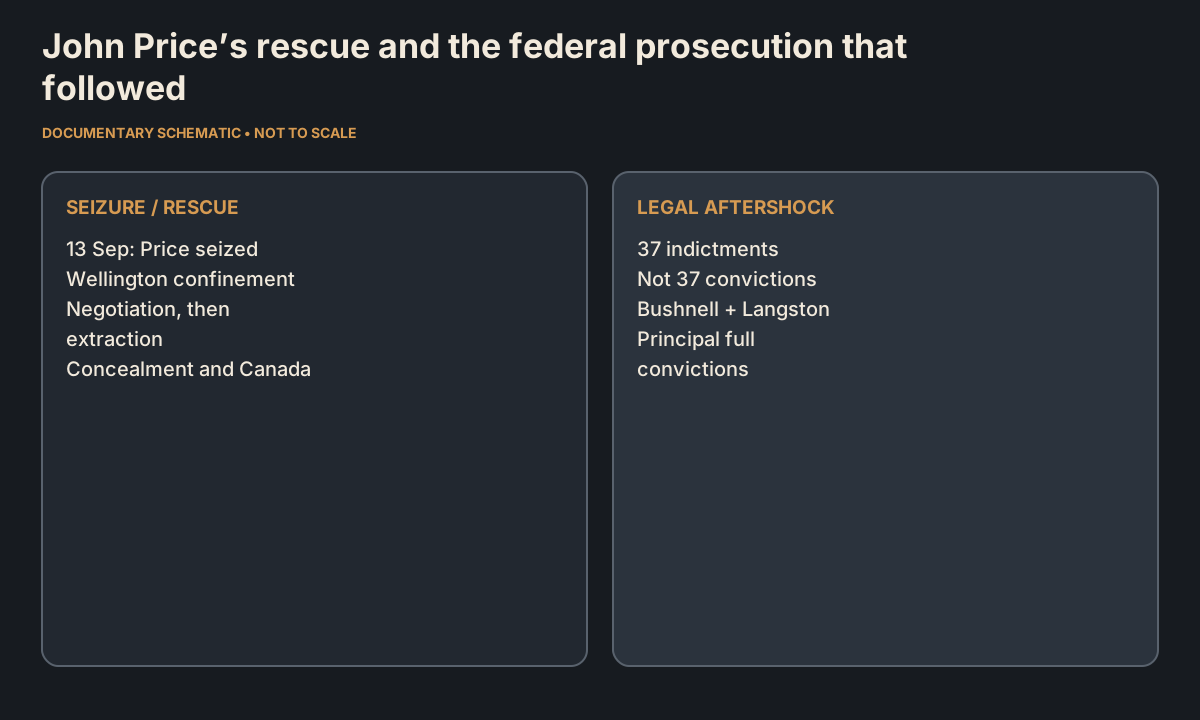
Simplified documentary reconstruction; not to scale. Evidence qualifications are written directly into the visual and explained in the adjacent text.
Evidence discipline
What the record supports
Status labels distinguish secure conclusions from uncertainty and rejected claims. Color is never the only signal.
MYTH
John Price was openly arrested in central Oberlin without deception.
Oberlin institutional sources say Price was lured away with an offer of work before the rendition party intercepted and seized him.
Sources: SRC-002, SRC-003, SRC-004DOCUMENTED
The successful rescue involved a biracial crowd from Oberlin and Wellington.
Institutional and contemporary sources identify Black and white participants, including Oberlin residents, students and Wellington citizens.
Sources: SRC-001, SRC-002, SRC-010WELL-SUPPORTED
Several hundred people gathered at the Wadsworth House.
Local institutional accounts give crowd estimates in the hundreds, commonly around 200–500. The precise number is not recoverable.
Sources: SRC-003MYTH
All 37 indicted rescuers were convicted under the Fugitive Slave Act.
Thirty-seven people were indicted, but only Simeon Bushnell and Charles Langston were fully tried and convicted before the remaining prosecution largely collapsed.
Sources: SRC-001, SRC-006, SRC-008, SRC-010DISPUTED
John Price’s exact age at the rescue is securely known.
Institutional sources variously describe Price as seventeen or eighteen, so his exact age remains uncertain.
Sources: SRC-001, SRC-006MYTH
Price was taken directly from Wellington to Canada immediately after the rescue.
He was first returned to Oberlin and concealed locally before being moved north.
Sources: SRC-002, SRC-003, SRC-006UNKNOWN
The complete route by which Price reached Canada is documented.
Institutional histories agree on the Canadian outcome, but the exact safe-house sequence and border crossing are not fully recoverable.
Sources: SRC-001, SRC-002, SRC-003WELL-SUPPORTED
Ohio kidnapping prosecutions against Price’s captors helped produce the collapse of the remaining federal rescue cases.
NPS, Ohio Memory and Oberlin sources describe a state–federal legal standoff in which charges against the captors and most remaining rescue prosecutions were abandoned through negotiation.
Sources: SRC-001, SRC-003, SRC-006