
At about two o'clock on 15 February 1851, the door of a federal courtroom in Boston gave way.
Men surged inside.
Shadrach Minkins—an escaped enslaved man who had been arrested only hours earlier—was pulled from federal custody and carried into the courthouse passage. A witness later said the decisive rush seemed to happen in about ten seconds.
Then the rescue changed form.
Getting Minkins out of the courtroom was only the first problem. Federal officers could search Boston. Slave catchers wanted to return him to Virginia. The Fugitive Slave Act of 1850 made helping him escape a federal crime.
So Boston's Black abolitionist network did not stop at the courthouse door. Minkins disappeared into Beacon Hill, moved through a chain of safe houses and escorts, passed through Concord and Leominster, and continued north until he reached Canada. The rescue took seconds. Getting him beyond federal reach took days.
From Norfolk to Boston
Shadrach Minkins had already escaped slavery once before the Boston rescue made him nationally known.
He was born enslaved in Norfolk, Virginia, probably around 1814. By 1849 he was sold to John DeBree. On 3 May 1850, Minkins escaped Norfolk. The exact route north is unknown, although travel by sea is considered likely.
By May he was in Boston.
There he found work as a waiter at Taft's Cornhill Coffee House, near the courthouse and the city's commercial center. He used the name Frederick while living in Boston.
His arrival came at a dangerous moment.
In September 1850 Congress enacted a new Fugitive Slave Act as part of the Compromise of 1850. The law strengthened federal mechanisms for seizing people accused of escaping slavery and returning them to claimants. It also exposed people who assisted freedom seekers to fines and imprisonment.
Boston's Black community responded by organizing.
Black Bostonians had long resisted slave catchers, but the new law made the threat more immediate. Lewis Hayden—himself an escaped enslaved man—became one of the most active organizers in the city's resistance network.
Minkins soon needed that network.
The arrest at the coffee house
John Caphart arrived from Norfolk acting for DeBree. A federal commissioner issued a warrant on 14 February. The next morning, federal deputies moved on the Cornhill Coffee House.
Patrick Riley, the principal deputy U.S. marshal in Boston, later gave a sworn account of the arrest. The officers initially had trouble identifying Minkins. Riley and another deputy entered the dining room as customers and ordered coffee.
Minkins served them. As he moved toward the bar area, other deputies closed in, took him by the arms and hurried him through a passage into the nearby courthouse. The arrest had been designed to prevent warning. It did not prevent a response.

The courthouse fills
News spread quickly.
Lawyers connected to Boston's antislavery movement came to the courthouse to represent Minkins. Among those involved were Samuel E. Sewall, Ellis Gray Loring, Charles List, Charles G. Davis, Robert Morris and others.
Morris's presence mattered beyond the courtroom. He was one of the first Black lawyers in Massachusetts and an active member of Boston's Vigilance Committee.
The defense gained time.
Commissioner George T. Curtis postponed the hearing until 18 February so Minkins's lawyers could examine the documents presented against him.
But the adjournment came with a dangerous order. Minkins was to remain in the custody of the deputy marshal inside the federal courtroom. Outside, the crowd grew. Black Bostonians and white antislavery supporters packed the passages and the area around the courthouse.
Federal officials understood that the situation was deteriorating. Riley sought additional help. He later testified that he asked city authorities for police support.
The reinforcements he wanted did not secure the room in time.

Ten seconds at the door
At about two o'clock, the guarded door opened as people inside prepared to leave. The door opened outward. Men in the passage seized its edge. Federal officers tried to hold it.
The pressure increased. Then the door gave way.
One witness, Henry Homer, later told the court that the whole breakthrough seemed to happen in roughly ten seconds. He described two men taking hold of Minkins and about twenty others following.
Other testimony and later historical reconstruction likewise place a core group of Black men at the front of the action. The exact identities of the men who physically seized Minkins are not securely established. That distinction matters.
Lewis Hayden is strongly documented as a central leader in the rescue movement and in Minkins's escape from Boston. Robert Morris was later accused of direct involvement and became one of Minkins's escorts. Elizur Wright was accused by some witnesses of helping open the way or signal the crowd.
But the courtroom testimony was contested, and later prosecutions failed to prove many of those allegations. The safest conclusion is also the most important one: A group of Black Bostonians forced entry, overwhelmed federal control of the room and removed Minkins from custody.
Out of the courthouse
The exit was chaotic. Homer remembered Minkins being rushed down the stairs and into the street, with parts of his clothing torn away during the movement.
Minkins himself apparently did not immediately understand who had control of him. A witness described him as frightened and uncertain whether the people around him were friends or enemies.
The rescuers had accomplished the spectacular part. Now they had to make him disappear. A crowd moving through central Boston could hide Minkins for only minutes. A network could hide him for much longer.
Beacon Hill
Later accounts attributed to Lewis Hayden say he and Robert Morris separated Minkins from the larger crowd and took him into Boston's Black neighborhood on Beacon Hill. There he was hidden in the attic of Elizabeth Riley on Southac Place. This was not an improvised refuge chosen at random.
The area around Southac Street was a center of Black abolitionist life. Lewis and Harriet Hayden lived nearby and their home became one of Boston's most documented Underground Railroad safe houses.
Minkins's rescue therefore moved almost immediately from mass action to controlled concealment. That transition was decisive. The courthouse crowd had broken custody. The neighborhood network had to prevent recapture.
Moving him out of Boston
The first hours after the rescue are not perfectly reconstructed.
National Park Service research includes a possible stop in Watertown before Minkins reached Cambridge. Other later testimony emphasizes a movement through East Cambridge.
The accounts converge on a more secure sequence.
Minkins reached the home of Reverend Joseph C. Lovejoy in Cambridge.
From there, Lewis Hayden and John J. Smith helped move him toward Concord.
At about three o'clock on the morning of 16 February, the party arrived at the home of Ann and Francis Bigelow. Ann Bigelow later recalled that the blinds were closed and the windows darkened to prevent passers-by from seeing what was happening inside. Minkins was exhausted. She prepared food for him, but remembered that fatigue and anxiety made it difficult for him to stay awake even while eating.
The relay was already preparing to move again.
Concord to Leominster
Francis Bigelow drove Minkins west to Leominster. There he was sheltered by Frances and Jonathan Drake, another antislavery household connected to the movement of freedom seekers. At this point the historical trail becomes less precise. Later accounts often draw the Underground Railroad as though it were a fixed secret railway with one established route.
Minkins's journey shows why that image can be misleading.
From Leominster northward, the exact path is not securely documented. He may have used rail lines through New Hampshire or Vermont, combined with overland travel. Different routes were possible, and the people helping him had every reason not to preserve an itinerary that federal authorities could follow.
What matters is that the network kept moving him. He did not remain in Massachusetts.
Four days north
Minkins later sent a letter from Montreal.
He wrote that the journey had taken four days and that the weather had been severe. He mentioned crossing ice twice, including one crossing he described as nine miles.
The surviving evidence does not allow every stage of those four days to be placed on a map. Modern reconstruction suggests he passed through New Hampshire and Vermont and entered Lower Canada before reaching Montreal by about 21 February. The uncertainty is important. The deliberately concealed Underground Railroad journey cannot be reconstructed as a precise route line.
The achievement is clear without doing so. Less than a week after federal officers arrested Minkins at his workplace in Boston, he was beyond the United States.
Washington reacts
The rescue humiliated the federal government. The Fugitive Slave Act was only months old, and one of its first major enforcement attempts in New England had ended with a prisoner being taken directly out of federal custody. President Millard Fillmore responded on 18 February with a proclamation condemning the courthouse action and calling on citizens and officials to enforce federal law.
Secretary of State Daniel Webster was especially angered. Webster had been a prominent defender of the Compromise of 1850 and viewed resistance to the fugitive-slave law as a threat to federal authority.
Federal prosecutors pursued alleged rescuers.
Lewis Hayden was indicted. Robert Morris was prosecuted. Elizur Wright, Charles G. Davis and others also faced legal action connected to the rescue.
The trials became a second arena of resistance.
The prosecutions fail
The government had a problem.
The rescue had happened in a crowded, fast-moving scene. Witnesses disagreed about who did what. The strongest legal cases required the government to connect specific defendants to specific criminal acts.
Robert Morris's first trial ended without a verdict.
At his second trial, prosecutors presented witnesses who claimed he had encouraged action at the courthouse and helped Minkins afterward. His defense attacked inconsistencies in the testimony.
The jury acquitted him in November 1851. The broader prosecution campaign likewise failed to produce convictions against the principal alleged rescuers. The federal government had lost Minkins. It also failed to punish the network in the way officials had hoped.
What later retellings simplify
The rescue has sometimes been reduced to a single sentence: Lewis Hayden stormed the courthouse and freed Shadrach Minkins. The real history is more complicated. Hayden was a central leader, but the surviving courtroom evidence does not securely identify the men who physically grabbed Minkins. The collective nature of the rescue matters. The rush itself may have been partly planned and partly opportunistic. Black abolitionists were mobilized and ready to resist, but the exact signal and timing remain disputed.
The courtroom rescue did not by itself make Minkins safe. His survival depended on immediate concealment and a multi-day relay north. The exact route to Canada is not known. Secure safe-house points should not be joined with invented precision. The rescuers were not acting without risk. The Fugitive Slave Act made assistance punishable by federal law, and many people connected with the rescue were arrested, indicted or tried.
The event was a collective rescue because collective action was what the situation required.
Why the rescue worked
The rescue succeeded because several different systems failed at once. The federal guard was too small to control the doorway and the crowd. The outward-opening door became a vulnerability when people in the passage seized it. The crowd provided immediate concealment once Minkins entered the street.
Boston's Black abolitionist community provided something even more important: organization after the breakthrough. Without the safe house, the carriage, the escorts and the next households waiting farther west, the courthouse action could have ended in recapture. The rescue was therefore not one technique. It was a chain.
Force broke federal custody.
Community concealed Minkins.
Mobility carried him away.
Distance made the rescue durable.
A life beyond the rescue
Minkins settled in Montreal.
He worked, married and raised a family. He operated businesses, including a barbershop, and lived there until his death in 1875.
His life in Canada matters because it changes how the Boston episode should be measured. The rescue was not successful merely because federal officers lost control of a courtroom for a few seconds. It was successful because Minkins was not returned to slavery. He reached a place where the federal fugitive-slave system could no longer seize him and send him back to Virginia.
That is what the people who broke through the courthouse door were trying to accomplish. And that is what they achieved.
Escape reconstruction
How the escape unfolded
An evidence-aware sequence of the principal stages.
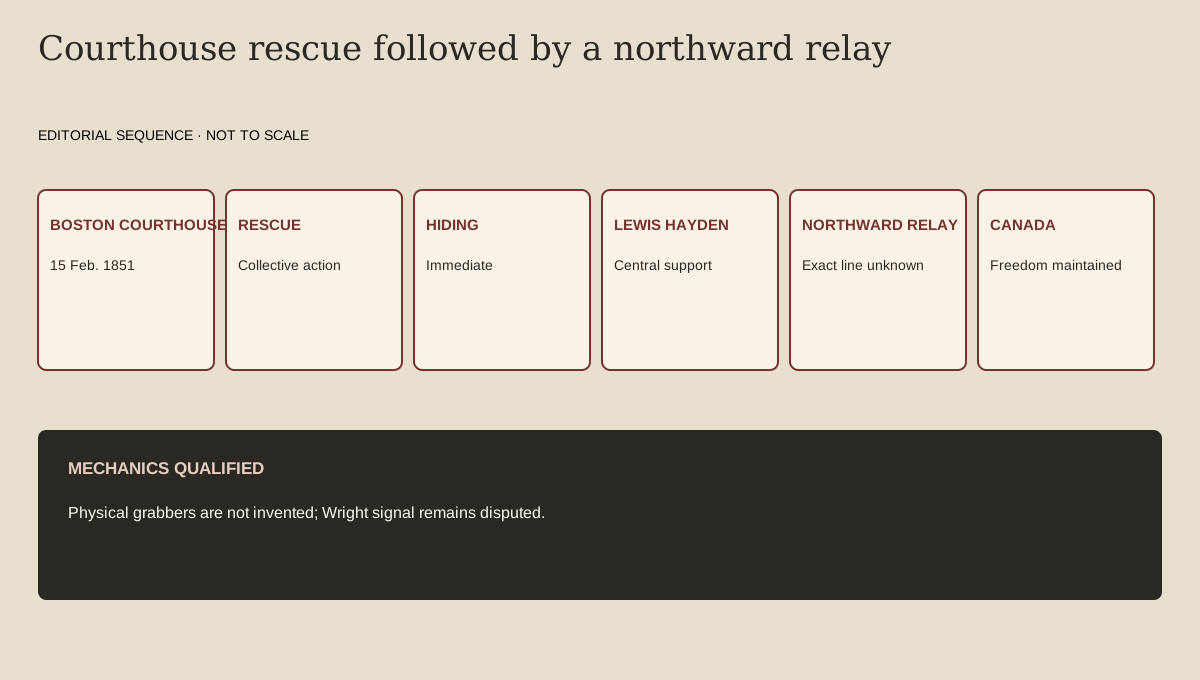
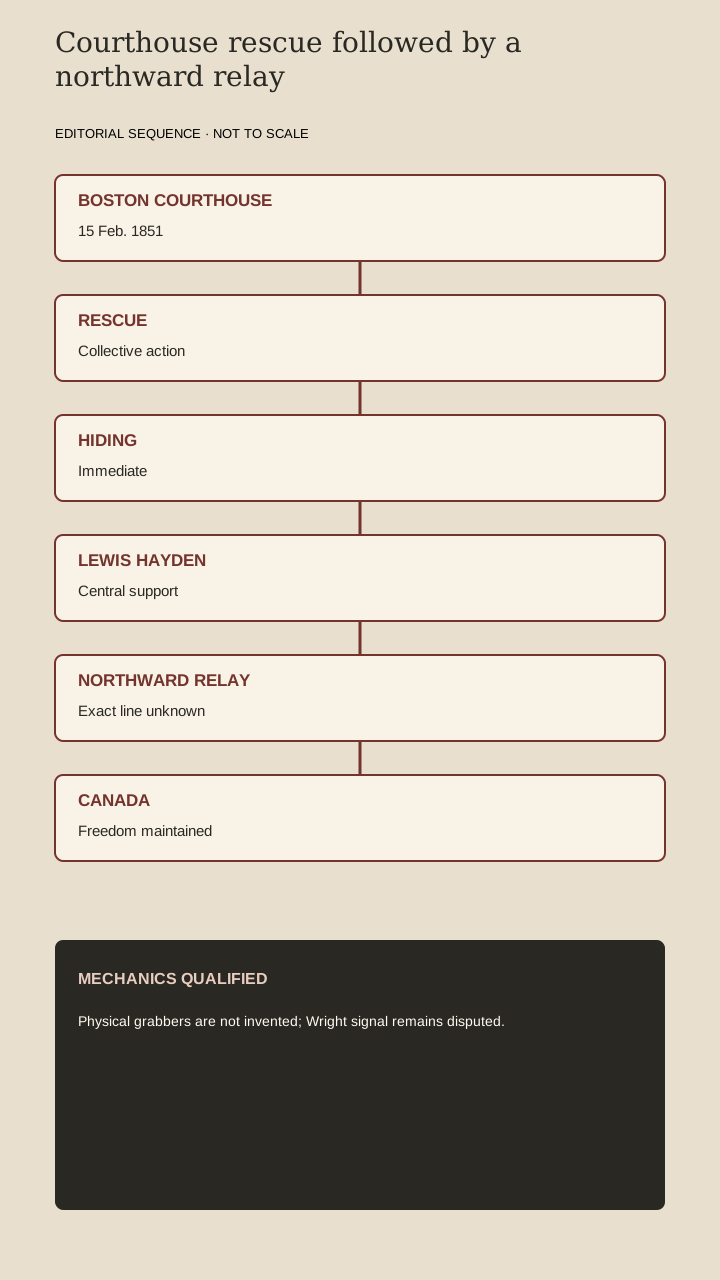
Simplified editorial reconstruction; not to scale. See adjacent text for evidence qualifications and unresolved details.
Problem → response
Escape was a sequence of problems
Each response solved a practical obstacle while often creating the next one.
- 01→
Obstacle
Federal custody inside the courtroom
Minkins was under the control of deputy U.S. marshals and ordered held in the courtroom until a later hearing.
Response
A group of Black rescuers exploited the vulnerable doorway, forced entry and overwhelmed the limited guard before additional protection arrived.
- 02→
Obstacle
Immediate risk of recapture in central Boston
Leaving the courthouse placed Minkins in public streets only blocks from federal and city authorities.
Response
The crowd concealed the movement long enough for Hayden, Morris and others to shift Minkins into the Black Beacon Hill safe-house network.
- 03→
Obstacle
Federal penalties for assistance
The Fugitive Slave Act exposed people who aided Minkins to federal criminal prosecution, fines and imprisonment.
Response
A network of Black and white abolitionists nevertheless provided shelter, transport, legal aid and onward connections.
- 04→
Obstacle
Distance to safety
Minkins remained vulnerable to the U.S. fugitive-slave system while inside the United States.
Response
Helpers moved him in stages through Massachusetts and farther north until he crossed into Canada.
- 05→
Obstacle
Need for secrecy after Leominster
A documented public route would have exposed both Minkins and the people assisting him.
Response
The surviving record becomes deliberately incomplete; modern reconstruction preserves multiple plausible northern routes rather than one certain itinerary.
The final accounting
Outcome
Freedom seeker rescued
Minkins was successfully removed from federal custody and was not returned to slavery.
Durable freedom
Minkins reached Canada and lived in Montreal until his death in 1875.
Federal prosecution outcome
Federal authorities prosecuted alleged rescuers but failed to secure convictions against the principal defendants associated with the rescue.
Evidence discipline
What the record supports
Status labels distinguish secure conclusions from uncertainty and rejected claims. Color is never the only signal.
DOCUMENTED
Black Bostonians forced their way into the federal courtroom and rescued Shadrach Minkins on 15 February 1851.
The event is preserved in the deputy marshal's return, eyewitness testimony, federal records, National Park Service interpretation and later legal proceedings.
Sources: SRC-001, SRC-002, SRC-003DOCUMENTED
Lewis Hayden was a central leader in the Minkins rescue and escape network.
Modern institutional sources, federal prosecution records and later accounts consistently place Hayden at the center of the rescue effort and post-rescue transport.
Sources: SRC-001, SRC-006, SRC-007UNKNOWN
Lewis Hayden can be securely identified as one of the two men who physically grabbed Minkins inside the courtroom.
The primary testimony describes two men taking hold of Minkins but does not securely identify those two. Hayden's broader leadership is well supported, but the physical-grabber identification should not be invented.
Sources: SRC-002, SRC-003DISPUTED
Elizur Wright gave a prearranged signal that triggered the rescue.
Federal witnesses accused Wright of widening the door or calling the crowd in, while the testimony was contested. The precise triggering signal is not secure enough to present as settled fact.
Sources: SRC-002, SRC-010MYTH
The exact escape route from Boston to Montreal is known.
Secure points include Beacon Hill, Cambridge, Concord and Leominster. The National Park Service explicitly notes that the route north from Leominster cannot be verified and offers multiple possibilities.
Sources: SRC-001, SRC-004, SRC-008MYTH
The courtroom rescue alone guaranteed Minkins's freedom.
The courthouse breakthrough only ended the immediate detention. Minkins still depended on concealment, transport and a multi-day Underground Railroad relay to reach Canada.
Sources: SRC-001, SRC-004, SRC-009MYTH
Federal authorities successfully convicted the principal rescuers.
The government arrested and indicted multiple suspected participants, but the principal cases ended without the convictions federal officials sought; Robert Morris, for example, was acquitted after an earlier mistrial.
Sources: SRC-003, SRC-006, SRC-007Selected chronology
Selected chronology
Minkins escapes slavery in Norfolk
Records used in the 1851 proceedings gave 3 May 1850 as the date Minkins escaped from Virginia.
Fugitive Slave Act becomes law
The 1850 federal law strengthened national enforcement mechanisms for seizing and returning people accused of escaping slavery.
Arrest at the Cornhill Coffee House
Federal deputies seized Minkins at his workplace and took him into the nearby courthouse.
Courthouse rescue
Black rescuers forced the courtroom door, removed Minkins from federal custody and carried him into the street.
Concealment and movement out of Boston
Minkins was sheltered in the Black community on Beacon Hill and then moved through the Cambridge area.
Arrival in Concord
Hayden, John J. Smith and Minkins reached the Bigelow home, where Minkins rested before Francis Bigelow drove him toward Leominster.
Fillmore issues federal proclamation
President Millard Fillmore condemned the rescue and called for enforcement of federal law and prosecution of those responsible.
Minkins reaches Canada
Modern reconstructions place Minkins across the border and in Montreal within roughly a week of the courthouse rescue.
Robert Morris acquitted
After an earlier mistrial, a jury acquitted Morris of charges connected with the rescue.