
On the morning of 1 October 1851, William “Jerry” Henry was working as a cooper in Syracuse, New York, when federal officers came for him. They did not initially tell him the full reason.
Contemporary reporting said Henry was led to believe he had been arrested for a minor criminal matter. Once he was restrained, the real danger became clear: federal authorities were acting under the Fugitive Slave Act of 1850, and Henry was being claimed as a man who had escaped enslavement in Missouri.
By nightfall, Syracuse had become the site of one of the most public acts of resistance to the law in the North.
The event is remembered simply as the Jerry Rescue. But that name compresses a complicated day into a single image. Jerry did not go directly from arrest to freedom. He escaped once, was recaptured, was injured and confined again, and only then was successfully removed from federal custody by a large biracial crowd.
Even that was not the end.
For several days afterward, Jerry remained hidden in Syracuse. He then had to be moved north through the Underground Railroad network, across Central New York and finally over Lake Ontario before he was safely outside United States jurisdiction.
The rescue in the police office was the dramatic center of the story. The real escape stretched much farther.
The Law Reached Into a Free State
The Fugitive Slave Act of 1850 transformed the risks facing people who had escaped slavery.
The federal law strengthened procedures for the capture and return of alleged fugitives from slavery. Federal commissioners could hear claims, and federal officers were empowered to arrest people accused of owing “service or labor” in another state. Those who obstructed recovery efforts or aided fugitives faced serious penalties.
Syracuse was an especially volatile place to enforce the statute.
The city had developed a strong abolitionist network. Jermain W. Loguen, himself a man who had escaped slavery, operated one of the region’s best-known Underground Railroad stations. Samuel J. May, a Unitarian minister, publicly attacked the Fugitive Slave Law. Gerrit Smith, Samuel Ringgold Ward and other antislavery activists repeatedly argued that resistance to slavery could require defiance of federal law.
The confrontation was sharpened by national politics.
Earlier in 1851, Secretary of State Daniel Webster had spoken in Syracuse and insisted that the Fugitive Slave Law would be enforced even in places where abolitionists opposed it. By October, the city was hosting a Liberty Party antislavery convention.
That was the setting when federal officers seized Jerry Henry.
Who Was Jerry?
The sources most securely identify him as William Henry, widely known as Jerry.
Syracuse University’s institutional history describes him as an escaped enslaved man who had been living in Syracuse and working as a cooper. Contemporary newspaper reporting likewise called him W. Henry and noted that he had been residing in the city.
Later accounts add more detail about his earlier life, including origins in North Carolina, enslavement in Missouri and previous escape attempts. Some also call him Jerry McHenry. Those biographical layers are not equally documented, and the name form varies in later historical writing.
For this reconstruction, the safest form is William “Jerry” Henry. What mattered on October 1 was that federal authorities claimed he was still legally bound to an enslaver in Missouri.

Arrested at Work
Henry was seized while working in a cooper shop in Syracuse’s First Ward.
The New York Daily Times reported the next day that U.S. Marshal Henry W. Allen arrested him as a fugitive from slavery. The newspaper said Henry initially believed he was being taken for some lesser offense and did not understand the true purpose of the arrest until he had already been handcuffed.
That detail appears repeatedly in Syracuse institutional accounts and helps explain why the capture succeeded so quickly.
Henry was taken before Joseph F. Sabine, a U.S. commissioner, for a hearing intended to determine whether federal process could return him to the claimant.
News spread rapidly.
The Liberty Party convention was already meeting nearby. Syracuse abolitionists moved toward Sabine’s office. A growing crowd gathered around the building.
The legal hearing was becoming a public confrontation.

The First Escape
This is where many short versions of the Jerry Rescue skip an important step. The first rescue attempt did not produce lasting freedom.
During the afternoon proceedings at Sabine’s office, supporters pressed into the building and confusion erupted. Jerry managed to break free. Syracuse University’s route reconstruction has him fleeing east along Water Street, through the central city and toward a bridge over the Erie Canal.
For a brief period, he was outside federal custody. Then officers caught him again.
The recapture was violent. Later abolitionist accounts emphasized the force used to restrain and transport him. Samuel J. May, speaking within weeks of the rescue, described public fury at seeing a Black man dragged through Syracuse in chains under a law many residents regarded as morally intolerable.
Jerry was taken to the police offices in the Raynor Block, also associated in later local memory with the Journal Building. The first escape had failed. But it had changed the atmosphere.
From Protest to a Rescue Plan
By evening, the confrontation was no longer simply an angry crowd reacting spontaneously.
Abolitionist leaders met and discussed what should be done. Syracuse University’s historical materials identify a secret meeting at the office of Dr. Hiram Hoyt as part of the planning. Jermain Loguen, Samuel J. May, Gerrit Smith and Samuel Ringgold Ward were all important figures in the resistance surrounding the case.
The exact tactical roles of each participant are harder to assign.
This matters because later commemorative versions can make the rescue look like a small, perfectly organized team operation. It was broader and messier than that. Black and white abolitionists, convention delegates, local residents and onlookers formed a mass crowd. Some people organized. Some spoke. Some physically forced entry. Many more surrounded the building and made continued federal control of Jerry increasingly difficult.
Contemporary and later estimates often put the crowd at roughly 2,500 people. That number should be treated as approximate. What is secure is the scale: federal officers were facing a crowd far larger than the small force holding Jerry.
The Evening Breach
Around the police office, pressure built.
Accounts describe stones striking the building, doors being forced and rescuers using heavy objects—including a battering ram in later recollections—to break their way inside. Pistols were fired during the confrontation. At least one federal officer was injured while escaping the crowd.
The essential sequence is not in doubt. The crowd breached the police office.
Jerry was still in restraints when his rescuers reached him. The shackles associated with the rescue became preserved artifacts in Syracuse historical collections, and later accounts describe how the irons had to be cut or filed away after he was removed.
The federal officers lost control of their prisoner. This time Jerry was not immediately recaptured. The successful Jerry Rescue had occurred. But the men who freed him had only solved the first problem.
Syracuse was still inside the United States, and the Fugitive Slave Act was still in force.
Hiding Jerry in Syracuse
The safest next move was not a public flight north. It was disappearance.
Syracuse University and Oswego County historical reconstructions place Jerry in a series of local hiding places after the rescue. One particularly effective choice was the home of Caleb Davis, whose public reputation did not make him an obvious abolitionist safe-house candidate.
Jerry remained concealed in Syracuse for several days.
The pause was important. Federal officers, local authorities and supporters of the law could search roads and transportation points. A visible movement immediately after the rescue might have ended in another arrest.
The Underground Railroad worked best when movement could be broken into stages. Jerry’s rescuers waited, arranged transportation and moved him only when the next link was ready.
North Through Central New York
The route then turned toward Lake Ontario. Syracuse University’s historical map and the Oswego County Historical Society reconstruct the movement north by wagon along the Cicero road corridor toward Brewerton and Mexico, New York. An Oswego County account places Jerry with a Quaker named Ames in the town of Mexico and later with a man named Clarke near Oswego.
The precise house-to-house sequence is later historical reconstruction rather than a contemporaneous travel log, so it should not be rendered as GPS-level certainty. But the broad route is consistent across institutional sources:
Syracuse → north through Central New York → Oswego area → Lake Ontario → Canada.
At the lake, the final problem was jurisdiction.
Crossing into British territory meant the Fugitive Slave Act could no longer be used to carry Jerry back from a U.S. state.
A vessel willing to take him across the lake became the decisive last link.
Across Lake Ontario
Oswego County tradition preserves a careful nighttime transfer.
A local ally searched for a captain willing to carry Jerry across Lake Ontario. Once a vessel was found, arrangements were made to meet it offshore, minimizing the risk of an arrest at a normal dock or departure point.
Syracuse University’s reconstruction says Jerry was taken by a British ship to Kingston, Ontario. There he finally reached durable freedom. Unlike the first sprint from Sabine’s office, this stage ended outside the reach of the federal law that had caused his seizure.
Jerry established himself in Kingston and again worked in a skilled trade. Local Kingston research places him there in assessment records and records his death in October 1853, only about two years after the rescue.
His freedom was real, but brief.
The Rescuers Faced Federal Prosecution
The United States government did not treat the event as a harmless local disturbance.
A federal grand jury indicted numerous people associated with the rescue. Scholarly work places the number at about twenty-six indictments.
The prosecutions became another test of the Fugitive Slave Act.
Enoch Reed was convicted on a charge connected to obstructing federal authority, though litigation and appeals continued and he died before the legal process fully concluded. Other defendants were acquitted, faced divided juries or saw cases postponed. Ultimately, federal prosecutors struggled to obtain convictions in a community where potential jurors often already had strong views about the law.
At the same time, local opponents of the seizure pursued a striking counterattack: Deputy U.S. Marshal Henry W. Allen was indicted under New York law for kidnapping Jerry.
Allen was acquitted.
The competing cases exposed the constitutional and political collision at the heart of the rescue. Federal law said Jerry could be seized. Many Syracusans believed the seizure itself was the greater wrong.
What the Rescue Actually Proved
The Jerry Rescue did not repeal the Fugitive Slave Act. It did demonstrate the limits of enforcement when a community was willing to resist openly.
Most Underground Railroad assistance depended on secrecy. Jerry’s rescue was different. It occurred in the center of a city, in front of a mass crowd, during an antislavery political gathering, and in direct confrontation with federal power.
It was therefore both an escape and a public political act.
That helps explain why the event was remembered for decades afterward. Abolitionists celebrated its anniversary. Syracuse preserved objects associated with Jerry’s captivity. The city eventually erected a monument in Clinton Square.
Yet the most important part of the story is easy to lose beneath the symbolism. Jerry had to escape twice on October 1.
The first escape was his own desperate flight from the commissioner’s office. It ended at the canal in recapture.
The second required a community willing to violate federal law in public. And even that did not make him safe. Only after days of concealment, a wagon journey north, help from the Underground Railroad network and a crossing of Lake Ontario did the rescue become complete. The police-office door was the dramatic barrier.
The national border was the real one.
Escape reconstruction
How the escape unfolded
An evidence-aware sequence of the principal stages.
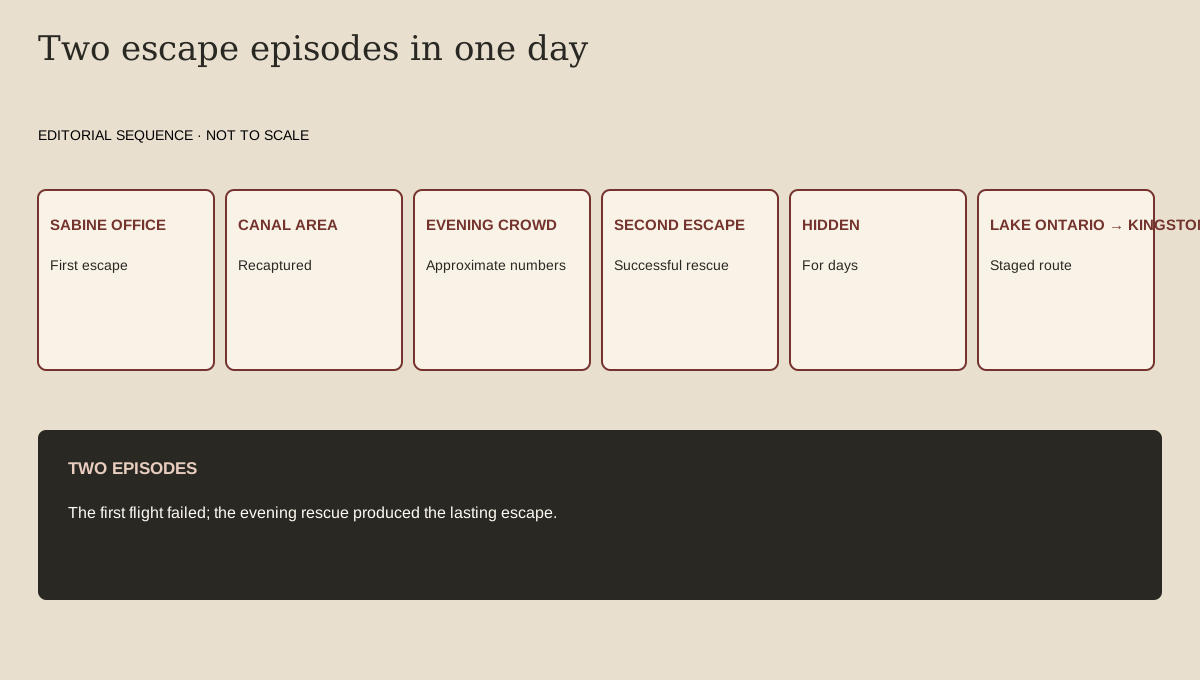

Simplified editorial reconstruction; not to scale. See adjacent text for evidence qualifications and unresolved details.
Evidence discipline
What the record supports
Status labels distinguish secure conclusions from uncertainty and rejected claims. Color is never the only signal.
MYTH
The Jerry Rescue was one successful escape attempt on October 1, 1851.
Jerry first escaped from Commissioner Sabine’s office and was recaptured near the Erie Canal. The successful evening rescue from the police office was a second escape episode.
Sources: SRC-001, SRC-002DISPUTED
About 2,500 people participated directly in breaking Jerry out.
Historical accounts often estimate the surrounding crowd at roughly 2,500, but that figure is not an exact count and should not be equated with the number who physically entered the building.
Sources: SRC-001, SRC-009DOCUMENTED
William “Jerry” Henry was being held under the Fugitive Slave Act of 1850.
Contemporary reporting, federal case records and Syracuse institutional history all identify the arrest as federal fugitive-slave enforcement.
Sources: SRC-001, SRC-002, SRC-008UNKNOWN
Every famous abolitionist associated with the Jerry Rescue personally stormed the police office.
Loguen, May, Smith and Ward were central participants in the resistance surrounding the rescue, but surviving evidence does not support assigning every leader a precise physical role during the breach.
Sources: SRC-003, SRC-004, SRC-005MYTH
Jerry was safe as soon as he left the police office.
He remained hidden in Syracuse for several days and then required a staged Underground Railroad route north and a Lake Ontario crossing before reaching Canada.
Sources: SRC-001, SRC-007WELL-SUPPORTED
Jerry reached Kingston, Canada West, after the rescue.
Syracuse, Oswego County and Kingston institutional sources converge on Kingston as his destination and later home.
Sources: SRC-001, SRC-007, SRC-010UNKNOWN
The exact house-to-house route from Syracuse to the Canadian border is fully documented.
Later institutional histories reconstruct a plausible sequence through Syracuse, Mexico and the Oswego area, but no complete contemporaneous travel log survives.
Sources: SRC-001, SRC-007DISPUTED
“Jerry McHenry” is the only historically correct name for the escapee.
Later scholarship sometimes uses McHenry, but contemporary and Syracuse institutional sources identify him as W. Henry or William ‘Jerry’ Henry. William ‘Jerry’ Henry is the better-supported form.
Sources: SRC-001, SRC-002, SRC-009Selected chronology
Selected chronology
Fugitive Slave Act becomes law
The federal statute strengthens procedures for seizing and returning alleged fugitives from slavery and penalizes assistance or obstruction.
Jerry is arrested in Syracuse
Federal officers seize William “Jerry” Henry at work and take him before U.S. Commissioner Joseph Sabine.
First escape and recapture
Jerry escapes from Sabine’s office during disorder but is recaptured near an Erie Canal crossing and returned to custody.
The successful Jerry Rescue
A large biracial crowd forces entry into the police office and removes Jerry from federal custody.
Jerry is hidden and moved north
After several days of concealment in Syracuse, allies move Jerry north through the Underground Railroad network toward Oswego.
Jerry reaches Canada West
A vessel carries Jerry across Lake Ontario to Kingston, where he settles and returns to work.
Federal indictments follow
A federal grand jury indicts numerous people associated with the rescue, beginning years of difficult prosecutions.
Jerry dies in Kingston
William “Jerry” Henry dies in Kingston after roughly two years of freedom in Canada.