
On New Year's Day 1834, a steamboat carrying an enslaved young man from St. Louis reached Cincinnati. The man was known to his enslavers as Sandford. He had another name for himself: William. He had tried to escape before, with his mother, and had been captured. This time he would leave alone.
Brown later described the opening he used in remarkably ordinary terms. While the steamboat was unloading and passengers moved baggage between vessel and shore, he carried a trunk up the wharf, separated himself from the crowd, and kept going. There was no hidden compartment, forged pass, or elaborate disguise. The decisive mechanism was opportunity: a routine piece of work took him onto free-state soil, and a moment of divided attention allowed him to disappear.
What followed was harder than stepping off the boat. Ohio had prohibited slavery, but Brown was not legally secure there. Federal law and the Constitution still recognized claims by enslavers against people who escaped across state lines. Brown therefore spent days moving north through winter weather while trying not to be seen, uncertain whom he could trust and uncertain even of the road ahead.
His escape became not only a journey out of slavery but the beginning of the public identity under which he would become one of the nineteenth century's most important Black abolitionist writers.
Before the Final Escape
Brown had already learned what a failed escape could cost.
In his 1847 narrative, he described an earlier attempt to flee St. Louis with his mother. They crossed the Mississippi into Illinois in a small boat and traveled north, hiding by day and moving at night. After roughly ten days they were stopped by men carrying an advertisement for their capture and a reward. Brown was bound and taken back to St. Louis. His mother was later sold south. Brown never saw her again.
The exact year of that failed attempt is less secure than the events themselves. Later biographical sources have dated it differently, and Brown's first narrative does not give a clean calendar date for the episode. What matters for the 1834 escape is that the earlier failure had given him direct experience of pursuit, arrest, forced return, and family separation.
Afterward Brown passed through several enslavers and employers. By late 1833 he was held by Captain Enoch Price, a St. Louis steamboat owner and commission merchant. Brown worked for Price's household and also served aboard Price's vessel, the Chester. When the Price family traveled from New Orleans upriver toward Cincinnati, Brown understood that the voyage was bringing him close to a free state.
According to Brown, Price recognized the risk. He asked whether Brown had ever been in a free state. Brown deliberately gave an answer designed to calm him, saying in effect that he had been to Ohio and did not like it. Brown also allowed the household to believe that his attachment to an enslaved woman named Eliza would discourage him from leaving. These were not incidental details in Brown's telling. They show that the escape began before he stepped onto the wharf: he tried to reduce suspicion while waiting for the geography of the voyage to create an opening.
He also prepared modestly. Brown said he had saved small amounts of money, obtained cloth, made a bag for provisions, and decided that New Year's Day would be the day he left slavery.
January 1, 1834
Brown's 1847 narrative says that the steamboat had proceeded up the Ohio River after stops at Cairo and Louisville and that January 1 was the day he had chosen to act. Focused scholarship and later institutional biographies place the departure at Cincinnati.
The essential sequence is unusually well supported. While the vessel was discharging cargo, Brown took a trunk ashore. The trunk gave him an ordinary reason to leave the boat. Once up the wharf, he moved away from the activity around the landing and headed for cover.
He did not simply start walking north in daylight. He hid until night.
That decision reflected the legal and social danger of the place he had reached. Ohio was a free state, but federal policy did not transform an escaped enslaved person into someone beyond an enslaver's claim. The Fugitive Slave Act of 1793 created a process for recovering people who escaped slavery across state lines, while the Constitution's fugitive-slave clause protected slaveholders' claims. Brown had personal reason to fear discovery: in his narrative he recalled another enslaved man who had escaped near Cincinnati only to be captured.
Once darkness came, Brown encountered a more basic problem. He did not know the roads well enough to know which direction led north. Clouds initially hid the North Star. When the sky cleared, he used the star to orient himself and began moving.
Brown later estimated that he traveled twenty to twenty-five miles before daylight. Historian W. Edward Farrison noted that this was a demanding distance for a winter night and treated the figure cautiously. The safest conclusion is not that the mileage can be independently verified, but that Brown remembered pushing hard during the first night and then returning to concealment during the day.

A Flight Through Winter
The final escape was not a single dash from a steamboat to safety. It became a prolonged movement through Ohio.
Brown said he traveled primarily at night and hid during daylight. He carried little: provisions, the clothes he was wearing, and a tinderbox that allowed him to make fire. After several days his food ran out. He took ears of corn from a barn and roasted them. Freezing rain coated his clothes. His feet became frostbitten, and he developed a severe cold.
The exact route cannot be responsibly reconstructed street by street or town by town. Brown did not provide it, and later scholarship has emphasized how little geographical precision survives. Any modern map that draws a confident line across Ohio would create certainty the evidence does not support.
What can be reconstructed is the logic of his movement. He was trying to go north toward Lake Erie and eventually Canada. He avoided houses because asking for help could expose him. He moved when darkness reduced the chance of recognition. He relied on broad celestial direction rather than a documented chain of Underground Railroad stations.
This point matters because the escape is sometimes retrofitted into the familiar image of a mature, organized Underground Railroad route. Brown certainly received antislavery assistance, but his account of the early journey is dominated by isolation, uncertainty, and self-navigation.
The Quaker Who Gave Him a Name
Exposure eventually forced Brown to change strategy.
After days in the cold, he concluded that he could not continue without shelter. He watched the road and eventually encountered an older man whose dress Brown associated with the Society of Friends. Brown admitted that he still feared betrayal. The man left to get a covered wagon, and Brown considered fleeing before he returned.
The man did return. He and his wife took Brown into their home.
Brown identified his benefactor as Wells Brown, an elderly Quaker who had aided other fugitives. Brown stayed with the household for roughly two weeks while recovering from frostbite and illness. They fed him, provided clothing, and obtained boots for him.
The episode also produced the name by which Brown entered history.
Brown had been born William, but an enslaver later ordered that he be called Sandford after another William entered the household. During his flight, he resolved to reclaim William. At the Quaker household, Wells Brown suggested that a free man should have a second name. Brown accepted his benefactor's name while insisting on keeping William. He became William Wells Brown.
This naming story comes from Brown's own narrative, written thirteen years after the escape, and cannot be independently reconstructed conversation by conversation. But the broad fact that he adopted the name Wells Brown during his flight is deeply embedded in his autobiographical record and repeated by later scholarship.
Cleveland, Not Immediate Safety in Canada
Brown left the Quaker household intending to continue toward Canada.
He eventually reached Cleveland. Here another common simplification needs correction: Brown's own 1847 account does not describe him crossing directly into Canada as the final act of the January escape. Instead, he found Lake Erie frozen and decided to remain in Cleveland rather than continue a long winter journey by land through Buffalo or another route.
He obtained work at the Mansion House, first for board and then for wages. In the spring he found employment on a Lake Erie steamboat.
That outcome was freedom in practice, but not full legal security. Brown could live and work outside the direct control of Enoch Price, yet federal law left him vulnerable to recapture. The distinction became especially important after the stronger Fugitive Slave Act of 1850. By then Brown had become a prominent abolitionist and was traveling in Britain. He remained abroad for years partly because returning to the United States exposed him to renewed danger.
In 1848, Price himself wrote a letter acknowledging that Brown had run away from him on January 1, 1834. Price offered to sell Brown formal manumission papers. Brown refused to buy his own freedom on principle. In 1854 British supporters paid for the legal release, allowing him to return to the United States with substantially greater security.
Why the Escape Worked
Brown's success did not depend on a single ingenious device.
First, river travel moved him into an unusually favorable position. His work aboard the Chester carried him from a slave state and through the Ohio River corridor to a place where leaving the boat could put him onto free-state ground.
Second, he managed suspicion. His statements to Price and the household encouraged them to believe that he was unlikely to run. That mattered because the opportunity to walk ashore with baggage existed only if he was still trusted enough to perform ordinary work.
Third, he used concealment rather than speed alone. Hiding during the day reduced exposure when strangers could identify, question, detain, or report him.
Fourth, he adapted. When he could not orient himself, he waited for the sky to clear. When provisions failed, he improvised. When exposure made solitary travel unsustainable, he finally accepted help despite his fear of betrayal.
And finally, assistance mattered. Wells Brown and his household did not engineer the original escape from the steamboat, but their intervention may have been decisive in keeping the fugitive alive and moving. Brown reached them sick, frostbitten, and exhausted. Recovery, clothing, boots, food, and some money transformed the next stage of the journey.
What Brown's Story Became
Thirteen years later, Brown published Narrative of William W. Brown, a Fugitive Slave, Written by Himself. The book turned the private knowledge of slavery, sale, forced labor, family separation, river commerce, and escape into antislavery testimony.
The escape had also reshaped Brown's relationship to the same transportation system that had once moved enslaved people and slave traders. Working on Lake Erie, he later helped other fugitives travel toward Canada. In his narrative he claimed that during part of 1842 he carried sixty-nine fugitives without charge. That later activity made him not only a person who had escaped slavery but an active participant in other people's efforts at self-emancipation.
He went on to become an abolitionist lecturer, historian, playwright, novelist, and physician. His literary career included Clotel, often identified as the first novel published by an African American.
Yet the beginning of that public life remained the New Year's Day departure from the Chester: a trunk carried onto a Cincinnati wharf, a disappearance into cover, a winter journey whose exact path is still partly unknown, and an enslaved man reclaiming both movement and name.
Brown's escape deserves to be remembered without making it cleaner than the evidence allows. He did not move instantly from slavery into complete legal freedom, and he did not follow a fully documented chain of safe houses to Canada. He created an opportunity, survived a dangerous journey through a supposedly free state, accepted aid when he could no longer continue alone, and built a life beyond the authority of the men who had claimed him as property.
Escape reconstruction
How the escape unfolded
An evidence-aware sequence of the principal stages.
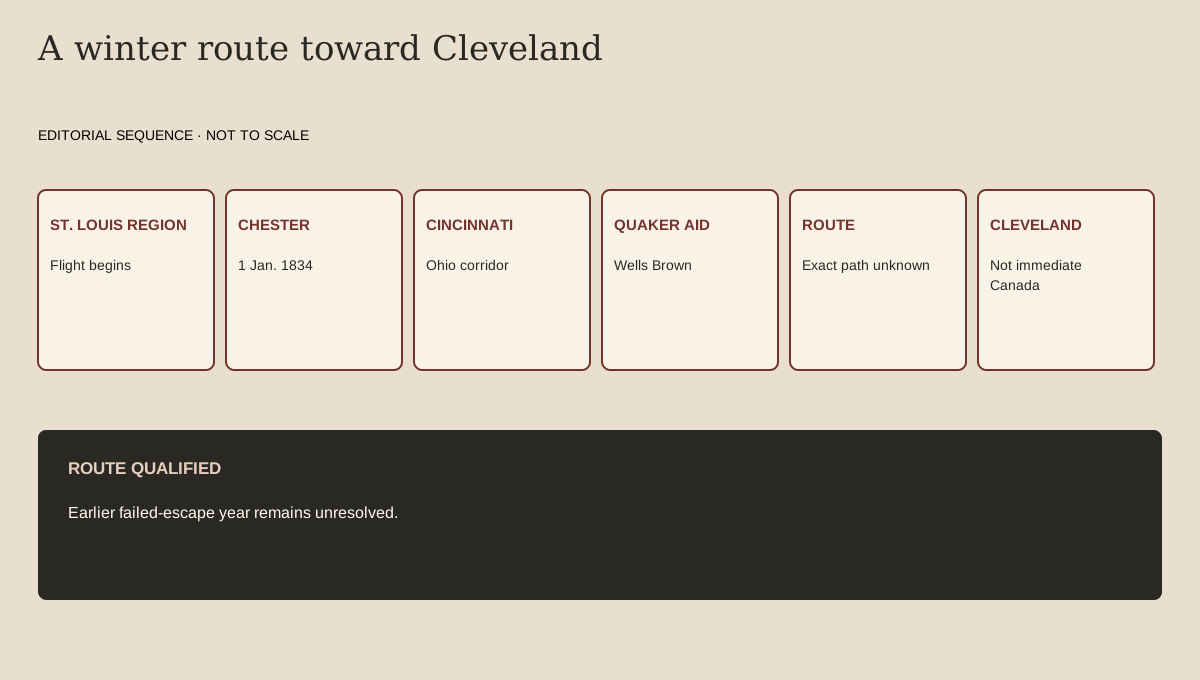
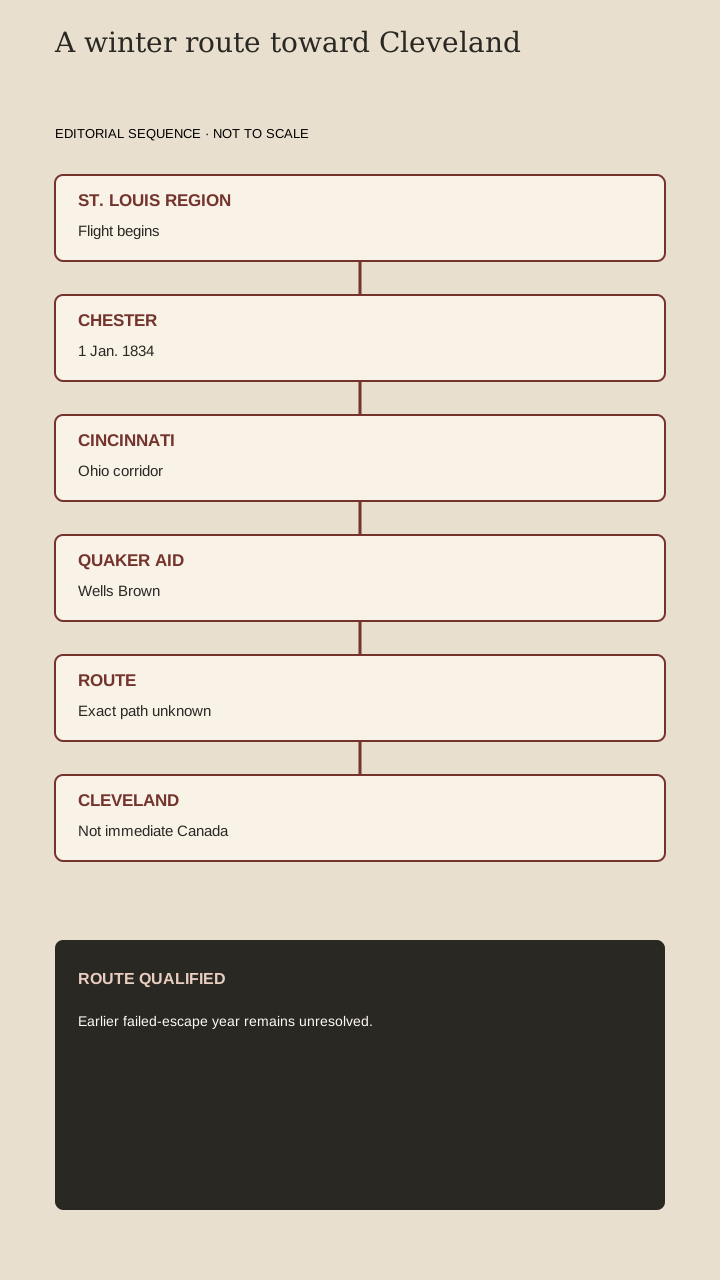
Simplified editorial reconstruction; not to scale. See adjacent text for evidence qualifications and unresolved details.
Material evidence
Tools of Escape
The objects used in an escape reveal how a plan worked under constraint.
- 01Preparation
Provision bag
Brown said he made a small cloth bag and carried provisions for the journey.
- 02Survival
Tinderbox
Brown reported using a tinderbox to make fires during severe winter cold.
Problem → response
Escape was a sequence of problems
Each response solved a practical obstacle while often creating the next one.
- 01→
Obstacle
Risk of recapture in a free state
Federal law and the constitutional fugitive-slave framework left escaped enslaved people vulnerable even after entering Ohio.
Response
Brown avoided public exposure, hid during daylight, and traveled mainly at night.
- 02→
Obstacle
Unknown route
Brown lacked detailed geographic knowledge and did not leave a precise itinerary across Ohio.
Response
He used the North Star for broad direction and continued north without a securely documented chain of guides.
- 03→
Obstacle
Winter exposure
Cold, freezing rain, frostbite, illness, and dwindling food threatened the journey.
Response
Brown used fire where possible, improvised food, and eventually accepted shelter from an Ohio Quaker household.
The final accounting
Outcome
Immediate escape
Brown successfully left the Chester at Cincinnati and avoided recapture during his flight north.
Destination reached
He reached Cleveland and remained there rather than immediately crossing into Canada.
Legal status
He remained vulnerable to an enslaver’s legal claim until supporters secured formal manumission in 1854.
Evidence discipline
What the record supports
Status labels distinguish secure conclusions from uncertainty and rejected claims. Color is never the only signal.
DOCUMENTED
Brown escaped from Enoch Price on January 1, 1834.
Brown’s own narrative gives New Year’s Day as the planned and executed escape date, and Enoch Price’s 1848 letter independently acknowledged that Brown ran away from him on the first day of January 1834.
Sources: SRC-001, SRC-006WELL-SUPPORTED
The successful departure occurred at Cincinnati.
Brown’s narrative establishes an upriver voyage toward Cincinnati and the January 1 escape sequence; focused scholarship and multiple institutional biographies explicitly locate the departure at Cincinnati.
Sources: SRC-001, SRC-002, SRC-003MYTH
The exact route Brown followed across Ohio can be mapped confidently.
Brown did not give a precise itinerary, and focused scholarship stresses that the surviving evidence is insufficient for a street-by-street or town-by-town route reconstruction.
Sources: SRC-001, SRC-002MYTH
Brown went directly from Cincinnati into Canada during the escape.
His 1847 narrative says he reached Cleveland, found Lake Erie frozen, and chose to remain there rather than continue immediately to Canada.
Sources: SRC-001, SRC-002, SRC-003WELL-SUPPORTED
Brown adopted the name William Wells Brown during the flight.
Brown repeatedly described reclaiming the name William and taking Wells Brown from the Quaker who sheltered him. The conversation is autobiographical and cannot be independently verified word for word, but the naming event is consistently attested.
Sources: SRC-001, SRC-002, SRC-005DISPUTED
Brown’s earlier failed escape with his mother occurred specifically in 1832.
The failed escape and recapture are secure, but Brown’s first narrative does not give a clear year and later sources date the attempt differently. The year remains unresolved.
Sources: SRC-001, SRC-002, SRC-003Selected chronology
Selected chronology
Failed escape with his mother
Brown and his mother fled St. Louis, crossed into Illinois, and traveled north before being captured and returned. Later sources disagree on the precise year.
Escape from the Chester at Cincinnati
Brown carried a trunk ashore during unloading, left the riverfront activity, and hid until night.
Sheltered by Wells Brown
After severe winter exposure, Brown accepted help from an elderly Quaker household and recovered before continuing north.
Arrival in Cleveland
Brown reached Cleveland, found Lake Erie frozen, and stayed, obtaining work rather than immediately crossing into Canada.
Brown publishes his first slave narrative
Narrative of William W. Brown, a Fugitive Slave made the escape and his experiences under slavery central evidence in his abolitionist work.
Enoch Price acknowledges the escape date
Price wrote that Brown had escaped from him on the first day of January 1834, independently corroborating the central date and ownership claim.
Formal legal freedom secured
Supporters purchased Brown’s freedom, reducing the legal danger of return to the United States after years of vulnerability as a fugitive.