
John Gerard’s Tower of London Escape: Across the Moat on a Rope in 1597
On the night of 4 October 1597, John Gerard escaped from the Tower of London by a method that is often summarized too neatly. He did not simply climb down a rope into a waiting boat.
Gerard and another Catholic prisoner surnamed Arden first reached the roof of a small tower beside the moat. Friends outside fixed one end of a heavy rope beyond the Tower. The prisoners hauled the other end up to themselves and passed it around a large gun on the roof. Only then did they discover a problem they had not fully anticipated: the distance was so great that the rope stretched across the moat almost horizontally.
Arden crossed first.
Gerard followed with hands and arms still weakened by torture earlier that year. The rope sagged. He lost the favorable position in which he had begun, swung beneath it, and had to keep dragging himself forward until he reached the wall on the far side. There he was too exhausted to get over unaided. One of the men waiting outside climbed up and pulled him across by the feet.
That was the successful attempt. The previous night, the prisoners had reached the roof and waited—only to watch their rescue operation fail when the outside boat was delayed and then nearly wrecked by the Thames current near London Bridge. The escape succeeded because a plan that had already failed once was rebuilt overnight.

Why John Gerard Was in the Tower
Gerard was not an ordinary criminal prisoner.
He was a Jesuit priest working clandestinely in Elizabethan England. By the late sixteenth century, the English government treated the presence of Jesuits and seminary priests as a political as well as religious security problem. Government papers discussed keeping such missionaries out of the country, finding the networks that sheltered them and identifying Catholic recusants.
That policy developed in a reign marked by genuine fears of rebellion, foreign intervention and plots against Elizabeth I. The state did not regard underground missionary work as a private religious matter.
Gerard, however, drew a distinction between his religious mission and political conspiracy.
In the account he later wrote of his imprisonment, he said that he openly admitted being a Jesuit priest and trying to reconcile people to the Catholic Church. When interrogators pressed him about political activity and the identities of Catholics who had assisted him, he denied political involvement and refused to give them names.
He had been captured in 1594. After years in other prisons, he was transferred to the Tower of London in April 1597.
Historic Royal Palaces places his initial Tower confinement in the Salt Tower. The transfer put him inside one of the English state’s most intimidating prison environments—and within reach of torture authorized by the Privy Council.
The Damage to His Hands
Gerard’s later account describes being suspended by his wrists in manacles during interrogation.
The historical importance of this episode for the escape is not the horror of the procedure by itself. It is what happened afterward.
Gerard said his hands were initially so damaged that he could not feed himself normally or hold ordinary objects. Several weeks passed before he could move his fingers enough to use a knife. He later wrote that full sensation did not return and that some numbness remained at the time of the escape.
Henry Garnet, Gerard’s Jesuit superior in England, was writing about the torture while Gerard was still imprisoned. Letters quoted in the nineteenth-century edition of Gerard’s life report that he had been repeatedly suspended and that interrogators were trying to make him reveal his superior’s location and the channels through which letters had reached him.
By the autumn, Gerard could use his hands again. But he was about to choose an escape method that required him to suspend much of his weight from them.
The Oranges Were a Communication System
Before Gerard could escape physically, he had to solve a different problem. He needed to communicate.
Gerard gradually won concessions from his gaoler. Money from supporters outside helped. He arranged for the man to carry small religious objects and messages between the Tower and Gerard’s contacts.
Then Gerard asked for oranges. He ate or distributed the fruit, but he also kept the juice.
According to his account, Gerard fashioned a writing implement from a quill he had requested under the pretext of making a toothpick. He obtained paper for wrapping small devotional objects. On apparently blank portions of that paper, he wrote with orange juice.
When the paper dried, the writing became difficult to see. His contacts could warm the sheet and reveal it.
Gerard was not describing an implausible literary trick. Surviving early-seventeenth-century papers in The National Archives show that the same Catholic underground later used orange juice for clandestine correspondence. Henry Garnet himself used it while imprisoned after the Gunpowder Plot.
For Gerard, the technique mattered because it converted an apparently isolated prisoner into a participant in an outside network.
Eventually the arrangement became less secretive. Gerard discovered that his gaoler could not read, and the gaoler became willing—for payment—to carry more ordinary correspondence.
The escape would depend on that communications channel.
The Prisoner Across the Garden
The escape plan itself did not begin as an escape plan.
Gerard could see another Catholic prisoner across a small garden. That prisoner, surnamed Arden, had been confined for years and was allowed to exercise on the leads of his building.
Gerard wanted to visit him for religious reasons.
He used signals across the garden to explain the orange-juice method, then paid his gaoler for permission to visit Arden’s quarters. Gerard’s account says that on a visit associated with the Nativity of the Blessed Virgin, he celebrated Mass there.
While the two prisoners were together, Gerard noticed something important about the building. It stood close to the moat. The location suggested that a man might be able to escape from the top of the building if a rope could somehow connect the roof to friends outside. Gerard asked Arden what he thought.
The possibility now became a plan.
Material evidence
Communication and crossing materials
Invisible writing, a weighted messenger line, doubled rope, anchors and a boat supported distinct phases of the escape.
- 01Enabled Gerard to communicate covertly with supporters outside his cell.
Orange juice
Used as invisible ink on paper so hidden writing could be revealed by warming.
- 02Made clandestine writing possible while ordinary writing equipment was restricted.
Improvised quill pen
Gerard modified a quill obtained under the pretext of making a toothpick.
- 03Opened the final internal barrier between the prisoners and the leads.
Knives
Used by the prisoners to loosen stone around the bolt securing the inner door to the roof.
- 04Allowed the prisoners to haul the heavy escape rope upward without requiring rescuers to throw it to the roof.
Lead ball and stout string
A light messenger line with a lead weight was thrown toward the outside helpers.
- 05Provided the physical crossing route.
Doubled heavy rope
A replacement rope brought on the second night was doubled on Henry Garnet's instructions and stretched across the moat.
- 06Anchored the external end of the traverse.
Outside stake
One end of the rope was secured to a stake or anchoring point on the far side, according to Gerard.
- 07Provided an anchor or turning point while preserving the possibility of pulling the rope away afterward.
Large gun on the tower
Gerard says the tower end of the rope was passed around a large gun without being permanently knotted.
- 08Carried the group away from the immediate Tower area.
Boat
Used by the outside support party and as the getaway vehicle after the prisoners had crossed the moat.
First, Ask the Outside Network
Gerard did not attempt the crossing immediately.
He wrote to Henry Garnet, explained the circumstances and asked for guidance. Garnet approved an attempt if Gerard believed it could be made without unacceptable danger to his life.
Gerard then contacted supporters. In his account, he names John Lilly and Richard Fulwood as the two men he appointed to go to the outer bank of the moat opposite Arden’s tower. Their equipment and signals were deliberately simple.
The outside men would carry a heavy rope and secure one end to a stake. Gerard and Arden would throw a lead ball attached to stout string from the roof. The outside men would locate the weight, attach the light string to the heavy rope, and allow the prisoners to haul the rope upward.
The outside helpers were to display something white so the prisoners could recognize them in the darkness. A boat would be ready for the escape after the crossing. The important point is the direction of the rope transfer. The rescuers did not need to throw the full escape rope up to the tower.
The prisoners sent a light messenger line first. That small decision made the rest possible.
Could the Gaoler Simply Be Bought?
Before committing to the rope plan, Gerard’s supporters tried something easier. Could his gaoler simply be bribed to release him? Gerard says John Lilly offered a very large immediate payment plus a continuing annual payment if the gaoler would knowingly facilitate the escape. The gaoler refused.
That distinction matters because later retellings sometimes blur two different kinds of corruption.
The gaoler did accept money for favors. Gerard used those favors to communicate and to visit Arden.
But according to Gerard, the man rejected the offer to become a deliberate escape accomplice. The prisoners therefore returned to the rope plan.
Problem → response
Escape was a sequence of problems
Each response solved a practical obstacle while often creating the next one.
- 01→
Obstacle
Prison isolation
Gerard needed to communicate with people outside without exposing the network.
Response
He used orange-juice writing, aliases and paid delivery through his gaoler.
- 02→
Obstacle
Separation from Arden
Gerard was not housed in the same quarters as the prisoner whose building offered the escape opportunity.
Response
He gradually paid his gaoler for permission to visit.
- 03→
Obstacle
Locked roof access
The door leading toward the roof was bolted.
Response
The prisoners loosened the stonework around the bolt using knives.
- 04→
Obstacle
First rescue boat failure
Suspicion near the shore and dangerous tide conditions made the first attempt impossible.
Response
The outside party abandoned the attempt and returned with a new rope the following night.
- 05→
Obstacle
Unexpected rope geometry
The span was so long that the rope was nearly horizontal and a test bundle would not slide.
Response
The escapees converted the planned descent into a self-propelled traverse.
- 06→
Obstacle
Gerard's impaired hands and arms
Gerard still reported weakness and numbness from torture earlier that year.
Response
The rope was doubled, Arden crossed first, Gerard used arms and legs to advance, and John Lilly physically pulled him over the final wall.
The Locked Route to the Roof
Gerard again persuaded the gaoler to let him spend the night with Arden. The gaoler locked both men inside. That did not leave them with an open path to the roof.
The inner door leading upward was itself secured. Gerard says the prisoners used their knives to loosen the stone into which the bolt engaged. Once they had created enough movement, they could reach the leads.
A sentry occupied the garden below. The prisoners therefore moved without a light and kept their voices low. Around midnight, the rescue boat approached. Then the first attempt began to collapse before either prisoner had left the tower.
The First Escape Attempt Failed on the Water
Gerard’s outside party consisted of John Lilly, Richard Fulwood and another man who had once been Gerard’s gaoler in an earlier prison. That former gaoler helped obtain the boat and acted as its steersman. As they approached the agreed landing area, someone emerged from a nearby cottage and called toward them, apparently mistaking them for fishermen.
The outside party delayed rather than risk attracting attention. The tide continued to change.
By the time they judged it safe to try again, too much time had passed. They abandoned the rescue and attempted to return by way of London Bridge.
Old London Bridge was a dangerous obstruction in a strong tide. Its many piers constricted the river and could create violent currents.
Gerard and Arden, still on the tower roof, could tell that something had gone badly wrong. The rescue boat was driven into danger at the bridge.
Other boats came near but hesitated to approach. Eventually a stronger boat rescued Lilly and Fulwood. Their own boat capsized immediately afterward, and the remaining man survived by catching a rope lowered from the bridge.
The escape was over for the night. Nobody had crossed the moat.
Try Again Tomorrow
The next day Gerard received another message from Lilly. The rescue party would return that night. They had nearly died. They had lost their first rope.
They still intended to try again. Gerard now had to solve the inside problem one more time: persuade the gaoler to allow another night in Arden’s quarters without making him suspicious. He succeeded. Meanwhile, Gerard wrote letters to leave behind.
One was intended to protect the gaoler. Another attempted to clear the Tower lieutenant. A third explained Gerard’s own position to the Privy Council.
Whatever those letters accomplished afterward, they reveal something important about the escape plan before it happened. Gerard anticipated that the security failure could destroy the people responsible for guarding him. He wanted the authorities to believe—accurately, he insisted—that the gaoler had not knowingly agreed to the escape.
The New Rope
On the second night, the boat reached its position without the previous interruption. The former gaoler stayed with it. Lilly and Fulwood came ashore with a new rope. They secured one end outside.
Gerard and Arden threw the weighted string. The outside men found it and attached the heavy rope. The prisoners hauled. The rope was thick.
It was also doubled, a precaution Gerard attributed to Henry Garnet’s concern that a single strand might fail under Gerard’s weight. At the tower end, Gerard says the rope was passed around a large gun rather than permanently knotted, because the plan was to recover it afterward if possible. Now the escapees discovered a problem.
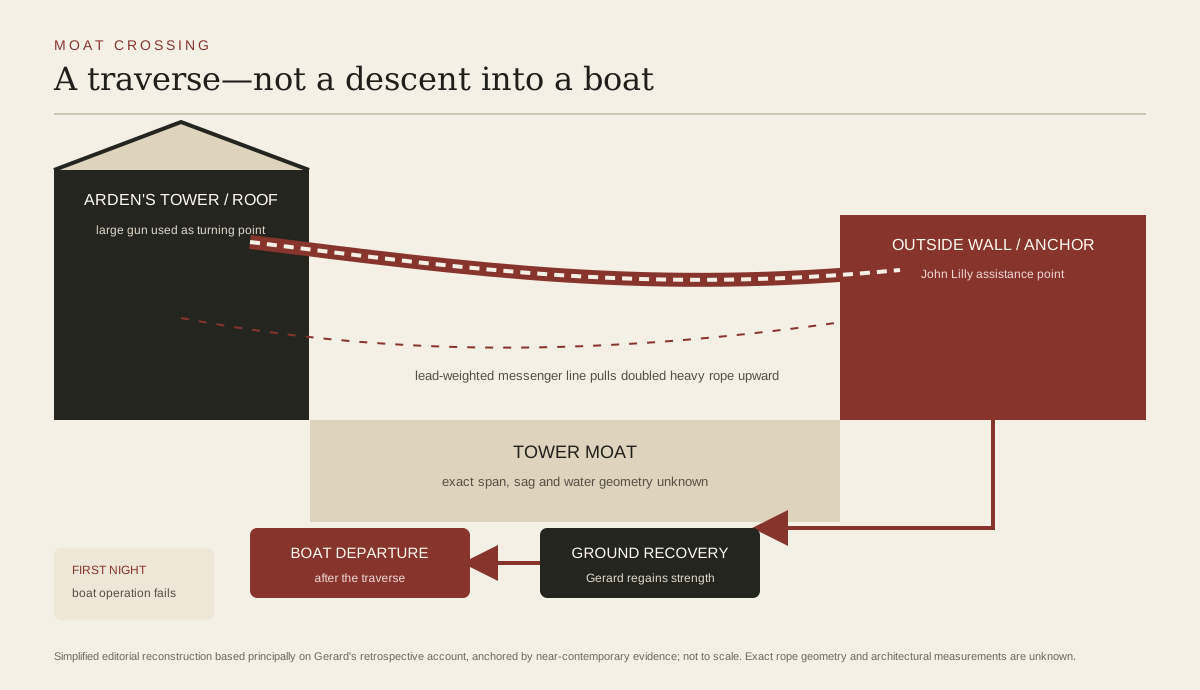
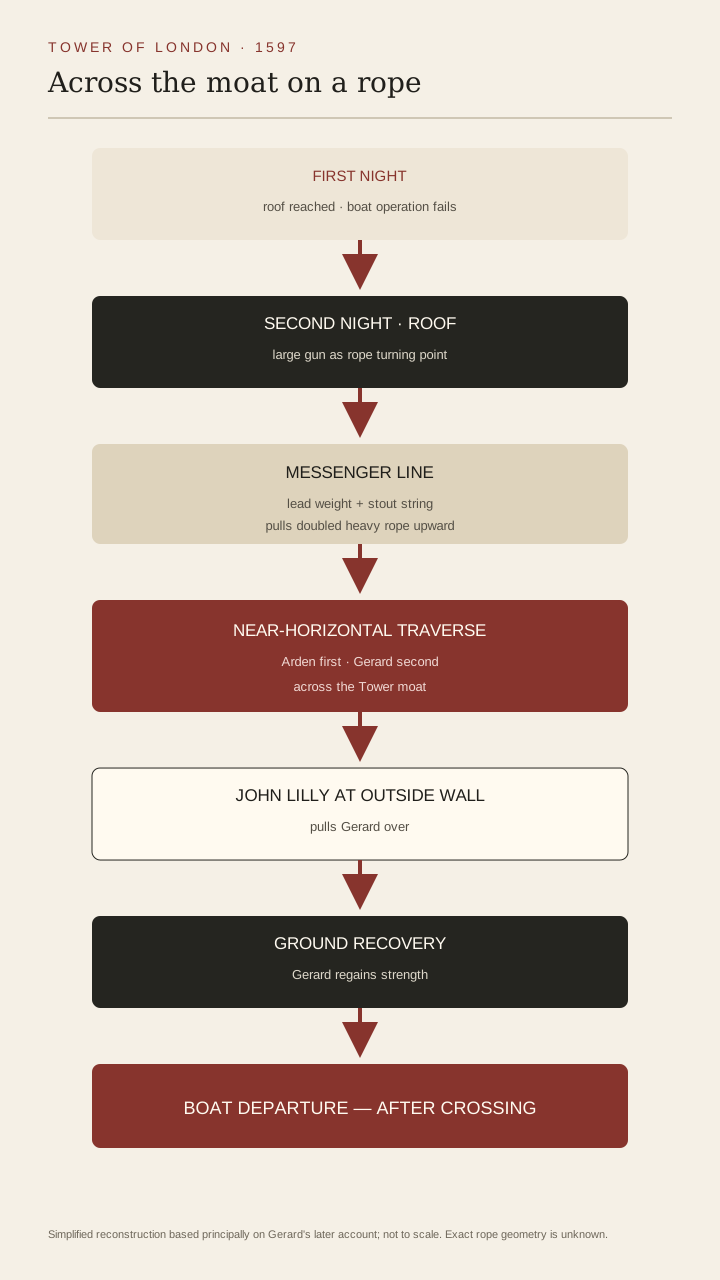
Moat-crossing reconstruction
A messenger line, a heavy rope, and a near-horizontal traverse
Gerard's later participant narrative supplies most operational detail; near-contemporary evidence anchors the escape itself. The diagram preserves that distinction.
- 01
First attempt
The prisoners reached the roof, but the boat operation failed; they returned and tried again the next night.
- 02
Messenger line
A lead-weighted light line allowed the prisoners to haul the doubled heavy rope upward.
- 03
Rope traverse
Arden crossed first; Gerard followed with hands and arms still impaired by torture.
- 04
Lilly's assistance
John Lilly pulled Gerard over the outside wall and helped him recover.
- 05
Boat after crossing
Only after the rope traverse and ground recovery did the party reach the getaway boat.
Simplified editorial reconstruction based principally on John Gerard's retrospective account, anchored by near-contemporary evidence for the escape itself; not to scale. Exact rope geometry and architectural measurements are unknown.
This Was Not a Slide
The rope did not descend steeply toward safety. The span was too long. Instead, it stretched from the tower toward the outside anchoring point at such a shallow angle that Gerard described it as appearing almost horizontal. The prisoners tested it.
They bundled books and other possessions inside Gerard’s cloak and placed the bundle on the doubled rope. It did not slide. The bundle stopped almost immediately. That test changed the escape from a controlled descent into a suspended traverse.
The men would have to move themselves across.
There was no easy way back to the original plan. The rope was now in place, and leaving it could expose the whole operation.
Arden went first.
Arden Crosses
Gerard described Arden as stronger and more physically capable at that moment. He crossed ahead of him.
The first man’s weight altered the system. The rope sagged more than Gerard had anticipated.
That mattered because Gerard’s own crossing would be performed with damaged hands and a less favorable rope geometry. Still, he followed. The exact full-body movement matters because it has often been replaced in popular retellings by a word such as “abseiled,” “slid,” or “climbed down.” Gerard’s account describes something different.
He gripped the rope with his right hand, supported himself with his left arm, and wrapped his legs around it. He began face downward.
After only a short distance his body rotated under the rope. Now he was hanging beneath it. He nearly lost his grip.
The Middle of the Moat
Gerard kept moving. At roughly the middle of the span, he stopped. His strength and breath were failing. After resting, he continued, stopped again, and eventually reached the wall on the far side of the moat.
But the crossing still was not complete.
The sagging rope left him hanging in a poor position. His feet could reach the top of the wall, but he could not bring himself over it.
John Lilly climbed onto the wall. He caught Gerard by the feet and pulled him across. Gerard says he could not initially stand.
The rescue party had brought restorative drink for him. After recovering enough to move, he walked to the boat.
That sequence corrects one of the most persistent simplifications of the story.
The boat was the getaway vehicle after the rope crossing. It was not waiting directly beneath Gerard to receive him from a vertical descent.
Leaving the Rope Behind
The escapees had hoped to remove the rope. That would reduce the evidence of what had happened. They could not.
The outside men released the rope from their end and cut away part of it, but the tower end remained hanging. Gerard says they had passed the rope around the gun without tying it specifically so they might pull it free.
It would not come. Trying harder risked creating noise or dropping the rope into the water with a conspicuous splash. They abandoned it. The group entered the boat and moved away.
Only after travelling some distance did they land.
The Escape Network Splits Up
Gerard’s fellow escapee went with John Lilly to the London house Gerard used as a base. Gerard identifies the woman managing that house as Mistress Line—Anne Line, who is independently documented as a Catholic safe-house operator connected with Gerard and Garnet. Gerard himself went with Richard Fulwood to another Jesuit-linked house. There he encountered “Little John.”
Elsewhere in the same autobiographical material, Gerard identifies Little John as Nicholas Owen, the skilled builder of priest hiding places who had been arrested with Gerard years earlier. Owen and Gerard then rode toward Henry Garnet. This is the point at which Owen is securely present in Gerard’s own story of the immediate aftermath. It is not the same as evidence that he masterminded the rope operation.
What Happened to the Gaoler?
Gerard expected trouble for the Tower gaoler who had allowed him to visit Arden. He therefore arranged a warning. According to Gerard, supporters offered the gaoler a horse, a guide, a safe place away from London and financial support if he chose to flee. The man accepted.
Gerard later claimed that the former gaoler eventually converted to Catholicism and lived for several years on the annuity Gerard had promised him. That final part comes from Gerard’s retrospective account and lacks the same level of independent corroboration as the escape itself. It should be read as Gerard’s account of the man’s later life, not as an independently established administrative record.
Evidence discipline
What the record supports
Status labels distinguish secure conclusions from uncertainty and rejected claims. Color is never the only signal.
WELL-SUPPORTED
John Gerard escaped from the Tower on 4 October 1597.
Modern Jesuit archival material gives the date directly. Morris also quotes an 8 October 1597 Henry Garnet letter placing the escape on St Francis' night.
Sources: SRC-001, SRC-002DISPUTED
Gerard's fellow escapee was definitely named John Arden.
Modern Jesuit archival material calls him John Arden, while Morris's edition indexes the escapee as Francis Arden. The near-contemporary Garnet letter quoted by Morris says only 'one Arden' and does not supply a forename.
Sources: SRC-001, SRC-002MYTH
Gerard simply slid or abseiled down a rope into a waiting boat.
Gerard describes an almost horizontal rope traverse across the moat. He reached the opposite wall, was pulled over by John Lilly, recovered on the ground, and then walked to the boat.
Sources: SRC-001MYTH
The rescuers threw the heavy escape rope up to Gerard.
Gerard says the prisoners threw a lead-weighted light line toward the outside party, who attached it to the heavy rope so the prisoners could haul the rope upward.
Sources: SRC-001LATER CLAIM
Nicholas Owen masterminded the Tower rope escape.
Gerard's narrative places Nicholas Owen ('Little John') in the immediate post-escape support network but describes the operational plan as developed by Gerard and Arden, approved by Garnet, and executed outside by Lilly and Fulwood. The reviewed primary core does not establish Owen as mastermind.
Sources: SRC-001, SRC-014WELL-SUPPORTED
Gerard's Tower gaoler did not knowingly join the escape conspiracy.
Gerard says the gaoler accepted bribes for privileges but rejected a direct offer to facilitate escape, and Gerard left letters explicitly clearing him of prior knowledge. Independent proof of the gaoler's state of mind remains limited.
Sources: SRC-001WELL-SUPPORTED
Gerard used orange juice as invisible ink while imprisoned.
Gerard describes the method in detail. Surviving later letters from the same Catholic underground preserved by The National Archives independently demonstrate orange-juice secret writing as an authentic contemporary technique.
Sources: SRC-001, SRC-009LATER CLAIM
The other prisoner's wife smuggled the heavy escape rope into the Tower.
Gerard says the wife carried religious items into her husband's cell, but his escape narrative places the heavy rope with the outside helpers, who brought it to the moat. The reviewed primary narrative does not establish that she smuggled the escape rope inside.
Sources: SRC-001UNKNOWN
The exact rope span, tower height and attachment geometry can be reconstructed precisely.
The narrative establishes the broad arrangement but does not provide reliable exact measurements or enough architectural detail for a scale reconstruction.
Sources: SRC-001, SRC-004, SRC-010Was the Other Escapee John Arden or Francis Arden?
The escape itself is not in doubt. The other prisoner’s full name is less secure. Modern Jesuit archival material calls him John Arden. John Morris’s nineteenth-century edition of Gerard’s life instead indexes the escapee as Francis Arden.
Yet the near-contemporary Henry Garnet letter quoted by Morris says only that “one Arden” escaped with Gerard. It does not give a first name.
This is exactly the kind of small discrepancy that disappears in most retellings because one modern name gets copied repeatedly. The surviving evidence is less tidy than later retellings sometimes suggest. For that reason, this article uses Arden unless discussing the disagreement directly.
Did Nicholas Owen Mastermind the Escape?
Possibly—but the reviewed primary narrative does not establish it.
Later accounts often credit Nicholas Owen with planning or engineering the operation. His wider expertise makes the claim intuitively attractive: Owen was famous for constructing concealed spaces and repeatedly helped Catholic priests avoid capture.
But Gerard describes the escape plan as developing between himself and Arden. Gerard sought Garnet’s approval and specifically appointed Lilly and Fulwood to the outside operation.
Nicholas Owen appears in Gerard’s own account immediately after the escape, with horses available for the next stage. That proves involvement in the support network. It does not prove that he designed the rope crossing.
Did Gerard’s Gaoler Help Him Escape?
Not knowingly, if Gerard’s own account is accurate. The gaoler did make the escape possible indirectly. He carried messages. He accepted money.
He allowed Gerard to visit Arden. Those were major security failures.
But Gerard says the man refused a direct bribe to release him and had no knowledge of the planned breakout. Gerard left letters trying to prevent the authorities from treating him as a deliberate accomplice.
The distinction is important. An official can be corrupt enough to weaken security without agreeing to the final crime.
How Reliable Is Gerard’s Story?
Gerard’s autobiography is unusually rich evidence, but it was written years after the event. That creates two obligations. The first is to use it. Without Gerard’s account, much of the escape’s mechanical sequence would disappear: the orange-juice correspondence, the first failed boat attempt, the messenger line, doubled rope, failed bundle test, sagging traverse and Lilly’s final assistance.
The second is to calibrate it.
Gerard wrote as a Jesuit reflecting on persecution, providence, courage and mission. His text is not a neutral police report. It includes interpretations of motives and episodes he learned from others after the fact.
Fortunately, several elements can be checked.
Henry Garnet’s letter within days of the escape confirms Gerard and an Arden escaped from the Tower. Modern archival work preserves the 4 October date. Historic Royal Palaces independently places Gerard in the Tower and treats his torture account as an important historical source. Government records from the period independently confirm the state campaign against Jesuit and recusant networks. Surviving orange-juice letters from the same Catholic underground demonstrate that the communication method Gerard describes was genuinely used.
The result is a case with a strong core and a clearly identifiable edge of uncertainty.
Why the Escape Matters
Gerard’s escape is memorable because it combined several different kinds of vulnerability. The Tower’s defenses were not simply overcome by strength. The escape exploited:
- a gaoler willing to sell favors but not freedom;
- the possibility of clandestine correspondence;
- access from one prisoner’s quarters to another;
- a roof door whose masonry could be loosened;
- an outside Catholic support network;
- a water route away from the fortress;
- and an improvised rope system capable of bridging the moat.
Then the plan failed. The boat could not reach them. The outside party nearly drowned. The prisoners tried again the next night.
On the second attempt, the central mechanical assumption failed too: the rope did not behave like a slide. Gerard still crossed it. That is why the best reconstruction of the escape does not need embellishment. The documented problems are enough.
Selected chronology
Capture, two attempts and escape
Gerard is captured
After years of clandestine Jesuit missionary work, Gerard is arrested and enters a succession of prisons.
Transferred to the Tower
Gerard is moved from the Clink to the Tower of London and initially confined in the Salt Tower.
Interrogation and torture
Gerard is repeatedly suspended by the wrists during efforts to obtain information about Catholic and Jesuit networks.
Gerard begins trying to reach the prisoner across the garden
Gerard's account dates the beginning of his efforts to arrange a religious visit to the last day of July.
The escape possibility is recognized
During a visit to Arden's quarters, Gerard notices how close the building stands to the moat and begins planning a rope escape.
First attempt fails
The prisoners reach the roof, but the outside rescue boat cannot complete the operation and is nearly wrecked near London Bridge.
Gerard and Arden escape
The prisoners traverse the Tower moat on a doubled rope and leave by boat.
Gerard leaves England
After years of continued clandestine work, Gerard leaves England amid the aftermath of the Gunpowder Plot.