
John Oldcastle’s escape from the Tower of London is one of the better-known episodes in the early history of Lollardy, but the escape itself is less fully documented than its consequences.
By September 1413, Oldcastle was a prominent knight, a former military associate of the future Henry V, and—through his marriage to Joan Cobham—a parliamentary lord commonly styled Lord Cobham. He was also an increasingly visible supporter of Lollard religious ideas associated with John Wycliffe. After an ecclesiastical prosecution led by Archbishop Thomas Arundel, Oldcastle was condemned as a heretic and committed to the secular authorities. Henry V allowed a forty-day respite in the hope that his former associate would recant.
Oldcastle did not recant. In October he escaped from the Tower.
What happened next turned a religious prosecution into a political crisis. Oldcastle remained at large, became linked to the failed Lollard rising outside London in January 1414, and avoided capture for nearly four years. Yet the surviving sources do not support every later story about how he left the Tower, exactly what he planned afterward, or the manner of his eventual death. Catholic chroniclers, Tudor Protestants, and later dramatists all had reasons to reshape his story.
At a Glance
- Prisoner: Sir John Oldcastle, commonly styled Lord Cobham
- Reason for confinement: condemned for heresy after an ecclesiastical trial
- Conviction: 25 September 1413
- Prison: Tower of London
- Escape: October 1413; exact day disputed
- Known associate after the escape: William Fisher, a Smithfield parchment-maker later prosecuted in connection with Oldcastle’s flight
- Political aftermath: Oldcastle was implicated in the failed Lollard rising of January 1414 and was subsequently outlawed
- Time at large: nearly four years
- Capture: late 1417 near Welshpool in the Welsh Marches
- Execution: 14 December 1417 in London
- Evidence warning: detailed escape mechanics and several later martyr/traitor stories are not securely established by contemporary evidence
Soldier, lord, and Lollard
Oldcastle did not enter the Tower as an obscure dissenter. He had served the Lancastrian monarchy in Wales, represented Herefordshire in Parliament, and fought in France. His relationship with Henry, Prince of Wales—the future Henry V—gave later writers an especially powerful story: an old companion of the king transformed into a condemned heretic and political fugitive.
His marriage to Joan Cobham raised his status further. From 1409 he was summoned to Parliament and was commonly known as Lord Cobham. At the same time, evidence of his support for Lollard preaching became harder for church authorities to ignore.
Lollardy was not a single, rigid program, but its adherents were associated with criticism of clerical wealth and authority and with ideas drawn from Wycliffe’s theology. Oldcastle’s own positions are unusually visible because a record of his 1413 prosecution survives. During the proceedings he resisted orthodox formulations on the Eucharist and the necessity of sacramental confession to a priest and strongly criticized religious images and papal authority.
Those views were not reconstructed centuries later from legend alone. Archbishop Arundel’s account of the proceedings was circulated after the trial as part of the campaign against Lollardy. It is an interested ecclesiastical document, but it preserves a detailed contemporary record of the questions Oldcastle faced and the answers attributed to him.
Convicted and sent back to the Tower
Oldcastle was brought before the ecclesiastical court in September 1413 after earlier citations had failed to bring him into submission. Proceedings took place at St Paul’s and the Blackfriars.
On 25 September, Arundel and the other clerics declared him a heretic. The ecclesiastical court could condemn him for heresy but relied on the secular power to carry out the resulting punishment. Oldcastle was returned to the Tower.
Henry V did not immediately permit the sentence to be carried out. Contemporary and near-contemporary accounts agree that Oldcastle received a respite of forty days, apparently to give him a final opportunity to recant.
The precise conditions of his imprisonment are less clear. A near-contemporary royalist account claimed that Oldcastle had been relieved of fetters after promising to submit at a later church assembly and then exploited the opportunity. Other accounts simply say that he escaped. There is no secure contemporary description of a tunnel, wall climb, disguised departure, bribed guard, or other detailed physical mechanism.
That absence matters. The Tower was a royal fortress and prison, but wealthy or high-status prisoners could experience custody very differently from later popular images of a uniformly sealed dungeon. A gap in the evidence should not be filled with a mechanically satisfying escape story.
An October escape without a secure day
The month is clear. The exact date is not.
A date of 19 October 1413 became common in historical writing, supported by nineteenth-century reconstruction of government financial and administrative records. Other modern timelines have used 28 October.
There is a problem with both forms of precision. A royal prohibition against sheltering Oldcastle has been dated to 10 October, the same day Arundel ordered wider publication of the proceedings against him. If that dating and interpretation are correct, Oldcastle may already have been outside the Tower by then.
The contradiction is old enough that the Victorian Dictionary of National Biography explicitly noted it. No surviving narrative source supplies a reliable hour-by-hour account capable of resolving the problem.
The responsible conclusion is therefore narrower: Oldcastle escaped from the Tower in October 1413, during the period in which execution had been delayed. The exact day remains disputed.
William Fisher and the London network
The identity of at least one person associated with Oldcastle after the escape is better supported.
William Fisher, described as a parchment-maker in the Smithfield area, was later accused of helping arrange Oldcastle’s escape and of sheltering him. Fisher was executed in 1416. Medieval records and later historical syntheses sometimes describe him simply by his occupation—“the parchment-maker”—which helped produce variant names and labels in later retellings.
The evidence for Fisher does not establish a complete escape team. Nor does it prove precisely how anyone gained access to Oldcastle inside the Tower. It does show that the flight was connected to a London support network capable of concealing a nationally wanted man after he got out.
Oldcastle appears to have remained hidden in or around London for some time. Government searches and later prosecutions show that authorities suspected sympathetic households, artisans, and religious dissidents of providing shelter and assistance.
This is the point at which the history of the escape merges with the history of organized Lollard resistance.
The rising of January 1414
By early January, Henry V’s government believed that a serious conspiracy involving Oldcastle was underway. Royal and monastic chronicles described plans to seize or kill the king and leading clergy, while later official proceedings treated Oldcastle as the principal rebel.
An armed gathering did take place in the St Giles’s Fields area outside London on the night of 9–10 January 1414. The government had advance warning. The king mobilized forces, access to London was controlled, suspected rebels were intercepted, and the gathering collapsed. Some participants were captured and executed.
Oldcastle escaped again.
The difficulty lies in moving from those secure facts to the most expansive version of the royal case. Government accusations described an enormous conspiracy aimed at destroying the existing church settlement and overturning royal authority. Hostile chronicles supplied dramatic numbers and motives. Tudor Protestant writers later moved in the opposite direction, minimizing or denying the rebellion in order to preserve Oldcastle as a religious martyr.
Modern scholarship is more cautious. Oldcastle’s involvement in a political Lollard conspiracy is well supported, but the precise size of the movement, the full program attributed to it, and even whether Oldcastle personally stood in St Giles’s Fields when the royal forces moved in are less certain.
The escape should therefore not be written as though it automatically proves every treason allegation made afterward. It placed Oldcastle beyond legal custody and allowed him to participate in or encourage a movement that the crown treated as rebellion. The exact boundaries between religious resistance, conspiracy, and later official amplification remain debated.
Nearly four years as a fugitive
After the January failure, the crown offered a very large reward for Oldcastle’s capture. He was summoned to answer in county courts, failed to appear, and was formally outlawed in 1414.
For nearly four years he avoided arrest.
The documentary trail becomes intermittent. Oldcastle was connected with supporters in Herefordshire and the Welsh Marches, and royal authorities repeatedly searched for him. Reports tied him to later disturbances and conspiracies, but the evidence for individual allegations varies sharply.
His ability to remain free is itself important evidence of continued assistance. A wanted nobleman associated with a failed religious-political rising could not easily survive for years without shelter, money, information, or sympathetic contacts.
By late 1417, that protection failed. Oldcastle was captured in the region near Welshpool after a violent struggle in which he was badly wounded. His injuries were serious enough that he was transported toward London in a horse-litter.
Capture, judgment, and execution
Oldcastle was brought before Parliament on 14 December 1417. By then two legal identities had accumulated around him: the heretic condemned in 1413 and the outlawed traitor of the post-escape rebellion.
He was condemned and taken to St Giles’s Fields for execution that same day.
The official parliamentary wording has traditionally been rendered as Oldcastle being “hanged and burnt hanging.” That formula establishes the combination of treason and heresy punishment, but it does not settle every physical detail later attached to his death. Some accounts imply that he was burned alive while suspended; others are compatible with hanging first and burning afterward.
Tudor Protestant writers had powerful reasons to emphasize prolonged martyrdom. Catholic and royalist writers had equally strong reasons to emphasize treason, rebellion, and divine punishment. Neither tradition should be allowed to supply certainty that the earlier record does not contain.
The execution also returned Oldcastle to the place associated with the failed rising of 1414. Whether intended as deliberate symbolism or simply as use of an established execution site, the connection strengthened the later fusion of heretic, rebel, and martyr in historical memory.
From Oldcastle to Falstaff
Oldcastle’s afterlife became so contested that it eventually entered Shakespearean history.
Sixteenth-century Protestant writers, especially John Bale and John Foxe, recast him as an early Protestant martyr. Their works preserved important older material but also interpreted it through Reformation conflict. The failed rising was particularly awkward for a martyr narrative, and some Protestant accounts minimized, denied, or blamed the treason accusations on hostile clergy.
At almost the same time, theatrical tradition pushed Oldcastle in another direction. The comic companion of Prince Hal in Shakespeare’s Henry IV plays appears originally to have been called Sir John Oldcastle. Surviving textual traces and early testimony support the name change to Falstaff, apparently after objections from descendants associated with the Cobham title.
The Folger Shakespeare Library notes that Elizabethan audiences would have recognized the controversy. Oldcastle could be remembered as a brave soldier, a condemned heretic, a traitor, a Protestant martyr, or the name behind a comic stage character—sometimes all at once.
Those later identities are part of his historical importance, but none tells us how he physically left the Tower in October 1413.
What the escape record actually supports
The durable core of the story is smaller than the legend.
Oldcastle was convicted of heresy on 25 September 1413 and confined in the Tower while a forty-day respite delayed execution. He escaped in October. William Fisher was later prosecuted in connection with the escape and with sheltering him. Oldcastle remained free, became implicated in the Lollard rising suppressed in January 1414, survived as a fugitive for nearly four years, and was finally captured and executed in December 1417.
The exact day of the Tower escape is uncertain. Its physical mechanics are unknown. The most sweeping claims about the January rising come from politically interested sources, while later Protestant martyrology reshaped the same events in the opposite direction.
That distinction is what makes Oldcastle’s escape historically valuable. The event itself is real and consequential, but the surviving evidence forces a separation between what happened, what the Lancastrian government said had happened, and what later religious and literary cultures wanted Oldcastle to become.
Evidence discipline
What the record supports
Status labels distinguish secure conclusions from uncertainty and rejected claims. Color is never the only signal.
DISPUTED
John Oldcastle escaped from the Tower on a securely established exact day in October 1413.
Nineteenth- and twentieth-century reconstructions often give 19 October, while a royal prohibition against harboring him dated 10 October suggests an earlier escape; another modern chronology gives 28 October. October 1413 is secure, but the exact day is not.
Sources: SRC-002, SRC-004UNKNOWN
The surviving record explains exactly how Oldcastle physically got out of the Tower.
Near-contemporary sources confirm the escape but do not provide a reliable physical mechanism. Later stories about assistance do not justify inventing a route, disguise, climb, bribery sequence, or security failure.
Sources: SRC-002, SRC-004WELL-SUPPORTED
William Fisher was associated with Oldcastle’s escape and concealment.
Historical records identify Fisher, a Smithfield parchment-maker, as a helper who sheltered Oldcastle and was later prosecuted in connection with the escape.
Sources: SRC-002DISPUTED
Every accusation in the crown’s account of the January 1414 rising can be accepted literally.
An armed Lollard-linked rising and Oldcastle’s political involvement are well supported, but the scale, full program, and Oldcastle’s physical presence at the gathering are less certain. Modern scholarship stresses the political interests of Lancastrian sources.
Sources: SRC-002, SRC-004MYTH
Later Protestant accounts provide neutral evidence for the mechanics of Oldcastle’s escape and execution.
Bale, Foxe, and later Protestant tradition helped construct Oldcastle as a proto-Protestant martyr. Their works preserve older material but are part of a confessional reception history, not neutral contemporary confirmation.
Sources: SRC-006, SRC-007MYTH
Shakespeare’s Falstaff was unrelated to the historical Oldcastle.
Folger scholarship documents strong evidence that Falstaff was originally called Oldcastle and was renamed, probably after objections connected with Oldcastle’s descendants.
Sources: SRC-007, SRC-008Documentary reconstruction
Escape, contested rebellion and later reception
A case-local editorial visual separates the documented sequence from uncertainty without implying exact modern geography or operational detail.

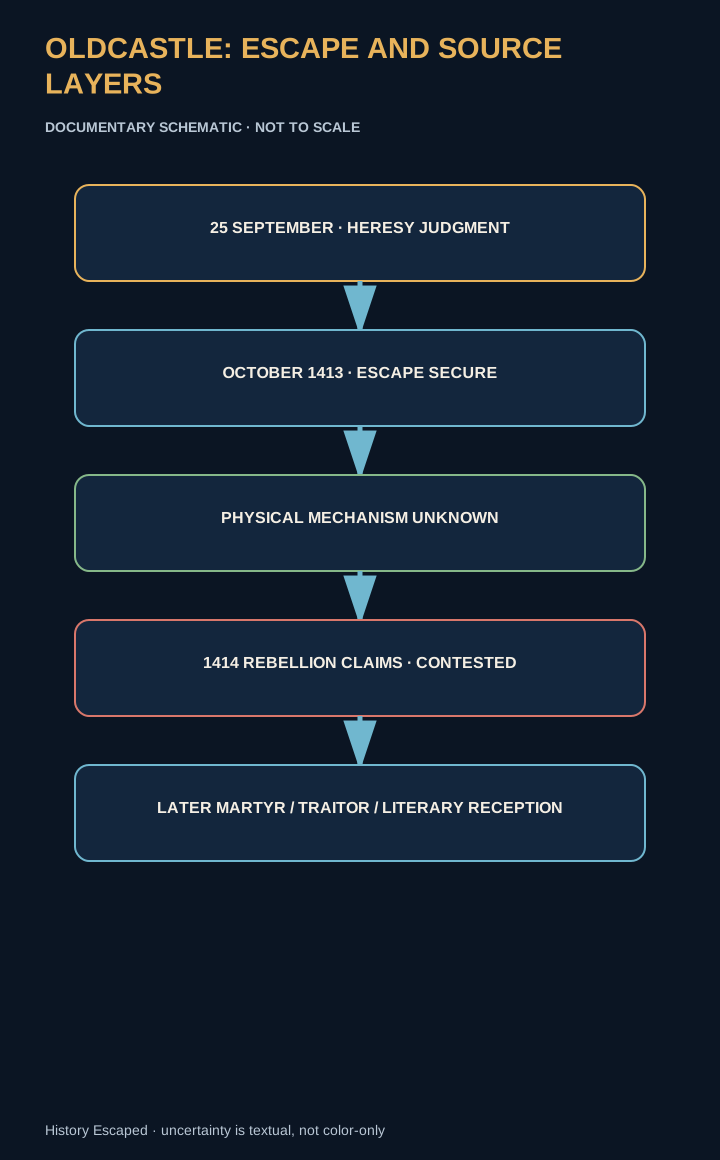
Simplified editorial reconstruction based on the cited historical record; not to scale. Uncertainty is stated directly in the visual and adjacent text.