
Captured while carrying underground information across the Slovak frontier, Jan Karski was tortured by the Gestapo, survived a suicide attempt, and was moved under guard to a hospital in Nowy Sącz. His escape on 28 July 1940 was not a lone dash for freedom but a coordinated Polish underground rescue built around doctors, couriers, guards and an evacuation network.
The courier the Gestapo needed alive
In June 1940, Jan Kozielewski — later known permanently as Jan Karski — was already doing work that made capture exceptionally dangerous.
He was serving as a courier between the Polish underground and the Polish government-in-exile. His value did not come from carrying a weapon or commanding a unit. It came from what he knew.
Karski had an unusually strong memory, knowledge of languages and geography, and an ability to carry political and organizational information across borders without depending entirely on written documents. During his early missions, he moved information between occupied Poland and the Polish authorities then based in France.
In June 1940 he set out again, traveling south toward Hungary through Slovakia. The mission failed near Demjata, northeast of Prešov.
Modern accounts based on Karski’s recollections and later research agree that he and his guide stopped after an exhausting journey and were betrayed to the authorities. Karski was arrested on the night of 14–15 June and eventually delivered into Gestapo hands.
The Germans found enough evidence to understand that this was not an ordinary border crosser. Interrogation followed.
Karski later described severe beatings and the fear that continued torture would eventually break his ability to protect the underground information he carried in memory. After one of the interrogations, he attempted suicide by cutting his wrists.
The attempt failed. That failure created the opening from which the escape would eventually grow.
From a prison cell to a hospital bed
Karski first regained consciousness under medical care in Slovakia. He was later transferred under Gestapo control to the hospital in Nowy Sącz.
The move was not a release.
The German authorities wanted him alive. His injuries required treatment, but once he recovered enough, interrogation could resume. In Nowy Sącz he remained a prisoner in a secured ward.
The hospital, however, was not politically neutral ground.
Members of its staff were connected to the Polish underground. Among them was the young physician Jan Słowikowski, a sworn member of the Union of Armed Struggle, or ZWZ — the major military resistance organization that preceded the Home Army.
Słowikowski later became central to the rescue. Karski did not trust him immediately.
That caution was rational. A captured courier could not assume that a sympathetic-looking doctor was safe. German counterintelligence could use false contacts to identify underground networks. Karski later remembered considering the possibility that his hospitalization itself might be part of a trap.
Słowikowski nevertheless began creating time. According to the Polish History Museum’s reconstruction and Słowikowski family testimony, the doctor encouraged Karski to appear more seriously ill and manipulated or exaggerated temperature readings so that the prisoner would remain in the hospital rather than be returned quickly to interrogation. Time was the first resource the rescuers needed.
The second was communication.

Getting a message out
Karski knew at least one local contact from before his arrest: Zofia Rysiówna. Before the failed frontier mission, he had passed through Nowy Sącz and made contact with the Ryś family’s underground circle. Now he needed to reach them without exposing himself to a false intermediary.
The Polish History Museum describes Słowikowski helping arrange a confession, during which Karski could ask a priest to make contact outside. Zofia Rysiówna then entered the hospital disguised as a nun or hospital sister.
The exact choreography is preserved through memoir and later participant testimony rather than a surviving German operations report, but the broad chain is well supported. Karski’s message went out.
Zofia carried information toward the underground network and to Kraków contacts associated with the Polish Socialist Party. The rescue that followed was therefore not the work of one organization alone. The Museum of the History of Polish Jews describes it as a joint action involving the ZWZ and the Kraków Polish Socialist Party.
Karski, meanwhile, remained under guard and feared renewed interrogation.
Later accounts say he asked that poison be brought to him if rescue proved impossible. That fact should not be romanticized. It belongs to the evidence because it shows how strongly Karski believed another round of torture could endanger other people.
The underground chose rescue.

The people around the hospital
The operation is often summarized as “Karski escaped from a hospital.” That wording hides the network that made the sentence possible. Jan Słowikowski worked inside the hospital. Zofia Rysiówna carried messages and helped connect Karski to the resistance.
Her brother Zbigniew Ryś became one of the organizers outside. Local ZWZ members prepared the extraction and onward movement. Polish guards assigned to the hospital were brought into the plan. Kraków socialist contacts helped authorize and support the effort.
Years later Karski emphasized that Słowikowski’s role had been exceptional. In a statement written in 2000, he credited the physician with prolonging his hospital stay, concealing his true condition, enabling contact with Kraków and actively helping organize the escape.
That is a more accurate description of what happened than the image of a prisoner suddenly noticing an open window and running. The escape was an operation.
28 July 1940
Local historical research places the rescue on Sunday, 28 July 1940. By then the conspirators had worked out both an internal and external plan.
Inside the hospital, guards and other people who might interfere were to be made unable or unwilling to stop the departure. Later testimony describes sedative-laced drinks and the cooperation of Polish policemen guarding the ward.
Outside, underground members waited to receive Karski and move him away from the building.
The exact route through the hospital differs in detail across later reconstructions. Some accounts emphasize a window; others describe movement toward the rear of the hospital and the mortuary area before the group withdrew.
The evidence is strong enough to say that Karski left the guarded ward with inside assistance and exited the hospital into the hands of waiting resistance members. It is not necessary to pretend that every door and window can be reconstructed with architectural precision.
Karski was still physically weak. His wrists had been badly injured, and his recovery had been deliberately prolonged in part to keep him away from the Gestapo.
This was therefore not an escape built around speed. It was built around temporary control of the environment. For a short period, the people who normally made the hospital a prison ceased to function as an effective barrier. That was enough.
Out of Nowy Sącz
Leaving the building was only the first stage.
The Gestapo would quickly discover that a valuable prisoner was gone. A conspicuous wounded man could not simply walk through occupied Poland.
Zbigniew Ryś’s later account describes a planned withdrawal away from the hospital, movement toward local waterways and use of a kayak to carry Karski toward Marcinkowice. The Polish History Museum’s reconstruction places Karski first in hiding near Marcinkowice and then, after further movement, at the Kąty estate near Iwkowa. The estate became a place of recovery and what underground organizations treated as quarantine.
A courier who had been arrested could not return immediately to his former contacts. The enemy might know his face, his routes, his aliases or some of his connections. The network itself needed time to determine what had been compromised.
Karski spent months recovering and remaining out of circulation. The rescue had succeeded physically. Operational safety required a longer disappearance.
The price paid by the rescue network
The escape did not end the danger for the people who helped him.
For a time, the German investigation failed to expose the network. Later, however, the Nowy Sącz underground suffered a major crackdown.
The Polish History Museum states that on 21 August 1941 German forces shot 32 people directly or indirectly connected with Karski’s rescue. A museum plaque commemorating the episode describes the killings as retaliation.
Local accounts add important chronology: the exposure of the network developed many months after the hospital operation, not as an immediate same-night reprisal. Zofia Rysiówna was arrested in 1941 and survived years of imprisonment in Ravensbrück. Jan Słowikowski went into hiding. Other participants and associates were imprisoned or killed.
The causal history is therefore more complicated than the simple phrase “32 people were killed because Karski escaped.” What can safely be said is that German repression eventually struck the circle connected to the operation with devastating force, and that the Polish History Museum directly associates the August 1941 execution of 32 people with the rescue. Karski learned the scale of that cost only later.
It stayed with him.
Why he had been worth rescuing
There is a temptation to explain the 1940 rescue mainly through what Karski would do two years later.
In 1942 he entered the Warsaw ghetto and a transit camp at Izbica, gathered eyewitness evidence of the persecution and mass deportation of Jews, and carried reports to Allied leaders in London and Washington. He eventually met officials including British Foreign Secretary Anthony Eden and U.S. President Franklin D. Roosevelt.
Those later events made Karski internationally famous. But the people who rescued him in July 1940 did not possess that future. They were not saving “the man who would tell Roosevelt about the Holocaust,” because that mission did not yet exist. They were rescuing a Polish underground courier who knew information that could endanger a resistance network and who might still be useful to the underground if he survived.
That distinction matters. It gives the rescuers their own historical agency instead of making them supporting characters in a story whose importance is visible only from hindsight.
Did Karski escape by himself?
No.
Karski participated in his own escape. He maintained contact discipline, took the opportunity created for him, and physically left the guarded ward despite serious injuries.
But the historical record consistently describes an organized rescue. Słowikowski helped keep him in the hospital and facilitate contact. Zofia Rysiówna carried messages. Zbigniew Ryś and other underground members prepared the extraction.
The ZWZ and Kraków socialist network supported the operation. Cooperating guards helped neutralize the ward’s security. Others moved and hid Karski after he left the hospital. Calling this a “hospital escape” is fair.
Calling it a solo escape is not.
What is certain — and what comes from later memory
The broad structure is unusually secure. Karski was arrested during a courier mission in Slovakia. The Gestapo tortured him. He attempted suicide because he feared betraying underground secrets.
He survived and was moved under guard to the hospital in Nowy Sącz. He made contact with the resistance. The ZWZ, with socialist support, organized a rescue. He escaped in late July 1940 and was hidden while he recovered.
The fine operational details require more caution.
Karski published his own wartime memoir, Story of a Secret State, in 1944. It is a near-contemporary participant source, but still a memoir written for publication during the war.
Other precise details — the preparation of guards’ drinks, the responsibilities of individual rescuers, the kayak route, exact signals and exact hospital movements — come from later statements by Karski, Słowikowski family testimony, Zbigniew Ryś’s recollections and local historical reconstruction. Those sources are valuable. They should not be silently upgraded into a minute-by-minute German record that does not exist.
Why the rescue worked
The escape succeeded because several systems overlapped in Karski’s favor. The Gestapo needed him alive, which moved him from an interrogation environment into a hospital. The hospital contained underground sympathizers. Karski had a preexisting local contact whom the resistance could identify.
The underground could reach beyond Nowy Sącz to political and military networks in Kraków. Polish personnel inside the security arrangement could be recruited or induced to cooperate. And, most importantly, the rescuers planned beyond the hospital door. They had hiding places and onward movement available once Karski was outside.
The operation did not defeat German power in Nowy Sącz. It created a short interval in which German custody stopped working. Then the underground made Karski disappear.
The escape before the mission history remembers
Karski returned to clandestine activity after recovery. His later wartime mission would become one of the most important episodes in the history of witnessing the Holocaust: entering places of persecution, memorizing what he saw, leaving occupied Europe and reporting to Allied leaders. The hospital rescue made that later work possible. Karski himself said so explicitly near the end of his life.
But the 1940 episode deserves to stand on its own. It was a rescue of a tortured courier from a guarded hospital. It depended on a physician using medicine as cover, a young woman carrying messages through occupied territory, local organizers coordinating people inside and outside the building, guards willing to cooperate, and a clandestine network capable of moving a wounded man away before the Gestapo could recover control.
Karski survived the hospital. The escape belonged to everyone who made the ward stop being a prison.
Escape reconstruction
How the escape unfolded
An evidence-aware sequence of the principal stages.
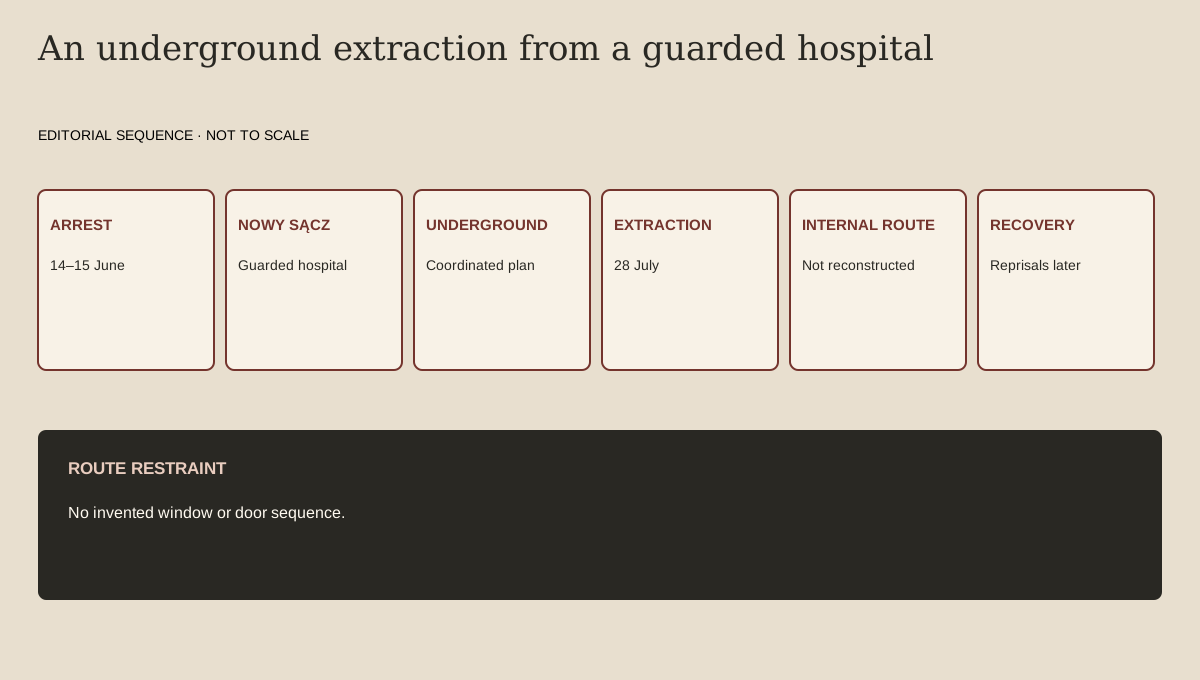
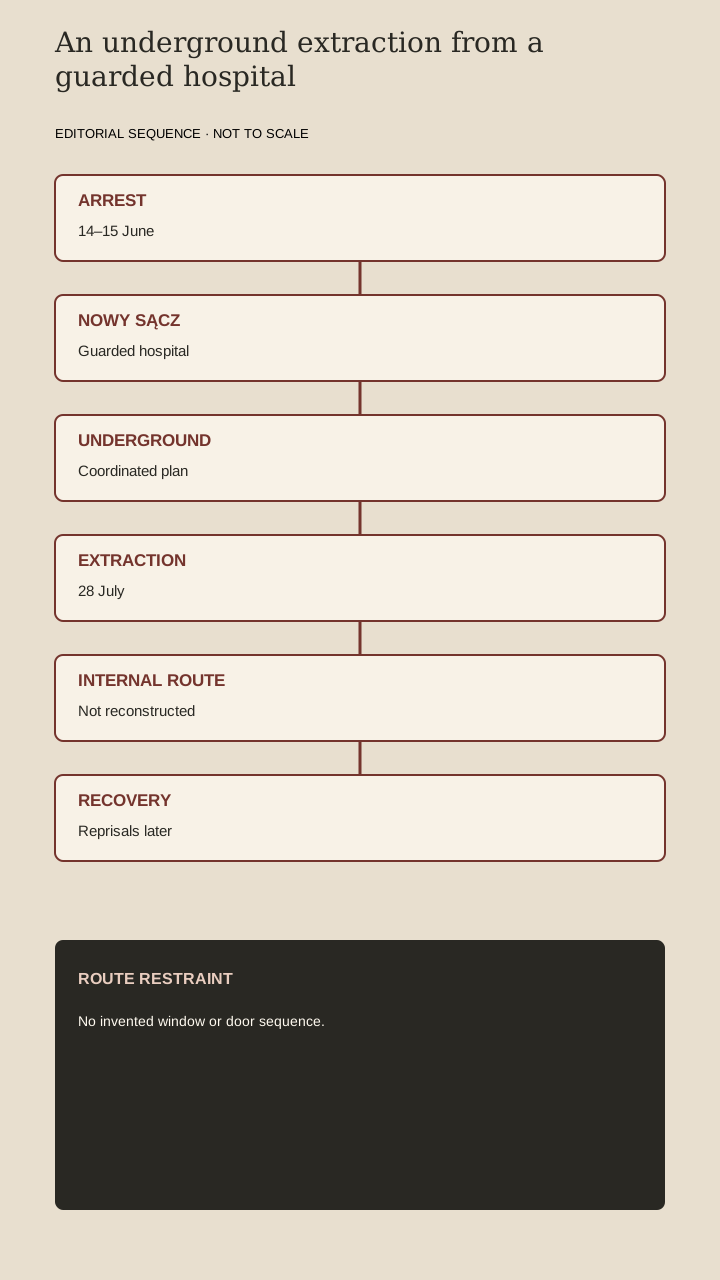
Simplified editorial reconstruction; not to scale. See adjacent text for evidence qualifications and unresolved details.
Problem → response
Escape was a sequence of problems
Each response solved a practical obstacle while often creating the next one.
- 01→
Obstacle
Karski’s physical condition
Torture and severe wrist wounds left him weak and made a rapid solo breakout unrealistic.
Response
The resistance used the hospital itself as the operational environment, buying time for recovery and planning before moving him into a prepared evacuation network.
- 02→
Obstacle
Guarded hospital custody
Karski remained a Gestapo prisoner even while receiving medical care and could be returned to interrogation once he recovered.
Response
Underground-linked staff and cooperating Polish guards created a temporary breakdown in the security system long enough for the extraction.
- 03→
Obstacle
Risk of exposing the resistance
Any false contact, premature escape or post-escape movement could expose underground personnel and routes.
Response
Karski used a trusted local contact chain, and after the rescue he was moved through prepared hiding places and kept under clandestine quarantine.
The final accounting
Outcome
Karski escapes Gestapo custody
The 28 July 1940 hospital operation removes Karski from German custody and places him under underground protection.
Karski returns to underground work
After months of recovery and quarantine, Karski resumes clandestine activity and later undertakes his 1942 mission to report on Nazi persecution and mass murder.
The rescue network suffers later German repression
Participants and associates were arrested, imprisoned and killed; the Polish History Museum associates 32 executions in August 1941 with people directly or indirectly connected to the operation.
Evidence discipline
What the record supports
Status labels distinguish secure conclusions from uncertainty and rejected claims. Color is never the only signal.
MYTH
Karski simply escaped from the hospital by himself.
The episode was an organized resistance rescue. Karski physically left custody, but physicians, couriers, ZWZ organizers, socialist contacts, guards and an onward hiding network made the extraction possible.
Sources: SRC-002, SRC-003, SRC-006, SRC-007WELL-SUPPORTED
The hospital escape took place on 28 July 1940.
The date is preserved in local historical reconstruction and fits the established arrest-and-hospital chronology. The major international institutional summaries generally give July 1940 without a day.
Sources: SRC-007, SRC-010WELL-SUPPORTED
Jan Słowikowski played a central role in keeping Karski in the hospital and arranging his rescue.
The Polish History Museum, Karski Educational Foundation and Karski’s own 2000 statement all emphasize Słowikowski’s role in prolonging the hospital stay, facilitating communication and helping organize the escape.
Sources: SRC-002, SRC-006, SRC-009DISPUTED
Every detail of the hospital exit route is securely documented.
Later accounts differ in emphasis between a window escape and movement through rear hospital areas. The secure conclusion is that Karski left the guarded hospital with inside assistance and was handed to waiting resistance members; precise architectural choreography should not be overstated.
Sources: SRC-006, SRC-007, SRC-009LATER CLAIM
The guards were drugged as part of the escape plan.
This detail appears in later Słowikowski family testimony, Karski’s 2000 statement and local participant-based reconstructions. It is plausible and well attested retrospectively, but it is not treated as a surviving contemporaneous German record.
Sources: SRC-006, SRC-007, SRC-009MYTH
Exactly 32 people were immediately executed because Karski escaped.
The Polish History Museum links 32 people shot on 21 August 1941 to the rescue network, but local testimony shows that the crackdown unfolded many months after the July 1940 escape. The number is institutionally supported; the word 'immediately' is not.
Sources: SRC-002, SRC-008, SRC-012MYTH
The underground rescued Karski because it knew he would later report the Holocaust to Roosevelt.
That later mission had not yet occurred. In 1940 the resistance was rescuing a valuable courier who knew sensitive underground information and could return to service if he survived.
Sources: SRC-002, SRC-003, SRC-004Selected chronology
Selected chronology
Karski is arrested in Slovakia
During a courier mission south through Slovakia, Karski and his guide are arrested near Demjata and Karski is eventually delivered to the Gestapo.
Torture and suicide attempt
After severe interrogation, Karski attempts suicide because he fears that continued torture could force him to betray underground information.
Transfer to Nowy Sącz hospital
The Gestapo moves the wounded courier to a guarded hospital ward, where physician Jan Słowikowski becomes a crucial underground contact.
Operation extracts Karski from the hospital
Underground participants inside and outside the hospital coordinate Karski’s departure from Gestapo custody and move him into hiding.
Karski enters clandestine recovery
After initial concealment near Marcinkowice, Karski is moved to the Kąty estate and remains out of circulation while recovering and protecting the underground network.
German repression strikes the rescue network
The Polish History Museum links the execution of 32 people directly or indirectly connected with the rescue to the later German crackdown surrounding the operation.
Karski begins the mission for which he becomes best known
After returning to underground work, Karski later enters the Warsaw ghetto and Izbica transit camp and carries eyewitness reports to Allied leaders.