Irena Sendler’s release from Gestapo custody in 1943 was a bribed underground rescue rather than a physical jailbreak. After her arrest in Warsaw in October, the German security police interrogated and tortured her and sent her to Pawiak, the notorious prison complex used against political prisoners and resistance members. She refused to reveal the identities of colleagues or Jewish children and families connected with the rescue network around Żegota, the underground Council for Aid to Jews.
Within weeks, Żegota organized a bribe. The strongest source-critical Polish reconstruction says that on 13 November 1943 Sendler was selected for execution and then released through the intervention of a bribed German official. She survived because an underground network reached into the machinery of occupation before that machinery killed her.
The event is often retold as a narrow escape at the edge of a firing squad. That broad danger is real, but several popular details—including the exact arrest day, the exact injuries inflicted during torture, the exact date of release, and the claim that she alone had saved 2,500 children—require qualification.
At a Glance
- Person rescued: Irena Sendler, codename “Jolanta”
- Organization: Żegota, the Council for Aid to Jews
- Arrest: October 1943; strong institutional sources differ between 18 October and 20 October
- Custody: Gestapo interrogation and Pawiak Prison, Warsaw
- Treatment: severe beating and torture; Sendler later connected lasting leg problems to the abuse
- Sentence/status: condemned or selected for execution
- Best-supported release date: 13 November 1943
- Rescue mechanism: Żegota-organized bribe to German personnel
- Key organizers in the Polish Righteous reconstruction: Maria Palester, Jadwiga Piotrowska, Julian Grobelny, and Małgorzata Palester
- After release: Sendler went into hiding under false identity and continued underground aid work
- Evidence warning: a Yad Vashem chronology places the release later, by February 1944; the exact wartime chronology is therefore not perfectly uniform across major institutions
Żegota and the children’s network
Żegota was created in German-occupied Poland in 1942 to coordinate assistance to Jews facing persecution and murder. Supported by the Polish government-in-exile, it brought together Polish and Jewish underground activists and supplied hiding places, false papers, money, food, and medical help.
Sendler was already a social worker with Warsaw’s municipal welfare department and had been helping Jews before formally joining Żegota. Her work depended on networks rather than solitary heroics.
By 1943 she was deeply involved in assistance to Jewish children living outside the Warsaw ghetto under false identities. She helped arrange placements in private homes, orphanages, convents, hospitals, and other institutions and participated in maintaining coded information that could reconnect children with their identities if relatives survived.
The scale of that work has become one of the most repeated—and disputed—parts of Sendler’s later reputation. The United States Holocaust Memorial Museum describes her as helping several hundred children. Yad Vashem says the exact number saved by Sendler and her partners is unknown. Current historical work associated with POLIN Museum’s Polish Righteous project argues that the widely repeated figure of 2,500 children personally saved by Sendler is too high and that no more than about 500 children can presently be supported for the network in which she worked.
Sendler herself later spoke of encoded information concerning 2,500 Jewish children. That testimony matters, but it should not be converted automatically into a verified count of children whom she personally removed from the ghetto or personally saved.
The arrest-date conflict
Even the date of Sendler’s arrest is not entirely stable. The Polish Righteous project gives 18 October 1943. The Warsaw Ghetto Museum also uses 18 October in its biographical treatment.
Yad Vashem gives 20 October 1943. Sendler herself later remembered that the Gestapo came on her name day. That memory helped sustain the 20 October tradition.
There is no reason to pretend those dates agree. The secure statement is that Gestapo officers arrested Sendler in mid-to-late October 1943, shortly after she had taken leadership responsibility in Żegota’s children’s section. The exact arrest day therefore remains DISPUTED, with 18 and 20 October both documented in major institutional sources.
What the Gestapo found—and failed to find
The search of Sendler’s home could have endangered far more people than Sendler herself. Accounts agree that incriminating information concerning hidden children and underground aid had to be concealed before German officers found it. Polish Righteous research says Janina Grabowska, a friend and colleague who happened to be present, hid the papers under her clothing.
The precise physical form of Sendler’s lists has acquired its own mythology through the later “jars” story. The historically important point is simpler: the German search did not capture the information that could have exposed children, carers, addresses, and underground contacts.
Sendler was taken into Gestapo custody and interrogated. Her later oral testimony states that the Germans beat and tortured her and that her leg problems resulted from the abuse. She also said she was pressed for the organization’s name, leaders, addresses, and the people involved in helping Jews. She did not provide them.
Torture without embellishment
The severity of Sendler’s treatment is not in doubt. USHMM records her own testimony that she was beaten and tortured. Yad Vashem and other major institutions likewise describe brutal interrogation and torture at Pawiak and Gestapo facilities.
Popular retellings often become more anatomically specific. They say that both legs and feet were broken, or that particular bones were shattered in particular sessions.
Those claims appear in later biographies, memorial projects, and obituaries, but Sendler’s preserved USHMM testimony is less specific: she says the beatings and torture caused her lasting leg problems. For an extremely sensitive case, the distinction matters.
It is secure that she was severely tortured and injured; uncertain fracture details should not be turned into spectacle.
Pawiak
Pawiak was one of the central prisons of German terror in occupied Warsaw. The complex held political prisoners, underground activists, people seized in street roundups, and many Jewish prisoners. Interrogation was closely connected with the Gestapo headquarters on Szucha Avenue, while Pawiak functioned as a place of confinement, transfer, torture, execution selection, and deportation.
Sendler’s later account describes clandestine notes passing between her and Żegota while she was imprisoned. That communication mattered because the underground knew she was in danger and because her arrest threatened networks that remained active outside.
Żegota therefore tried to do more than provide moral support. It began trying to get her out.
How the rescue was organized
The most useful detailed reconstruction comes from the Polish Righteous project. According to that account, Jadwiga Piotrowska and Maria Palester pressed Żegota chairman Julian Grobelny to finance a bribe. Małgorzata Palester helped carry the money into the chain that reached German personnel.
That is the central escape mechanism. There was no assault on Pawiak, tunnel, disguise, forged release order, or physical fight through the prison.
The underground bought Sendler’s release from inside the occupation system. The identity and exact role of the bribed German functionary should be handled cautiously. Some later accounts call him a guard, others a Gestapo officer or agent. The source base is much stronger for the fact of bribery than for a complete personnel file on the person who accepted it.
13 November 1943
The Polish Righteous chronology says that on 13 November 1943, Sendler was designated for execution with a group of prisoners and was released that same day because of the bribe. This is the strongest day-specific chronology located for the case.
It is not the only chronology. Yad Vashem’s public biography says Sendler was arrested on 20 October and, after her release in February 1944, continued underground activity. Other later accounts place the release still differently, sometimes in January 1944.
Those differences cannot be reconciled cleanly. The strongest source-critical chronology is 13 November 1943 because it comes from a recent Polish reconstruction explicitly naming the participants in the bribe network. Other respected Holocaust institutions preserve a later chronology, so the conflict remains visible.
Was she officially declared dead?
A common version says the Germans entered Sendler’s name on a list of executed prisoners, allowing her to disappear more safely. That detail appears in major later biographical traditions, including Yad Vashem material, but it is not equally explicit in every institutional reconstruction.
The practical outcome is well supported: after release, Sendler could not resume ordinary legal life. She adopted false identity papers under the name Klara Dąbrowska, changed residences, and continued clandestine work.
Her survival therefore did not restore normal freedom. It converted a death-sentence prisoner into an underground fugitive.
Continuing the work
Sendler’s rescue did not end her involvement with Żegota. USHMM states that she continued working under a new alias despite the danger. Polish Righteous research likewise describes her returning to leadership work in the children’s department after a period of concealment.
That continuation helps explain why Żegota was willing to take extraordinary risks to save her. She carried knowledge, relationships, and experience that were useful to a wider rescue network. The goal was not simply to save a respected colleague; it was also to preserve an operating system of assistance to Jews still in hiding.
Sendler later framed the issue in similar terms. In oral history she said Żegota needed her alive because of the coded information and the children connected to it. The exact scale of that file is disputed, but the organizational logic is clear.
Who betrayed her?
The route by which the Gestapo reached Sendler is also uncertain. One tradition says the owner of a laundry used as an underground contact point was arrested, tortured, and gave up names.
Sendler later also spoke of learning that a neighbor had denounced her. The Polish Righteous project explicitly notes the conflict.
There is no need to choose between them without stronger evidence. The arrest can be described as resulting from denunciation or compromise within the underground environment, while the exact informer remains DISPUTED.
Rescue, not solitary escape
The language of “escape” can distort this case if it makes Sendler appear to have physically defeated prison security by herself. Her survival depended on collective action.
Sendler endured interrogation without exposing the people the Gestapo wanted. Grabowska protected incriminating material during the arrest. Underground contacts maintained communication with Pawiak. Piotrowska and Palester pushed for action. Grobelny authorized money. Małgorzata Palester helped move the bribe. A German official accepted payment and released the condemned prisoner.
That chain of action is the history. It is also why the case belongs in an escape archive even though there was no conventional breakout. Sendler moved from lethal state custody to clandestine freedom through a covert rescue operation conducted inside an occupied city.
What the evidence supports
Irena Sendler was arrested by the Gestapo in Warsaw in October 1943. Major institutions disagree on whether the day was 18 or 20 October.
The Germans failed to obtain the information hidden during the search of her home. Sendler was interrogated, severely beaten and tortured, and sent to Pawiak.
She did not reveal the rescue network. Żegota organized a bribe to get her out. The best-supported detailed chronology identifies Maria Palester, Jadwiga Piotrowska, Julian Grobelny, and Małgorzata Palester as central to that effort.
The strongest source-critical Polish account dates the release to 13 November 1943, on a day Sendler had been selected for execution. Other respected institutional sources place her release later, so the precise chronology remains a genuine source conflict.
Afterward she lived under false identity and continued underground rescue work. The episode should therefore be remembered neither as an individual jailbreak nor as a miracle detached from organization. It was a coordinated rescue from Gestapo custody, carried out by people who understood that saving Sendler could also protect the people and networks still depending on her silence.
Evidence discipline
What the record supports
Status labels distinguish secure conclusions from uncertainty and rejected claims. Color is never the only signal.
MYTH
Sendler physically broke out of Pawiak Prison.
The major sources describe an underground-organized bribe that caused German personnel to release her before execution, not a physical jailbreak.
Sources: SRC-001, SRC-002, SRC-004, SRC-005DISPUTED
Sendler’s arrest date is securely 20 October 1943.
Yad Vashem and Sendler’s later name-day memory support 20 October, while POLIN-linked Polish Righteous research and the Warsaw Ghetto Museum give 18 October.
Sources: SRC-001, SRC-005, SRC-006DISPUTED
Sendler’s release date is securely 13 November 1943 across all major sources.
The strongest detailed Polish chronology gives 13 November 1943, while Yad Vashem’s public chronology places her release later, by February 1944.
Sources: SRC-001, SRC-002, SRC-005WELL-SUPPORTED
Gestapo torture caused lasting injuries to Sendler’s legs.
Sendler’s USHMM oral history explicitly links her later leg problems to beating and torture.
Sources: SRC-003DISPUTED
Both of Sendler’s legs and feet were definitely fractured in a specifically documented pattern.
Later biographies and memorial retellings give specific fracture claims, while Sendler’s preserved oral testimony is less anatomically precise.
Sources: SRC-003DISPUTED
Sendler personally saved exactly 2,500 Jewish children.
Sendler later described encoded records involving 2,500 children, but Yad Vashem says the exact number is unknown, USHMM says several hundred, and current POLIN-linked historical research treats 2,500 as inflated.
Sources: SRC-003, SRC-004, SRC-005, SRC-007DISPUTED
The exact person who denounced Sendler is securely known.
Sources preserve competing accounts involving compromise of a laundry contact point and a later claim by Sendler that a neighbor denounced her.
Sources: SRC-002, SRC-006Evidence diagram
Żegota's rescue network
The evidence shows an organized bribed release rather than a lone physical prison break.
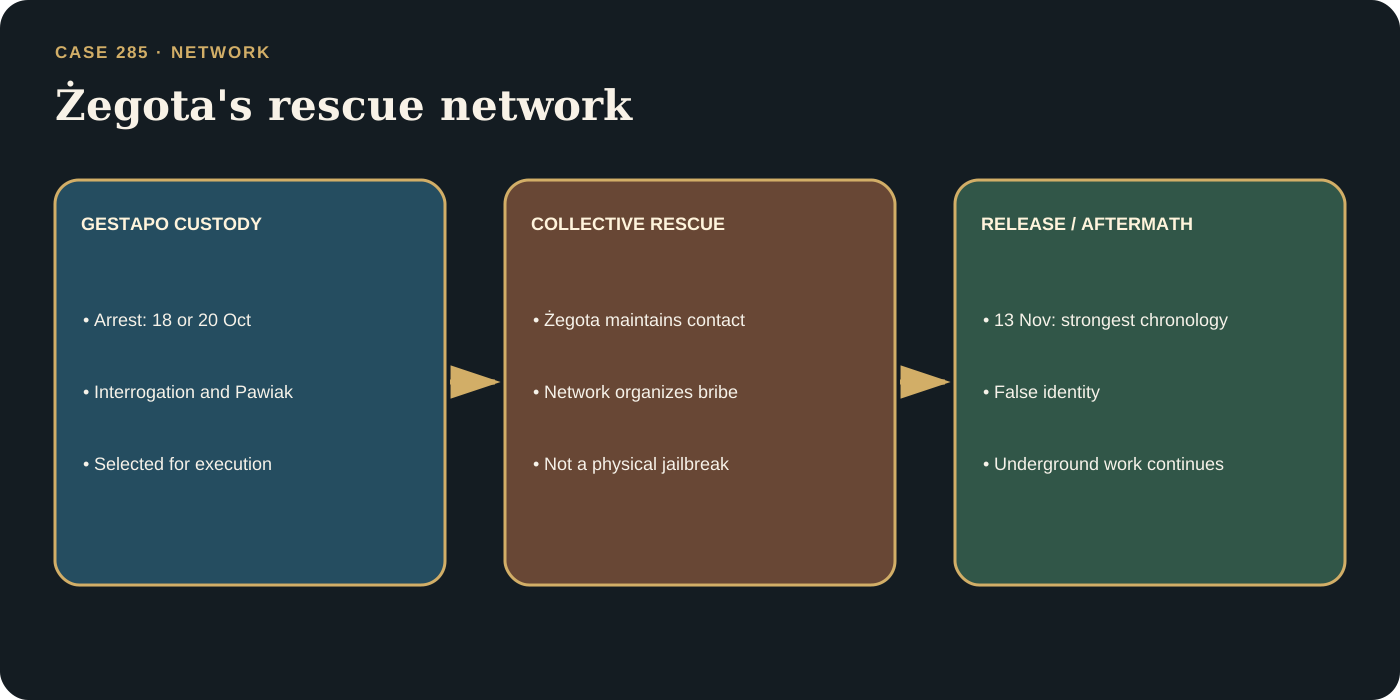
The evidence shows an organized bribed release rather than a lone physical prison break.