
Condemned to death inside German-occupied Lyon, a French Resistance officer turned the materials of his cell into a route over the roof and beyond Montluc’s walls.
Montluc under German control
Montluc had been built as a military prison, but its wartime role changed sharply after the German occupation of the southern zone of France. German authorities partially requisitioned the prison in January 1943 and took it over completely on 17 February. It became a place of confinement for Resistance members, hostages, Jews, and other people caught in the machinery of German repression in Lyon.
Thousands passed through Montluc during the German period. The prison was closely connected to the occupation authorities and the Gestapo apparatus operating in the city. Executions and deportations formed part of the wider system surrounding the site. For an individual prisoner, therefore, a sentence or transfer could carry consequences far beyond continued confinement.
André Devigny entered that system in April 1943.
A career soldier who had joined Resistance activity after France’s defeat, Devigny became involved in the Gilbert network, which was connected to British intelligence. On 17 April 1943 he was arrested at Annemasse, near the Swiss border. He was imprisoned at Montluc the following day.
His official Order of the Liberation biography records torture between his arrest and late May and says he did not reveal his network. It also records an earlier escape attempt during a transfer: Devigny broke away, was shot, and was recaptured. He was returned to prison with a clearer sense of what failure could cost.
On 20 August, he learned that he had been sentenced to death.
Material evidence
Improvised materials
The objects used in an escape reveal how a plan worked under constraint.
- 01
Spoon
Used to dismantle part of the wooden cell door.
- 02
Textile-and-wire cords
Used for descent and wall crossing; surviving examples are held by the Musée de l’Ordre de la Libération.
- 03
Improvised hooks
Metal hooks were fashioned from a cell fitting and used with the cords.
- 04
Bed wire
Wire taken from the bed was used to reinforce and join the textile cordage.
Cell 107 and a door taken apart slowly
French government heritage material identifies Devigny’s confinement as cell 107.
His solution did not begin with a single dramatic break. It depended on altering the cell without making the alteration obvious enough to end the attempt before it began.
The Musée de l’Armée records that Devigny used a simple spoon to dismantle part of the wooden door. The exact day-by-day sequence should not be embellished beyond the evidence, but the principle is clear: the door was worked on gradually so that it could eventually be opened from inside.
At the same time, the cell supplied raw material for the next barriers. Textile was cut into broad strips, folded, reinforced with wire, and joined into lengths of cord. Wire could be taken from the bed. Hooks were fashioned from a hinged metal fitting associated with the cell’s electric light. These were not props devised by a later filmmaker. The escape apparatus was preserved after the war and entered a museum collection.
The surviving objects matter because they anchor the story in physical evidence. They also show why calling the escape a “spoon escape” is incomplete. The spoon helped solve the door. The cords and hooks solved the vertical and perimeter problems that followed.
After Devigny learned of his death sentence, he had a cellmate: Antoine Gimenez. Whatever the circumstances that brought the two men together, the institutional record is clear that Gimenez escaped with him.
Escape sequence
From Cell 107 to outside Montluc
The surviving evidence establishes the operational sequence without providing measured wall heights or a complete site plan.
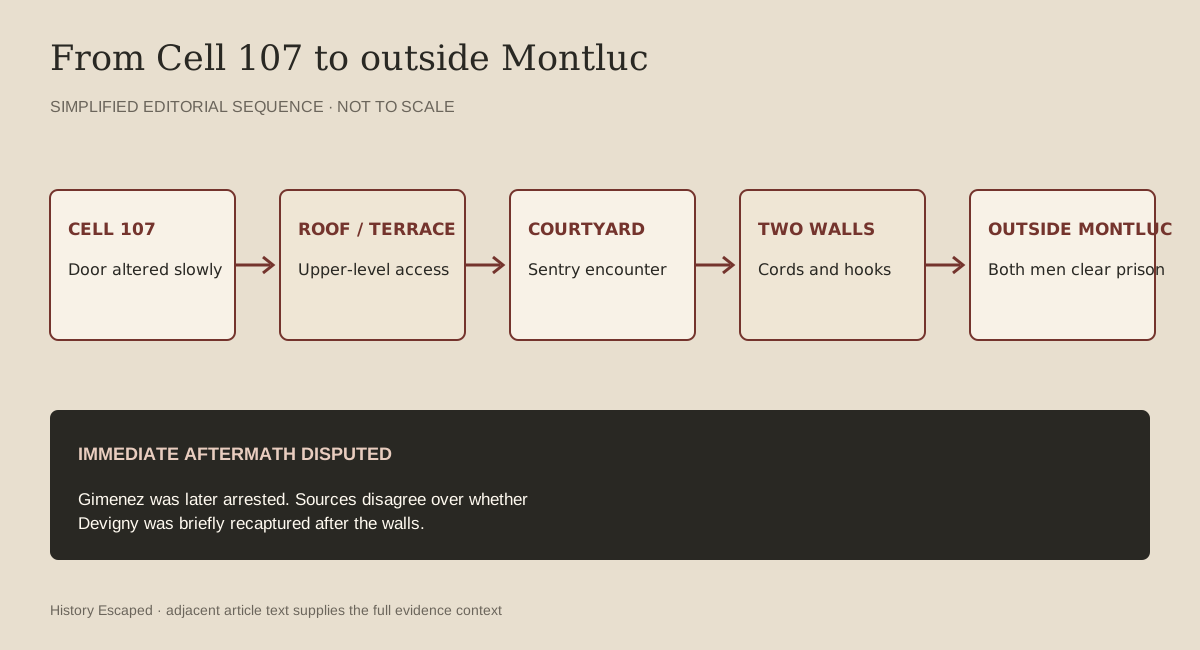
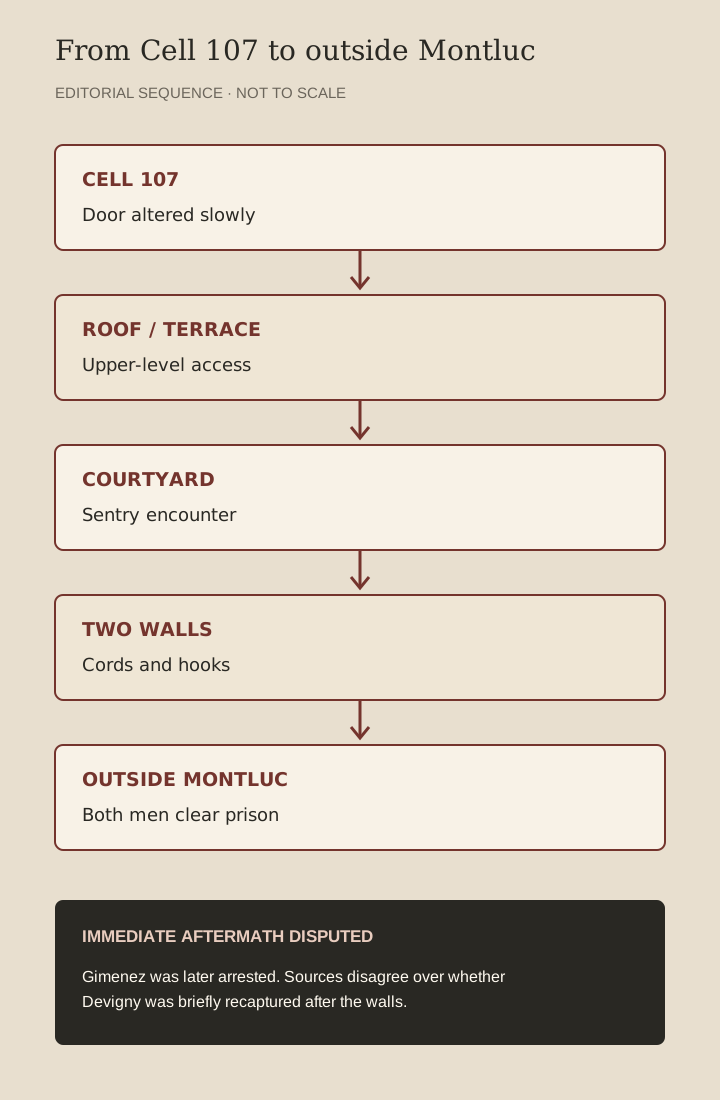
- 01
Cell 107
Devigny gradually altered the door and prepared improvised cordage and hooks.
- 02
Roof / terrace
Devigny and Gimenez gained the upper level before moving inward.
- 03
Courtyard
The evidence supports a sentry encounter without fixing exact geometry.
- 04
Two walls
Improvised cords and hooks carried the pair across both perimeter walls.
- 05
Aftermath
Gimenez was later arrested. Sources disagree over whether Devigny was briefly recaptured after the walls.
Simplified editorial sequence based on institutional and material evidence; not to scale. Exact wall heights and route geometry are unknown, and the immediate post-wall aftermath is disputed.

The night of 24–25 August
During the night of 24–25 August 1943, the prepared route became an actual escape.
Devigny and Gimenez got out of the cell and reached the upper part of the prison. A Musée de l’Armée photograph made during the later filming of Bresson’s adaptation identifies a ventilation opening associated with the emergence onto the terrace. The photograph is a reenactment image rather than wartime evidence, but its location at Montluc helps explain the transition from the interior to the roof level.
From there, the men still had to move through the prison complex and beyond its outer defenses.
French institutional accounts describe Devigny using his improvised cords and hooks to descend and to cross two perimeter walls. They also state that he strangled a sentry while moving through a courtyard. The surviving accounts reviewed for this article do not justify adding the guard’s name, an exact struggle sequence, or a claim about his final condition.
What can be said with confidence is that the escape depended on linked solutions: the altered cell door, access to the roof or terrace, cordage capable of bearing weight, hooks that could secure it, and the ability to negotiate the prison’s final walls. Failure at any one stage could have left both men trapped inside the complex or exposed in an internal yard.
By the end of the prison sequence, Devigny and Gimenez were outside Montluc. Then the sources divide.
Evidence discipline
What the record supports
Status labels distinguish secure conclusions from uncertainty and rejected claims. Color is never the only signal.
DOCUMENTED
Devigny and Gimenez escaped Montluc during the night of 24–25 August 1943.
The date and both escapees are independently preserved by the Montluc Memorial, the Order of the Liberation, and the surviving-object record.
Sources: SRC-001, SRC-003, SRC-004DOCUMENTED
The escape used cords made from prison textiles and wire plus improvised metal hooks.
The objects survive in a museum collection and are described in a specialist Resistance-history object record.
Sources: SRC-004WELL-SUPPORTED
A spoon was used to dismantle part of the cell door.
The Musée de l’Armée includes this detail in its Devigny collection interpretation, but the spoon itself was not independently verified as a surviving object in this pass.
Sources: SRC-005WELL-SUPPORTED
Devigny strangled a sentry while crossing an internal courtyard.
The action appears in official institutional accounts. The sources reviewed do not support adding the guard’s identity or a separate claim about his ultimate fate.
Sources: SRC-003, SRC-005DISPUTED
Devigny was recaptured at Vaulx-en-Velin and escaped again by jumping into the Rhône.
The Order of the Liberation and Musée de la Résistance en ligne report this sequence. The Montluc Memorial says Gimenez was arrested while Devigny was never recaptured, and scholarly discussion is compatible with only the companion being returned to the prison.
Sources: SRC-001, SRC-003, SRC-004, SRC-010DOCUMENTED
The 1956 film A Man Escaped is a direct adaptation of Devigny’s account and was filmed at Montluc.
French film and scholarly records identify Devigny’s work as the source and document Bresson’s use of Montluc as a filming location.
Sources: SRC-008, SRC-009, SRC-010
Was Devigny caught again after the walls?
The immediate aftermath is the most important unresolved question in the case.
Today’s Mémorial national de la prison de Montluc says that Antoine Gimenez was arrested a few hours later and André Devigny was never recaptured. The memorial’s educational material goes further, describing Devigny as the only escapee from Montluc during the German period who was not recaptured.
Two other major French institutions preserve a different version. The Order of the Liberation’s official biography says Devigny and his companion were caught at Vaulx-en-Velin. In that account, Devigny escaped again by jumping into the Rhône and hid in mud for approximately five hours. The Musée de la Résistance en ligne, in its detailed record of the surviving cords and hooks, repeats essentially the same sequence.
There is also a useful piece of scholarly context. Historian Marc André, writing about the memory of Montluc, refers to the arrest and return to a cell of the ordinary-law prisoner who had escaped with the Resistance member. That wording fits the version in which Gimenez was brought back while Devigny remained at large, although it does not by itself prove that Devigny was never briefly seized outside the prison.
The responsible conclusion is narrower than either dramatic certainty. The escape from Montluc is not in dispute. Gimenez’s later arrest is well established. Devigny was never returned to Montluc and ultimately reached safety. Whether he was briefly caught at Vaulx-en-Velin before escaping again into the Rhône remains disputed among strong French sources.
That uncertainty should remain part of the story rather than being edited away.
From Lyon to Switzerland
Devigny’s official biography records that he was sheltered and recovered for roughly ten days in the Vaulx-en-Velin area before reaching Switzerland. He remained there until January 1944.
His escape from the prison therefore did not instantly end his wartime danger. In January he entered Spain and was imprisoned there for approximately two months. By mid-April 1944 he had reached Casablanca. He then joined French forces and later fought in the campaigns in Provence and Alsace.
In December 1945 he was made a Compagnon de la Libération, one of the major honors associated with Free France and the Resistance.
The route from Montluc to renewed military service is important because it keeps the outcome precise. Devigny did not simply cross a wall and become safe. He escaped one prison, remained a hunted man, moved through neutral and authoritarian territory, endured another period of imprisonment in Spain, and only later rejoined the war from North Africa.
Problem → response
Escape was a sequence of problems
Each response solved a practical obstacle while often creating the next one.
- 01→
Obstacle
Locked cell and wooden door
The first barrier had to be altered without ending the escape preparations prematurely.
Response
Devigny gradually dismantled part of the wooden door from inside, with a spoon identified by museum interpretation as the improvised tool.
- 02→
Obstacle
Roof / terrace transition
The escape required reaching the upper level of the prison before the outer walls could be approached.
Response
The prepared cell exit allowed Devigny and Gimenez to reach roof or terrace level before approaching the outer barriers.
- 03→
Obstacle
Armed or guarding personnel
Official sources state that Devigny strangled a sentry in an internal courtyard.
Response
Official institutional accounts state that Devigny strangled a sentry while crossing an internal courtyard; do not add an unsupported identity or fate.
- 04→
Obstacle
Two perimeter walls
Two outer walls still separated the escapees from the city after they left the cell block.
Response
The pair used improvised textile-and-wire cords and metal hooks to negotiate the two outer walls.
- 05→
Obstacle
Post-escape pursuit
Gimenez was arrested after the breakout; Devigny’s exact immediate encounter with pursuers is disputed.
Response
Gimenez was arrested; Devigny ultimately avoided return to Montluc, while strong sources disagree over whether he was briefly seized outside the prison.
Why the escape worked
It is tempting to reduce a successful prison escape to courage or luck. Neither explains the mechanics at Montluc.
Devigny’s preparation attacked separate problems separately. The door had to be made openable. Materials had to be accumulated without losing their usefulness. Textile had to become load-bearing cordage. Metal had to become a hooking system. The route beyond the cell had to connect roof level, interior space, and two outer walls.
The surviving apparatus suggests a process of adaptation rather than access to specialized escape equipment. Prison bedding, wire, a spoon, and a metal fitting became parts of a system. That is the central reason a simple diagram is useful for this case: the achievement is best understood as a chain of barriers, not a single ingenious object.
The death sentence also placed a hard limit on delay. We know Devigny learned of it on 20 August and escaped during the night of 24–25 August. What we should not do is invent a precise execution timetable unless a source directly establishes one.
The escape becomes A Man Escaped
Devigny later wrote an account of his imprisonment and escape, Un condamné à mort s'est échappé. Library catalog records identify Gallimard’s first publication in 1956.
That same year, director Robert Bresson released a film based on Devigny’s story. In English it became known as A Man Escaped. Bresson filmed at Montluc itself, and the production’s close relationship to the real location became part of the film’s unusual historical texture. The French national film record identifies the film as a 1956 work adapted from Devigny; Bresson received the directing prize at Cannes in 1957.
The film has become so famous that it can easily replace the historical event in popular memory. The historical record comes first: the prison record, institutional biography, surviving escape objects, and scholarship establish the escape; Bresson’s film belongs to its cultural afterlife.
That distinction is especially important because the film does not resolve the disagreement over what happened to Devigny after he cleared the prison walls.
What the evidence allows us to say
The essential escape is unusually secure.
André Devigny was imprisoned at Montluc in 1943. He learned he had been condemned to death. He and Antoine Gimenez escaped on the night of 24–25 August. The door had been compromised from inside; improvised textile-and-wire cords and metal hooks were used in the breakout; the route involved the roof or terrace, a courtyard, and two perimeter walls. Physical pieces of the escape apparatus survive.
The cleanest popular retelling becomes less certain only after the men were outside.
That is not a weakness in the case. It is part of what makes the history worth reconstructing carefully. A famous escape can be both exceptionally well documented and still contain one unresolved episode. The job is not to choose the most cinematic version. It is to show exactly where the evidence stops agreeing.
Selected chronology
Selected chronology
German authorities fully requisition Montluc
Montluc becomes a German-controlled military prison and major occupation detention site.
Devigny is arrested
He is arrested at Annemasse and is imprisoned at Montluc the following day.
Death sentence
Devigny learns that he has been sentenced to death.
Escape from Montluc
Devigny and Antoine Gimenez escape during the night of 24–25 August using the prepared cell exit, cords, and hooks.
Devigny reaches Switzerland
After the escape and a period of shelter in the Lyon area, Devigny reaches Switzerland.
Entry into Spain
Devigny enters Spain and is imprisoned there for roughly two months.
Arrival in Casablanca
By mid-April, Devigny reaches Casablanca and subsequently rejoins French military operations.
Memoir and film
Gallimard publishes Devigny’s account, and Robert Bresson releases the film adaptation later known in English as A Man Escaped.