
A king usually sits at the center of power. In Scotland in 1528, the sixteen-year-old James V sat at the center of government while another family controlled access to him.
For roughly two years, Archibald Douglas, 6th Earl of Angus, and his allies dominated the royal household and the machinery of government. James was legally king and had even been declared old enough to exercise royal authority, but the political reality was different. The Douglases controlled his person, placed relatives and supporters around him, and used possession of the monarch to protect their own position.
In June 1528, James broke that arrangement. He separated himself from Douglas control, reached a secure base at Stirling, and began ruling in his own name. The escape ended one political regime and opened another.
The famous version of the story is more cinematic. In that account James was at Falkland Palace, announced an early hunt, pretended to retire for the night, changed into a groom’s clothes, slipped to the stables with trusted servants, and rode through the darkness to Stirling before his keepers understood what had happened.
That version may preserve genuine memory. But it comes from a later chronicle, and modern scholarship has warned that the detailed Falkland story is not supported by contemporary evidence. The escape itself is certain. Some of its most memorable mechanics are not.
A King Whose Captors Ruled in His Name
James V had been king since infancy. His father, James IV, was killed at Flodden in 1513, leaving Scotland with another royal minority and a familiar problem: whoever controlled the child king could claim unusual leverage over the government.
By the mid-1520s, that struggle centered on Archibald Douglas, Earl of Angus, who was also the estranged second husband of James’s mother, Margaret Tudor. A political arrangement created in 1525 was supposed to rotate custody of the young monarch among groups of major nobles. Angus received the king first.
He did not give him back when his turn ended.
The result was effectively a coup carried out through custody. In 1526 parliament declared that James, then fourteen, could exercise royal authority personally. Formally, the minority problem seemed solved. In practice, Angus and his circle continued to control the king’s environment. Douglas relatives entered the royal household, while Angus himself became chancellor.
This was not imprisonment in the later penitentiary sense. James attended court, traveled, hunted, and performed the public role of monarch. Yet that freedom existed within a guarded political system. A parliamentary case brought after his liberation accused Angus and his allies of holding the king’s person against his will for about two years.
That contemporary accusation is crucial. It shows that the later language of “captivity” was not merely romantic storytelling. James’s government itself treated the Douglas possession of his person as coercive and politically illegitimate.
Rescue Attempts Had Already Failed
James did not simply decide one night to run because no one had tried anything else. Before 1528, armed rivals of the Douglases had attempted to remove him from their control.
In 1526 Sir Walter Scott of Buccleuch confronted the party around the king near Darnick, close to Melrose. The attempt failed. Later that year John Stewart, Earl of Lennox, mounted another challenge. His forces were defeated near Linlithgow, and Lennox was killed.
Those failures made the problem more dangerous. The king was not merely surrounded by unpopular guardians. Competing factions were willing to fight over possession of him, and the monarch himself could be exposed to battle in the process.
The later forfeiture proceedings against Angus specifically accused the Douglas regime of exposing the young king to battle. That charge helps explain why an escape by James himself mattered so much. A successful flight could do what armed rescue had failed to accomplish while avoiding another attempt to seize the monarch amid fighting.
It also meant that the escape required more than getting beyond a guard. James had to reach a place where other magnates could gather around him quickly enough to prevent the Douglases from simply reclaiming him.
Stirling provided that political refuge.

What Can Be Said With Confidence
The strongest evidence does not give a minute-by-minute chase narrative. It gives something more important: the political fact of liberation.
In the September 1528 parliamentary process against Angus and other Douglases, the record described Angus as having held the king’s person against his will for roughly two years and stated that in June the king “put himself to liberty.” The same body of proceedings shows that within weeks Angus was being summoned on treason charges and accused of trying to raise forces against the king and those supporting him.
That sequence fixes the central event securely.
James was under Douglas control. In June 1528 he escaped that control. He then had enough independent authority to direct orders against Angus, reorganize government, and pursue the Douglas faction.
Institutional histories also agree that James reached Stirling and began to rule on his own account. Stirling was more than a convenient castle. It was a powerful royal stronghold and a natural place from which a newly independent king could gather supporters.
The uncertainty concerns the route into that freedom.

The Famous Falkland Story
The best-known narrative comes from Robert Lindsay of Pitscottie, a sixteenth-century chronicler writing after the event.
In that telling, James was staying at Falkland under Douglas supervision. Several leading Douglases were absent, leaving James Douglas of Parkhead responsible for the king’s security. James announced that he wanted an early hunting expedition the next morning. He encouraged his keeper to retire early, apparently went to bed, then changed into the clothing of a stable servant. With trusted companions and horses ready, he slipped away during the night and rode for Stirling.
It is an excellent escape story because every detail has a function. The hunt creates a reason for early preparations. The feigned bedtime lowers suspicion. The disguise makes the king less recognizable. The stables provide speed. Stirling provides safety.
But those same details should not be upgraded from story to certainty merely because they fit together so well.
Historian Jamie Cameron, in the major modern study of James V’s personal rule, explicitly cautioned that there is no contemporary evidence for Pitscottie’s colorful account of the Falkland escape. That does not prove the story false. It changes its evidence status.
Even modern institutional summaries are not fully consistent about the point of departure. Historic Environment Scotland material on the political crisis confirms the end of Douglas control in 1528 and the move to Stirling, while one of its battle histories places James’s departure at Edinburgh rather than Falkland. Older and popular histories tend to repeat Falkland.
The evidence separates two claims: James escaped Douglas custody and secured himself at Stirling in June 1528. That is strongly grounded. He escaped specifically from Falkland by disguising himself as a groom after staging a false hunting plan. That belongs to later tradition and should be presented as such.
From Flight to Counter-Coup
The physical movement was only the first half of the escape.
James needed to make his separation from the Douglases politically irreversible. Once he had independent access to supporters and royal machinery, he moved quickly.
A royal summons dated 13 June 1528 began proceedings against Angus and other leading Douglases. The accusations included keeping the king against his will and later resisting royal orders. By July, Angus was being formally summoned to answer treason charges. In September parliament proceeded against the Douglas leadership.
The timing matters. James did not spend months hiding. His escape worked because he emerged as a functioning monarch almost immediately.
This is what distinguished the event from an ordinary flight. James was not trying to disappear from the state. He was trying to recover it.
The Douglases still possessed land, followers, castles, and military power. Angus did not vanish the moment the king reached safety. The struggle continued, particularly around strongholds such as Tantallon. Yet the central political advantage of the Douglas regime had been broken: it no longer possessed the person of the king.
That loss could not easily be repaired.
Why the Escape Worked
The decisive factor was not a rope, tunnel, broken lock, or concealed weapon. It was the difference between possessing royal office and possessing royal authority.
Angus had built his dominance around proximity to James. The Douglas faction could fill offices and issue policy under the king’s formal authority because the king was physically within its control. Once James reached supporters outside that circle, the logic reversed. The same royal legitimacy that had protected Angus could now be used against him.
Three conditions made the escape effective.
First, James had supporters beyond the Douglas household. His mother, rival magnates, and men alienated by Angus gave him a political network to join once he was free.
Second, he had a defensible destination. Stirling offered security and a royal setting from which his actions looked like government, not rebellion.
Third, he acted fast. Orders, summonses, and the reconstitution of royal power followed the break with Angus. The escape therefore became a transfer of effective authority rather than a temporary disappearance.
The contrast with the failed rescues of 1526 is striking. Armed intervention had left the king exposed while rival factions fought around him. The 1528 escape removed the central prize before the Douglases could organize another contest for possession.
What Happened to Angus
James’s victory in June 1528 was decisive, but it was not instantly complete.
Angus and his relatives were pursued through legal and military means. Their lands were targeted for forfeiture, and their strongholds became centers of resistance. Tantallon Castle in particular proved difficult for the king to reduce.
Eventually Angus left Scotland and spent years in England, where Henry VIII treated him as a useful political exile. He would not regain his Scottish position while James V lived.
James, meanwhile, entered the period historians call his personal rule. He was only sixteen.
His later treatment of Douglas relatives helped create a reputation for implacable hostility toward the family, but the politics of the reign should not be reduced to revenge. The break of 1528 also forced James to build a government capable of operating without the faction that had dominated his household.
In that sense, the escape was not merely an episode in his youth. It was the beginning of his adult kingship.
The Escape and the Legend
The story is most compelling when its evidence levels are kept visible.
There really was a young king held under coercive political control. There really had been failed attempts to free him. He really did break Douglas custody in 1528. He really did establish himself beyond their reach and begin ruling personally.
What cannot be demonstrated with the same confidence is the scene that generations of writers loved most: Falkland at night, the false hunt, the groom’s clothing, the quiet stable, and the hard ride before dawn.
Those details may be true. They may preserve oral memory. They may also reflect the way later chroniclers shaped political events into memorable narratives.
The historical achievement does not depend on them.
James V escaped because he converted a brief separation from his custodians into a successful seizure of his own royal authority. Whether he did it in a groom’s coat from Falkland or by a less dramatic route, the result was the same: the Douglases woke to discover that the king they had controlled was now using the powers of kingship against them.
Escape reconstruction
How the escape unfolded
An evidence-aware sequence of the principal stages.
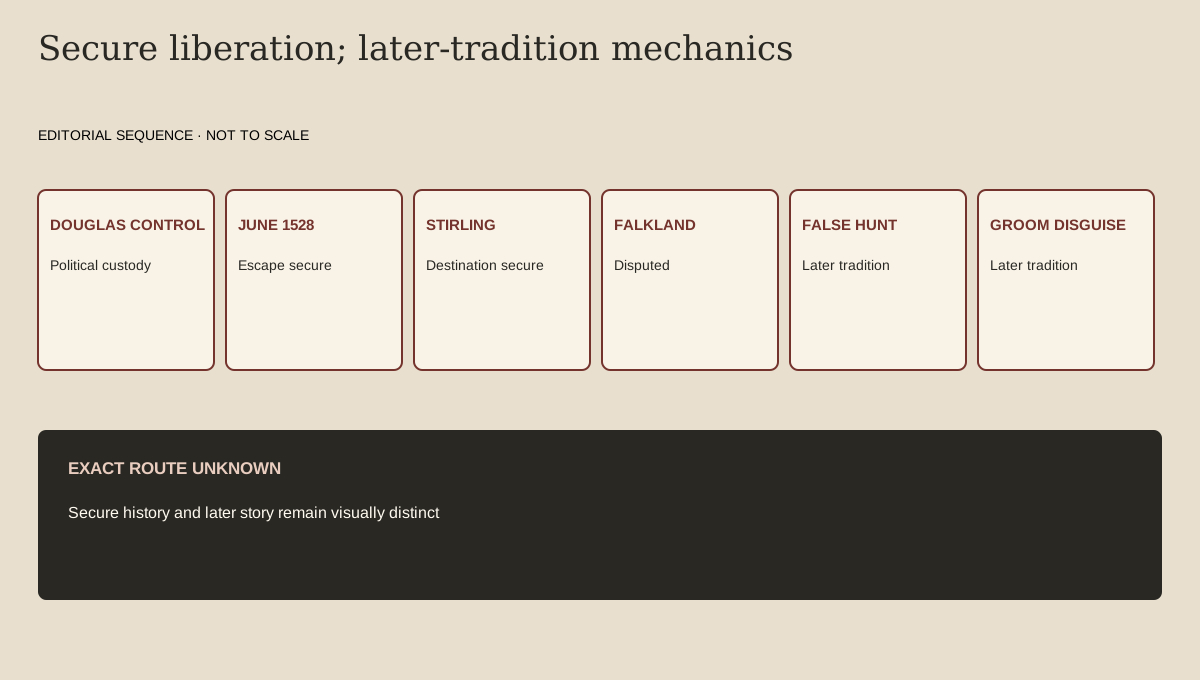
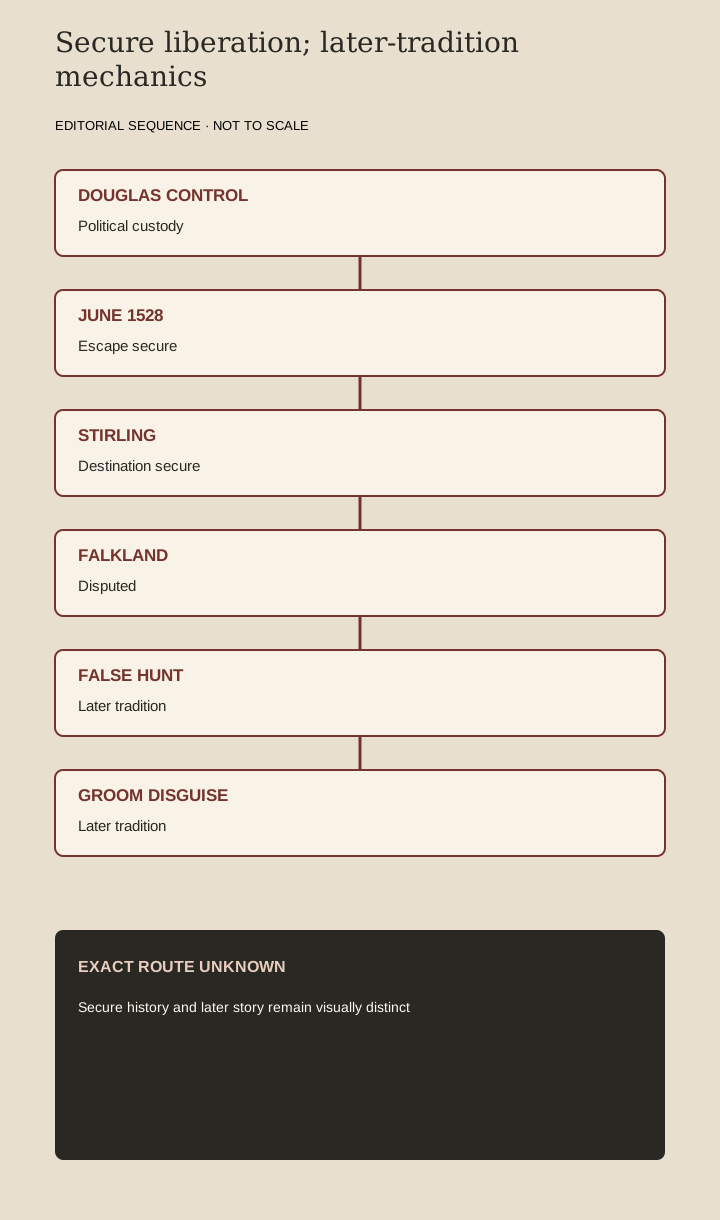
Simplified editorial reconstruction; not to scale. See adjacent text for evidence qualifications and unresolved details.
Problem → response
Escape was a sequence of problems
Each response solved a practical obstacle while often creating the next one.
- 01→
Obstacle
Douglas control of the royal household
Angus and his relatives occupied key posts and physically supervised access to the young king.
Response
James exploited an opportunity to separate himself from the household and reach supporters outside Douglas control.
- 02→
Obstacle
Earlier rescue attempts had ended in armed conflict
Attempts to free James at Darnick and Linlithgow failed and exposed the king to factional violence.
Response
The successful 1528 break depended on the king's own movement rather than another army trying to seize him in battle.
- 03→
Obstacle
Escape alone did not guarantee political safety
The Douglases still controlled followers, lands, offices and strongholds after James got away.
Response
James reached a secure royal base and immediately used legal and political authority against Angus and his allies.
The final accounting
Outcome
Douglas custody ended
James was no longer physically controlled by Angus's faction and could act through an independent royal government.
Personal rule began
The escape is conventionally treated as the beginning of James V's personal rule.
Douglas resistance continued
Angus retained military resources and strongholds after losing the king, so the political struggle did not end in a single night.
Evidence discipline
What the record supports
Status labels distinguish secure conclusions from uncertainty and rejected claims. Color is never the only signal.
DOCUMENTED
Archibald Douglas and his faction held James V against his will for about two years.
The 1528 parliamentary forfeiture process explicitly accused Angus of holding the king's person against his will for roughly two years.
Sources: SRC-001DOCUMENTED
James V escaped Douglas control in June 1528.
The same contemporary parliamentary record states that in June the king put himself at liberty.
Sources: SRC-001DISPUTED
James escaped specifically from Falkland Palace.
Falkland is central to Pitscottie's later narrative and many subsequent retellings, but modern scholarship notes the absence of contemporary evidence for the colorful Falkland account, and some institutional reconstructions place the departure at Edinburgh.
Sources: SRC-002, SRC-005, SRC-007LATER CLAIM
James disguised himself as a groom after announcing a false hunting expedition.
These memorable mechanics come from the later Pitscottie tradition and should not be rendered as securely documented fact.
Sources: SRC-002, SRC-007MYTH
The escape instantly destroyed all Douglas power in Scotland.
Possession of the king was lost immediately, but Angus retained followers, lands and fortified positions and remained a serious political and military problem after June 1528.
Sources: SRC-001, SRC-002Selected chronology
Selected chronology
Rotating custody scheme
A political arrangement placed the king's physical custody in rotating groups of nobles, with Angus prominent in the first group.
James declared able to exercise royal authority
Parliament treated the fourteen-year-old king as able to exercise authority personally, while Angus continued to control his person and household.
Darnick liberation attempt fails
Sir Walter Scott of Buccleuch's attempt to remove James from the party around him failed near Darnick.
Lennox challenge collapses
A further attempt associated with the Earl of Lennox ended in defeat near Linlithgow and Lennox's death.
James puts himself at liberty
James escaped Douglas custody and established his independent authority; the precise departure location remains disputed.
Royal summons against leading Douglases
A royal summons initiated proceedings that later included the charge that Angus had held the king against his will.
Forfeiture proceedings advance
Parliament proceeded against the Douglas leadership on treason charges, formalizing the political break created by James's escape.