
Georg Gärtner’s forty years in hiding began with one night in the New Mexico desert. On 21 September 1945, the former German soldier left Camp Deming, crossed beneath the prison-camp perimeter and reached a railroad line outside the compound. He boarded a westbound Southern Pacific freight car and rode toward California.
The escape itself was over quickly. The consequences lasted until 1985.
At a Glance
- Date: Night of 21 September 1945
- Place: Camp Deming, New Mexico
- Escapee: Georg Gärtner
- Status: German prisoner of war held by the United States
- Military background: Former German army sergeant associated with the Afrika Korps
- Method: Under the camp perimeter, past sentries, then onto a freight train
- First major destination: San Pedro, California
- Long-term identity: Dennis F. Whiles
- Time unrecaptured: Almost forty years
- Public surrender: 11 September 1985
- Major correction: “Hitler’s Last Soldier in America” was a memoir title, not evidence that Gärtner spent forty years as an active military holdout
A Prisoner After the War
Gärtner had been in American captivity for roughly two years by the time he escaped. Born in Schweidnitz in Lower Silesia in 1920, he entered the German military in 1940 and served in North Africa. He was captured in Tunisia in 1943 as Axis forces collapsed there and was eventually transported across the Atlantic as a prisoner of war.
The United States held hundreds of thousands of Axis prisoners during the Second World War. Many worked outside their compounds under guard, replacing labor lost to military service. The camps ranged from large permanent bases to branch camps serving farms, construction projects and local industries. Camp Deming in New Mexico became the last one Gärtner intended to see from inside the wire.
Germany Had Surrendered
By September 1945 the military situation had changed completely. Germany had surrendered in May.
Japan had surrendered in August. Yet prisoners held in the United States had not all been sent home. Repatriation was a vast administrative process that continued after the fighting ended.
For most German POWs, the end of captivity meant eventual return to Europe. Gärtner saw that prospect differently.
The Home He Expected No Longer Existed in the Same Form
Schweidnitz lay in Silesia. The defeat of Nazi Germany transformed the region. Soviet armies had occupied the area, the postwar border shifted west, Schweidnitz became the Polish city of Świdnica, and much of the German population was displaced.
Gärtner did not know exactly what would happen to him. He knew enough to be afraid.
In 1985 he said that he believed repatriation could send him back toward a homeland now under Soviet control and that he feared what Soviet authorities might do to a former German soldier. That fear motivated the escape.
It should not be confused with proof that the United States had issued a specific order to turn Gärtner over to a Soviet prison. He was acting on what he believed his future would be.
Camp Deming
Gärtner spent his final period of captivity at Camp Deming. In his later account, he said he served as a translator there, a role that gave him exposure to information moving through the camp as prisoners waited for decisions about their return to Europe.
The camp sat in a landscape that offered little natural concealment. Leaving the wire would only be the first problem.
A fugitive German POW in rural New Mexico still had to cover distance quickly enough that an alarm did not trap him near Deming. The railroad provided the answer.
Listening to the Trains
Later accounts say Gärtner paid attention to the sound and timing of freight trains passing near the camp. He did not need a printed railway timetable to know that trains moved through the area.
Night after night, he could hear them. The memoir tradition turns that observation into a calculated plan: reach the tracks at the right time and use a freight train to put hundreds of miles between himself and the camp before the search widened.
The exact timetable details come from later recollection. The planned use of the train is much more secure.
September 21
At his public surrender forty years later, Gärtner gave the escape date as 21 September 1945. The Los Alamos Historical Society uses the same date.
Some later summaries give September 22, probably because the escape unfolded at night and was discovered or recorded on the following day. September 21 remains the stronger date because it is the one Gärtner himself gave publicly in 1985. He was twenty-four.
Under the Wire
Gärtner’s own concise description is more useful than many later embellished versions. He said he crept beneath fences and wires, avoided sentries and made his way out of Camp Deming.
Later retellings specify a double barbed-wire perimeter and describe him using the shadows of the barracks before crawling under. Those details fit the basic account.
There is no need to turn them into an exact security diagram. The essential fact is that Gärtner did not cut through the perimeter or overpower a guard. He got underneath it.
The Hour Between Camp and Train
A later detailed reconstruction places the beginning of the escape around nine at night. In that version, Gärtner allowed roughly half an hour to clear the perimeter and another half hour to reach the railroad before the expected freight train arrived.
Those numbers should be read as memoir-derived planning rather than stopwatch data. What matters is the dependency.
If he reached the tracks too late, he would be a fugitive on foot in open New Mexico. If the train arrived as expected, the geography of the search would change immediately.
The Southern Pacific Freight
The train came. Gärtner reached it and climbed aboard an open freight car.
UPI later reported that he had watched or calculated the train’s pattern before the escape. At his 1985 surrender, he identified it as a Southern Pacific train.
The freight carried him west. No elaborate network was waiting for him at the other end.
The railroad simply gave him distance. That was enough.
San Pedro
Gärtner later identified San Pedro, California, as his first destination after the escape. He had crossed from guarded captivity in New Mexico into one of the largest population centers on the Pacific coast.
The transition created a new problem. In camp he had been one prisoner among many.
Outside, every ordinary requirement of civilian life—food, housing, work, identification—could expose him. He could not remain Georg Gärtner.
The First Year Was Not the American Dream
The polished Dennis Whiles identity came later. According to the biography released around his 1985 surrender, Gärtner spent much of the next year moving among West Coast communities, working wherever he could and worrying about pursuit.
He washed dishes. He worked as a laborer.
He cut timber and did migrant work. UPI later reported that over the full forty years he moved at least twenty times and used several names.
The early strategy was mobility. The long-term strategy became normality.
Becoming Dennis Whiles
Eventually the name Dennis F. Whiles became the identity that lasted.
Gärtner improved his English and obtained a Social Security card under the assumed name. He moved into jobs in construction, sales, skiing and tennis.
By the time people knew Dennis Whiles as an instructor or businessman, the German POW fugitive was concealed less by hiding than by familiarity. He was a coworker.
A coach. A neighbor.
Later, a husband and stepfather. The disguise was a biography.
Wanted, but Not Found
Gärtner was not forgotten immediately. U.S. authorities searched for him, and wanted notices circulated.
The exact bureaucratic timeline is less tidy than later stories suggest. Some accounts place the practical end of the Army search in the early 1960s; an immigration official told UPI in 1985 that an FBI fugitive warrant had been canceled in 1976.
Either way, the active hunt faded long before Gärtner surfaced. He was also frequently described as one of the FBI’s “most wanted” fugitives.
That phrase should not be confused automatically with the formal FBI Ten Most Wanted list. What is secure is simpler.
The government wanted him. It never caught him.
Why His Escape Was So Unusual
Gärtner was one of thousands of German prisoners who tried to escape from American camps. Historian Arnold Krammer gave the number as 2,222.
Smithsonian’s history of German POWs in the United States uses the same figure and notes that it represented less than one percent of the German prisoner population. Most escapees were captured quickly.
Many lasted less than a day. By the time the final repatriation process ended, only a small number remained unaccounted for.
Those men gradually reappeared. Gärtner did not.
The Last One Still Missing
One of the other long-term fugitives was Kurt Rossmeisl, who had lived in Chicago under another identity after escaping from American custody. Rossmeisl surrendered in 1959.
After that, Gärtner was effectively the last unresolved German POW fugitive in the United States. That is the historically useful meaning behind the “last” language attached to his story.
It does not mean he remained Germany’s last combatant. His war had become a private effort to avoid discovery.
A Photograph That Could Have Ended Everything
In January 1952, a Southern Pacific passenger train named the City of San Francisco became trapped by heavy snow in the Sierra Nevada. Gärtner later said he joined a ski-rescue effort that helped people affected by the disaster.
The Los Angeles Times reported in 1985 that his photograph appeared afterward. No one recognized the escaped POW.
The incident exposes how deeply Dennis Whiles had replaced Georg Gärtner in public view. A wanted man could appear in a news photograph and remain invisible.
Marriage
Gärtner met Jean Clarke at a YMCA dance in California. They married in 1964.
He did not tell her who he really was. Under the Whiles identity, he worked as a skiing and tennis instructor and in construction-related businesses. The couple later lived in Hawaii and Colorado.
The longer the marriage lasted, the harder the secret became to explain. Travel created particular problems because Gärtner could not easily produce the genuine birth and citizenship records a normal passport application required.
Jean knew there was a missing part of her husband’s life. She did not know it began behind barbed wire in New Mexico.
The Secret Breaks
By the early 1980s, Jean’s patience had nearly ended. The strongest 1985 account places the crisis around 1983. Other later summaries place the confession in 1984.
The exact private date matters less than what happened. Jean threatened to leave if her husband would not explain the past he had concealed throughout their marriage.
Gärtner told her. Dennis Whiles was Georg Gärtner. The forty-year secret now belonged to two people.
Calling Arnold Krammer
Gärtner eventually contacted historian Arnold Krammer, whose research on German POWs in the United States had discussed the unresolved fugitive. UPI later described the first telephone conversation.
Gärtner initially identified himself as Dennis Whiles and said he had once been a German POW. Then he told Krammer that he had escaped from Camp Deming and believed himself to be the last fugitive German prisoner still unaccounted for.
Krammer agreed to help tell the story. The result was a book.
“Hitler’s Last Soldier in America”
Gärtner and Krammer published Hitler’s Last Soldier in America in 1985. The title was memorable.
It was also misleading if taken literally. Gärtner had not spent forty years carrying out orders for Adolf Hitler.
He had not maintained an armed postwar resistance. He had not been hiding in a bunker waiting for Germany to win a war that ended in 1945.
He had escaped POW custody and built an American civilian identity he was afraid to lose. “Hitler’s Last Soldier” was a publishing title, not his legal or military status in 1985.
September 11, 1985
The public ending was carefully staged. On 11 September 1985, Gärtner appeared before reporters in the San Pedro and Terminal Island area and identified himself.
He formally presented himself to U.S. immigration authorities.
Television turned the event into something close to a ceremonial surrender, and later summaries often say he surrendered to Today host Bryant Gumbel. The government, not a television presenter, received him. After forty years, the United States finally knew where Georg Gärtner was.
What Could the Government Do?
The answer was not obvious. Gärtner had been brought to America by the U.S. government as a prisoner.
He had escaped after Germany’s surrender but before his own repatriation. The original search had long since faded.
He had lived for decades under false identity documents but had also been married to an American citizen for more than twenty years. Immigration officials released him rather than placing him back behind bars.
The question shifted from wartime custody to immigration status. He was eventually allowed to remain.
Later accounts record that he became a U.S. citizen in 2009.
One Night and Forty Years
The four decades are what made Gärtner famous. They are not what made the escape work.
That happened at Camp Deming. He decided that repatriation was more frightening than becoming a fugitive in a country where he had arrived as an enemy prisoner.
He got beneath the wire. He reached the tracks on time.
He boarded the freight car. By the time the camp knew it had lost him, the geography of the search had already changed. Dennis Whiles came later.
Evidence discipline
What the record supports
Status labels distinguish secure conclusions from uncertainty and rejected claims. Color is never the only signal.
DISPUTED
Gärtner escaped Camp Deming on 22 September 1945.
Some later summaries use 22 September, but Gärtner's own 1985 public account and New Mexico historical material use 21 September, which is preferred here.
Sources: SRC-002, SRC-006MYTH
The United States had specifically ordered Gärtner to be delivered to Soviet imprisonment.
Gärtner said he feared repatriation to a transformed Silesian homeland under Soviet influence. That fear is documented; a specific U.S. order consigning him personally to Soviet punishment is not.
Sources: SRC-002, SRC-004MYTH
Gärtner stumbled upon a freight train by chance after leaving Camp Deming.
The train was part of the escape plan; later accounts say he had observed or inferred the rail pattern before leaving.
Sources: SRC-004, SRC-010UNKNOWN
The exact minute-by-minute Camp Deming timing is independently documented in a contemporary guard log.
Detailed 9 p.m./10 p.m. timing comes from later memoir-based reconstruction, not a contemporary camp log surfaced in this production pass.
Sources: SRC-010MYTH
Gärtner immediately adopted the stable identity Dennis Whiles after leaving the train.
He spent an unstable early period moving between jobs and places and used multiple aliases before Dennis Whiles became his durable identity.
Sources: SRC-003, SRC-004, SRC-005MYTH
Gärtner spent forty years physically hiding from society.
Under the Whiles identity he worked publicly, taught skiing and tennis, married, operated businesses, and lived ordinary civilian life.
Sources: SRC-002, SRC-003, SRC-004UNKNOWN
Gärtner was formally on the FBI Ten Most Wanted list for forty years.
He was wanted by U.S. authorities and FBI material circulated, but the specific formal Ten Most Wanted designation was not established by the sources used here.
Sources: SRC-004, SRC-005MYTH
Gärtner surrendered to television host Bryant Gumbel.
Television was part of the public event, but Gärtner formally presented himself to U.S. immigration authorities.
Sources: SRC-002, SRC-004MYTH
The title Hitler's Last Soldier in America means Gärtner remained an active Nazi military holdout until 1985.
The phrase was the title of Gärtner and Arnold Krammer's 1985 memoir and publicity campaign; Gärtner lived as an escaped POW and civilian fugitive, not an armed postwar combatant.
Sources: SRC-001, SRC-005Documentary reconstruction
The 1945 escape and forty years hidden
A case-local editorial visual separates the documented sequence from uncertainty without implying exact modern geography or operational detail.
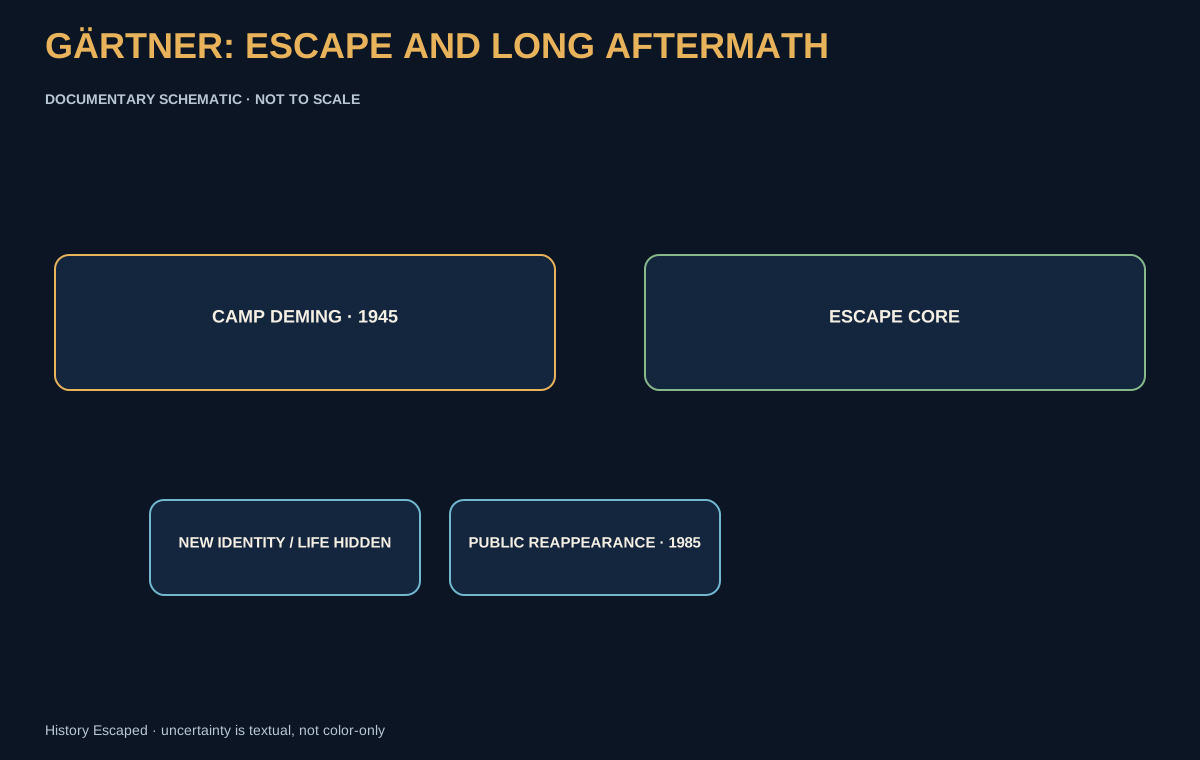
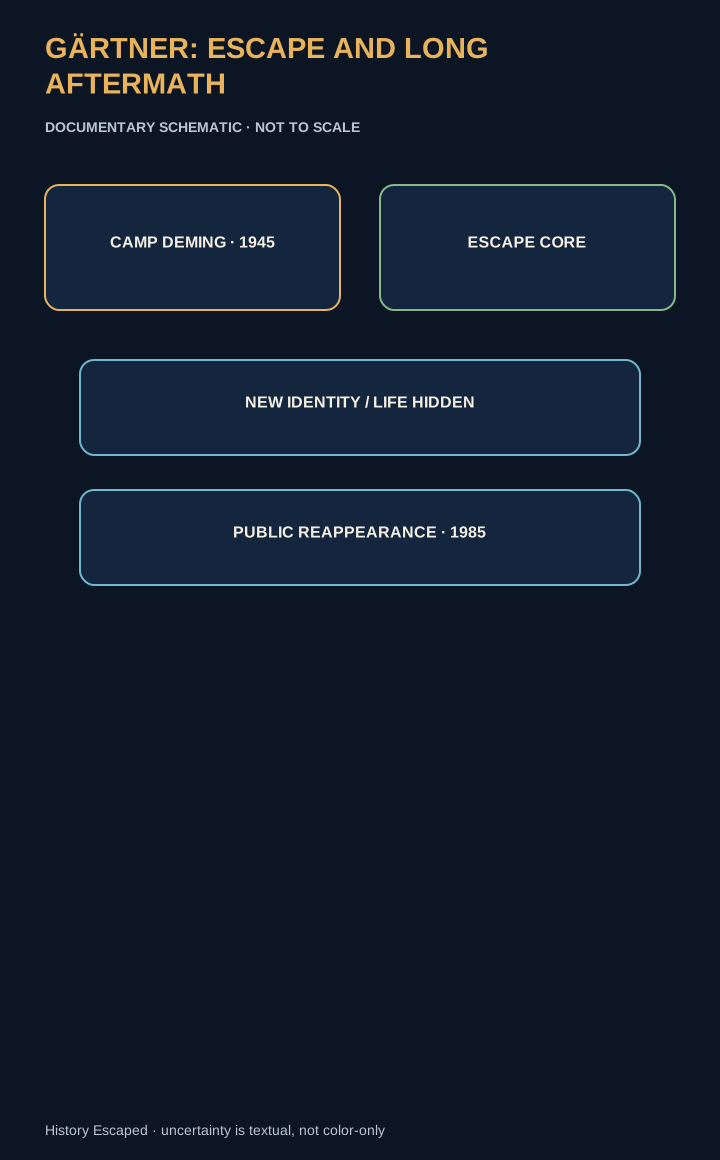
Simplified editorial reconstruction based on the cited historical record; not to scale. Uncertainty is stated directly in the visual and adjacent text.